2.06 Reactions That Run Both Ways: Dynamic Equilibrium and Le Chatelier
describe a reversible reaction at dynamic equilibrium, and use evidence from color changes and Le Chatelier’s principle to predict and explain, at the molecular level, how adding or removing a substance or changing temperature shifts an equilibrium.
- I can identify and describe how changing one component of a chemical reaction system (such as adding a reactant or removing a product) will affect the amounts of substances at equilibrium, using evidence and Le Chatelier’s Principle.
- I can explain, at the molecular level, how a change in concentration of one component causes the rates of the forward and backward reactions to change until equilibrium is re-established.
- I can describe a system at equilibrium by explaining that both the forward and backward reactions are happening at the same rate, so the system appears stable overall.
Phase 3: Make Sense
Warm-Up ~5 min
Do Now. A sealed bottle of water sits half full for a week. Molecules are still leaving the liquid every second, yet the water level does not change. Write how both statements can be true.
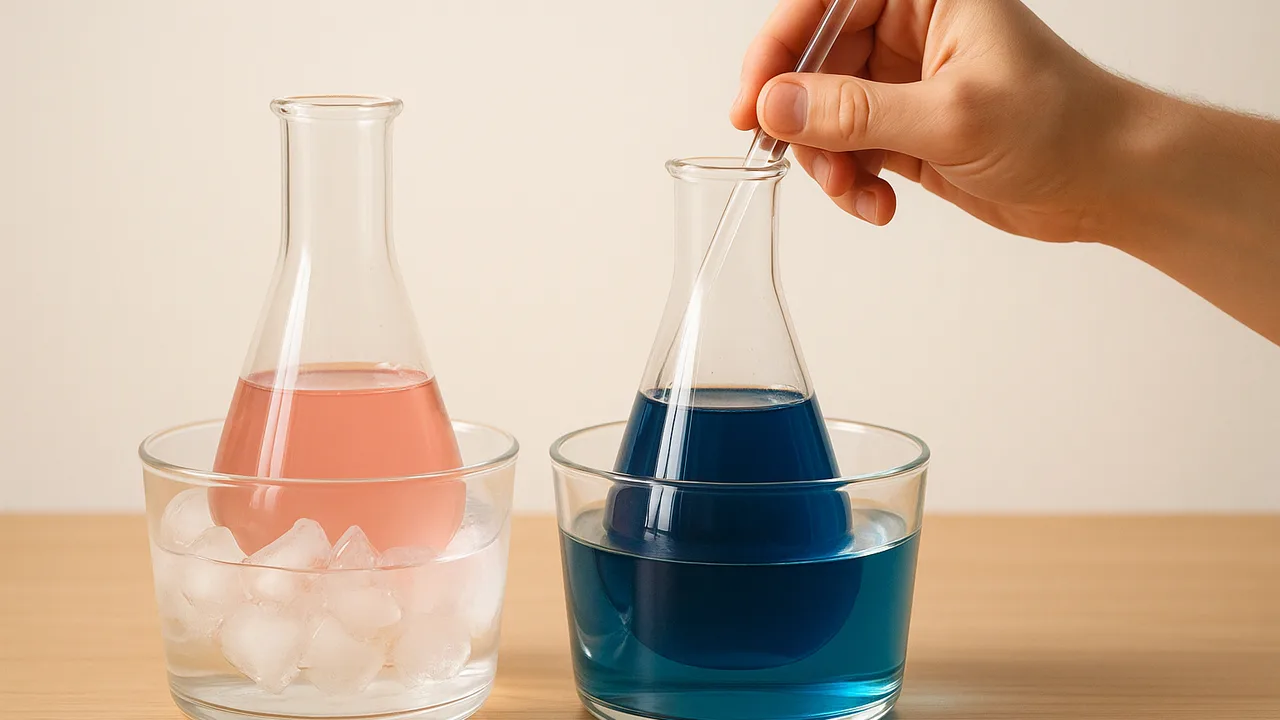
A pink solution of cobalt(II) chloride turns blue when warmed. What do you predict when the warm, blue tube goes into ice?
Instruction ~10 min
Reversible reactions. Peroxide decomposition only runs one way. Many reactions can also run backward: products collide and re-form reactants. We write them with a double arrow, ⇌. The forward reaction goes left to right; the reverse reaction goes right to left.
Dynamic equilibrium. Start with only reactants: the forward rate is high and the reverse rate is zero. As products build up, the forward rate falls (fewer reactant collisions) and the reverse rate rises (more product collisions). Eventually the two rates are equal. The amounts then stop changing, though both reactions continue. That is dynamic equilibrium: stable overall, busy underneath. The amounts at equilibrium are constant, not necessarily equal.
Today’s two systems. At your stations: Fe3+(aq) (pale yellow) + SCN−(aq) (colorless) ⇌ FeSCN2+(aq) (blood red). The darker the red, the more FeSCN2+. Teacher demo with sealed tubes: [Co(H2O)6]2+ (pink) + 4Cl− ⇌ [CoCl4]2− (blue) + 6H2O. The forward cobalt reaction is endothermic: it absorbs heat.
Le Chatelier’s principle. If a system at equilibrium is disturbed by a change in concentration or temperature, it shifts in the direction that partly undoes the change until a new equilibrium is reached. Add a reactant and the system uses some of it up (shifts right). Remove a product and the system makes more (shifts right). For an endothermic reaction, treat heat as a reactant: heating shifts right, cooling shifts left.
Station procedure. Your teacher mixes a dilute stock of FeSCN2+ (light orange-red) into five labeled wells. Well 1 is the control. Add 3 drops of: (2) 0.1 M FeCl3; (3) 0.1 M KSCN; (4) a few crystals of Na2HPO4, which binds Fe3+ and removes it from the equilibrium; (5) water, to check that dilution alone is not causing the change. Record the color against well 1 on a white card.
Worked example 1: adding a reactant, molecule by molecule. Destiny added FeCl3 to well 2 and it turned darker red. Her explanation: “Extra Fe3+ ions mean more Fe3+–SCN− collisions per second, so the forward rate jumped above the reverse rate. FeSCN2+ built up, which raised the reverse rate, until the two rates were equal again, with more red ion than before.” Well 4 went the other way: phosphate removed Fe3+, the forward rate dropped, and the color faded.
Worked example 2: heat as a reactant. In the cobalt demo, Tomas predicted: “The forward reaction absorbs heat. Warming adds heat, so the system shifts right to use it up: more blue [CoCl4]2−. Ice removes heat, so it shifts left: pink.” Adding water (a product) turned the blue tube pink; adding concentrated chloride (a reactant) turned it blue. Every observation fits one principle.
A catalyst does not shift an equilibrium. It speeds the forward and reverse reactions equally, so equilibrium is reached sooner, with the same amounts.
Reading. OpenStax Chemistry 2e, chapters 13.1 (chemical equilibria) and 13.3 (shifting equilibria: Le Châtelier’s principle), CC BY 4.0.
Guided Exercises ~15 min
Answer as you record each well, then for the cobalt demo.
Independent Practice ~10 min
Lab analysis, in your Rate Notebook.
Make a results table for wells 1–5 and the cobalt demo: change made, color observed, direction of shift, and a one-line Le Chatelier reason for each.
Sketch a graph of forward rate and reverse rate against time for well 2, from the moment the FeCl3 is added until the new equilibrium. Label where the rates become equal again.
Closure ~5 min
The cobalt system changes color with temperature and changes back. Next phase, we design the co-op’s storage-check indicator around it.
Exit ticket: why is a reversible reaction better than a one-way reaction for an indicator that must warn about warm storage many times?
Teacher notes
Materials: per team, a well plate, dropper bottles of 0.1 M FeCl3, 0.1 M KSCN and water, a few Na2HPO4 crystals, a white card. Stock FeSCN2+: about 1 mL each of 0.1 M FeCl3 and 0.1 M KSCN in 100 mL water. Teacher demo: cobalt(II) chloride hexahydrate dissolved in ethanol with a few drops of water to a violet-pink color, in stoppered tubes; hot water from a kettle, ice bath, saturated calcium chloride or sodium chloride solution as the chloride source.
Safety: students do not handle cobalt solutions in this lesson. Collect thiocyanate and cobalt waste separately.
Listen for: “at equilibrium the reaction stops”; “equilibrium means equal amounts”; “adding Fe3+ makes it red because Fe3+ is red” (it is pale yellow).
Support / stretch: a shift card: “add it → use it up; remove it → make more.” Stretch: predict the color of the cobalt tube in a 40 °C bath with extra water added, and explain the competing effects.