4.01 A Grain Older Than the Oceans: Isotopes and the Nucleus
How Do We Know How Old It Is? Exhibit Panels and a Half-Life Model for a Natural History Museum
How can a few atoms locked inside a crystal smaller than a grain of sand tell us that Earth is about 4.5 billion years old, and how does the same nuclear physics keep a smoke detector working and help doctors see inside the body?
The mystery: A crystal of the mineral zircon, too small to see clearly without a magnifier, has been dated to about 4.4 billion years old: older than any known rock on Earth. On a kitchen ceiling nearby, a smoke detector holds a speck of americium-241 that has been giving off radiation, quietly and safely, every second since the day it was installed.
use the number of protons to identify an element, describe isotopes with nuclear notation, calculate an average atomic mass from isotope data, and describe what changes in the nucleus of americium-241 when it decays.
- I can model and explain how the number of protons identifies an element.
- I can show and describe the number of protons and neutrons in the nucleus before and after radioactive decay.
- I can identify and model the particles released during alpha, beta (electron and positron), and gamma decay, and compare the energy released in nuclear processes to chemical processes.
Phase 1: Spark
Warm-Up ~5 min
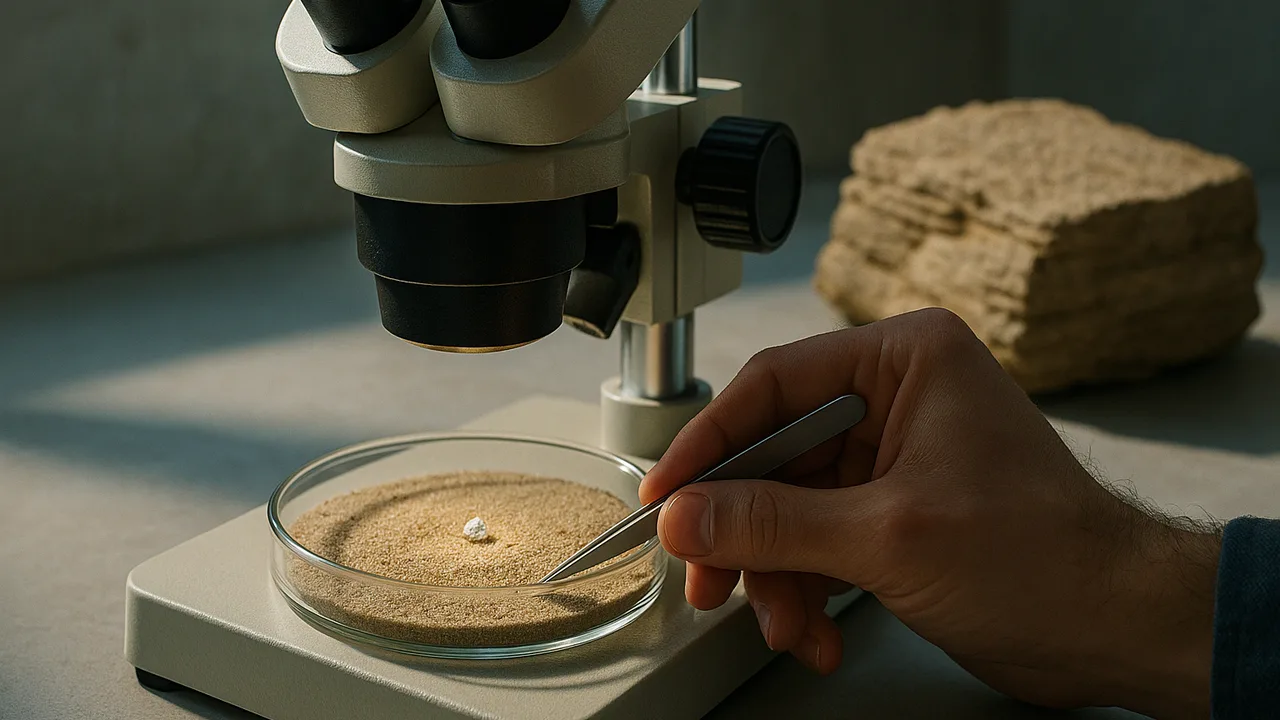
Do Now. Look at the two photos: a zircon crystal under a microscope, next to a grain of sand for scale, and the inside of a smoke detector with its small metal chamber circled. Write two things you notice and one question that connects the two objects.
A scientist says a zircon crystal is about 4.4 billion years old. What do you think she measured to find that out?
Instruction ~10 min
The phenomenon. Geologists sorting sand from ancient sandstone found zircon crystals (ZrSiO4) a few tenths of a millimeter long. One of them formed about 4.4 billion years ago, when Earth was only about 150 million years old. Zircon is tough, it resists weathering, and when it crystallizes it takes uranium atoms into its structure but almost no lead. Meanwhile, in millions of homes, a smoke detector holds a tiny source of americium-241, an element that does not occur in nature in useful amounts. Both objects depend on the same thing: nuclei that change. To understand them, we start inside the atom.
The nucleus. An atom is mostly empty space around a tiny, dense nucleus made of protons (charge +1) and neutrons (charge 0); together these are called nucleons. The nucleus holds more than 99.9% of the atom’s mass in about one ten-thousandth of its width. The atomic number Z is the number of protons, and it identifies the element: every atom with 92 protons is uranium, whatever else is true of it. The mass number A is protons plus neutrons, so the number of neutrons is N = A − Z.
Isotopes and notation. Atoms of the same element with different numbers of neutrons are isotopes. Carbon-12, carbon-13 and carbon-14 all have 6 protons, with 6, 7 and 8 neutrons. In nuclear notation the mass number is written top left and the atomic number bottom left: 146C. Isotopes of an element have nearly identical chemistry, because chemistry depends on electrons, but their nuclei can behave very differently: carbon-12 is stable forever, while carbon-14 is radioactive.
Worked example 1: reading a nucleus. Tomas looked up americium on the periodic table: Z = 95. Americium-241 therefore has 95 protons and 241 − 95 = 146 neutrons. Uranium-238 (Z = 92) has 238 − 92 = 146 neutrons too: same neutron count, different elements, because the proton count differs. A neutral atom of either also has as many electrons as protons.
Average atomic mass. The atomic mass on the periodic table is a weighted average of an element’s natural isotopes, in unified atomic mass units (u). Worked example 2: chlorine. Amara used the NIST values: chlorine-35 has a mass of 34.969 u and makes up 75.76% of natural chlorine; chlorine-37 has 36.966 u and 24.24%. Average = (0.7576 × 34.969 u) + (0.2424 × 36.966 u) = 26.492 u + 8.961 u = 35.45 u, the value on the periodic table. No single chlorine atom has a mass of 35.45 u; it is the average of a mixture.
A nucleus that changes. Americium-241 is unstable. Each second, a small fraction of its nuclei throw out an alpha particle: 2 protons and 2 neutrons bound together, the same as a helium-4 nucleus. The americium nucleus is left with 93 protons, so it is no longer americium; it is neptunium-237. Check: 241 = 237 + 4 nucleons; 95 = 93 + 2 protons. In a smoke detector the alpha particles knock electrons off air molecules in a small chamber, so a tiny current flows between two plates. Smoke particles soak up the charged molecules, the current drops, and the alarm sounds.
Why this is not chemistry as usual. In every reaction you have studied, atoms kept their identity and only their electrons rearranged. In a nuclear change the proton count itself changes, so one element becomes another, and the energy involved is millions of times larger. That is the key idea of this unit and the key to every clock in the museum’s exhibit.
Reading. OpenStax Chemistry 2e, sections 2.3 (atomic structure and symbolism) and 21.1 (nuclear structure and stability), CC BY 4.0; isotopic masses and abundances from the NIST Atomic Weights and Isotopic Compositions tables.
Guided Exercises ~15 min
Work with a partner and a periodic table. For every nucleus, write Z, A and N before you answer.
Independent Practice ~10 min
Complete the nucleus table in your Exhibit Notebook.
| Isotope | Z | A | N | Where it shows up in this unit |
|---|---|---|---|---|
| Carbon-14 | ||||
| Potassium-40 | ||||
| Argon-40 | ||||
| Uranium-238 | ||||
| Lead-206 | ||||
| Technetium-99 |
Potassium-40 and argon-40 have the same mass number. Explain, using protons and neutrons, how they can have the same mass number and still be different elements.
Write three questions about the zircon or the smoke detector for the question board: one we could answer with a lab, one with published data, and one that needs a model of the nucleus first.
Closure ~5 min
We have two phenomena and a model of the nucleus. Next class, you meet the museum that needs our help and we build the Wonder Board.
Exit ticket: explain why changing the number of neutrons gives a new isotope but changing the number of protons gives a new element.
Teacher notes
Materials: generic photos of a zircon crystal beside a sand grain under magnification and of an opened smoke detector (photo only), periodic tables, chart paper for the question board, devices for the PhET sim or the paper version.
Answers: boron 0.199 × 10.013 + 0.801 × 11.009 = 1.993 + 8.818 = 10.81 u. Table: C-14 6/14/8; K-40 19/40/21; Ar-40 18/40/22; U-238 92/238/146; Pb-206 82/206/124; Tc-99 43/99/56.
Listen for: “isotopes are radioactive versions” (most isotopes of most elements are stable); “the mass number is the atomic mass”; “the smoke detector is dangerous to stand under” (the alpha particles do not get out of the chamber).
Support / stretch: give a Z, A, N template with the subtraction written in. Stretch: natural magnesium is 78.99% Mg-24 (23.985 u), 10.00% Mg-25 (24.986 u) and 11.01% Mg-26 (25.983 u); show that the average is 24.31 u.