3.02 Project Brief and Wonder Board: The Hatchery’s Bad-Water Days
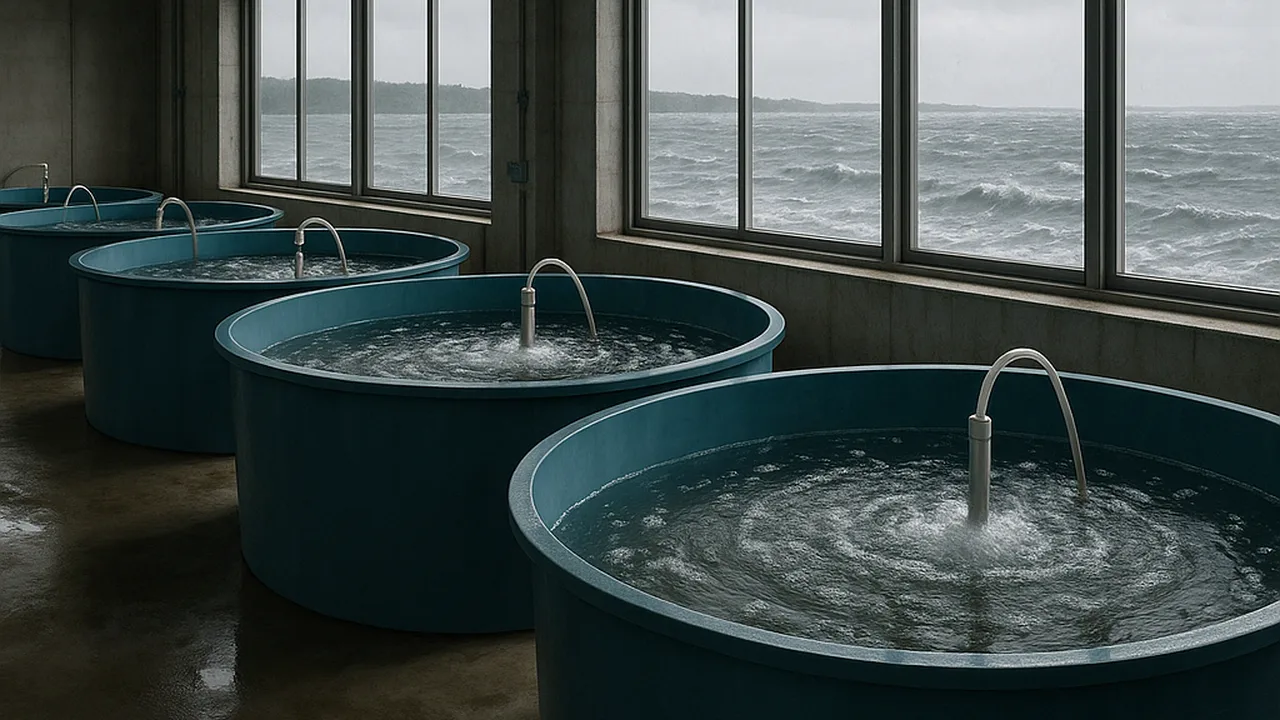
Shells in Sour Water: A Water Chemistry Brief for a Shellfish Hatchery
Why do oyster and clam larvae die when CO2-rich water reaches a hatchery’s intake, how is that water connected to the carbon in the air, the rocks and living things, and how can the hatchery protect its larvae as atmospheric CO2 keeps rising?
The mystery: Drop a piece of chalk or a seashell into vinegar and it fizzes and slowly disappears. Along cold, windy coasts, shellfish hatcheries have watched most of a week’s oyster larvae die on days when deep, CO2-rich water welled up to the surface and flowed into their tanks; the larvae could not build their first shells.
Questions we will figure out together in this unit:
- Why does vinegar dissolve a shell but seawater usually does not?
- How much more acidic is upwelled water than normal surface water?
- Can a larva build a shell if the pH is only a little low?
- Where does the extra CO2 in the air come from, and how much reaches the ocean?
- Why does the ocean not just turn acidic all at once?
- Could the hatchery add something to the water to protect the larvae?
- Will this get worse as CO2 keeps rising?
- How would the hatchery know a bad-water day is coming?
explain the hatchery’s request, describe how upwelling brings CO2-rich water to the coast, compare the main carbon reservoirs, and turn our questions into need-to-knows for the project.
- I can identify and compare the amounts of carbon found in the hydrosphere, atmosphere, geosphere, and biosphere.
- I can create a model that shows how carbon moves between the hydrosphere, atmosphere, geosphere, and biosphere.
- I can use a model to describe how carbon cycles between the hydrosphere, atmosphere, geosphere, and biosphere.
- I can explain the amounts and rates at which carbon moves between different spheres of the Earth.
- I can show in my model how plants capture carbon dioxide and how human activities increase carbon dioxide in the atmosphere, affecting the climate.
Phase 1: Spark
Warm-Up ~5 min
Do Now. An oyster larva is smaller than a grain of sand and must build its first shell within about two days of hatching. Write what you think a larva needs from the water around it to build that shell.
Oyster shells are mostly calcium carbonate. Which two dissolved ions does a larva pull from seawater to build one?
Instruction ~10 min
Meet the client. A small shellfish hatchery on a cold-water bay has written to our class. It spawns adult oysters and clams, raises the larvae in large tanks of seawater pumped in from the bay, and sells young shellfish (seed) to local farms. For several seasons, the hatchery has had “bad-water days”: within a day or two of strong winds blowing along the coast, most of the larvae in new tanks fail to build shells and die. Its owners have two requests:
- A water chemistry brief that explains what pH and carbonate do to shell-building, how the water’s carbon is connected to the carbon cycle and to rising CO2 in the air, and how the hatchery should monitor its intake.
- A bench-tested buffering fix: how much sodium carbonate or sodium bicarbonate to add to intake water on bad days, backed by a simple computational model of where ocean pH is headed.
Driving question. Why do larvae die when CO2-rich water reaches the intake, how is that water connected to the carbon in the air, rocks and living things, and how can the hatchery protect its larvae as atmospheric CO2 keeps rising?
What upwelling does. Along some coasts, steady winds push surface water offshore, and cold water from a few hundred meters down rises to replace it. That deep water has been out of contact with the air for years to decades. As organic matter sank into it and decayed, respiration added CO2, so upwelled water carries more dissolved CO2, a lower pH and less carbonate than surface water. Rising CO2 in the atmosphere adds more on top. On upwelling days the hatchery is pumping in that water.
A first look at the carbon cycle. Carbon moves among four reservoirs. Rounded estimates (IPCC Sixth Assessment Report, 2021), in billions of tonnes of carbon (GtC):
| Reservoir | Main forms of carbon | Approximate carbon (GtC) |
|---|---|---|
| Atmosphere | CO2, a little CH4 | about 870 (about 590 before 1750) |
| Biosphere (land plants and soils) | wood, leaves, soil organic matter | about 450–650 in plants; 1,500–2,400 in soils |
| Hydrosphere (ocean) | dissolved bicarbonate and carbonate, CO2, organic carbon | about 38,000 |
| Geosphere | limestone and other sedimentary rock; coal, oil, gas | tens of millions in rocks; roughly 1,000–2,000 in fossil-fuel reserves |
Worked example 1: comparing reservoirs. Sofia compared the ocean with the air: 38,000 ÷ 870 ≈ 44. The ocean holds more than forty times as much carbon as the atmosphere. She added, “So if the ocean takes up even a small share of the extra CO2 in the air, it is a small change for the ocean, but it still changes the chemistry near the surface.” That is a need-to-know: how much does the ocean take up, and what does it do to pH?
Worked example 2: from wonder to need-to-know. “Why do the larvae die?” becomes “At what pH and carbonate level can a larva no longer build a shell faster than it dissolves?” The second version tells us exactly what to measure.
Breaking the problem down. Sub-problems (HS-ETS1-2): (a) explain how CO2 changes pH and carbonate; (b) measure how fast shell material dissolves at different pH; (c) connect local water to the global carbon cycle; (d) model where ocean pH is headed; (e) design and test a dose of buffer; (f) plan monitoring. Teams of four rotate weekly: Lead Chemist, Data Analyst, Lab Manager and Communicator.
Guided Exercises ~15 min
Use the client letter and the reservoir table.
Independent Practice ~10 min
Start your Water Chemistry Notebook and the team charter.
In 3–4 sentences, restate the hatchery's two requests and break the project into at least three sub-problems.
Sketch a first carbon-cycle diagram with the four reservoirs as boxes and at least three arrows showing ways carbon moves between them. Label each arrow with a process (for example, photosynthesis or dissolving).
Closure ~5 min
We know the client, the driving question and our teams. Next phase, we measure pH in the lab.
Exit ticket: in two sentences, connect a windy day on the coast to dead larvae in the hatchery tanks.
Teacher notes
Materials: the client letter (generic, on hatchery letterhead you design), a photo or micrograph of oyster larvae (generic), the reservoir table, role cards, chart paper for the Wonder Board.
Setup: keep the Wonder Board posted all unit; 3.06 and 3.09 return to it. The hatchery is fictional; real hatchery losses during upwelling are a documented phenomenon, described in 3.08’s case study. Keep invented numbers out of the letter.
Listen for: “the ocean is turning into acid” (surface seawater is still basic, about pH 8.1); carbon in the ocean pictured only as CO2 bubbles.
Support / stretch: give a sentence frame for need-to-knows (“We need to know ___ so that we can ___”). Stretch: express the atmosphere’s carbon as a percent of the ocean’s and explain what that ratio means for how fast each reservoir can change.