3.03 Measuring pH: Red Cabbage, Test Strips, Meters and Your Breath
measure the pH of household substances three ways, use pH = −log[H+] to compare acidity, distinguish strong from weak acids, and show with evidence that exhaled CO2 makes water more acidic.
- I can use a model to describe how carbon cycles between the hydrosphere, atmosphere, geosphere, and biosphere.
- I can explain the amounts and rates at which carbon moves between different spheres of the Earth.
- I can show in my model how plants capture carbon dioxide and how human activities increase carbon dioxide in the atmosphere, affecting the climate.
Phase 2: Investigate
Warm-Up ~5 min
Do Now. Rank these from most acidic to most basic before you test them: lemon juice, tap water, baking-soda solution, white vinegar, seltzer water, washing-soda solution. Mark the one you are least sure about.
Solution A has pH 3 and solution B has pH 5. How do their hydrogen-ion concentrations compare?
Instruction ~10 min
Why a lab here. The hatchery’s problem is a few tenths of a pH unit. Before we can reason about tenths, we need to know what pH measures, how to measure it, and how good each method is. Today you test household substances with three tools of increasing precision, then test what your own breath does to water. This lab runs one 50-minute period.
What pH means. Pure water ionizes very slightly: H2O ⇌ H+ + OH−. At 25 °C, [H+][OH−] = Kw = 1.0 × 10⁻¹⁴, so in pure water both are 1.0 × 10⁻⁷ M. Because these concentrations span many powers of ten, we use a logarithm: pH = −log[H+]. Neutral is pH 7; below 7 is acidic; above 7 is basic. A drop of one pH unit means ten times more H+.
Worked example 1: logs both ways. Keisha’s vinegar has [H+] = 3.9 × 10⁻³ M. pH = −log(3.9 × 10⁻³) = 2.41. (Significant figures: the two digits in 3.9 become the two decimal places in 2.41.) Going back: seawater at pH 8.10 has [H+] = 10−8.10 = 7.9 × 10⁻⁹ M. At pH 8.20 it would be 6.3 × 10⁻⁹ M. A drop of just 0.10 unit multiplies [H+] by 100.10 = 1.26, a 26% increase.
Strong and weak acids. A strong acid such as HCl ionizes completely, so 0.10 M HCl has [H+] = 0.10 M and pH 1.00. A weak acid such as acetic acid ionizes only a little, set by its acid dissociation constant Ka = 1.8 × 10⁻⁵ (OpenStax Chemistry 2e, Appendix H). For 0.10 M acetic acid, [H+] ≈ √(Ka × 0.10) = 1.3 × 10⁻³ M, pH 2.87. Same concentration, about 75 times less H+. Carbonic acid, formed when CO2 dissolves in water, is weaker still.
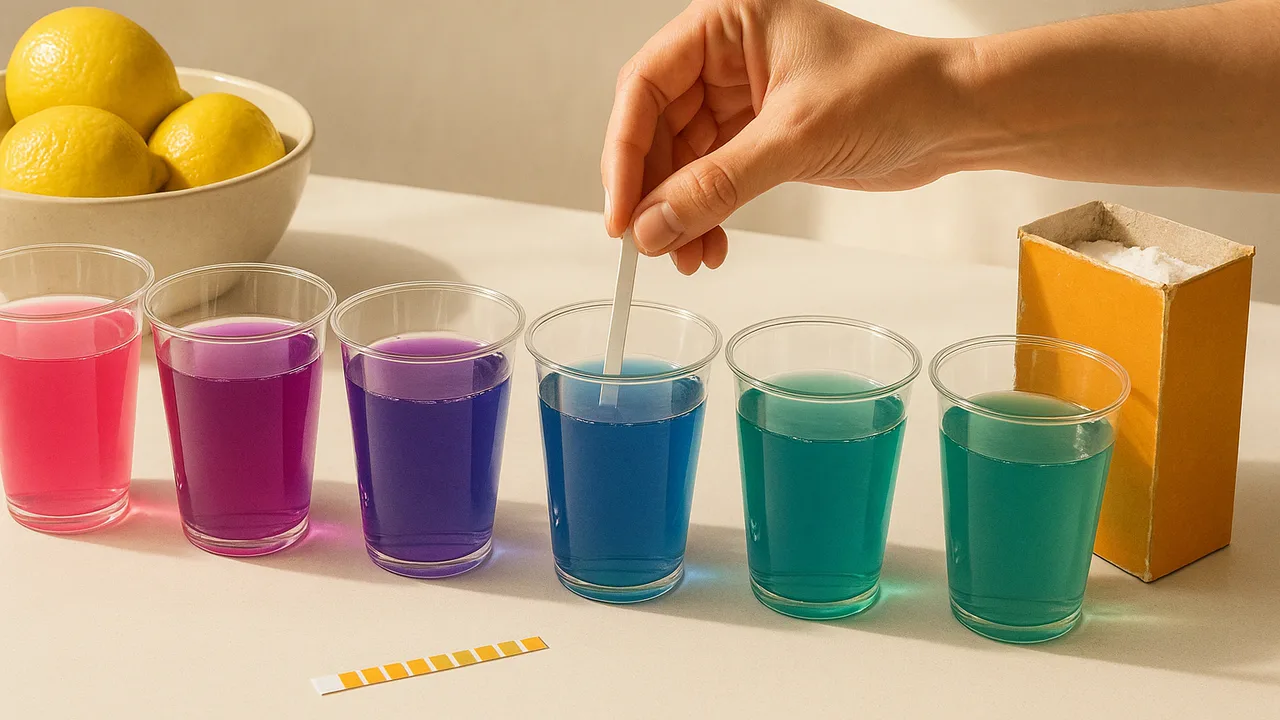
Three ways to measure. An indicator is a weak acid whose acid and conjugate-base forms have different colors. Red cabbage juice holds anthocyanin pigments that turn roughly red below pH 3, pink-violet around 4–6, purple near 7, blue around 8, green around 9–11 and yellow above 12. Test strips carry several indicators and read to about 0.5–1 unit. A calibrated pH meter reads to 0.01 unit, but only if it has been calibrated with standard buffers just before use.
Procedure, part A. (1) Put 10 mL of each sample in a labeled cup: lemon juice, white vinegar, seltzer, tap water, baking-soda solution (1 teaspoon in 250 mL), and teacher-made washing-soda solution. (2) Add 2 mL of cabbage indicator to a 5 mL portion of each and record the color. (3) Dip a test strip in each and record the pH. (4) Read each with the calibrated meter, rinsing the probe with distilled water between samples.
Procedure, part B: your breath. (5) Put 50 mL of distilled water and 5 mL of cabbage indicator in a cup and record the meter reading. (6) Using your own straw, blow out gently through the water for 60 seconds. (7) Record the color and pH again. Exhaled air is about 4% CO2, about a hundred times more than room air.
| Sample | Cabbage color | Strip pH | Meter pH | [H+] from meter (M) |
|---|---|---|---|---|
| Lemon juice | ||||
| Vinegar | ||||
| Seltzer | ||||
| Tap water | ||||
| Baking-soda solution | ||||
| Washing-soda solution | ||||
| Water before / after breath |
Worked example 2: reading the breath result. Diego’s sample data: distilled water pH 6.2 before (it had already absorbed some CO2 from room air), 5.0 after breathing through it. [H+] rose from 6.3 × 10⁻⁷ to 1.0 × 10⁻⁵ M, about 16 times. Carbon moved from his cells (the biosphere), through his breath (a small, very CO2-rich piece of the atmosphere) into water (the hydrosphere), where it made carbonic acid: CO2 + H2O ⇌ H2CO3 ⇌ H+ + HCO3−. The ocean does the same with the air above it, on a planetary scale.
Guided Exercises ~15 min
Answer as you collect data; return to the cards after clean-up.
Independent Practice ~10 min
Lab analysis, in your Water Chemistry Notebook.
Fill in the [H+] column from your meter data. How many times more H+ is in vinegar than in tap water? Show the calculation.
Compare the three methods: for which samples did cabbage, strip and meter agree, and where did they not? Which method should the hatchery use for daily intake checks, and why?
Closure ~5 min
You can measure pH and you showed that CO2 acidifies water. Next class: what that does to shell over several days.
Exit ticket: surface seawater has fallen from about pH 8.2 to about 8.1. Is the ocean now acidic? Explain, and say what has actually changed.
Teacher notes
Materials (per team): cabbage indicator (teacher prepares ahead by steeping chopped red cabbage in hot water from a kettle or hot plate, then straining and refrigerating), wide-range pH strips, a pH meter or probe, pH 4, 7 and 10 calibration buffers, distilled water and wash bottle, 10 mL graduated cylinder, cups, individual straws, splash goggles. Samples: lemon juice, white vinegar (5%), plain seltzer, tap water, baking-soda solution, washing-soda (sodium carbonate) solution about 1% made by the teacher.
Calibrate meters at the start of the period; show students the calibration step. No-lab alternative: the PhET sim plus a teacher video of the breath test.
Listen for: “pH 8 is twice as basic as pH 4”; “weak acid means dilute acid”; reading cabbage color under colored lights.
Support / stretch: give a pH ↔ [H+] ladder card from 10−1 to 10−13. Stretch: compute [OH−] and pOH for the washing-soda sample and show pH + pOH = 14.