1.04 Squeezing a Syringe: Pressure, Volume and Boyle’s Law
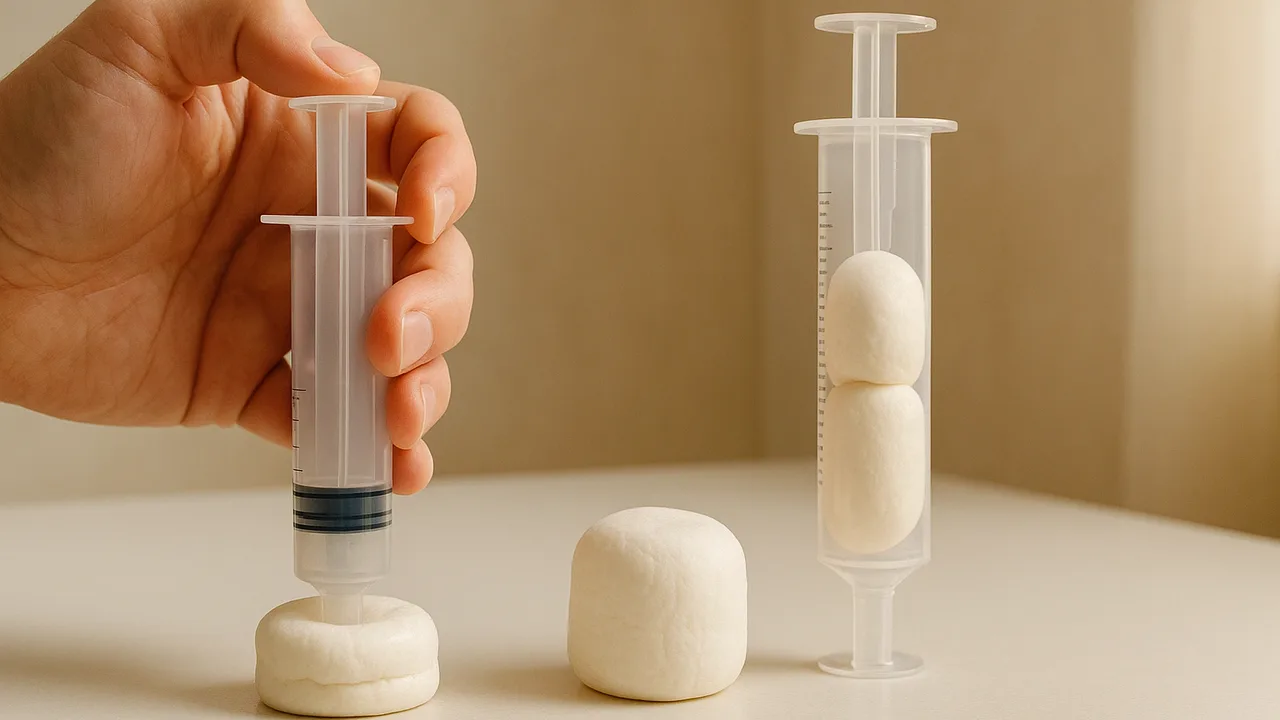
measure how the volume of a trapped gas changes as pressure on it changes, show that PV stays nearly constant, and explain Boyle’s law with particle collisions in a two-scale model.
- I can develop models that identify and describe all parts of a system and its surroundings, showing how energy flows between them.
- I can clearly represent both macroscopic (large-scale) and molecular/atomic (small-scale) views of a system in my models.
- I can show in my models how energy appears in different forms at both the macroscopic scale (like motion, sound, light, thermal energy, potential energy, or energy in fields) and the molecular/atomic scale (like kinetic energy of particles, potential energy from positions in fields, and energy in fields).
- I can use my models to illustrate that energy at the macroscopic scale can be explained as a combination of energy from the motion of particles or objects and energy from their relative positions, at both the macroscopic and microscopic scales.
Phase 2: Investigate
Warm-Up ~5 min
Do Now. Pull the plunger of a capped syringe out, then push it in. Describe what your thumb feels each way and draw the particles inside for both.
Air is trapped in a sealed syringe at 20.0 mL. You push until the volume is 10.0 mL, keeping the temperature the same. What happens to the pressure?
Instruction ~10 min
Why a lab here. The station’s balloon rises into air that pushes on it less and less. To predict its size we need to know how a gas’s volume depends on the pressure around it. Today you squeeze trapped air and measure.
Boyle’s law. For a fixed amount of gas at constant temperature, pressure and volume are inversely proportional: P1V1 = P2V2. Halve the volume and the pressure doubles; let the outside pressure fall to a quarter and a flexible container grows to four times its volume. A graph of P against V is a curve (a hyperbola); a graph of P against 1/V is a straight line through the origin.
The particle reason. At constant temperature the particles keep the same average speed, so each hit is just as hard as before. Squeeze them into half the volume and each particle crosses the box and reaches a wall twice as often, and the wall area per particle shrinks too. Twice the hits per square meter per second means twice the pressure. Nothing about the particles’ energy changed; only how crowded they are.
Worked example 1: the balloon at 10 km, pressure only. Yusuf took the station’s planned launch volume of 2.0 m3 at 101.3 kPa and asked what Boyle’s law alone predicts at 10 km (26.5 kPa). V2 = P1V1 / P2 = 101.3 × 2.0 / 26.5 = 7.6 m3. He flagged it: “This ignores the cold. Next class we combine both effects.”
Worked example 2: one helium cylinder. Hana’s team checked whether one rented helium cylinder is enough. The sample cylinder holds 50 L at 15,000 kPa. Released to 101.3 kPa at the same temperature: V2 = 15,000 × 50 / 101.3 = 7,400 L, or 7.4 m3. Helium at such high pressure is not perfectly ideal, so the real figure is a little lower, but one cylinder comfortably fills a 2.0 m3 balloon.
Two ways to measure. Pressure sensor: connect a sealed syringe to a gas pressure sensor, set the plunger to 20.0 mL, and record pressure at 25, 20, 15 and 10 mL. Syringe and weights: stand a capped 60 mL syringe upright in a clamp and stack books on a small board on the plunger. Pressure on the gas = room pressure + (weight ÷ plunger area). For a plunger of area 5.3 cm2 (5.3 × 10⁻⁴ m2), each 1.0 kg of books adds 9.8 N ÷ 5.3 × 10⁻⁴ m2 ≈ 18 kPa.
| Trial | V (mL) | P (kPa) | P × V (kPa·mL) | 1/V (mL−1) |
|---|---|---|---|---|
| 1 | ||||
| 2 | ||||
| 3 | ||||
| 4 |
Reading the result. Sample sensor data: 25.0 mL at 81.2 kPa, 20.0 mL at 101.3 kPa, 15.0 mL at 135.5 kPa, 10.0 mL at 202.0 kPa. The products are 2,030, 2,026, 2,033 and 2,020 kPa·mL: constant within about 1%. Small drift comes from the air in the tubing (not counted in the syringe scale), slight warming when you push fast, and leaks at high pressure. Push slowly and wait a few seconds before each reading so the gas returns to room temperature.
Guided Exercises ~15 min
Use your data table and the sim.
Independent Practice ~10 min
Lab analysis, in your Gas Notebook.
Graph P against V and P against 1/V for your data. Which is linear? Report your average P × V and its spread, and name the largest source of error in your setup.
Use Boyle's law to predict the station's balloon volume at 5 km (54.0 kPa) and at 20 km (5.5 kPa), ignoring temperature. Then say, from 1.03, whether the cold air will make the real volume larger or smaller than your answers.
Closure ~5 min
We now have two laws: temperature changes volume one way, pressure another. Next phase, we put them into one equation that works for the whole flight.
Exit ticket: a diver's exhaled bubble grows as it rises to the surface. Explain why with Boyle's law and the particle model.
Teacher notes
Materials (per team): a needle-free 60 mL syringe with tip cap or a gas pressure sensor with syringe kit, a ring stand and clamp, a small board, books of known mass (or a bathroom scale to weigh them), a ruler to measure the plunger diameter, calculators, devices for PhET or the paper alternative.
Timing: data 25 minutes, sim 10 minutes, analysis 15 minutes. If you have only weights, measure the plunger’s inside diameter and compute its area (A = πd2/4); for a 60 mL syringe it is usually about 2.6 cm.
Listen for: “squeezing makes the particles smaller”; “the particles get faster when squeezed” (only if the push is fast enough to warm the gas, which we discuss in 1.06); gauge pressure used in place of absolute.
Support / stretch: pre-fill the P × V column for the first row. Stretch: explain why pushing the plunger quickly gives a slightly higher pressure reading than pushing it slowly.