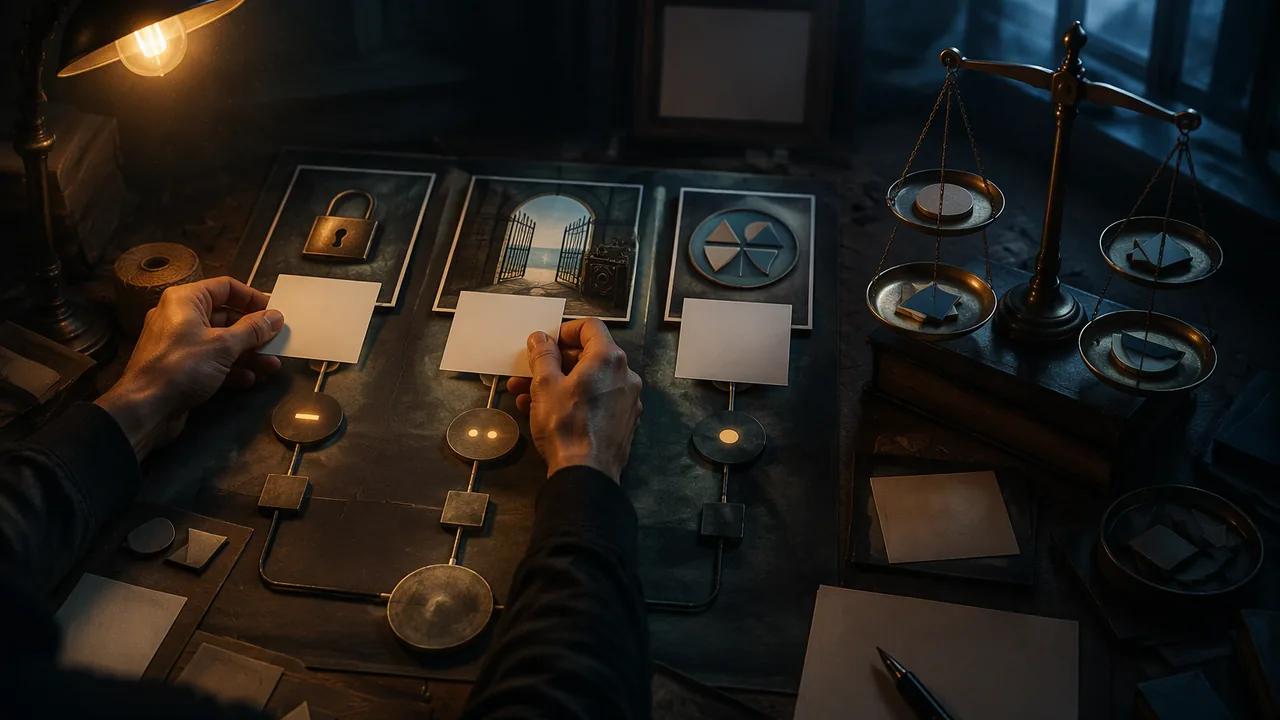
explain what copyright and trademark protect, identify public-domain and Creative Commons material, write correct attributions, and analyze a use under the four fair-use factors.
Instruction
Designers use other people’s work every day: photos, illustrations, icons, fonts. Using it legally is part of the job, and clients rely on you to get it right.
Copyright is automatic. In the United States, an original creative work is protected by copyright the moment it is fixed in a tangible form: saved, drawn, photographed. No notice or registration is needed. The owner controls copying, distribution, adaptations, and public display and performance. For works created today by an individual, protection generally lasts for the author’s life plus 70 years. “I found it on Google” means nothing: almost every image online is under copyright unless its owner has said otherwise.
What copyright does not protect. The U.S. Copyright Office’s Circular 33, Works Not Protected by Copyright, is a primary source every designer should read. It explains that ideas, methods and systems are not protected, only their particular expression; that names, titles, short phrases and slogans are not protected by copyright (though they may be protected as trademarks); and that “Copyright law does not protect typeface or mere variations of typographical ornamentation or lettering.” It also says the general layout or format of a page or poster is not protected. Font files, however, are software distributed under a license, and that license governs how you may use and share them. This is why this course uses fonts under the SIL Open Font License, which allows them to be used in your designs and shared freely, though not sold on their own.
Public domain. Works in the public domain can be used by anyone for anything. In the United States this includes works published in 1930 or earlier (as of 2026), and works made by federal government employees as part of their jobs, such as most NASA photographs. Be careful: some federal symbols, such as agency logos and insignia, are restricted by other laws even though they are not copyrighted. Many museums release images of public-domain artworks under CC0, a tool that waives all rights.
Creative Commons. Creative Commons licenses let creators give permission in advance. Every CC license requires attribution (BY). Add-ons change the terms: SA (ShareAlike) means adaptations must use the same license; NC (NonCommercial) means no commercial use; ND (NoDerivatives) means no adaptations. A CC BY-NC image cannot go on a paid client’s advertisement. A CC BY-ND photo cannot be cropped into a collage. Credit a CC work with TASL: Title, Author, Source (link), License (link), for example: “Harbor at Dawn” by J. Rivera, from the city photo archive, licensed under CC BY 4.0.
Trademark. Trademarks protect names, logos and slogans that identify a business in the marketplace, so customers are not confused. They are registered with the U.S. Patent and Trademark Office. You cannot use another company’s logo in a way that suggests it endorses your client, and you should never design a logo that could be confused with an existing one.
Fair use. Federal copyright law (17 U.S.C. § 107) allows some uses without permission, weighed case by case on four factors: (1) the purpose and character of the use, including whether it is commercial or transforms the work with new meaning, as in criticism, commentary, news or teaching; (2) the nature of the work, where creative works get more protection than factual ones; (3) the amount and substantiality of what is used; and (4) the effect on the market for the original. No single factor decides. There is no safe percentage: the “change it 30%” rule is a myth. Fair use is often reasonable in critique, commentary and coursework. It is rarely a safe basis for a paid client’s advertisement.
Credit is not permission. Naming the photographer does not make it legal to use a photo you have no license for. When in doubt, make it yourself, use public-domain or properly licensed material, or ask permission in writing. Photos of identifiable people used to promote something also need a signed model release, and for anyone under 18, a parent or guardian must sign.
📖 Read for this lesson
The reading opens over the lesson; close it to come back to exactly where you were. The checks below draw on it.
Formative check
Work through these before moving on. They are not graded — they tell you whether the standard below has landed yet.
Your paid client wants a photo licensed CC BY-NC on their product advertisement. What should you do?
If you change an image by at least 30%, you can use it without permission.
A correct Creative Commons credit follows TASL: Title, , Source and License. A license marked forbids commercial use.
According to U.S. Copyright Office Circular 33, which of these is NOT protected by copyright?
Choose the rights case card you found hardest to decide. Summarize the strongest argument on each side and the fair-use factor or license term that decided it.
How confident are you that you can decide whether I may use an image, write a correct attribution and apply the four fair-use factors?
Rights Lab Kit: The Rules from Their Sources, Eight Case Cards with Analysis and Three Correct Attributions
Circular 33 (copyright.gov); 17 U.S.C. 105-107; CC BY 4.0 and BY-NC 4.0 deeds; Andy Warhol Foundation v. Goldsmith, No. 21-869 (May 18, 2023); retrieved Sept. 26, 2026 · Public domain (U.S. government works and court opinion; statutes) and CC BY 4.0 (Creative Commons deed text, short quotations), with SLS original scenarios and analysis
Why this reading. The lab asks you to decide eight rights case cards with reasons and write three correct attributions. To do that you need the rules and the cases. This reading prints the rules from the primary sources (short quotations only), then the eight cards with an analysis to check your reasoning against. Sources retrieved Sept. 26, 2026. Scenarios are constructed (SLS original); this is teaching, not legal advice.
The rules, from their sources
Copyright owners’ rights (17 U.S.C. § 106) include the rights to reproduce the work, to prepare derivative works, to distribute copies and, for graphic works, to display them publicly. U.S. government works (§ 105): “Copyright protection under this title is not available for any work of the United States Government.” Fair use (§ 107): for purposes such as criticism, comment, news reporting, teaching, scholarship or research, weighed on four factors: (1) “the purpose and character of the use, including whether such use is of a commercial nature or is for nonprofit educational purposes”; (2) “the nature of the copyrighted work”; (3) “the amount and substantiality of the portion used”; (4) “the effect of the use upon the potential market.”
U.S. Copyright Office, Circular 33, Works Not Protected by Copyright: “Copyright law does not protect typeface or mere variations of typographical ornamentation or lettering.” Words and short phrases “such as names, titles, and slogans, are uncopyrightable.” “The general layout or format of a … poster … is uncopyrightable.” Familiar symbols, including “arrows and other directional or navigational symbols” and “hazard warning symbols,” are uncopyrightable. Fonts as software are licensed separately.
Creative Commons BY 4.0: you may share and adapt “for any purpose, even commercially,” but “You must give appropriate credit, provide a link to the license, and indicate if changes were made.” The NC add-on: “A commercial use is one primarily intended for commercial advantage or monetary compensation.”
Warhol v. Goldsmith (2023). Andy Warhol Foundation for the Visual Arts v. Goldsmith, No. 21-869, decided May 18, 2023, opinion of the Court by Justice Sotomayor. In 2016 the Foundation licensed Warhol’s “Orange Prince,” derived from a 1981 photograph by Lynn Goldsmith, to Condé Nast for $10,000 for a magazine cover. The Court held that the first fair-use factor favored Goldsmith, because the licensing shared substantially the same purpose as the original photograph and was commercial.
Eight case cards, with analysis
- A paid client wants a CC BY-NC photo in an ad. Not allowed: an ad is a commercial use. Find another image or ask the photographer in writing.
- A CC BY 4.0 photo, cropped and color-adjusted, in a client’s poster. Allowed, even commercially, if you credit, link the license and say it was cropped and adjusted.
- “I changed the photo by 30 percent, so it is mine.” There is no safe percentage; the four factors decide, case by case.
- A poster set in a font under the SIL Open Font License. Allowed; the license, not copyright, governs fonts as files, and the typeface design itself is not protected under Circular 33. Check each font’s own license.
- A federal agency photograph and the agency’s logo. The photograph is a government work under § 105 (check that an agency did not receive it from a private photographer); the logo may be restricted by other laws. Smokey Bear, for example, is defined in 16 U.S.C. § 580p as a Forest Service character; ask the agency before using such a mark.
- A critique slide in your own course portfolio, submitted for grading, showing a current movie poster. Probably fair use: purpose is criticism and teaching, nonprofit, a limited audience, and it does not replace the poster. Posting the slide publicly online weakens the case. Likely, not guaranteed.
- A client asks for a logo “just like” a famous sneaker brand’s. Trademark, not copyright, is the problem: it may confuse customers, and a slogan or short name is not copyrightable but can be a trademark.
- Turning a stock photographer’s portrait into a stylized poster the client will license to a magazine. After Warhol, a use that serves the same purpose as the original and is commercial weighs against fair use, even with added expression. Get a license. A signed model release is also needed for a recognizable person, and a guardian must sign for anyone under 18.
Three attributions, corrected
(a) Constructed CC BY 4.0 photo, cropped: “Harbor at Dawn” by J. Rivera, Harbor City Photo Archive, licensed under CC BY 4.0 (link to the deed); cropped. (b) Henri de Toulouse-Lautrec, Divan Japonais, 1893, color lithograph, Art Institute of Chicago, 1949.1002; public domain (open-access record, retrieved Sept. 26, 2026). (c) See America. Visit the national parks, NYC Art Project, WPA, 1936-40, Library of Congress 98518589; no known restrictions on publication. Credit is good practice for public-domain work, but credit is never permission for work you have no license for.
Sources: U.S. Copyright Office, Circular 33: Works Not Protected by Copyright (copyright.gov); Cornell LII, 17 U.S.C. 107 Fair use (law.cornell.edu); Creative Commons, Attribution 4.0 International deed (creativecommons.org); Supreme Court, Andy Warhol Foundation v. Goldsmith, No. 21-869 (supremecourt.gov); Art Institute of Chicago, Divan Japonais (1949.1002) (artic.edu)