document a full design process from brief to tested prototypes, argue in writing which approach better meets the success criteria, and pitch the recommendation to the client in a recording.
Instruction
Designers are hired for their thinking as much as their images. A case file (in a portfolio it is often called a case study) shows that thinking: it takes a reader from the problem to the solution and shows the evidence for each decision.
Choose a brief. Pick one: (1) a public library’s summer reading program for teenagers; (2) a community garden’s first volunteer planting day; (3) a family bakery’s first Saturday stand at a farmers’ market. All three are hypothetical Missouri clients, described in full in the project reading, so you do not need to contact anyone. You may instead choose a real Missouri client you know, such as a family business, church, library or nonprofit, but only with a parent’s knowledge, and never post a real client’s work online without their permission.
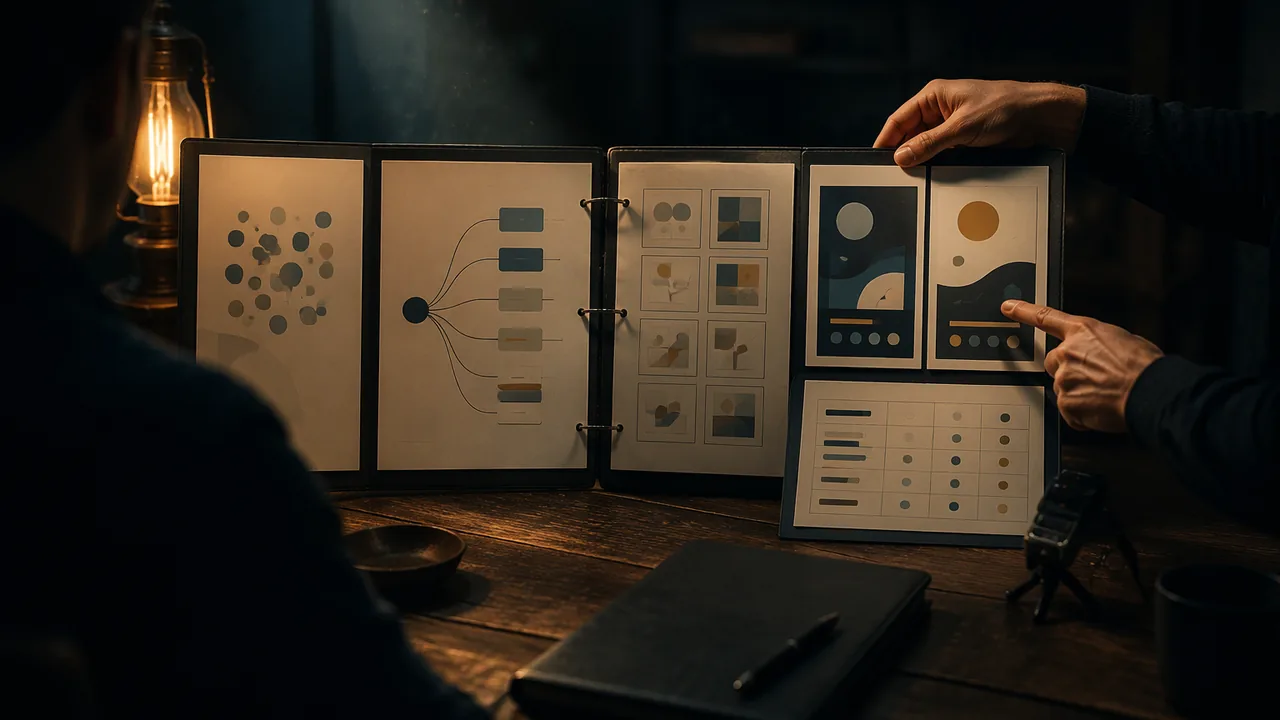
What goes in the case file. In order: your problem statement with success criteria; a summary of your audience research and your audience profile; your mind map and at least twenty thumbnails; your mood board with its source list; your two prototypes; your test plan and results table; and your written analysis. Keep each section short and visual except the analysis.
The written analysis (500-700 words). This is an argument. Your claim is which approach better meets the success criteria, or how the two should be combined. Your evidence is your test data and your research. A strong analysis does four things. It states the claim early. It presents the evidence with numbers and quotations from testers. It addresses the strongest case for the other approach fairly, which might be that more testers were drawn to its image, and explains why your claim still holds or how you would combine them. And it ends with what you would test next. Write in the third person or first person consistently, and use design vocabulary precisely.
Revising your own draft. In Stage 2, set the draft analysis aside for a day, then read it with a highlighter and mark each sentence that makes a claim without evidence; an adult reader may do the same if one is willing. You revise until every claim has support.
The pitch. Record three minutes addressed to the client (video, or audio over your slides). Open with the problem, not with your design. Show the two prototypes side by side, give the one or two numbers that matter most, and make your recommendation. Then answer, on the same recording, the client questions printed in the project reading. Clients often ask about cost, time and risk, so say what the final version would need and what could go wrong. Speak to the client’s goals, not your own taste: “This version gets more students to the sign-up page” persuades; “I like this one better” does not.
Professional quality. Name your files consistently, proofread everything, and make sure your case file can be understood by someone who never saw you work on it. That person is the portfolio reviewer you will meet next semester.
📖 Read for this lesson
The reading opens over the lesson; close it to come back to exactly where you were. The checks below draw on it.
Formative check
Work through these before moving on. They are not graded — they tell you whether the standard below has landed yet.
Which sentence best addresses a counterargument in the analysis?
A pitch should open by showing your favorite design before explaining the problem.
How confident are you that you can document a full design process and argue from test evidence which approach works better?
Submit: Design problem case file + 500-700-word analysis + three-minute pitch
Task: Solve one community design brief through the full process (define, research, ideate, prototype, test) and argue, using your evidence, which of two approaches better meets the success criteria. Record a pitch of your recommendation to the client.
Interviews must follow the research-ethics rules from Lesson 2.3 and be arranged with a parent’s knowledge. The pitch is recorded (video, or audio over your slides).
Submission workflow
- Stage 1 — Plan. Problem statement with success criteria, research summary and audience profile, mind map, twenty thumbnails and a draft test plan.
- Stage 2 — Self-reviewed draft. Mood board with sources, two prototypes, test results and a draft analysis; after a day away you mark every unsupported claim (an adult reader may help) and record your revisions.
- Stage 3 — Revised final. The complete case file and a 500-700-word analysis with every claim supported by evidence.
- Stage 4 — Pitch. A recorded three-minute pitch to the client, with recorded answers to at least two of the client questions in the project reading.
How it is scored
| Criterion | What proficient looks like |
|---|---|
| Problem definition (GADP.COM.5 / GADP.DES.8) | A precise problem statement naming audience, action, constraints and measurable success criteria. |
| Research and empathy (GADP.DES.8 / GADP.COM.4) | Ethical research from at least three people, turned into an audience profile traceable to evidence. |
| Ideation and prototypes (GADP.DES.8) | At least twenty thumbnails; two genuinely different approaches built to equal fidelity. |
| Testing and evidence (GADP.DES.6) | Criteria written before testing; results recorded accurately and fairly. |
| Written analysis (WHST.9-10.1) | Clear claim supported by data, the strongest counterargument stated and answered, next steps identified. |
| Revision (WHST.9-10.5) | Documented changes after self-review (and any adult reader’s notes) strengthen the argument. |
| Pitch (SL.9-10.4) | Clear, client-centered reasoning with evidence; accurate answers to questions. |
Design Case File and Pitch: Three Complete Client Briefs, Criteria at Four Levels, an Exemplar Paragraph and the Pitch Plan
SLS original brief, criteria and exemplar; hypothetical Missouri clients and constructed data · SLS original
Why this reading. The project asks for a case file, a 500-700-word analysis and a three-minute pitch. The lesson names three community clients; you need their briefs, the criteria, an exemplar, the client questions for your recorded pitch and a self-marking sheet. All three are hypothetical Missouri clients; their numbers and quotations are constructed (SLS original), so you do not need to contact anyone. If you choose a real client you know instead, do it only with a parent’s knowledge.
Three complete briefs (choose one)
| 1. Library summer reading | 2. Community garden | 3. Family bakery stand | |
|---|---|---|---|
| Client and objective | Eastside Public Library: 200 teens in the summer reading program, up from 120 last year | Cedar Street Community Garden: 30 volunteers at its first planting day, Saturday, April 18 | Hilltop Family Bakery: 40 customers at its first Saturday farmers’ market stand, May 9 |
| Audience | Ages 13-17, on library and community bulletin boards and in the library teen room | Neighbors of all ages, on shop windows and a neighborhood app | Market shoppers of all ages, on the market’s sign board and the bakery’s social page |
| Message and action | Read anything, win a prize; sign up at the desk or online | Bring gloves; we supply tools and lunch; sign up online | Bread baked this morning by a local family; first 20 customers get a free roll; find us at stall 12 |
| Constraints | Letter, color, library logo (green book) | 11 × 17, two ink colors, Spanish and English | Letter print and a square 1:1 social image; the bakery’s brown and cream |
What goes in the case file, in order
Problem statement with success criteria; research summary and audience profile; mind map and at least 20 thumbnails; mood board with source list; two prototypes; test plan and results table; the analysis. Each section short and visual except the analysis. A worked pattern for all of these is in the readings for Lessons 2.1 to 2.4 (the food bank example).
Criteria at four levels (SLS original)
| Criterion | 2 Developing | 3 Proficient | 4 Exemplary |
|---|---|---|---|
| Problem and research | Restates the brief | Statement with audience, action, constraints, success measure; three sourced interviews | Profile sentences all traceable to notes |
| Ideation and prototypes | Fewer than 20 thumbnails; two versions differ in color only | 20+ thumbnails; two different strategies | Rejected ideas explained |
| Testing | No criteria before testing | Criteria first; results table; at least three testers (or fewer plus a labeled self-test) | Limits of the test stated |
| Analysis (500-700 words) | Opinion | Claim early; evidence with numbers; strongest counter-case addressed | Says what to test next |
| Pitch (3 minutes) | Opens with the design | Opens with the problem; two prototypes; one or two key numbers; a recommendation | Answers cost, time and risk questions |
Exemplar: the counter-case paragraph (food bank data, SLS original)
“The strongest case for Version A is its appeal: 7 of 12 testers (58.3 percent) said they would stop for it, against 5 of 12 (41.7 percent) for B. That matters, because a poster no one stops for communicates nothing. But stopping is not the goal. Only 5 of 12 testers who saw A could say what it asked them to do, and the median time to find the shift was 11 seconds against 4. I therefore recommend B’s headline and hierarchy with A’s crate at a smaller size, and I would test that hybrid next with a different group.” (About 110 words; the full analysis is 500-700.)
Pitch in numbers and order
Three minutes is 390 to 450 words at 130 to 150 words per minute; aim well below, and show images. You record the pitch (video, or audio over your slides). Order: the client’s problem (30 seconds); the two prototypes side by side (45); the one or two numbers that matter (30); the recommendation (30); then answers to at least two of the client questions below. Speak to the client’s goals: “this version gets more students to the sign-up page.”
Client questions for the end of your recording (answer at least two)
- Cost: what would printing or posting the final version cost us?
- Time: how long until the final is ready, and what do you need from us?
- Risk: what could go wrong with your recommendation, and how would we know?
- Why not the other version, since more people said they would stop for it?
Self-marking sheet
After a day away, mark every sentence in the draft analysis that makes a claim with no evidence next to it; an adult reader may mark it too. Revise until none is left.