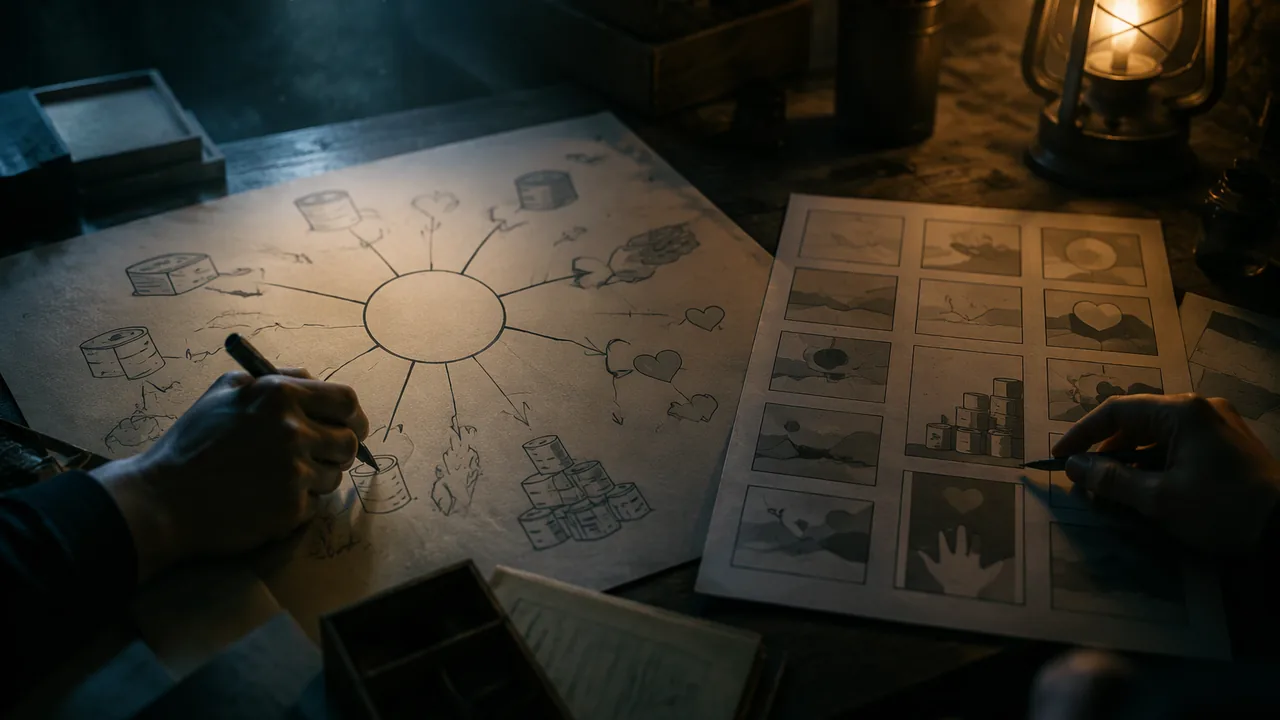
generate a large number of distinct ideas for a design problem using a mind map, word lists and thumbnail sketches, and select the strongest using the problem statement.
Instruction
Quantity first. The first idea anyone has for a volunteer poster is a pair of hands, or a heart. The second is usually a pair of hands holding a heart. Those ideas are not wrong, but they are the ideas everyone has, so they are easy to ignore. Designers deliberately produce many ideas quickly, because the unusual, memorable ones tend to appear after the obvious ones are out of the way. The rule in ideation is: generate first, judge later.
Mind maps. Write the core of your problem in the center of a page, such as teen volunteers / food bank. Branch out with every association: food, sorting, boxes, Saturday, friends, hunger, community, service hours, trucks, cans, crates, tables. Then branch off those: cans become stacking, towers, labels, pyramids. Spend five minutes and do not cross anything out. The outer branches, far from the center, are where fresh visual ideas live.
Word lists and forced connections. Make two columns: nouns from your mind map, and verbs or ideas about the message (join, build, share, fill, lift). Combine one from each at random: crates + build becomes a stack of crates shaped like a staircase or a city skyline; cans + fill becomes an empty shelf being filled one can per volunteer. Some combinations will be nonsense. A few will be concepts.
Thumbnails. Thumbnails are tiny, fast sketches, about 2 by 2.5 inches, that show the layout and the concept, not the detail. A thumbnail should take one or two minutes. Use boxes for text blocks and a line for a headline; draw images as simple shapes. Draw them in the same proportion as the final piece: a letter-size sheet is 8.5 by 11, a ratio of about 0.77, so a 2-inch-wide thumbnail should be about 2.6 inches tall. Keeping the proportion means the layout will work when you scale it up.
Observation drawing helps. If your concept uses an object such as a crate, a can or a hand, draw the real object from observation for two minutes first. You will draw it more convincingly and notice features (the ridges on a can, the handle holes in a crate) that make the image recognizable in a simple silhouette.
Selecting ideas. After you have at least twenty thumbnails, switch from generating to judging. Test each one against your problem statement: Will this audience understand it in three seconds? Does it lead to the action? Does it survive the constraints, for example printing in black and white? Is it different from what the audience has seen a hundred times? Mark your three strongest and write one sentence for each explaining why. Keep the rest; rejected thumbnails are part of your process record and sometimes become useful later.
Constraints as a tool. In this studio you will run a constraint round: redraw your best idea using only two shapes and one line of type. Constraints like this strip a concept to its core and often reveal whether it is strong enough to carry the design.
📖 Read for this lesson
The reading opens over the lesson; close it to come back to exactly where you were. The checks below draw on it.
Studio: Twenty Thumbnails in Forty Minutes
Question. How many genuinely different ways can one design problem be solved, and what happens to your ideas when you add a strict constraint?
Materials
- Your problem statement from Lesson 2.1
- Plain paper or a sketchbook, pencils, an eraser and one black fine-tip pen
- A thumbnail template sheet (twenty rectangles at 2 x 2.6 inches, or ruled by hand)
- A timer
- Sticky notes in two colors
- Take a short hand-and-wrist stretch between rounds; fast sketching for long periods strains the hand.
- Keep your posture upright with the paper at a comfortable angle; do not hunch over the page for the whole session.
- Photograph or scan your pages at the end of each session and save the images in two places.
Procedure
- Mind map (5 minutes): write the core of your problem in the center of a page and branch out with at least 30 associations. Do not cross anything out.
- Word list (5 minutes): make a column of nouns from the map and a column of message verbs, and write at least eight forced combinations.
- Thumbnail rounds (30 minutes): set a timer for 1.5 minutes per thumbnail and fill all twenty rectangles. Each thumbnail must be a different concept or a clearly different layout, not the same idea redrawn.
- Constraint round (5 minutes): redraw your favorite concept using only two simple shapes and one line of type.
- Viewer vote: ask a family member or other adult to place a colored sticky note (or a colored-pen dot) on the three thumbnails they find clearest and a second color on the one they find most surprising. If no one is available, take a break of at least an hour, then vote yourself using the selection matrix in the lab reading.
- Select three concepts against your problem statement and write one sentence of justification for each.
Data
| Measure | Your result |
|---|---|
| Associations on the mind map | |
| Thumbnails completed | |
| Thumbnails that are distinct concepts (not variations) | |
| Thumbnail numbers chosen as clearest by your viewer (or by you after the break) | |
| Thumbnail number chosen as most surprising | |
| Your three selected concepts |
Analysis
- At what point in the rounds (early, middle or late) did your most unusual idea appear? What does that suggest about stopping at your first idea?
- Did your viewer’s ‘clearest’ choices (or your after-the-break vote) match your first instinct? Explain any difference using the problem statement.
- What did the two-shapes-and-one-line constraint remove from your favorite idea, and was the idea still recognizable?
If you cannot do this studio in person: Every step of this lab works on paper with no device: time yourself with any clock, and draw the thumbnail rectangles with a ruler. If no viewer is available for the vote, use the selection matrix in the lab reading after a break.
Formative check
Work through these before moving on. They are not graded — they tell you whether the standard below has landed yet.
During ideation you should cross out weak ideas as soon as you draw them.
Your final poster will be 11 x 17 inches (portrait). What proportion should your thumbnails use?
Mind map
Tap to revealBranch associations outward from the core problem
Forced connection
Tap to revealCombine a random noun and a message verb to spark a concept
Thumbnail
Tap to revealOne- to two-minute sketch of layout and concept, in proportion
Constraint round
Tap to revealRedraw with severe limits to test whether a concept is strong
Describe your three selected concepts in one sentence each and explain which part of your problem statement each one answers best.
How confident are you that you can generate twenty distinct ideas for a design problem and choose the strongest using my problem statement?
Ideation Sheet: A Worked Mind Map, Forced Connections, Thumbnail Sizes and a Selection Matrix
SLS original lab sheet; constructed example · SLS original
Why this reading. The lab asks for a mind map, at least twenty thumbnails and three selected concepts with reasons. This sheet gives a worked mind map and forced-connection table for the food bank brief (reading “The Food Bank Brief,” Lesson 2.1), the thumbnail sizes, and a selection matrix. SLS original.
Worked mind map, as text
Center: teen volunteers / food bank. First ring: food, sorting, boxes, Saturday, friends, hunger, community, service hours, trucks, cans, crates, tables. Second ring, from cans: stacking, towers, labels, pyramids, opening, shelf. From crates: build, stairs, city skyline, handles. From Saturday: alarm clock, sleeping in, pancakes, sunrise. The far ring (sunrise, alarm clock, skyline) is where fresh ideas are.
Forced connections
| Noun | Message word | Concept |
|---|---|---|
| crates | build | Crates stacked as a skyline or staircase |
| cans | fill | An empty shelf filled one can per volunteer |
| alarm clock | join | Alarm set to 8:30 with a smile instead of a snooze |
| sunrise | share | Sun rising from a bowl |
Thumbnail sizes in proportion
Letter is 8.5 × 11 in., a height-to-width ratio of 11 ÷ 8.5 = 1.29, so a thumbnail 2 in. wide is 2 × 1.29 = 2.6 in. tall. An 11 × 17 in. poster has a ratio of 17 ÷ 11 = 1.55, so a 2 in. wide thumbnail is 2 × 1.55 = 3.1 in. tall. Draw a page of boxes at that size and fill each in one or two minutes.
Selection matrix (score 0 to 2)
Criteria taken from the problem statement: (a) understood in three seconds from 3 to 5 feet; (b) leads to the scan action; (c) survives black and white; (d) not what the audience has seen a hundred times.
| Concept | a | b | c | d | Total |
|---|---|---|---|---|---|
| Hands holding a heart | 2 | 1 | 2 | 0 | 5 |
| Crate staircase | 2 | 1 | 2 | 2 | 7 |
| Alarm clock at 8:30 | 2 | 2 | 2 | 1 | 7 |
| Shelf filled by cans | 1 | 1 | 2 | 2 | 6 |
Choose the three highest, and write one sentence each, for example: “Alarm clock at 8:30: the clock face doubles as a scan-code frame, which answers the action.” Keep the rejected thumbnails as part of your process record.
Constraint round
Redraw the best idea with two shapes and one line of type: a square (the crate) with a rising line of steps, and the words “Build Saturday.” If it still reads, the concept is strong.