design and revise a poster that deliberately applies at least three principles, test those principles through a blind critique, and present a semester portfolio with a professional next step.
Instruction
This project asks you to prove that you can use principles on purpose, and that other people can see them.
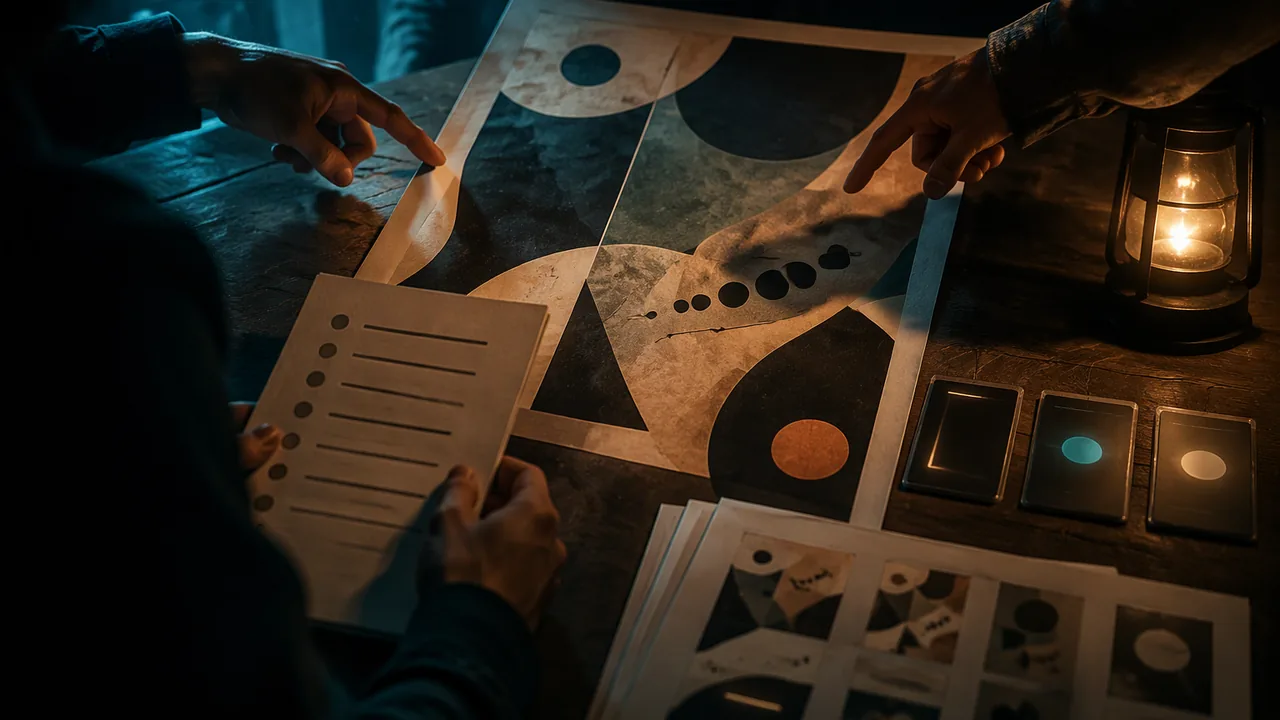
The poster. An original 11 × 17 inch digital poster on a theme that crosses cultures, developed from your Lesson 4.4 draft. Choose at least three principles to drive the design, such as asymmetrical balance, progressive rhythm and scale contrast, and write them down privately before critique. Every image and font must be yours or properly licensed and listed in your asset log.
Blind critique. In Stage 2 your poster gets a blind principle hunt. Seal your three intended principles (on a card in an envelope, or in a dated file you do not open). Then either ask one or two family members or other adults to run the principle hunt with the checklist in the project reading, without telling them your intentions, or, after at least two days away, run it yourself on a grayscale print or screen view for one minute. Afterward, compare: which intended principles did they find? Which did they miss? Did they find principles you did not plan? A missed principle is a signal that it is too weak to register; strengthen it or drop it. A surprise principle may be a strength to keep, or an accident to fix.
Revision and reflection. Revise the poster, logging each change. In a 400-600-word reflection, explain how each of your three principles shaped specific decisions, what the blind critique revealed, and what you changed as a result. Use design vocabulary precisely and quote the critique.
The semester portfolio. Gather your four projects: the Unit 1 flyer and case presentation, the Unit 2 case file, the Unit 3 iteration portfolio and this poster. For each, include the final, one or two process images, and a two- or three-sentence caption: the problem, your role and the result. Put them in a consistent format, a single PDF or a set of slides.
The portfolio review. Record a three-minute review of one project, speaking as if to a portfolio reviewer. Missouri college programs use reviews like this: students who want the University of Missouri’s BFA in Graphic Design must pass a Graphic Design BFA Portfolio Review. Explain the problem, show the process, and say what you would do next. Then answer, on the same recording, two of the reviewer questions in the project reading. Speak as you would in a professional setting: be prepared, be concise, and answer directly.
Your next step. End the review by naming one concrete next step. Options include entering a design competition such as those run by SkillsUSA (the career and technical student organization for students in trade, technical and skilled service programs; SkillsUSA Missouri works through chapters in public career and technical programs, so check whether you can take part before you plan on it, and check the current contest list), taking on a small design job for a real Missouri client such as a family business, church, library or nonprofit, with a parent’s knowledge, as a work-based learning experience, arranging an informational interview with a working designer with a parent’s help, or strengthening a specific skill for Semester B. Work-based learning connects what you do in this course with how the profession actually works.
What reviewers look for. Clear problems, evidence of process, strong craft, and the ability to explain decisions. Next semester you will turn this collection into a professional portfolio.
📖 Read for this lesson
The reading opens over the lesson; close it to come back to exactly where you were. The checks below draw on it.
Formative check
Work through these before moving on. They are not graded — they tell you whether the standard below has landed yet.
In the blind principle hunt, no one found the rhythm you intended. What is the best response?
SkillsUSA is a career and technical student organization whose chapters compete in skills contests, including design contests.
How confident are you that you can apply three principles so others can see them, revise from critique, and present my portfolio professionally?
Submit: Principles poster (revised) + critique comparison + 400-600-word reflection + semester portfolio + three-minute review
Task: Design an original 11 x 17 inch poster on a theme that crosses cultures, deliberately applying at least three principles. Test the principles through a blind critique, revise, reflect, assemble your four-project semester portfolio, and present one project in a recorded portfolio review with a professional next step.
The review is recorded (video, or audio over your slides).
Submission workflow
- Stage 1 — Plan. Proportion plan, symbol research note, list of the three intended principles (kept private) and the first draft.
- Stage 2 — Blind-critiqued draft. A blind principle hunt (by one or two adult viewers, or by you after two days away with your intentions sealed) and your written comparison of intended and identified principles.
- Stage 3 — Revised final. Revised poster with change log and asset log, the 400-600-word reflection, and the assembled four-project portfolio.
- Stage 4 — Portfolio review. A recorded three-minute review of one project, recorded answers to two reviewer questions, and a named next step.
How it is scored
| Criterion | What proficient looks like |
|---|---|
| Principles applied (GADP.DES.6 / GADP.DES.3 / GADP.DES.1) | At least three principles applied deliberately and strongly enough that a blind principle hunt identifies them. |
| Design quality (GADP.DES.6) | Effective use of elements and principles, a clear hierarchy, and a visual metaphor that communicates across cultures. |
| Critique and revision (GADP.PRF.2 / GADP.PRF.3 / GADP.PRF.4) | Blind-critique findings compared with intentions, and revisions that respond to them. |
| Reflection (WHST.9-10.2) | Precise explanation of how each principle shaped decisions, supported by critique evidence. |
| Portfolio (GADP.PRF.2 / GADP.PRF.3) | Four projects presented consistently with finals, process images and captions. |
| Review and next step (SL.9-10.6) | Professional, concise presentation adapted to a portfolio reviewer, and a concrete next step (a contest, work-based learning or a skill goal). |
Principles Poster and Portfolio Review: Four Theme Briefs, Criteria at Four Levels, a Worked Critique Comparison and the Review Plan
SLS original brief, criteria and worked example; constructed poster; University of Missouri, BFA in Graphic Design catalog page (portfolio review requirement), and Missouri DESE, SkillsUSA page, retrieved Nov. 9, 2026 · SLS original
Why this reading. The portfolio project asks for a revised 11 × 17 in. poster that applies three principles, a blind-critique comparison, a 400-600-word reflection, a four-project portfolio and a recorded three-minute review. The lesson describes them; here are four theme briefs, criteria at four levels, the blind-hunt checklist, a worked critique comparison, a portfolio caption, the review plan and the reviewer questions. SLS original; the poster in the example is constructed.
Four theme briefs
| Theme | Audience and place | One message |
|---|---|---|
| Water | A community center lobby, seen from 6 feet | Water sustains everyone; save it |
| Home | A library display window | Home is people, not a building |
| Harvest | A farmers’ market bulletin board | Shared food, shared work |
| A shared celebration | A neighborhood festival flyer wall | Everyone is invited |
Format: 11 × 17 in., 300 ppi = 3,300 × 5,100 px (3,375 × 5,175 px with 0.125 in. bleed); margin 0.75 in.; every image and font yours or licensed and logged.
Criteria at four levels
| Criterion | 2 Developing | 3 Proficient | 4 Exemplary |
|---|---|---|---|
| Principles | Two, or unclear | Three named in advance and visible in the poster | Others can find all three without help |
| Cross-cultural symbol | Assumed meaning | Researched note with source, two audiences | Two independent sources; changed the design because of the research |
| Critique and revision | Changes unlogged | Comparison of intended and found principles; every change logged | Weak principles strengthened or dropped with a reason |
| Reflection (400-600 words) | Restates the poster | Each principle tied to specific decisions; quotes the critique | Explains what the critique revealed that you could not see |
| Portfolio and review | Four files | Four projects with final, process image and caption; 3-minute review | Names one concrete next step |
Running a blind hunt without a classroom
Seal your three intended principles first (a card in an envelope, or a dated file you do not open). Then choose one route. Adult viewers: give one or two family members or other adults the poster and this checklist, without your intentions: balance (symmetrical, asymmetrical, radial), alignment, proximity, contrast, emphasis, repetition, rhythm (regular, progressive, irregular), movement, unity, scale and proportion, and the Gestalt groupings (closure, similarity, continuation, figure-ground, common region). Ask them to circle three and point to the evidence for each. Self-test: after at least two days away, view the poster in grayscale for one minute, circle three from the same checklist with evidence, and only then open the envelope. Label a self-test as weaker evidence.
Blind critique comparison, worked (constructed)
Intended: asymmetrical balance, progressive rhythm, scale contrast. Viewer 1 (a parent) found scale contrast and asymmetrical balance; viewer 2 (a neighbor) found scale contrast and unity. Nobody named rhythm. Response: a missed principle is too weak to register; strengthen it or drop it. The rhythm was three circles of 0.5, 0.75 and 1.125 in. (each 1.5 times the last). The fix: add a fourth, 1.6875 in. (0.75 × 1.5 × 1.5) and space the circles with equal 0.5 in. gaps so the pattern shows. A surprise principle (unity) may be kept; check that it is not an accident.
Portfolio caption, worked
“Water poster, 11 × 17 in. The community center needed a poster that people would read from 6 feet. I designed and revised it after blind critique; in the second round both viewers found all three principles I planned.” Two or three sentences: the problem, your role, the result.
The review
You record the review (video, or audio over your slides), speaking as if to a portfolio reviewer. Missouri college programs use reviews like this: students who want the University of Missouri’s BFA in Graphic Design must pass a Graphic Design BFA Portfolio Review (University of Missouri catalog, retrieved Nov. 9, 2026). Three minutes is 390 to 450 words at 130 to 150 words per minute; use fewer and show images. Order: the problem (30 seconds), process (60), result and what you would do next (60), then answers to two reviewer questions. Reviewer questions (answer two): (1) What was the hardest decision in this project, and how did you make it? (2) What did the critique show you that you could not see yourself? (3) What would you do differently with twice the time? (4) Which skill do you most need to build next?
End with one concrete next step: entering a design contest (SkillsUSA Missouri works through chapters in public career and technical programs, according to the Missouri Department of Elementary and Secondary Education, so check whether you can take part, and check the current contest list and rules), a small design job for a real Missouri client such as a family business, church, library or nonprofit, with a parent’s knowledge, as work-based learning, an informational interview with a designer, arranged with a parent’s help, or strengthening one specific skill for Semester B.
Sources: University of Missouri Catalog, BFA in Graphic Design (catalog.missouri.edu); Missouri DESE, SkillsUSA (dese.mo.gov)