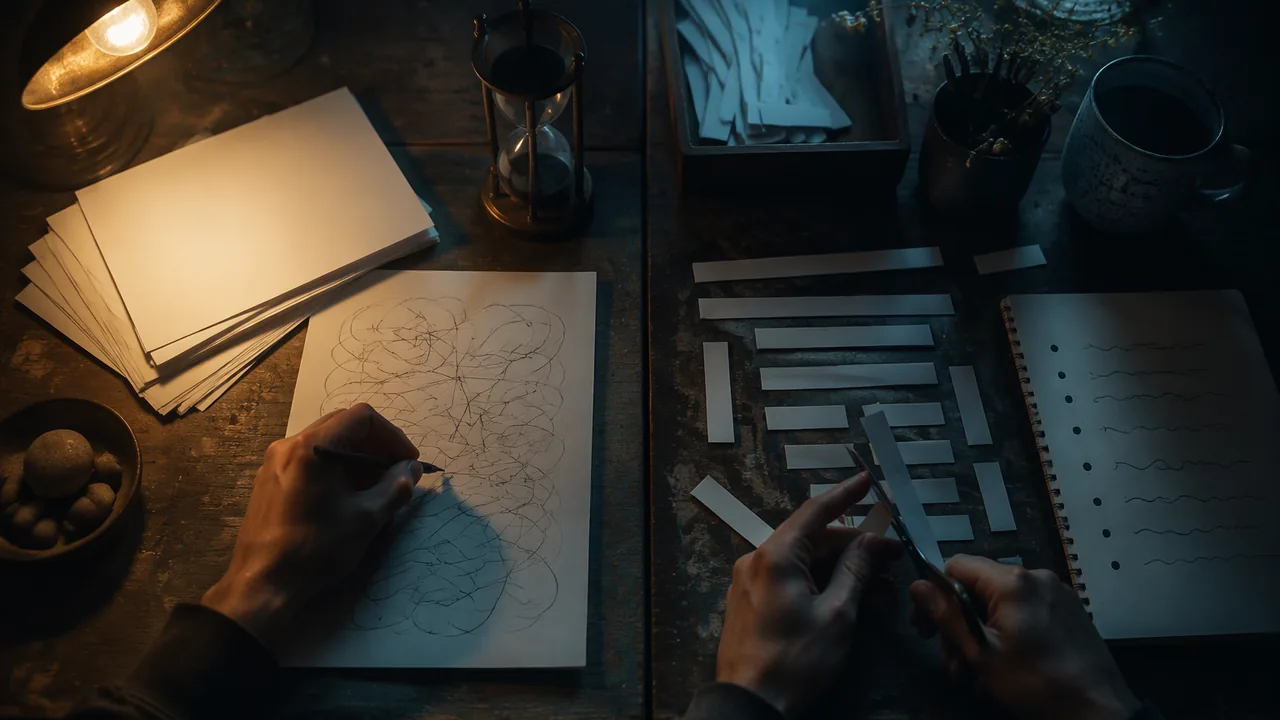
write to a short time limit without stopping to edit, keep a revision log that records what changed and why, and distinguish producing text from improving it.
Instruction
9-10.W.2.A asks for writing “over extended time frames and shorter time frames.” That sounds like an administrative note. It is actually the standard that describes how writers are made, and this course has so far given you only the extended half — four long assignments, each carried over weeks.
Why short, frequent writing matters. A student who writes four times a semester treats every piece as high-stakes, which produces two predictable failures: they cannot start, and they cannot cut. A student who writes for ten minutes most days starts easily, because starting is no longer an event, and cuts freely, because no sentence is precious when there are hundreds more behind it.
The two modes, and the rule that keeps them separate.
Generating is producing text without judging it. It is fast, messy, and its only measure is quantity. Ten minutes, no stopping, no backspace.
Revising is improving existing text. It is slow, judging, and structural — it cuts, reorders, and asks what a paragraph is for.
The rule: never do both at once. Editing while drafting is the single most common reason a piece stalls, because the judging mode kills sentences before the generating mode has produced enough to choose from. Draft badly on purpose, then fix.
This unit’s four timed pieces, ten minutes each, no editing during, published to your portfolio without polishing:
- A place you know well, described without naming what kind of place it is.
- A conversation you remember imperfectly, written as dialogue with the gaps left visible.
- The two minutes before something changed — stop before the change.
- An object that belonged to someone else, and what it says about them that they would not say.
At least one of these will become the seed of your capstone narrative. You will not know which in advance, which is the point.
The revision log. For each timed piece and for each stage of your capstone, one line: what I changed, and why. Not “fixed grammar” — specific: cut the first paragraph because the scene actually started in the second; changed “walked” to “picked her way” so the ground does the work the adverb was doing.
The log is scored, and here is the reason. Across this semester your drafts have improved, and neither you nor your instructor can currently point at which decisions did the improving. The log makes revision visible as a set of choices, which is the only way it becomes a skill you can repeat rather than something that happens when you have time.
Today you also submit the capstone narrative draft. 400-500 words, generated rather than polished. Stage 2 will make it better. Stage 1 only has to exist.
📖 Before this lesson, read: Narrative of the Life of Frederick Douglass, Chapters 10-11
The reading opens over the lesson; close it to come back to exactly where you were.
Reading: Workshop set: the two-mode rule, four Douglass mentor passages, four unpolished pieces with logs, and a generated draft
Frederick Douglass, Narrative of the Life of Frederick Douglass, an American Slave (1845), Project Gutenberg #23, retrieved 26 September 2026 · SLS original; quoted passages are public domain (Douglass, 1845)
Read each mentor passage against its prompt before you write. The pieces, logs, draft excerpt and criteria are written by SLS; the passages are copied from the Narrative.
This workshop asks you to write four ten-minute pieces without stopping to fix anything, to keep a revision log that records what changed and why, and to bring a first capstone draft that is generated, not polished. Below are the rule that keeps the two modes apart, four mentor passages (one for each timed prompt), four unpolished pieces written by SLS with the log entries their revision would produce, a log written the right way and the wrong way, an excerpt of a generated capstone draft, and the criteria.
1. The rule (SLS original)
There are two modes and they must not happen at the same time. Generating is producing text without judging it. It is fast, messy, and measured only by quantity. Revising is improving text that exists. It is slow, judging and structural. Routine for a timed piece: (1) set a timer for ten minutes; (2) write without stopping, without backspace, and without rereading; (3) when the timer ends, stop and put the piece aside; (4) later, in a separate sitting, revise it and log each change.
2. Mentor passages, one for each timed prompt
Frederick Douglass, Narrative of the Life of Frederick Douglass, an American Slave (1845). Each passage does something the prompt asks.
Prompt 1, a place you know well, described without naming what kind of place it is (Chapter III). This passage names its place at once, but look at how much of the description is what the place does to the people near it: the visitors who came to see it, the hungry boys, the lash.
This garden was probably the greatest attraction of the place. During the summer months, people came from far and near—from Baltimore, Easton, and Annapolis—to see it. It abounded in fruits of almost every description, from the hardy apple of the north to the delicate orange of the south. This garden was not the least source of trouble on the plantation. Its excellent fruit was quite a temptation to the hungry swarms of boys, as well as the older slaves, belonging to the colonel, few of whom had the virtue or the vice to resist it. Scarcely a day passed, during the summer, but that some slave had to take the lash for stealing fruit. The colonel had to resort to all kinds of stratagems to keep his slaves out of the garden.
Prompt 2, a conversation remembered imperfectly, with gaps left visible (Chapter VII). Douglass gives one remembered line of his own in quotation marks, and then summarizes what the boys did with it. He does not invent their replies.
I would sometimes say to them, I wished I could be as free as they would be when they got to be men. “You will be free as soon as you are twenty-one, but I am a slave for life! Have not I as good a right to be free as you have?” These words used to trouble them; they would express for me the liveliest sympathy, and console me with the hope that something would occur by which I might be free.
Prompt 3, the two minutes before something changed, stopping before the change (Chapter X). This is the day of the fight with Covey. The passage stops with the narrator on the ground and does not describe what happens next.
About three o’clock of that day, I broke down; my strength failed me; I was seized with a violent aching of the head, attended with extreme dizziness; I trembled in every limb. Finding what was coming, I nerved myself up, feeling it would never do to stop work. I stood as long as I could stagger to the hopper with grain. When I could stand no longer, I fell, and felt as if held down by an immense weight.
Prompt 4, an object that belonged to someone else, and what it says about them (Chapter VII). The book is an object, and what he finds in it turns out to be about him.
Just about this time, I got hold of a book entitled “The Columbian Orator.” Every opportunity I got, I used to read this book. Among much of other interesting matter, I found in it a dialogue between a master and his slave. The slave was represented as having run away from his master three times. The dialogue represented the conversation which took place between them, when the slave was retaken the third time.
Douglass, Narrative (1845), Project Gutenberg eBook #23, retrieved 26 September 2026.
3. Four unpolished pieces, each with its revision log (SLS original)
These were written in ten minutes each and are left rough on purpose so you can see what revision is for.
Piece 1: a place. Linoleum the color of weak tea, worn through to gray in a path from door to counter. A bell on a string that has been rung so often it barely rings. Six stools, one with a split seat mended with silver tape. The smell is coffee gone too long on the burner and bacon fat that has been in the walls since before I was born. It was a very old and kind of sad place. Somebody has written a date on the wall by the register in pencil and nobody has erased it. The window fogs at the corners. A man in a work jacket eats with his cap on, one hand flat on the counter as if the counter might leave. Behind the pass-through a radio plays the station it always plays.
Log: Cut “It was a very old and kind of sad place” because it hands the reader a verdict, and the tape and the pencilled date already argue it.
Piece 2: a conversation with gaps. “You’re not going to eat that.” “I’m eating it.” “You said—” “I said I might.” She turned the fork over. I don’t remember what came next. I remember it was about the car, or about her brother, and somebody said “always” in a voice that meant never. “Ask me tomorrow.” “I’m asking today.” The salt shaker was in my hand, and I could not have said when I had picked it up.
Log: Kept the gap after “I don’t remember what came next” because a made-up middle would have replaced the honest hole; cut the two lines of explanation that followed the last exchange because the exchange already carries the anger.
Piece 3: the two minutes before. The kettle had just started to tick. Dev was rinsing a cup that was already clean. On the table lay the envelope, opened along the top with a butter knife, the letter folded back into thirds the way it came. He hadn’t said anything and neither had I. Down the hall a door closed and the radiator answered. He set the cup upside down on the towel. He turned the towel so its edge lined up with the counter. “Do you want tea,” he said.
Log: Changed “put” to “set” for the cup, and stopped the piece on the spoken line because the change happens in the next second and the piece is about the two minutes before it.
Piece 4: an object. The pocketknife belonged to my uncle. Bone handle, gone yellow, and a nick in the blade where it had hit something it shouldn’t. The main blade has been sharpened so many times it has a waist. In the crease of the handle, where the spring is, a little cedar dust. He must have whittled that last. He kept it in his left pocket, which I only learned after he died, because it is the pocket with the shape of it worn into the cloth. He would never have said he was a careful man. The blade says he was.
Log: Moved “which I only learned after he died” after the pocket detail so the reader feels the loss through the cloth first and reads the fact second.
4. A revision log written two ways
| Weak entry | Why it fails | Strong entry |
|---|---|---|
| Fixed grammar and made it flow better. | A feeling. You could not repeat it. | Cut the opening paragraph because the scene actually started in the second. |
| Made the ending better. | Does not say what was changed. | Ended on the spoken line and cut the two sentences after it, because they explained the moment the line had already created. |
| Changed some words. | Not specific. | Changed “walked” to “picked her way” so the ground does the work the adverb was doing. |
The test: could someone else make the same change from your entry? If yes, it is a decision. If no, it is a feeling.
5. A generated capstone draft and its origin (SLS original)
Which timed piece it grew from and what I took from it. It grew from Piece 3. I took the opening posture (a person doing a small task while a large thing sits on the table) and the habit of stopping before the change.
Excerpt of the draft (imagined narrative, labeled as such; generated, not polished). The letter had come on a Tuesday. By Thursday it had a place on the table the way a cup has a place, and we walked around it. My brother made tea and did not drink it. My mother said the word “scholarship” twice, as if saying it might make it be one. [middle: the argument, come back to this] In the summer I had thought of myself as a person who was leaving. In the kitchen I was a person who had not yet been told whether I could. [ending: not sure, maybe the door, maybe the bus]
Log for the draft: Kept the bracketed placeholders because Stage 1 only has to exist; no polishing done. Stage 2 will replace the middle.
6. Criteria (SLS original)
| Part | Meets it when |
|---|---|
| Four timed pieces | Each is unpolished and complete enough to show the prompt. None was edited while it was being written. |
| Revision log | Each entry says what changed and why, specifically enough that another writer could make the same change. |
| Capstone draft, 400 to 500 words | It exists, it is generated, and placeholders are allowed. |
| Origin sentence | One sentence names which timed piece the draft grew from and what you took from it. |
Formative check
Work through these before moving on. They are not graded — they tell you whether the standard below has landed yet.
Why is editing while drafting the most common reason a piece stalls?
“Fixed grammar and made it flow better” is an adequate revision log entry.
Producing text without judging it is ; improving existing text is ; the rule that keeps a draft moving is never to do both at .
Submit Stage 1: (1) all four timed pieces, unpolished; (2) your revision log so far, one specific line per change; (3) a 400-500 word draft of your capstone narrative, generated rather than polished; (4) one sentence naming which timed piece it grew from and what you took from it.
How confident are you that you can write for ten minutes without stopping to fix anything, and then revise separately?
Narrative of the Life of Frederick Douglass, Chapters 10-11
Narrative of the Life of Frederick Douglass, Chapters 10-11 so far Bridge summary — not the primary text
A recap of what you have already read, written for this course, so the reading check below does not require re-opening every earlier popover.
Across Chapter 10, Douglass is broken by a year with Edward Covey and then restored by fighting back; a year with William Freeland brings a secret Sabbath school and a betrayed escape plot, and he returns to Baltimore to learn caulking and hand his wages to Hugh Auld. Chapter 11 opens with his refusal to explain how he escaped, so as not to endanger others, and reports only that on September 3, 1838, he reached New York. Alone and afraid there, he is helped by David Ruggles, marries Anna Murray, settles in New Bedford under the new name Douglass, and in August 1841 speaks for the first time at an antislavery convention on Nantucket.