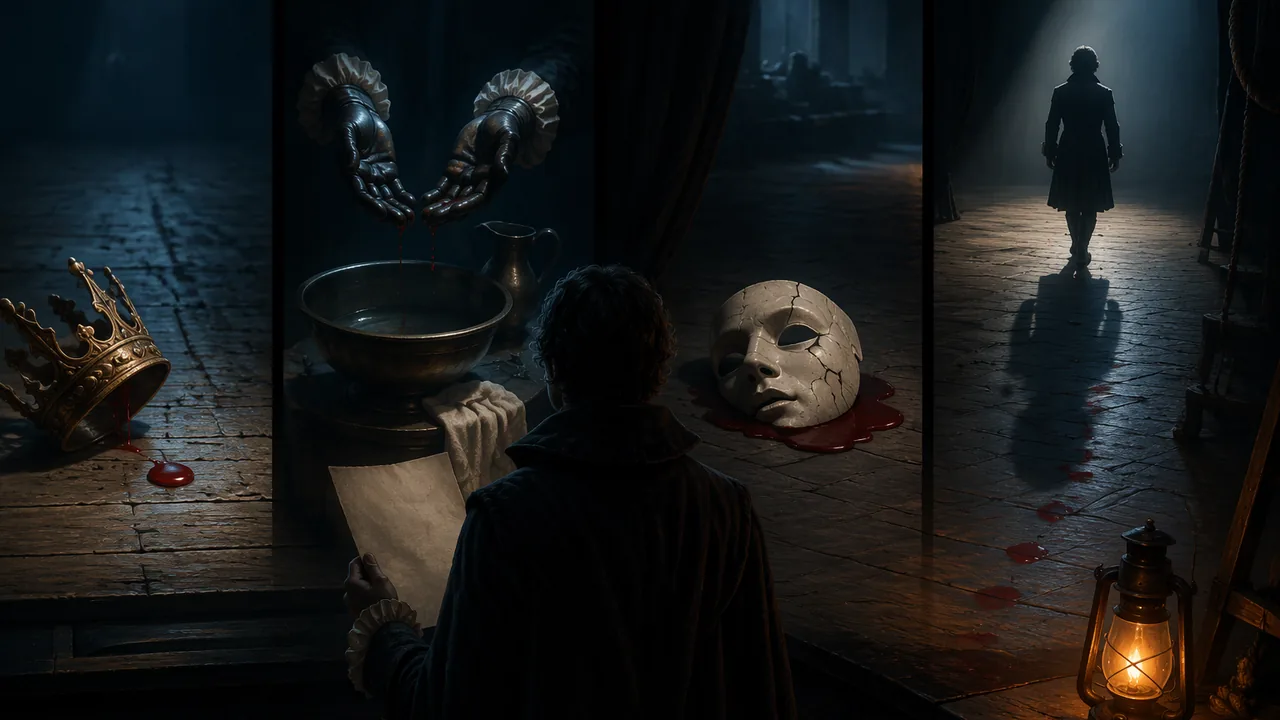
interpret a figure of speech in context, explain its role in the text, and trace how one repeated image changes meaning across a whole play.
Instruction
A figure of speech says one thing and means another, and asking what it means is only half the work. 9-10.RL.1.B / 9-10.RL.2.C asks you to interpret the figure and analyze its role — what it is doing at that point in the text, for that speaker, in front of that audience.
Four figures do most of the work in Macbeth.
Metaphor asserts an identity between unlike things. “Life’s but a walking shadow” (a line from near the end of the play, which you will reach in the unit’s last lesson) does not say life resembles a shadow; it says it is one. Notice the specific choice — a walking shadow, which is also stage vocabulary: an actor. Macbeth, near the end, describes life in the language of the theater he is standing in. The figure is doing more than expressing despair; it is telling the audience that the man has stopped believing his own actions were real.
Paradox is a statement that contradicts itself and is nonetheless true. The witches open the play with “Fair is foul, and foul is fair,” and Macbeth’s first line — spoken before he has met them — is “So foul and fair a day I have not seen.” The echo is the point: the play’s moral vocabulary is compromised before the plot starts, and the audience hears the compromise in a man who does not know he is quoting.
Personification gives human agency to what has none. Macbeth sees “pity, like a naked new-born babe, / Striding the blast.” Pity is not simply named; it is given a body, and a fragile one, riding a storm. The figure admits that pity is real and that it is helpless — which is exactly the state of Macbeth’s own conscience in that speech.
Motif is the one that requires reading the whole play. A motif is an image that recurs and changes, and the change is the argument.
Follow blood. You have now read its first two stages; the last two are previewed here from Acts III and V, and you will meet them in context later in the unit. In Act I it is heroic: the bleeding captain reports Macbeth “unseam’d” an enemy “from the nave to the chaps,” and the violence is praised. In Act II blood becomes evidence — “Will all great Neptune’s ocean wash this blood / Clean from my hand?” — and the question is not about stains but about whether an act can be undone. By Act III it is a medium Macbeth wades in: “I am in blood / Stepp’d in so far that, should I wade no more, / Returning were as tedious as go o’er.” By Act V it has become a hallucinated spot on Lady Macbeth’s hand that no one else can see, and it is on the hand of the character who said in Act II that “a little water clears us of this deed.”
Four appearances, four meanings: valor, guilt, commitment, madness. The word did not change. The play moved, and the image records the movement. That is what a motif is for, and tracing one is the single most reliable way to write about Shakespeare without retelling the plot.
The nuance half of 9-10.RL.1.B / 9-10.RL.2.C. Words also carry gradations. Ambitious, driven, ruthless and vaulting describe overlapping territory and judge it differently. When you write about Macbeth, the adjective you select is already an argument. Choose it on purpose.
📖 Before this lesson, read: Macbeth, Acts 1-2
The reading opens over the lesson; close it to come back to exactly where you were.
Reading: Figures of speech and motifs in Macbeth: contexts, mentors, a worked trace and a quotation bank
William Shakespeare, Macbeth (c. 1606), Globe text (Clark and Wright, 1864), via Open Source Shakespeare; Frederick Douglass, Narrative (1845), Chapter VII, via Project Gutenberg #23; Macbeth full text (Globe edition): https://www.opensourceshakespeare.org/views/plays/play_view.php?WorkID=macbeth&Scope=entire&pleasewait=1&msg=pl; retrieved 26 September 2026 · SLS original; quoted passages are public domain (Shakespeare, Macbeth, 1864 text; Douglass, Narrative, 1845)
Read the four figures aloud with their context first. Then read the blood trace once slowly before you begin your own.
Everything this lab asks you to work on is in front of you here: the figures named in the mini-lecture, in context; three mentor sentences from another public-domain writer; a worked trace of one motif; and a bank of quotations for the motifs you can choose for your own trace. Text is the Globe edition of Macbeth (Clark and Wright, 1864). Line numbers differ from edition to edition, so cite the act and scene from this page and take the line number from your own edition.
1. The four figures, in context
Metaphor (5.5), Macbeth after his wife’s death:
To-morrow, and to-morrow, and to-morrow,
Creeps in this petty pace from day to day
To the last syllable of recorded time,
And all our yesterdays have lighted fools
The way to dusty death. Out, out, brief candle!
Life’s but a walking shadow, a poor player
That struts and frets his hour upon the stage
And then is heard no more: it is a tale
Told by an idiot, full of sound and fury,
Signifying nothing.
Paradox (1.1, the witches; then 1.3, Macbeth’s first line, spoken before he has met them):
Fair is foul, and foul is fair:
Hover through the fog and filthy air.
So foul and fair a day I have not seen.
Personification (1.7, from the soliloquy you met in Lesson 1.1):
And pity, like a naked new-born babe,
Striding the blast, or heaven’s cherubim, horsed
Upon the sightless couriers of the air,
Shall blow the horrid deed in every eye,
To interpret each figure, ask three questions: what two things are set side by side, what does the pairing say that a plain statement would not, and what is the speaker doing by saying it at this moment?
2. Three mentor sentences (public domain)
Frederick Douglass, Narrative of the Life of Frederick Douglass (1845), Chapter VII. The three sentences describe what learning to read did to him.
The silver trump of freedom had roused my soul to eternal wakefulness.
It opened my eyes to the horrible pit, but to no ladder upon which to get out.
It looked from every star, it smiled in every calm, breathed in every wind, and moved in every storm.
The first names freedom as a trumpet that wakes a sleeper: a metaphor whose role is to explain why the awakening cannot be undone. The second is a metaphor built as a pair (pit and ladder), so the sentence itself contains the missing half: the sight is there, the way out is not. The third personifies freedom as something that looks, smiles, breathes and moves, and the repeated in every shows why there is no escape from it. In each case the figure does a job that the plain statement (“I could think of nothing else”) could not do.
3. A worked trace of one motif: blood (SLS original)
A motif trace has three parts for each appearance: the quotation, the meaning at that point, and what has changed since the last appearance. Here is the model, with one passage from each of four acts.
Act I, valor. A wounded captain praises Macbeth’s work on the battlefield (1.2):
Disdaining fortune, with his brandish’d steel,
Which smoked with bloody execution,
Like valour’s minion carved out his passage
Till he faced the slave;
Which ne’er shook hands, nor bade farewell to him,
Till he unseam’d him from the nave to the chaps,
And fix’d his head upon our battlements.
The blood is a sign of courage, and the language is admiring even though what it describes is savage. Nothing here is yet a stain.
Act II, guilt. Just after the murder (2.2):
Will all great Neptune’s ocean wash this blood
Clean from my hand? No, this my hand will rather
The multitudinous seas in incarnadine,
Making the green one red.
Blood has become something that cannot be washed off. The question is no longer about Duncan’s body but about whether the act can be undone, and the image grows until it colors the whole sea. In the same scene Lady Macbeth says the opposite (“A little water clears us of this deed”, 2.2), which sets up the reversal in Act V.
Act III, commitment. Macbeth to himself, deciding to go on (3.4):
All causes shall give way: I am in blood
Stepp’d in so far that, should I wade no more,
Returning were as tedious as go o’er:
Now blood is a river he has stepped into. He gives two reasons to continue, and both are about difficulty: turning back would be as hard as going forward. The image records that he no longer thinks the crime can be undone.
Act V, madness. Lady Macbeth, asleep and walking (5.1):
Out, damned spot! out, I say!—One: two: why, … account?—Yet who would have thought the old man to have had so much blood in him.
The blood only she can see is on the hand that once said water would clear it. The motif has come full circle. What was valor in Act I is now the thing that will not leave her.
Closing sentence (model): The change from valor to guilt to commitment to madness shows the play’s argument that an act done once is never finished with; it becomes the place the doer has to live.
4. Quotation bank for your own trace
Choose one motif below: sleep, clothing, darkness or children. Each has passages from at least three acts. Passages from Acts III to V preview scenes you will read in full later in the unit; you may use them now. Quote one line per act, say what the image means at that point, and close with one sentence on what the change records. The bank is enough to finish the exercise; you may also use any other passage from the complete play.
Sleep
Act II (2.2), Macbeth after the murder:
Methought I heard a voice cry ‘Sleep no more!
Macbeth does murder sleep’, the innocent sleep,
Sleep that knits up the ravell’d sleeve of care,
The death of each day’s life, sore labour’s bath,
Balm of hurt minds, great nature’s second course,
Chief nourisher in life’s feast,—
Act III (3.2), Macbeth of the murdered Duncan:
In restless ecstasy. Duncan is in his grave;
After life’s fitful fever he sleeps well;
Act V (5.1), the Doctor watching Lady Macbeth:
A great perturbation in nature, to receive at once the benefit of sleep, and do the effects of watching! In this slumbery agitation, besides her
Clothing
Act I (1.3), Banquo watching Macbeth take in the prophecy:
New horrors come upon him,
Like our strange garments, cleave not to their mould
But with the aid of use.
Act II (2.4), the Old Man to Ross, as the new king takes over:
Lest our old robes sit easier than our new!
Act V (5.2), a Scottish lord on the tyrant:
Nothing in love: now does he feel his title
Hang loose about him, like a giant’s robe
Upon a dwarfish thief.
Darkness
Act I (1.4), Macbeth, after Duncan names an heir:
For in my way it lies. Stars, hide your fires;
Let not light see my black and deep desires:
Act I (1.5), Lady Macbeth:
You wait on nature’s mischief! Come, thick night,
And pall thee in the dunnest smoke of hell,
That my keen knife see not the wound it makes,
Nor heaven peep through the blanket of the dark,
Act III (3.2), Macbeth before the second murder:
Till thou applaud the deed. Come, seeling night,
Scarf up the tender eye of pitiful day;
Children
Act I (1.7), Lady Macbeth in the persuasion scene:
Does unmake you. I have given suck, and know
How tender ’tis to love the babe that milks me:
I would, while it was smiling in my face,
Have pluck’d my nipple from his boneless gums,
And dash’d the brains out, had I so sworn as you
Act III (3.1), Macbeth alone, on the prophecy about Banquo:
Upon my head they placed a fruitless crown,
And put a barren sceptre in my gripe,
Thence to be wrench’d with an unlineal hand,
No son of mine succeeding. If ‘t be so,
Act IV (4.3), Macduff, told that his family is dead:
He has no children. All my pretty ones?
5. Choosing the adjective (SLS original)
The nuance half of the lab is about choosing among near-synonyms. These four words all describe how Macbeth wants the crown, and each passes a different judgment. Driven is close to neutral and implies a force pushing him. Ambitious is the ordinary word, mildly positive in general and negative in this play. Ruthless is a verdict on how he treats others and says nothing about why. Vaulting is his own word for it in 1.7, and the most self-critical, since a leap ends in a fall. A sentence that calls him driven excuses more than one that calls him ruthless. Choose the adjective that matches the claim you are making, and be ready to say why the closest neighbor would not do.
Formative check
Work through these before moving on. They are not graded — they tell you whether the standard below has landed yet.
“Life’s but a walking shadow, a poor player / That struts and frets his hour upon the stage.” What does the specific choice of theatrical vocabulary add beyond the general idea that life is brief?
Tracing the blood motif means listing every place the word “blood” appears in the play.
“Fair is foul, and foul is fair” is a , because it contradicts itself and is nonetheless true in this play; “pity, like a naked new-born babe” gives a human body to an abstraction and is therefore .
Trace one motif other than blood (sleep, clothing, darkness or children) using at least three passages from at least two acts; the quotation bank’s passages from later acts are previews you may use. Quote each with act-scene-line citation, state what the image means at that point, and close with one sentence naming what the change records about the play’s argument.
How confident are you that you can explain what a figure of speech is doing at a specific moment, not only what it means in general?
Macbeth, Acts 1-2
Macbeth, Acts 1-2 so far Bridge summary — not the primary text
A recap of what you have already read, written for this course, so the reading check below does not require re-opening every earlier popover.
In Act 1, three witches hail the victorious general Macbeth as future king, and when King Duncan names his son Malcolm heir and announces a visit to Macbeth’s castle, Lady Macbeth resolves that the king must die there; Macbeth argues himself out of the murder in a soliloquy, then lets his wife argue him back in. In Act 2, Macbeth follows an imagined dagger to Duncan’s chamber and kills him offstage, and Lady Macbeth returns the daggers and smears the drugged grooms with blood. At dawn Macduff discovers the body, Macbeth kills the grooms, Duncan’s sons flee, and Macbeth is named king.