write and publish a 900-1,200 word narrative of a turning point using scene, selection and ordering deliberately, and defend three pieces from across the year as evidence of my development.
Instruction
This is the capstone of English 9B and of the Grade 9 sequence. It asks you to use, in your own writing, the techniques you have spent two semesters analyzing in other people’s.
Piece 1 — Multimodal identity narrative, 900-1,200 words. Write a turning point in your own experience: a moment after which something was different. It may be small. The Douglass Narrative‘s turning point is a sentence he overhears his master say to his mistress.
Four requirements, each traceable to a lesson:
- Selection over assertion (4.1). Do not tell the reader what the moment meant. Choose what to include so that they arrive there.
- Scene where it matters, summary where it does not (4.1). At least one full scene slowed to near real time, and at least one stretch of months or years covered in a clause. The contrast must be deliberate.
- Telling detail and non-visual sensory language (2.4). The camera test applies throughout.
- An ordering that produces meaning (4.1). You may proceed chronologically, but if you do, be able to say why that is the right order rather than the default one.
If writing about your own experience is not something you want to do, an imagined narrative clearly labeled as such is equally acceptable and is assessed identically. Tell your instructor which you are submitting. You are never required to disclose anything.
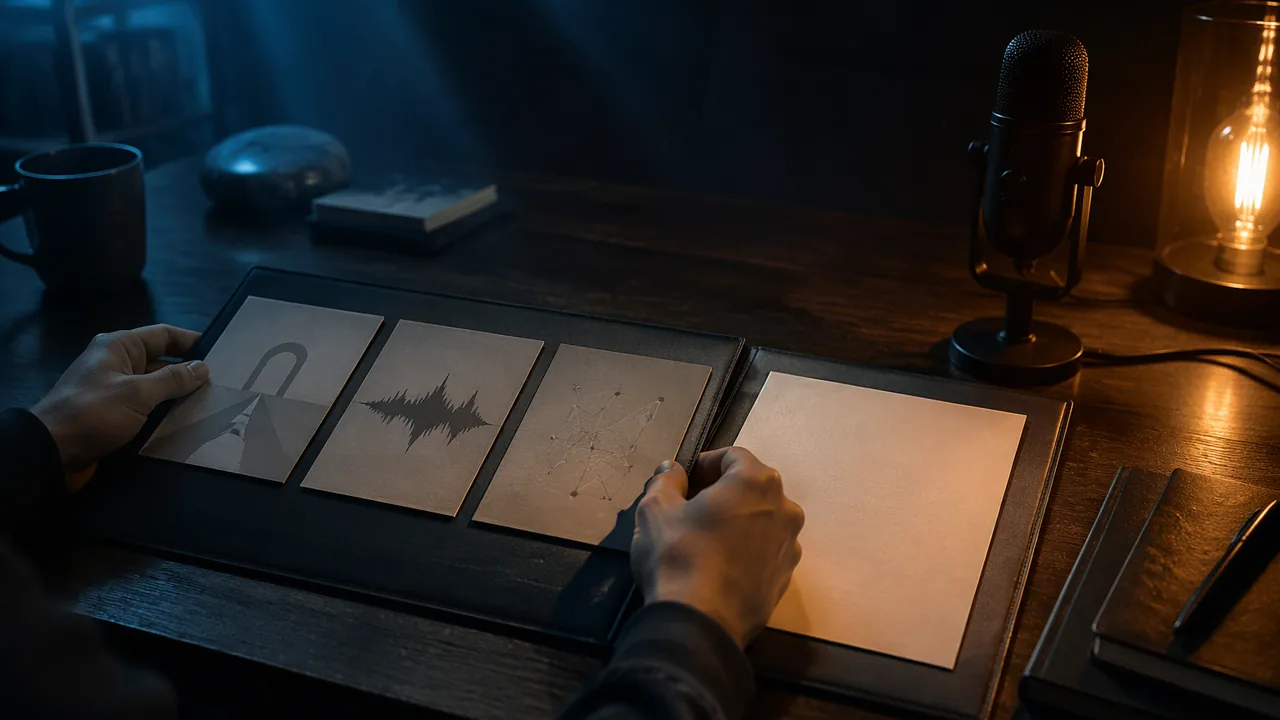
Publication (9-10.W.3.A.e). Publish to your course portfolio with at least one purposeful non-text element — image, audio, diagram or short video — that carries meaning the prose does not repeat. Apply the eyes-shut test from Lesson 4.4 in reverse: if you removed the prose, what would the element still say? If the answer is nothing, it is decoration.
Piece 2 — Craft commentary, 300 words. Name three structural decisions — what you put in scene, what you compressed, where you started, where you stopped, what you left out — and the effect intended by each. Decisions, not features. This is where the semester’s analytical work has to show up in your own voice.
Piece 3 — Revision log, complete, from Lesson 4.6.
The portfolio defense (9-10.SL.2.A / 9-10.SL.2.B / 9-10.SL.2.C), four minutes. Select three pieces from across English 9A and 9B. For each, say what it demonstrates about your development as a reader or a writer, and name one thing you would now do differently. Then answer one instructor question about a specific choice. Preparation for the question matters more than the selection: you are being assessed on whether you can account for your own decisions, which is the same skill the craft commentary asks for, under live conditions.
A student who prefers not to record may deliver the defense live in a scheduled session; both routes earn full credit, and both require the same preparation.
Academic honesty. The narrative must be yours — written by you, about experience you select, real or clearly labeled as imagined. This is the assignment where text generated by a language model is both easiest to detect and least defensible, because the craft commentary and the live defense both ask you to account for choices, and choices you did not make cannot be accounted for.
📖 Before this lesson, read: Narrative of the Life of Frederick Douglass, Chapters 10-11 and Appendix
The reading opens over the lesson; close it to come back to exactly where you were.
Reading: Key assignment set: the prompt, Douglass passages by chapter, a four-level rubric, a model narrative excerpt, log, media element and defense plan
Frederick Douglass, Narrative of the Life of Frederick Douglass, an American Slave (1845), Project Gutenberg #23, retrieved 26 September 2026 · SLS original; quoted passages are public domain (Douglass, 1845); the model narrative is imagined and SLS original
Use the passages to study selection, scene and summary before you plan your own piece. The prompt restatement, rubric, model narrative, commentary, log, media element and defense plan are written by SLS; the passages are copied from the Narrative.
This assignment refers to a prompt, passages to study, a rubric and a model. This reading puts all of them in one place: the prompt and its requirements, the passages of the Narrative that show selection, scene, summary and order at work (each located by chapter), the rubric at four levels, a model narrative excerpt with its craft commentary, a sample revision log, a description of a purposeful media element, and a plan for the portfolio defense with sample questions. The model is written by SLS about an imagined event and is labeled as such.
1. The prompt
Narrative, 900 to 1,200 words. Write a turning point in your own experience: a moment after which something was different. It may be small. If writing about your own experience is not something you want to do, an imagined narrative clearly labeled as such is equally acceptable and is assessed identically. You are never required to disclose anything.
- Selection over assertion. Do not tell the reader what the moment meant. Choose what to include so that they arrive there.
- Scene where it matters, summary where it does not. At least one full scene slowed to near real time, and at least one stretch of months or years covered in a clause. The contrast must be deliberate.
- Telling detail and non-visual sensory language. The camera test applies throughout.
- An ordering that produces meaning. You may proceed chronologically, but you must be able to say why that order and not another.
- Publication. Publish to your portfolio with at least one purposeful non-text element (image, audio, diagram or short video) that carries meaning the prose does not repeat.
Craft commentary, 300 words naming three structural decisions and the effect intended by each. Revision log, complete. Portfolio defense, four minutes: three pieces from English 9A and 9B, what each demonstrates, one thing you would now do differently, and one instructor question answered.
2. Passages that show the techniques (Douglass, Narrative, 1845)
Summary, years in a sentence (Chapter VII).
I lived in Master Hugh’s family about seven years. During this time, I succeeded in learning to read and write. In accomplishing this, I was compelled to resort to various stratagems.
Scene, a moment of understanding (Chapter VI).
I now understood what had been to me a most perplexing difficulty—to wit, the white man’s power to enslave the black man. It was a grand achievement, and I prized it highly. From that moment, I understood the pathway from slavery to freedom.
Scene and turning point (Chapter X). The passage that follows the fight with Covey names what it changed.
This battle with Mr. Covey was the turning-point in my career as a slave. It rekindled the few expiring embers of freedom, and revived within me a sense of my own manhood. It recalled the departed self-confidence, and inspired me again with a determination to be free. The gratification afforded by the triumph was a full compensation for whatever else might follow, even death itself. He only can understand the deep satisfaction which I experienced, who has himself repelled by force the bloody arm of slavery. I felt as I never felt before. It was a glorious resurrection, from the tomb of slavery, to the heaven of freedom. My long-crushed spirit rose, cowardice departed, bold defiance took its place; and I now resolved that, however long I might remain a slave in form, the day had passed forever when I could be a slave in fact.
Selection and refusal (Chapter XI). What he chooses not to tell:
I now come to that part of my life during which I planned, and finally succeeded in making, my escape from slavery. But before narrating any of the peculiar circumstances, I deem it proper to make known my intention not to state all the facts connected with the transaction. My reasons for pursuing this course may be understood from the following: First, were I to give a minute statement of all the facts, it is not only possible, but quite probable, that others would thereby be involved in the most embarrassing difficulties. Secondly, such a statement would most undoubtedly induce greater vigilance on the part of slaveholders than has existed heretofore among them; which would, of course, be the means of guarding a door whereby some dear brother bondman might escape his galling chains.
And what he tells in its place:
on the third day of September, 1838, I left my chains, and succeeded in reaching New York without the slightest interruption of any kind. How I did so,—what means I adopted,—what direction I travelled, and by what mode of conveyance,—I must leave unexplained, for the reasons before mentioned.
Douglass, Narrative (1845), Project Gutenberg eBook #23, retrieved 26 September 2026.
3. The rubric at four levels (SLS original)
| Criterion | 4 Exemplary | 3 Proficient | 2 Developing | 1 Beginning |
|---|---|---|---|---|
| Selection over assertion (9-10.W.2.A) | The reader reaches the meaning; nothing announces it. | Mostly implied; one sentence states the meaning. | The meaning is stated near the end. | The narrative is a statement of what was learned. |
| Scene and summary | At least one full scene and one deliberate compression, and the contrast is doing work. | Both present; the contrast is less deliberate. | Mostly summary or mostly scene. | No contrast. |
| Craft of detail (9-10.W.2.A) | Details pass the camera test; a non-visual detail; verbs carry the mood without adverbs. | Mostly concrete; one non-visual detail. | General description; visual only. | Judgments in place of details. |
| Ordering (9-10.RI.2.A) | The order produces meaning and the writer can say why this order. | A purposeful order; the reason is thin. | Chronological by default. | Confused order. |
| Media element (9-10.W.3.A.e, 9-10.SL.2.C) | Carries meaning the prose does not repeat; survives the eyes-shut test in both directions. | Adds meaning; partly repeats the prose. | Illustrates the prose. | Decoration. |
| Craft commentary (9-10.W.3.A) | Three decisions, each with the effect intended. | Three decisions; one effect vague. | Features named, not decisions. | Summarizes the story. |
| Portfolio defense (9-10.SL.2.A / 9-10.SL.2.B / 9-10.SL.2.C) | Accounts for three pieces, names one thing to do differently, and answers a live question about a specific choice. | Accounts for three pieces; the answer is general. | Describes the pieces without accounting for choices. | Cannot account for choices. |
4. A model narrative excerpt (imagined; SLS original)
This is an imagined narrative, written by SLS, and it is not attributed to any student or author. It is about 408 words: the opening scene and the compression. A full piece would be 900 to 1,200 words. Its order begins the morning after and goes back to the night before.
The morning after, the ferry ran late, and nobody said why.
I stood at the rail with my thermos and watched the harbor come up out of the fog in pieces: a piling, a gull, the orange side of a buoy. My father was in the wheelhouse with his back to me, as he was every morning, and I looked at his back the way you look at a house you are about to leave.
The night before, I had come down for water and heard the kitchen. Not voices. The scrape of a chair moved to a different place, and the small noise of a pen. I stopped on the third stair, where the wood gives, and did not put my weight on it. Through the rails I could see the table: the lamp pulled down low, my mother with her hands flat on a paper, my father across from her with his cap on the table between them, crown down, the way he never puts it. The paper had a company’s name across the top in blue. I could read the name. I could not read the number, and I understood that was the point of the number.
“Two seasons,” my father said.
“Two seasons you said last year,” my mother said.
He picked up the pen and put it down.
I went up without the water.
For nine years before that, the ferry had been the shape of every day. We had the six o’clock run and the nine and the long afternoon, the winters when the ice came in and he broke a lane by hand, the summers I stood at the rail and sold tickets to people who called me sweetheart. I could have told you the color of the water at any hour. I could not have told you what the ferry cost.
At the far pier he cut the engine and let her drift in. This is the part I still remember exactly: the rope, wet and heavy in my hands, and the cleat, and the little jolt as the line came taut. He came out of the wheelhouse to check my knot. He always checked my knot. He looked at it a while, though it was a good knot, and then he put his hand flat on the rail beside mine, not touching, and left it there.
“Tide’s turning,” he said.
We both looked at the water, which was not.
5. Craft commentary for the model (SLS original)
I made three decisions. First, where I started: on the morning after, not in the kitchen. The reader arrives already inside the aftermath and is then taken back to what caused it. What it costs is the suspense of not knowing; what it gains is a narrator who is already looking at her father’s back as a person looks at a house she is about to leave. Second, scene against summary: the kitchen is told almost in real time (the third stair, the cap crown down, the pen), while nine years fit in one paragraph that begins “For nine years.” The ratio does what a sentence about how much the ferry mattered could not: the reader feels the weight by watching how little space the years take and how much space the night takes. Third, what I left out: the number on the paper, and anything my father says later. The narrator can read the company’s name and not the number, so the reader shares her not-knowing. I let the last line stay unsaid, with the water not turning, so that no sentence tells the reader what the moment meant.
6. A sample revision log (SLS original)
- Stage 1: Wrote the excerpt in one sitting from the night-before scene; no editing.
- Stage 2: Moved the first line to the morning after because the scene already felt like an aftermath.
- Stage 2: Cut “which made me feel scared” after “the way you look at a house you are about to leave”, since the image already says it.
- Stage 3: Changed “walked up the stairs” to “went up without the water” so the missing water carries the feeling.
- Stage 3: Cut the final sentence of reflection and ended on the water.
7. A purposeful non-text element (SLS original)
The element. A strip of two bars: one labeled “nine years,” drawn narrow because it takes one paragraph of the story, and one labeled “one night,” drawn wide because it takes the whole scene, so that the width shows how much space each takes in the telling.
Eyes-shut test in both directions. With the strip removed, the reader loses the proportion that the prose never states numerically. With the prose removed, the strip still says that most of the weight sits on a small stretch of time. Since the strip says something with the words gone, it is not decoration.
8. The portfolio defense (SLS original)
Structure, four minutes. For each of three pieces, one minute: what it shows about you as a reader or a writer, and one thing you would do differently. The last minute is a live question about one choice.
An illustrative choice of three pieces. (1) A 9A essay: it shows that I could organize an argument, but I summarized before I analyzed; I would now start each paragraph with a claim about how the text works. (2) The 9B poem explication: it shows that I can run a substitution test; I would now name the least secure line earlier. (3) The capstone narrative: it shows that I can use scene against summary; I would now cut a reflective sentence I still left in.
Questions that may be asked (prepare for these):
- Why did you start where you did, and what would change if you started somewhere else?
- Which line in your revision log records your most important decision, and why?
- What does your non-text element say that your prose does not?
A model answer to the first (SLS original). “I started the morning after because I wanted the reader to look at the aftermath before knowing its cause. If I had started in the kitchen, the reader would be waiting for a decision, and my narrator would be a witness to it. Starting later makes her a person who already knows something and is not saying. I could see myself trying the kitchen first in a revision, but I would then have to find a different first image.”
Formative check
Work through these before moving on. They are not graded — they tell you whether the standard below has landed yet.
scene vs. summary
Tap to revealReal-time narration against a stretch of time in a clause; the contrast is a structural decision.
selection over assertion
Tap to revealChoosing what to include so the reader arrives at the meaning rather than being told it.
strategic media
Tap to revealA media element whose removal would cost the audience information.
generating vs. revising
Tap to revealProducing text without judging it, against improving text that exists — never both at once.
revision log
Tap to revealA specific record of what changed and why, making revision a repeatable skill.
Your narrative ends: “That was the day I learned that I was stronger than I thought.” What is the problem, and the fix?
How confident are you that you can account for three structural decisions in my own writing and the effect each was meant to have?
Submit: Multimodal Identity Narrative (900-1,200 words) + Portfolio Defense
Task: Write and publish a narrative of a turning point, using selection, scene-and-summary contrast, telling detail and deliberate ordering. Add one purposeful non-text element, a 300-word craft commentary and your revision log. Then defend three pieces from across the year.
Stages open in sequence and are scored separately.
Submission workflow
- Stage 1 — Four timed pieces, revision log and 400-500 word narrative draft. From Lesson 4.6.
- Stage 2 — Peer-reviewed draft (700+ words) + media plan. Upload, peer-review two classmates including the eyes-shut test on their media element, then submit a revision note naming one specific change and the feedback behind it.
- Stage 3 — Final narrative (900-1,200 words) published to the portfolio with its non-text element, plus the 300-word craft commentary and the complete revision log.
- Stage 4 — Portfolio defense (4 minutes): three pieces from 9A and 9B, what each demonstrates, one thing you would now do differently, and one instructor question answered. Live delivery in a scheduled session is an equal-credit alternative.
How it is scored
| Criterion | What proficient looks like |
|---|---|
| Selection over assertion (9-10.W.2.A) | The reader arrives at the meaning; the narrative does not announce it. |
| Scene and summary (9-10.RI.2.A, 9-10.W.2.A) | At least one full scene and one deliberate compression, and the contrast does work. |
| Craft of detail (9-10.W.2.A) | Telling detail passes the camera test; at least one non-visual sensory detail; verbs carry the mood without adverbs propping them. |
| Ordering (9-10.RI.2.A) | The sequence produces meaning, and the writer can say why this order rather than the default. |
| Media element (9-10.W.3.A.e, 9-10.SL.2.C) | Carries meaning the prose does not repeat; survives the eyes-shut test; published to the portfolio. |
| Craft commentary (9-10.W.3.A) | Three structural decisions named with the effect intended by each — decisions, not features. |
| Portfolio defense (9-10.SL.2.A / 9-10.SL.2.B / 9-10.SL.2.C) | Accounts for three pieces as evidence of development, names one thing to do differently, and answers a live question about a specific choice. |
Narrative of the Life of Frederick Douglass, Chapters 10-11 and Appendix
Narrative of the Life of Frederick Douglass, Chapters 10-11 and Appendix so far Bridge summary — not the primary text
A recap of what you have already read, written for this course, so the reading check below does not require re-opening every earlier popover.
Chapter 10 moves from Douglass’s year of being “broken” by Edward Covey to the fight that restores him, then through a year at William Freeland’s, a betrayed escape plot, jail, and his return to Baltimore as a wage-earning caulker. Chapter 11 withholds how he escaped, to protect others, and follows him from his arrival in New York on September 3, 1838, through his marriage, his new name in New Bedford and his first antislavery speech at Nantucket in 1841. In the Appendix, Douglass answers readers who might think him an enemy of all religion by distinguishing “the Christianity of this land” from “the Christianity of Christ.”