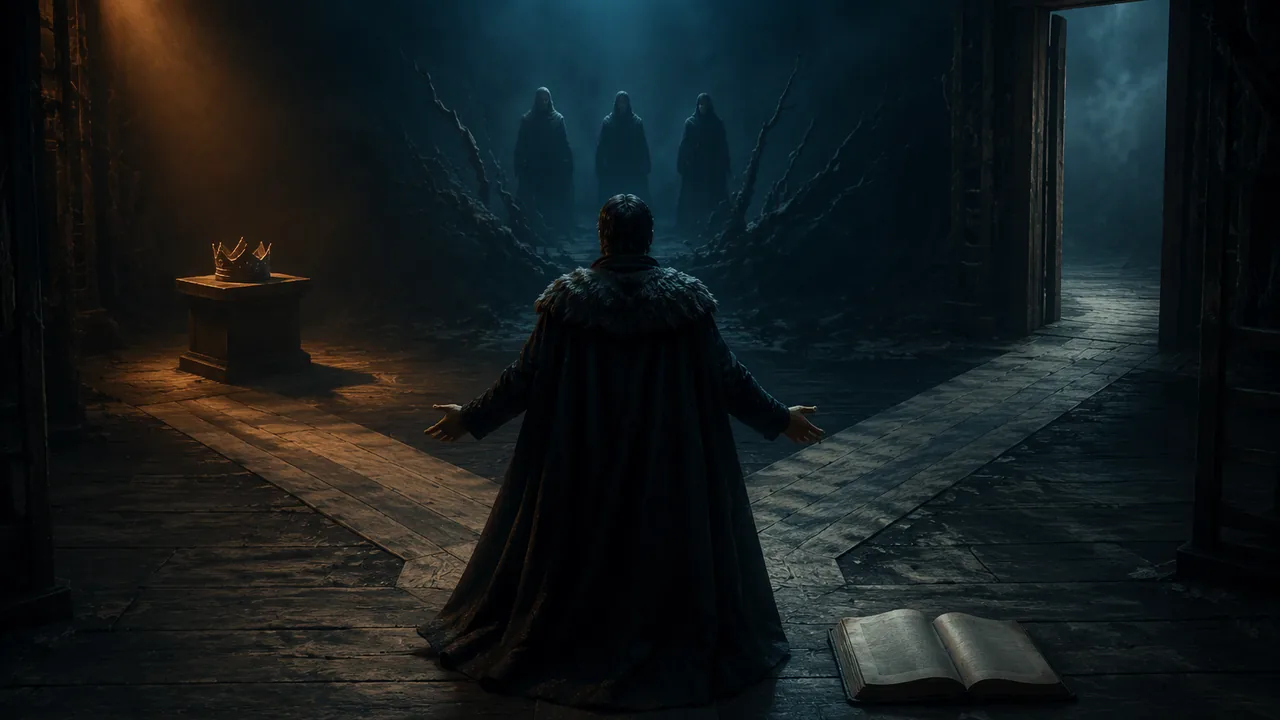
produce an 800-1,000 word analytical essay on whether Macbeth’s fall is chosen or determined, analyzing at least one soliloquy in detail, and defend one scene aloud as the play’s turning point.
Instruction
This is the unit’s summative assessment and the first of the semester’s four formal pieces. Read the whole page before drafting.
Finish the play first. Act 5, scenes 5 to 8, is assigned above. These scenes test every reading of agency you have built: Macbeth hears of his wife’s death, learns that Birnam Wood is moving, and finds out what “none of woman born” really meant. Read them before you draft, and notice which of his last choices are still his own.
The prompt. Does Shakespeare present Macbeth’s fall as chosen or as determined? Take a position on how the prophecies, Lady Macbeth’s pressure and Macbeth’s own ambition each contribute, and argue one reading. You are not being asked to conclude that it is a bit of both — that answer is available to everyone and costs nothing.
Requirements. 800-1,000 words. A thesis with Shakespeare as its subject, naming a choice and asserting its effect. Three to four body paragraphs organized around the playwright’s choices, not around plot order. At least one soliloquy analyzed in detail — not quoted in passing, but taken apart: where it falls in the action, what the audience gains from it, how its figurative language works. At least five quotations, verse formatted with line breaks and cited by act, scene and line. One paragraph that takes seriously the strongest scene against your reading: determinist readings must handle the Act I scene vii soliloquy in which Macbeth talks himself out of the murder; choice-based readings must handle the dagger and the witches’ final equivocations. A conclusion that says what the reading lets an audience see.
The oral component. Record a two-minute defense of one scene as the play’s true turning point. Name the scene, say what becomes irreversible there, and answer the obvious objection — usually that the murder itself or the final battle is the more natural candidate. You are assessed on adapting speech to an academic context: formal register, emphasis where your own argument places it. Supply a transcript. A student who prefers not to record may deliver live to the instructor in a scheduled session; both routes earn full credit.
Academic honesty. The analysis must be yours. The play is the only text you may reproduce, and quotations must be marked and cited. Text generated by a language model may not appear in the essay.
📖 Before this lesson, read: Macbeth, Act 5, Scenes 5-8
The reading opens over the lesson; close it to come back to exactly where you were.
Reading: Key Assignment: the prompt, key passages, a four-level rubric and models for the tragic agency essay
William Shakespeare, Macbeth (c. 1606), Globe text (Clark and Wright, 1864), via Open Source Shakespeare; Macbeth full text (Globe edition): https://www.opensourceshakespeare.org/views/plays/play_view.php?WorkID=macbeth&Scope=entire&pleasewait=1&msg=pl; retrieved 26 September 2026 · SLS original; quoted passages are public domain (Shakespeare, Macbeth, 1864 text)
Read the whole page before you draft. The passages are a starting point; the whole play is open to you.
This is the full assignment on one page: the prompt, the passages it draws on (located by act and scene), the four-level rubric, and models of the thesis, an outline, one body paragraph and the recorded defense. The text is the Globe edition (Clark and Wright, 1864). The models are SLS original and are there to show the moves, not to be copied.
1. The prompt
Does Shakespeare present Macbeth’s fall as chosen or as determined? Take one position on how much the prophecies, Lady Macbeth’s pressure and Macbeth’s own ambition contribute. Write 800 to 1,000 words, organized around Shakespeare’s choices rather than the order of events. Analyze at least one soliloquy in detail. Quote verse with line breaks kept, cited by act, scene and line (Lesson 1.6). Handle the strongest scene against your reading: a determinist reading must handle Macbeth’s reasoning in 1.7, and a choice-based reading must handle the dagger and the witches’ equivocations. After the final draft, record a two-minute defense of one scene as the play’s turning point, with a transcript.
2. Passages the prompt draws on
The prophecy (1.3):
First Witch. All hail, Macbeth! hail to thee, thane of Glamis!
Second Witch. All hail, Macbeth, hail to thee, thane of Cawdor!
Third Witch. All hail, Macbeth, thou shalt be king hereafter!
The first thought of the crown (1.3, an aside):
If chance will have me king, why, chance may crown me,
Without my stir.
The soliloquy where Macbeth argues himself out of the murder (1.7, lines 25 to 28; the full text is in Lesson 1.1):
That tears shall drown the wind. I have no spur
To prick the sides of my intent, but only
Vaulting ambition, which o’erleaps itself
And falls on the other.
Lady Macbeth and his answer (1.7):
But screw your courage to the sticking-place,
And we’ll not fail. When Duncan is asleep—
I am settled, and bend up
Each corporal agent to this terrible feat.
The dagger (2.1):
Thou marshall’st me the way that I was going;
And such an instrument I was to use.
The second murder, decided alone (3.1):
For Banquo’s issue have I filed my mind;
For them the gracious Duncan have I murder’d;
Put rancours in the vessel of my peace
Action outrunning thought (4.1):
Time, thou anticipatest my dread exploits:
The flighty purpose never is o’ertook
Unless the deed go with it; from this moment
The very firstlings of my heart shall be
The firstlings of my hand. And even now,
The witches’ equivocation, as promised (4.1) and as delivered (5.5 and 5.8):
Be bloody, bold, and resolute; laugh to scorn
The power of man, for none of woman born
Shall harm Macbeth.
I pull in resolution, and begin
To doubt the equivocation of the fiend
That lies like truth: ‘Fear not, till Birnam wood
I bear a charmed life, which must not yield,
To one of woman born.
Tell thee, Macduff was from his mother’s womb
Untimely ripp’d.
The whole play is open to you; you are not limited to this list.
3. The rubric at four levels
| Criterion | Not yet | Approaching | Proficient | Advanced |
|---|---|---|---|---|
| Thesis (9-10.W.2.A) | Describes the plot or says the play is about fate. | Takes a side, but the subject is a character and no choice is named. | Takes a position on agency, with Shakespeare as subject, naming a choice and its effect. | As Proficient, and the thesis holds and deepens across the essay rather than repeating. |
| Soliloquy analysis (9-10.RL.2.A, 9-10.RL.1.B, 9-10.RL.2.C) | Quoted in passing. | Summarizes what the soliloquy says. | Analyzes placement, what the audience gains, and how a figure works. | As Proficient, and shows what changes if the soliloquy is moved or cut. |
| Character as construction (9-10.RL.2.D) | Treats Macbeth as a real person. | Mixes both, with the playwright appearing only sometimes. | Analyzes how Shakespeare develops Macbeth across five acts. | As Proficient, using pattern (a motif, a recurring structure) as evidence. |
| Counter-scene (9-10.W.2.A) | Ignored. | Named, but dismissed in a sentence. | Handled honestly, explaining why the reading survives it. | As Proficient, and the counter-scene sharpens the thesis. |
| Verse conventions (9-10.W.3.A.b) | Prose-style quotation, no line numbers. | Some slashes or blocks; citations inconsistent. | Line breaks kept, act.scene.line, edition named. | As Proficient, and the quotations are trimmed to the words that carry the argument. |
| Scene defense (9-10.SL.2.A, 9-10.SL.2.B, 9-10.SL.2.C) | Retells the scene. | Names a scene and one reason. | Names what becomes irreversible, answers the obvious objection, in formal register with a transcript. | As Proficient, and the answer to the objection changes what the listener thinks. |
4. Models (SLS original)
Model thesis (a choice-based reading). Shakespeare gives Macbeth the strongest reasons against the murder in the play and then has him act anyway, so the prophecies tempt but do not decide, and the fall belongs to Macbeth.
Model outline.
- The prophecy is an invitation, not an order. Shakespeare lets Macbeth think of a way out even while he hears the prophecy (chance may crown me, without my stir, 1.3).
- The central soliloquy withholds every reason except ambition. The soliloquy in 1.7 lists the arguments against the murder, ends by calling ambition a fault, and is then followed by his wife’s entrance.
- Lady Macbeth supplies pressure, not motive. She attacks his courage; he says I am settled.
- The strongest scene against the reading: the dagger. Argue that the vision follows the decision, and records the way Macbeth talks himself forward.
- Later murders are chosen without the prophecy’s help. Banquo (3.1) and Macduff’s family (4.1) are killed on Macbeth’s own initiative.
Model body paragraph (about 170 words). Shakespeare places the play’s central soliloquy at the last moment when the murder can still be refused, and fills it with reasons for refusing. Macbeth argues that consequences return to the doer, that he owes Duncan as kinsman, subject and host, and that Duncan’s virtues will “plead like angels” against him. Only in the closing lines does he find a reason to go on, and it is one he criticizes in the same breath: “I have no spur / To prick the sides of my intent, but only / Vaulting ambition” (1.7.25-27). Shakespeare thereby gives the audience access to a mind that has already refused the crime by the time his wife enters. The figure matters: a spur pricks a horse and a vault overshoots its landing, so ambition is presented as a rider without a reason and a leap that must fall. The scene is not the story of a man forced toward murder. It is the record of a man who has taken away every excuse and will act without one.
Model recorded defense (about two minutes, from a transcript). “I am arguing that the turning point is Act One, scene seven, not the murder and not the last battle. The murder is the obvious choice, and I will answer it first: the murder is what follows from the turn, not the turn itself. In scene seven Macbeth is alone. He gives himself every reason not to kill Duncan and then admits that only ambition is left. That is the moment when the play’s question changes. Before, it asks whether he will be tempted. After, it asks what a man does who knows he has no excuse. What becomes irreversible is not a death but a self-knowledge: from here on, nothing that happens to him can be blamed on the witches, because he has already told us what he thinks of his own reasons. Look at his last line in the scene, I am settled. That is a decision, spoken plainly. Everything after it, the dagger, the banquet, the second and third murders, follows a decision the play has already shown us being made.”
Formative check
Work through these before moving on. They are not graded — they tell you whether the standard below has landed yet.
soliloquy
Tap to revealA speech alone on stage giving the audience access to a character’s interior.
paradox
Tap to revealA self-contradictory statement that is nonetheless true — “Fair is foul, and foul is fair.”
motif
Tap to revealA recurring image whose meaning changes across a work.
equivocation
Tap to revealSaying something true in a form designed to mislead.
catastrophe
Tap to revealThe final movement of a tragedy, in which consequences arrive.
A determinist reading argues the witches cause Macbeth’s fall. Which scene is the hardest for that reading to absorb?
How confident are you that you can analyze a soliloquy in detail — placement, audience access, figurative language — rather than quoting it in passing?
Submit: Tragic Agency Analytical Essay (800-1,000 words) + Scene Defense
Prompt: Does Shakespeare present Macbeth’s fall as chosen or as determined? Argue one reading, analyze at least one soliloquy in detail, and handle the strongest scene against you.
Stages open in sequence and are scored separately.
Submission workflow
- Stage 1 — Thesis & evidence organizer. From Lesson 1.6: thesis with Shakespeare as subject, five correctly formatted verse quotations, one counter-quotation, four topic sentences.
- Stage 2 — Peer-reviewed rough draft (600+ words). Upload, peer-review two classmates, then submit a revision note naming one specific change and the feedback behind it.
- Stage 3 — Final revised essay (800-1,000 words) + Works Cited naming your edition. MLA, PDF.
- Stage 4 — Recorded scene defense (2 minutes) with transcript. Live delivery in a scheduled session is an equal-credit alternative.
How it is scored
| Criterion | What proficient looks like |
|---|---|
| Thesis (9-10.W.2.A) | Takes a position on agency; Shakespeare is the subject; names a choice and asserts an effect; holds across the essay. |
| Soliloquy analysis (9-10.RL.2.A, 9-10.RL.1.B, 9-10.RL.2.C) | One soliloquy taken apart — placement, what the audience gains, how its figurative language works — not quoted in passing. |
| Character as construction (9-10.RL.2.D, 9-10.RL.1.A) | Analyzes how Shakespeare develops Macbeth across five acts rather than speculating about him as a person. |
| Counter-scene (9-10.W.2.A) | Handles the strongest scene against the reading honestly and explains why the reading survives it. |
| Verse conventions (9-10.W.3.A.b) | Line breaks preserved, spaced slashes or block format, act-scene-line citation, edition named in Works Cited. |
| Scene defense (9-10.SL.2.A, 9-10.SL.2.B, 9-10.SL.2.C) | Names what becomes irreversible; answers the obvious objection; formal register with a transcript supplied. |
Macbeth, Act 5, Scenes 5-8
Macbeth, Act 5, Scene 5: Dunsinane. Within the castle.
Source: William Shakespeare, Macbeth (c. 1606), Project Gutenberg eBook #1533 (gutenberg.org) · Public domain
Enter with drum and colours, Macbeth, Seyton and Soldiers.
MACBETH.
Hang out our banners on the outward walls;
The cry is still, “They come!” Our castle’s strength
Will laugh a siege to scorn: here let them lie
Till famine and the ague eat them up.
Were they not forc’d with those that should be ours,
We might have met them dareful, beard to beard,
And beat them backward home.
[A cry of women within.]
What is that noise?
SEYTON.
It is the cry of women, my good lord.
[Exit.]
MACBETH.
I have almost forgot the taste of fears.
The time has been, my senses would have cool’d
To hear a night-shriek; and my fell of hair
Would at a dismal treatise rouse and stir
As life were in’t. I have supp’d full with horrors;
Direness, familiar to my slaughterous thoughts,
Cannot once start me.
Enter Seyton.
Wherefore was that cry?
SEYTON.
The Queen, my lord, is dead.
MACBETH.
She should have died hereafter.
There would have been a time for such a word.
Tomorrow, and tomorrow, and tomorrow,
Creeps in this petty pace from day to day,
To the last syllable of recorded time;
And all our yesterdays have lighted fools
The way to dusty death. Out, out, brief candle!
Life’s but a walking shadow; a poor player,
That struts and frets his hour upon the stage,
And then is heard no more: it is a tale
Told by an idiot, full of sound and fury,
Signifying nothing.
Enter a Messenger.
Thou com’st to use thy tongue; thy story quickly.
MESSENGER.
Gracious my lord,
I should report that which I say I saw,
But know not how to do’t.
MACBETH.
Well, say, sir.
MESSENGER.
As I did stand my watch upon the hill,
I look’d toward Birnam, and anon, methought,
The wood began to move.
MACBETH.
Liar, and slave!
MESSENGER.
Let me endure your wrath, if’t be not so.
Within this three mile may you see it coming;
I say, a moving grove.
MACBETH.
If thou speak’st false,
Upon the next tree shalt thou hang alive,
Till famine cling thee: if thy speech be sooth,
I care not if thou dost for me as much.—
I pull in resolution; and begin
To doubt th’ equivocation of the fiend,
That lies like truth. “Fear not, till Birnam wood
Do come to Dunsinane;” and now a wood
Comes toward Dunsinane.—Arm, arm, and out!—
If this which he avouches does appear,
There is nor flying hence nor tarrying here.
I ’gin to be aweary of the sun,
And wish th’ estate o’ th’ world were now undone.—
Ring the alarum bell!—Blow, wind! come, wrack!
At least we’ll die with harness on our back.
[Exeunt.]
Macbeth, Act 5, Scene 6: The same. A Plain before the Castle. Bridge summary — not the primary text
This is a short recap written for this course, not William Shakespeare’s own words, so you can follow the story between close-reading lessons.
{summary}Macbeth, Act 5, Scene 7: The same. Another part of the Plain. Bridge summary — not the primary text
This is a short recap written for this course, not William Shakespeare’s own words, so you can follow the story between close-reading lessons.
{summary}Macbeth, Act 5, Scene 8: The same. Another part of the field.
Source: William Shakespeare, Macbeth (c. 1606), Project Gutenberg eBook #1533 (gutenberg.org) · Public domain
Enter Macbeth.
MACBETH.
Why should I play the Roman fool, and die
On mine own sword? whiles I see lives, the gashes
Do better upon them.
Enter Macduff.
MACDUFF.
Turn, hell-hound, turn!
MACBETH.
Of all men else I have avoided thee:
But get thee back; my soul is too much charg’d
With blood of thine already.
MACDUFF.
I have no words;
My voice is in my sword: thou bloodier villain
Than terms can give thee out!
[They fight.]
MACBETH.
Thou losest labour:
As easy mayst thou the intrenchant air
With thy keen sword impress, as make me bleed:
Let fall thy blade on vulnerable crests;
I bear a charmed life, which must not yield
To one of woman born.
MACDUFF.
Despair thy charm;
And let the angel whom thou still hast serv’d
Tell thee, Macduff was from his mother’s womb
Untimely ripp’d.
MACBETH.
Accursed be that tongue that tells me so,
For it hath cow’d my better part of man!
And be these juggling fiends no more believ’d,
That palter with us in a double sense;
That keep the word of promise to our ear,
And break it to our hope!—I’ll not fight with thee.
MACDUFF.
Then yield thee, coward,
And live to be the show and gaze o’ th’ time.
We’ll have thee, as our rarer monsters are,
Painted upon a pole, and underwrit,
“Here may you see the tyrant.”
MACBETH.
I will not yield,
To kiss the ground before young Malcolm’s feet,
And to be baited with the rabble’s curse.
Though Birnam wood be come to Dunsinane,
And thou oppos’d, being of no woman born,
Yet I will try the last. Before my body
I throw my warlike shield: lay on, Macduff;
And damn’d be him that first cries, “Hold, enough!”
[Exeunt fighting. Alarums.]
Retreat. Flourish. Enter, with drum and colours, Malcolm, old Siward, Ross, Thanes and Soldiers.
MALCOLM.
I would the friends we miss were safe arriv’d.
SIWARD.
Some must go off; and yet, by these I see,
So great a day as this is cheaply bought.
MALCOLM.
Macduff is missing, and your noble son.
ROSS.
Your son, my lord, has paid a soldier’s debt:
He only liv’d but till he was a man;
The which no sooner had his prowess confirm’d
In the unshrinking station where he fought,
But like a man he died.
SIWARD.
Then he is dead?
ROSS.
Ay, and brought off the field. Your cause of sorrow
Must not be measur’d by his worth, for then
It hath no end.
SIWARD.
Had he his hurts before?
ROSS.
Ay, on the front.
SIWARD.
Why then, God’s soldier be he!
Had I as many sons as I have hairs,
I would not wish them to a fairer death:
And so his knell is knoll’d.
MALCOLM.
He’s worth more sorrow,
And that I’ll spend for him.
SIWARD.
He’s worth no more.
They say he parted well and paid his score:
And so, God be with him!—Here comes newer comfort.
Enter Macduff with Macbeth’s head.
MACDUFF.
Hail, King, for so thou art. Behold, where stands
Th’ usurper’s cursed head: the time is free.
I see thee compass’d with thy kingdom’s pearl,
That speak my salutation in their minds;
Whose voices I desire aloud with mine,—
Hail, King of Scotland!
ALL.
Hail, King of Scotland!
[Flourish.]
MALCOLM.
We shall not spend a large expense of time
Before we reckon with your several loves,
And make us even with you. My thanes and kinsmen,
Henceforth be earls, the first that ever Scotland
In such an honour nam’d. What’s more to do,
Which would be planted newly with the time,—
As calling home our exil’d friends abroad,
That fled the snares of watchful tyranny;
Producing forth the cruel ministers
Of this dead butcher, and his fiend-like queen,
Who, as ’tis thought, by self and violent hands
Took off her life;—this, and what needful else
That calls upon us, by the grace of Grace,
We will perform in measure, time, and place.
So thanks to all at once, and to each one,
Whom we invite to see us crown’d at Scone.
[Flourish. Exeunt.]