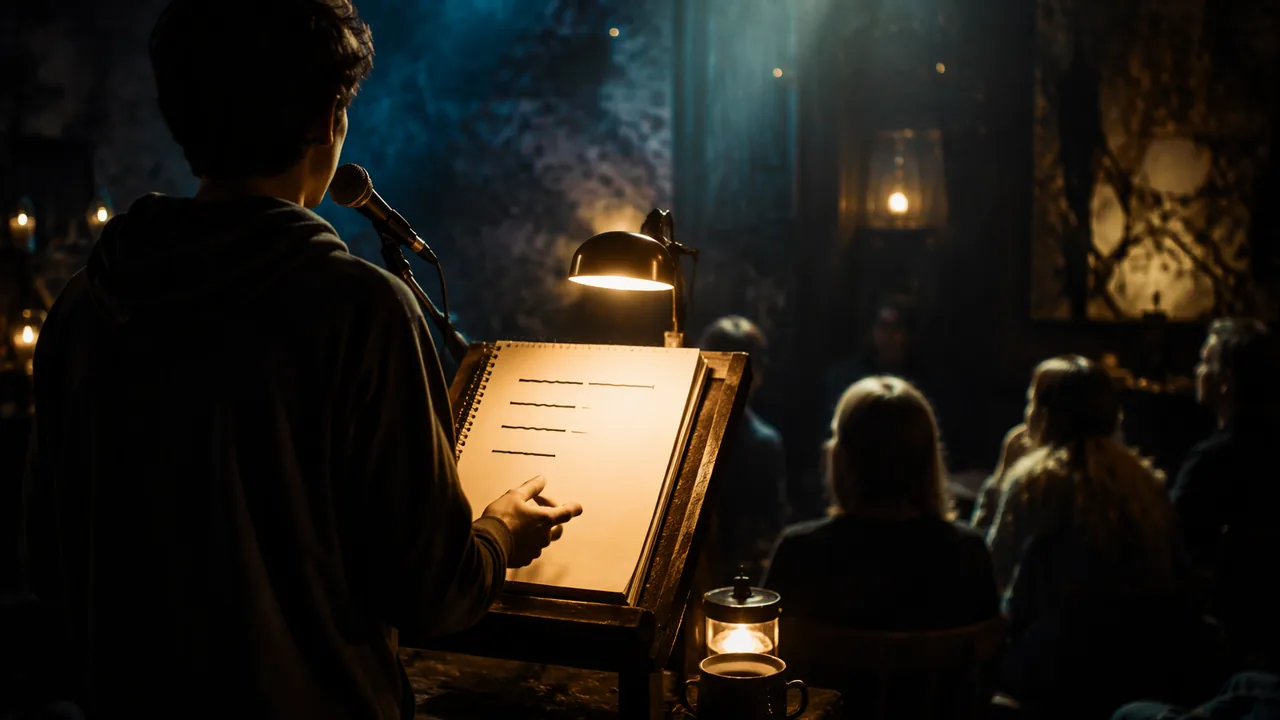
perform a poem aloud so that my pacing and emphasis carry an interpretation, and justify two specific delivery decisions from the text.
Instruction
Reading a poem aloud is not a way of presenting an interpretation you already have. It is a way of being forced to have one. The page lets you leave things undecided; the voice cannot. Every pause, every stress, every speed is a decision, and a listener hears all of them whether or not you made them on purpose.
Four decisions you cannot avoid.
1. The line ending. At an enjambed line, do you pause or run on? Both are defensible and they mean different things. Pausing honors the line as a unit and lets the suspended phrase register on its own. Running on honors the sentence and lets the syntax sweep. A small pause — a breath, not a stop — usually gets both. What you cannot do is treat a line ending as though it were not there.
2. Stress. Every line has a word that carries it. We wear the mask that grins and lies reads four different ways depending on which of we, wear, mask or grins you lean on, and each is an argument about the poem. Choose, and be able to say why.
3. Pace. Whitman’s four “When” lines must accumulate; read fast, they are a list, and read with weight, they are an oppression. Dunbar’s short refrain needs air around it or it sounds like a chorus rather than a closing door.
4. Register. Is the speaker addressing a room, a single person, or no one? Dunbar’s poem shifts mid-poem from a communal we to a direct cry — O great Christ — and a performance that keeps one register through both has flattened the poem.
The rule for this lab: every decision must be justified from the text. “It felt right” is not a justification. “I paused after ‘while’ because the enjambment leaves the clause incomplete, and the incompleteness is the point — the sentence cannot finish without the mask” is.
Listening is the other half, and it is where 9-10.SL.1.C is assessed. When you respond to a classmate’s performance you are analyzing an interpretation, not judging a performer. So the response has a required shape: name one decision you heard — a pause, a stress, a change of pace — say what reading of the poem it implies, and then either agree and extend it or name a line that makes it harder to hold. Comments on confidence, volume or nerves are not responses to an interpretation and earn no credit.
Accessibility. A student who prefers not to record may submit a fully annotated performance script — every pause, stress and pace change marked, with the textual justification for each — and deliver to the instructor in a scheduled session. Both routes earn full credit, and both are assessed on the justifications rather than on the delivery.
Reading: Performance lab set: three numbered poems, a worked performance script, response stems and criteria
Paul Laurence Dunbar, “We Wear the Mask” (1896), Complete Poems, Project Gutenberg #18338; Walt Whitman, “When I Heard the Learn’d Astronomer”, Leaves of Grass, Project Gutenberg #1322; William Shakespeare, Sonnet 73, Sonnets (1609), Project Gutenberg #1041; all retrieved 26 September 2026 · SLS original; quoted poems are public domain (Dunbar, 1896; Whitman; Shakespeare, 1609)
Read each poem aloud twice, then read the worked script. The script, the model response and the criteria are written by SLS; the poems are copied from the sources named.
You will perform one poem aloud, justify two delivery decisions from its text, and respond to two classmates. Below are the poems the lesson names, with every line numbered so that your justifications can cite them, a fully worked performance script for one poem, the response protocol with sentence stems, a model response, and the criteria you will be scored on. Read each poem aloud twice before you read the notes.
1. Three poems, numbered
We Wear the Mask, Paul Laurence Dunbar (1896)
1 We wear the mask that grins and lies,
2 It hides our cheeks and shades our eyes,—
3 This debt we pay to human guile;
4 With torn and bleeding hearts we smile,
5 And mouth with myriad subtleties.6 Why should the world be over-wise,
7 In counting all our tears and sighs?
8 Nay, let them only see us, while
9 We wear the mask.10 We smile, but, O great Christ, our cries
11 To thee from tortured souls arise.
12 We sing, but oh the clay is vile
13 Beneath our feet, and long the mile;
14 But let the world dream otherwise,
15 We wear the mask!
When I Heard the Learn’d Astronomer, Walt Whitman (Leaves of Grass)
1 When I heard the learn’d astronomer,
2 When the proofs, the figures, were ranged in columns before me,
3 When I was shown the charts and diagrams, to add, divide, and measure them,
4 When I sitting heard the astronomer where he lectured with much applause in the lecture-room,
5 How soon unaccountable I became tired and sick,
6 Till rising and gliding out I wander’d off by myself,
7 In the mystical moist night-air, and from time to time,
8 Look’d up in perfect silence at the stars.
Sonnet 73, William Shakespeare (1609)
1 That time of year thou mayst in me behold
2 When yellow leaves, or none, or few, do hang
3 Upon those boughs which shake against the cold,
4 Bare ruin’d choirs, where late the sweet birds sang.
5 In me thou see’st the twilight of such day
6 As after sunset fadeth in the west;
7 Which by and by black night doth take away,
8 Death’s second self, that seals up all in rest.
9 In me thou see’st the glowing of such fire,
10 That on the ashes of his youth doth lie,
11 As the death-bed, whereon it must expire,
12 Consum’d with that which it was nourish’d by.
13 This thou perceiv’st, which makes thy love more strong,
14 To love that well, which thou must leave ere long.
2. The four decisions, applied to one poem (SLS original)
Every performance makes four decisions whether or not the performer notices: the line ending, the stress, the pace and the register. Here they are made for the Whitman poem, with the justification for each. Marks used in a script: / a breath without a stop, // a full pause, CAPS a stressed word, >> speed up, << slow down.
| Lines | Decision and mark | Justification from the text |
|---|---|---|
| 1 to 4 | Line ending. A small breath (/) at the end of each line and no falling of the voice. Every line begins with When. | None of these lines completes a sentence. The syntax is one long when clause that waits for its main verb in line 5, so a falling voice at line 1 would announce an ending the sentence has not reached. |
| 2 to 4 | Pace. Speed up (>>) as the lines lengthen. | The four When lines run 6, 11, 14 and 15 words. The lecture accumulates, so the listener should feel it pile up before the speaker escapes it. |
| 5 | Stress. Lean on UNACCOUNTABLE, then a full pause (//). | This is the first word that is not part of the lecture, and the main clause arrives here (I became tired and sick). It is the poem’s turn in syntax before the turn in setting. |
| 6 to 8 | Register and pace. Slow down (<<) and lower the volume until it is half-voiced. A full pause (//) before line 8. | Lines 1 to 4 address a room. Lines 6 to 8 address no one, and line 8 names perfect silence. A performance that stays at lecture volume through the last line contradicts the words it is saying. |
One sentence stating the reading the delivery commits to: the speaker is relieved to leave a way of knowing that talks at him, and the poem does not say the stars are worthless, only that he wants to meet them unexplained.
A second defensible reading (SLS original). The last line is not a triumph over the astronomer. The speaker is still looking up at the stars, which is what the astronomer does too. On this reading line 8 is delivered with wonder and no defiance, and the pause before it is shorter. The poem allows both readings. What matters in this lab is that you choose one and can point to the line that supports your choice.
3. The same four decisions for Dunbar (SLS original)
- Line ending. Lines 1 to 5 are end-stopped, so give each its full stop. From line 6 lines 6, 8, 10, 12 and 14 are enjambed: breathe without dropping your voice, so the sentence stays open until it is closed by the mask in lines 9 and 15.
- Stress. We wear the mask that grins and lies can be read with the weight on we (a community), wear (a chosen act), mask (the object) or grins (the expression). If you choose we, you are reading the poem as collective testimony and not as private complaint. Say which you chose and why.
- Pace. The refrain in lines 9 and 15 needs air on both sides, or it sounds like a chorus and not like a door closing.
- Register. Line 10 changes from a plural, public voice to a direct address (O great Christ). Change your tone there. A performance that keeps one register throughout has flattened the poem.
4. Building your own script
- Choose one of the three poems. Read it aloud twice without any plan.
- Mark each line ending as end-stopped or enjambed.
- Choose the one word that carries each line and mark it in CAPS. Not every line needs one.
- Choose two places where the pace changes and mark them.
- Choose the two decisions you will defend. For each, write the line number, the mark, and two full sentences: what the text does there, and what reading your choice commits you to.
- Finish with one sentence stating the whole reading your delivery commits you to.
5. Responding to a classmate’s performance
A response addresses an interpretation, not a performer. It has three parts, in this order.
- Name a decision you heard. Stems: “In line __ you paused after …” / “You leaned on the word …” / “You sped up through lines __ to __.”
- Say what reading it implies. Stems: “That made me hear the speaker as …” / “That treats the poem as if it were …”
- Extend it or complicate it. Stems: “That fits line __, where …” / “I wonder how it fits line __, which seems to say …”
A model response (SLS original). “In lines 1 to 4 of the Whitman you kept your voice level and only breathed at each line end. That made me hear the four When lines as one sentence that was not finished, which fits line 5, where the main verb finally arrives. It also treats the lecture as something that goes on and on. I wonder how it fits line 4, with much applause, where I expected the room to sound pleased and your voice stayed flat. Was the flatness a choice?”
Not a response. “You sounded really confident and I liked your voice.” This describes the performer. It names no decision, implies no reading, and gives the performer nothing to extend or answer, so it earns no credit.
6. Criteria and levels (SLS original)
| Criterion | 4 | 3 | 2 | 1 |
|---|---|---|---|---|
| Justification | Two decisions, each tied to a line number and to a specific feature of the text, with the reading it commits to. | Two decisions tied to the text, one with a weaker link to a line. | Decisions named; justifications rest on feeling or on general statements about the poem. | Decisions not identified, or justified only by “it felt right.” |
| Whole reading | One sentence states a reading that the delivery actually carries. | A reading is stated but the delivery only partly carries it. | A theme is named without a reading of the speaker or the form. | None stated. |
| Response to peers | Names a decision, states the implied reading, then extends or complicates it with a line number. | Names a decision and the reading; extension is general. | Names a decision only, or comments on the poem and not the performance. | Comments on confidence, volume or nerves only. |
Scripted route: you may submit the annotated script from step 4 and deliver it to your instructor in a scheduled session. Both routes are scored on the justifications, not on the delivery.
Formative check
Work through these before moving on. They are not graded — they tell you whether the standard below has landed yet.
Which is an acceptable justification for a delivery decision in this lab?
Telling a classmate that their performance was confident and clear is a useful response in this lab.
Build your performance script for one anthology poem: mark every pause, stress and pace change, and write the textual justification for two of them in full sentences. Then state in one sentence what overall reading of the poem your delivery commits you to.
How confident are you that you can justify a pause or a stress from the poem’s own language rather than from how it felt?