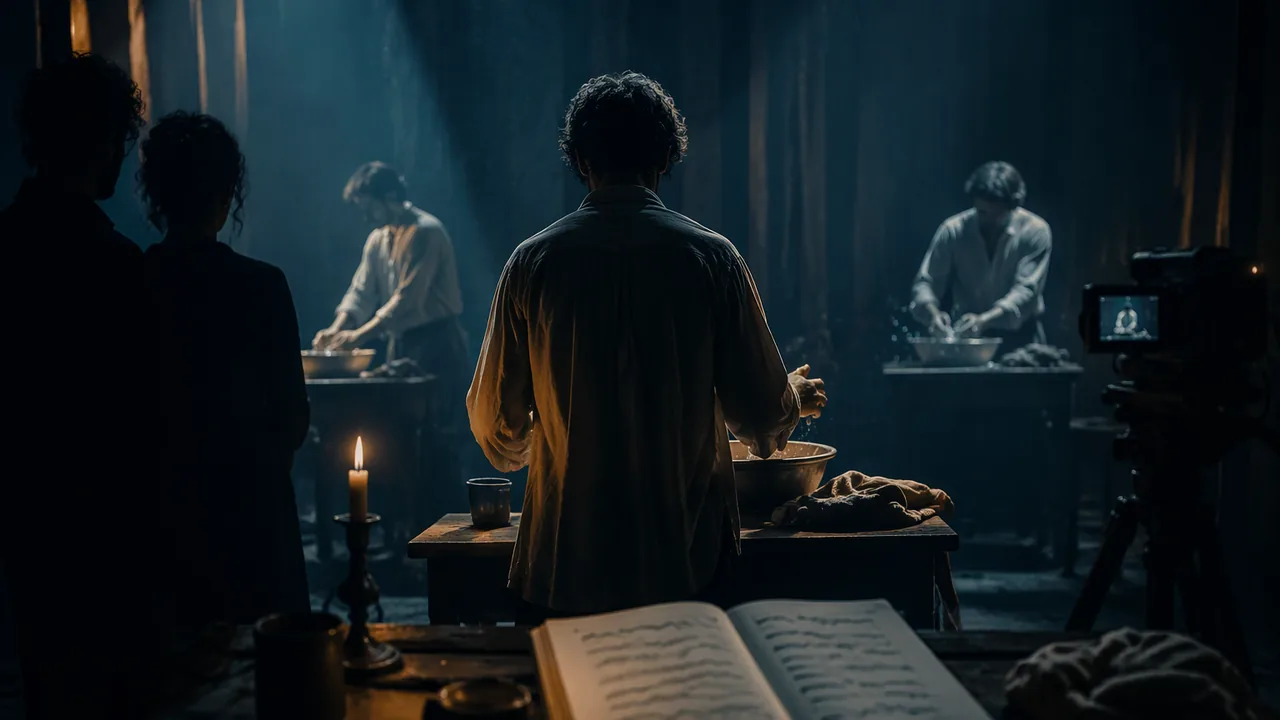
analyze how the sleepwalking scene is represented in two different artistic mediums, name what each emphasizes and what each leaves absent, and defend a judgment about which reading the text better supports.
Instruction
A play script is not the play. It is a set of instructions with most of the decisions left out, and the decisions left out are the ones an audience actually experiences. The sleepwalking scene, Act 5 scene 1, shows this more sharply than any other scene in Macbeth, because so much of it is action that the words only describe.
What the script does not specify. The Gentlewoman tells us that Lady Macbeth rubs her hands as if washing them, and that she has known her “continue in this a quarter of an hour.” The script does not say how long the washing lasts on stage, how fast it is, or whether it is frantic or slow. It does not say whether she senses the Doctor and Gentlewoman watching her, whether her voice is her own or an echo of the voices she remembers, where the taper stands, or whether the two watchers are frightened, clinical or close to tears. Every staging must answer all of those questions, because a body on a stage cannot be neutral, and every answer is an interpretation with consequences.
What the words do give you. Lady Macbeth, who spoke commanding verse in Acts 1 and 2, now speaks broken prose, and almost every fragment is a piece of an earlier scene. “Fie, my lord, fie! a soldier, and afeard?” echoes the night of the murder. “Yet who would have thought the old man to have had so much blood in him?” returns to Duncan’s chamber. “The Thane of Fife had a wife. Where is she now?” reaches a murder she took no part in. “Banquo’s buried; he cannot come out on’s grave” answers the banquet. And “What’s done cannot be undone” turns her own earlier comfort, “what’s done is done” in Act 3, into a sentence of despair. The scene is built like a memory replaying itself out of order.
Two familiar readings, both defensible from the same words. In the first, Lady Macbeth is a penitent whose conscience has finally broken through her will, and the Doctor’s verdict supports it: “More needs she the divine than the physician.” In the second, she is not repenting at all but trapped, still giving the orders she gave that night (“Wash your hands, put on your nightgown; look not so pale”) in a loop she cannot leave. Notice that she never asks forgiveness. The text supports both readings. The staging chooses.
The analytical procedure. Three questions, in this order, for each treatment:
- What does this medium emphasize? Film can hold her hands in close-up for the whole scene; a stage can show the sleeper and both watchers at once; an audio recording has no hands at all and must build the scene out of voice and silence.
- What did it have to add? Pace, volume, gesture, distance from the watchers. None of these is in the script. Every one of them is a claim.
- What is absent? A close-up removes the watchers, who are the scene’s onstage audience. An audio recording removes the washing, so the Doctor’s description has to carry it.
Credibility. A production is evidence of how the play was understood when it was made. The critic William Hazlitt, writing in 1817, describes the actress Sarah Siddons in this scene, and his account tells you how her age saw Lady Macbeth as much as how she played her. Say what a production is evidence of, and you have made a sharper claim than “this version was better.”
This lesson’s work. Choose two treatments of the sleepwalking scene in different mediums, using one of the three routes in the reading below: the two written treatments provided there, two recordings or filmed productions you can reach, or two readings you perform and record yourself. Build the three-question chart for each. Then record a ninety-second judgment: which treatment does the text better support, and which specific line makes you say so? Reply to two classmates: summarize the agreement, name the divergence, then qualify or justify. A typed transcript earns equal credit.
📖 Before this lesson, read: Macbeth, Act 5, Scenes 1-4
The reading opens over the lesson; close it to come back to exactly where you were.
Reading: One scene, two treatments: Macbeth, Act 5 scene 1, with a review of a performance and a worked chart
William Shakespeare, Macbeth (c. 1606), Project Gutenberg eBook #1533; William Hazlitt, Characters of Shakespear’s Plays (1817), Project Gutenberg #5085; retrieved 2 November 2026 · SLS original; quoted passages are public domain (Shakespeare, Macbeth; Hazlitt, 1817)
Read the scene aloud once before you read anything about it. Then decide which decisions the script leaves to the production.
A play script leaves most of a scene undecided, and a production has to decide it. This lesson gives you the sleepwalking scene, a map of where its fragments come from, a real review of a famous stage performance, and two written treatments, so that you can complete the chart and the recorded judgment without going anywhere else. Choose one route (see section 7). All three earn full credit. The scene is quoted from the same text as the reading card above.
1. The scene: Macbeth, Act 5 scene 1, from Lady Macbeth’s entrance
A Doctor and a Waiting-Gentlewoman have watched for two nights. Read the passage aloud once before you read anything about it.
Gentlewoman.
Neither to you nor anyone; having no witness to confirm my speech.
[Enter Lady Macbeth with a taper.]
Lo you, here she comes! This is her very guise; and, upon my life, fast asleep. Observe her; stand close.Doctor.
How came she by that light?Gentlewoman.
Why, it stood by her: she has light by her continually; ’tis her command.Doctor.
You see, her eyes are open.Gentlewoman.
Ay, but their sense are shut.Doctor.
What is it she does now? Look how she rubs her hands.Gentlewoman.
It is an accustomed action with her, to seem thus washing her hands. I have known her continue in this a quarter of an hour.Lady Macbeth.
Yet here’s a spot.Doctor.
Hark, she speaks. I will set down what comes from her, to satisfy my remembrance the more strongly.Lady Macbeth.
Out, damned spot! out, I say! One; two. Why, then ’tis time to do’t. Hell is murky! Fie, my lord, fie! a soldier, and afeard? What need we fear who knows it, when none can call our power to account? Yet who would have thought the old man to have had so much blood in him?Doctor.
Do you mark that?Lady Macbeth.
The Thane of Fife had a wife. Where is she now?—What, will these hands ne’er be clean? No more o’ that, my lord, no more o’ that: you mar all with this starting.Doctor.
Go to, go to. You have known what you should not.Gentlewoman.
She has spoke what she should not, I am sure of that: heaven knows what she has known.Lady Macbeth.
Here’s the smell of the blood still: all the perfumes of Arabia will not sweeten this little hand. Oh, oh, oh!Doctor.
What a sigh is there! The heart is sorely charged.Gentlewoman.
I would not have such a heart in my bosom for the dignity of the whole body.Doctor.
Well, well, well.Gentlewoman.
Pray God it be, sir.Doctor.
This disease is beyond my practice: yet I have known those which have walked in their sleep, who have died holily in their beds.Lady Macbeth.
Wash your hands, put on your nightgown; look not so pale. I tell you yet again, Banquo’s buried; he cannot come out on’s grave.Doctor.
Even so?Lady Macbeth.
To bed, to bed. There’s knocking at the gate. Come, come, come, come, give me your hand. What’s done cannot be undone. To bed, to bed, to bed.
After she leaves, the Doctor gives his verdict:
Foul whisp’rings are abroad. Unnatural deeds
Do breed unnatural troubles: infected minds
To their deaf pillows will discharge their secrets.
More needs she the divine than the physician.
2. What the script does not say (SLS original)
Read the scene again and list what the words leave open. A staging has to answer every one of these, because a body on a stage cannot be neutral.
- The washing. How long, how fast, and does it stop while she speaks? The Gentlewoman says a quarter of an hour; no production plays it that long.
- The taper. She carries a light because she commands it. Does she hold it, set it down, or forget it?
- Her voice. Is a soldier, and afeard? spoken in her own sleeping voice or in the sharp voice of Act 2?
- The watchers. Are the Doctor and Gentlewoman frightened, clinical, or moved? Does she ever seem to sense them?
- The last lines. Is To bed, to bed, to bed a comfort, a command, or a child’s chant?
3. Where the fragments come from (SLS original, with quotations from the play)
Almost every line she speaks in her sleep answers something said earlier. The right-hand column quotes the earlier moment.
| In her sleep (5.1) | Earlier in the play |
|---|---|
| Out, damned spot! … What, will these hands ne’er be clean? | 2.2, to Macbeth after the murder: “A little water clears us of this deed” |
| Fie, my lord, fie! a soldier, and afeard? | 2.2, taking the daggers from him: “Infirm of purpose!” |
| Yet who would have thought the old man to have had so much blood in him? | 2.2: “Had he not resembled / My father as he slept, I had done’t.” |
| The Thane of Fife had a wife. Where is she now? | 4.1, Macbeth, alone with Lennox: “The castle of Macduff I will surprise; / Seize upon Fife”. She was not there, yet she knows. |
| Banquo’s buried; he cannot come out on’s grave. | 3.4, Macbeth to the ghost: “Thou canst not say I did it. Never shake / Thy gory locks at me.” |
| There’s knocking at the gate. | 2.2: “I hear knocking / At the south entry” |
| What’s done cannot be undone. | 3.2: “Things without all remedy / Should be without regard: what’s done is done.” |
4. A critic on the role, and a review of a performance
These two passages are public domain. The first is how one critic read Lady Macbeth in the early acts:
William Hazlitt, Characters of Shakespear’s Plays (1817), on Lady Macbeth:
This swelling exultation and keen spirit of triumph, this uncontrollable eagerness of anticipation, which seems to dilate her form and take possession of all her faculties, this solid, substantial flesh-and-blood display of passion
Hazlitt also reviewed a performance, and this is what a production, not a script, is evidence of. The performer is Sarah Siddons, the leading tragic actress of her day, and the second half of the passage describes her in this very scene:
In speaking of the character of Lady Macbeth, we ought not to pass over Mrs. Siddons’s manner of acting that part. We can conceive of nothing grander. It was something above nature. It seemed almost as if a being of a superior order had dropped from a higher sphere to awe the world with the majesty of her appearance. Power was seated on her brow, passion emanated from her breast as from a shrine; she was tragedy personified. In coming on in the sleeping-scene, her eyes were open, but their sense was shut. She was like a person bewildered and unconscious of what she did. Her lips moved involuntarily–all her gestures were involuntary and mechanical. She glided on and off the stage like an apparition. To have seen her in that character was an event in every one’s life, not to be forgotten.
Two things to notice. Hazlitt says nothing about the words; he describes a body: her eyes were open, but their sense was shut, all her gestures were involuntary and mechanical. His phrase about her eyes almost repeats the Gentlewoman’s line, so the performance made the text visible. And he is describing how the role was understood in his time, as tragedy personified and as a figure moving without will, not settling what Shakespeare intended. That is the difference between evidence of a reading and evidence of a text.
5. Two treatments of the scene (SLS original, invented for this lesson)
These are not records of real productions. They are written the way a promptbook or a sound script is written, so that you have two different mediums to compare. Both use exactly the words above.
Treatment A: a stage production, small theater, almost no light. The audience sits close on three sides. The Doctor and Gentlewoman stand at the front edge of the stage with their backs half to the audience, so the audience watches her over their shoulders. She sets the taper on the floor to free both hands. The washing is slow and methodical, the same three movements repeated, and it never stops, even while she speaks. Her voice is low and level throughout, until Oh, oh, oh!, the only loud sound in the scene. On give me your hand she holds out her hand to the empty air where Macbeth would have stood.
Treatment B: an audio recording, no music. A clock ticks under the whole scene. The Doctor and Gentlewoman whisper close to the microphone, so the listener stands where they stand. Lady Macbeth’s voice comes from farther off and keeps changing: on a soldier, and afeard? it turns sharp and commanding, as in Act 2, and on all the perfumes of Arabia it breaks into weeping. The washing is never heard; the listener knows of it only through the Doctor’s Look how she rubs her hands.
6. A worked chart for the two treatments (SLS original)
| Treatment A (stage) | Treatment B (audio) | |
|---|---|---|
| What the medium emphasizes | Her hands and the watchers at once; the audience sees the washing go on and on while she talks. | Her voice and its changes; the listener hears whose voice she is borrowing in each fragment. |
| What it had to add | A taper set down, a fixed rhythm of washing, a level voice, an outstretched hand. | A ticking clock, whispered commentary, a shift into her Act 2 voice, weeping. |
| What is absent | Variety of voice; the fragments all sound the same, so their different sources are harder to hear. | The washing itself, the scene’s central action, which survives only as the Doctor’s report. |
| What reading it implies | She is trapped in a loop, replaying the night without repenting. | She is a penitent whose conscience is breaking through. |
The test against the text. Which treatment does the text support? Look at what she says rather than what the watchers say about her. The Doctor calls for a priest, but she never asks forgiveness, and her last words are instructions to a husband who is not there:
Come, come, come, come, give me your hand. What’s done cannot be undone. To bed, to bed, to bed.
7. Choose one route
Option A: the two treatments above. Use Treatments A and B, plus the Hazlitt review, as your two treatments in different mediums. Build your chart from section 6 as a model, changing at least two cells to your own reading.
Option B: two recordings you can reach. Any two audio recordings, filmed stage productions, film adaptations or graphic adaptations of this scene that you have access to. Fill in the three-question chart from what you see and hear.
Option C: your own two readings. Read the scene aloud twice, once so that Lady Macbeth is a penitent breaking down and once so that she is trapped in a loop she does not understand. Record both (or write an annotated script for each). The two readings are your two treatments; compare a spoken performance with the plain text on the page.
8. A model ninety-second judgment (SLS original) and a model reply
Model judgment, about ninety seconds when read aloud: “I chose the reading in Treatment A, because the text supports the view that Lady Macbeth is trapped rather than repenting. The Doctor says she needs a priest more than a doctor, but that is his reading of her, not hers. Listen to what she actually says: she gives orders. Wash your hands, put on your nightgown; look not so pale. She is still managing the night of the murder. The deciding line for me is What’s done cannot be undone. In Act 3 she told her husband that what is done is done, as a comfort. Now the same words have become a wall. Treatment A keeps her washing without stopping, so the audience sees a loop with no way out. What Treatment A leaves out is the variety of voices that the audio version brings out. I think that loss is real, but the endless washing is the clearest picture of a mind that cannot leave one night.”
Model reply to a classmate: “You and I agree that the fragments all come from earlier scenes. Where we differ is on whether her weeping in Treatment B means repentance. I would qualify my view: Oh, oh, oh! could be grief without repentance, so the weeping alone does not settle which reading the text supports.”
9. Question stems for the discussion
- What decision did this treatment make that the script does not?
- Which line of the text supports that decision, and which line makes it harder to hold?
- What would the audience miss if this medium were swapped for the other?
- What is this production evidence of: the play, or the time it was made in?
Formative check
Work through these before moving on. They are not graded — they tell you whether the standard below has landed yet.
Two productions stage the sleepwalking scene very differently: in one, Lady Macbeth scrubs her hands frantically and weeps; in the other, she washes slowly and almost calmly, like a routine. What is the strongest analytical claim about the difference?
“Here’s the smell of the blood still: all the perfumes of Arabia will not sweeten this little hand.” Which of Lady Macbeth’s earlier lines does this reverse?
A filmed production is good evidence for what Shakespeare intended.
For the sleepwalking scene and your two chosen treatments, complete the chart: what each medium emphasizes, what each had to add that the script left open, and what each leaves absent. Then draft your ninety-second judgment: which treatment the text better supports, and the one line that decides it for you.
How confident are you that you can name a decision a production had to make that the script left open, and test it against a line of the text?
Macbeth, Act 5, Scenes 1-4
Macbeth, Act 5, Scene 1: Dunsinane. A Room in the Castle.
Source: William Shakespeare, Macbeth (c. 1606), Project Gutenberg eBook #1533 (gutenberg.org) · Public domain
Enter a Doctor of Physic and a Waiting-Gentlewoman.
DOCTOR.
I have two nights watched with you, but can perceive no truth in your
report. When was it she last walked?
GENTLEWOMAN.
Since his Majesty went into the field, I have seen her rise from her
bed, throw her nightgown upon her, unlock her closet, take forth paper,
fold it, write upon’t, read it, afterwards seal it, and again return to
bed; yet all this while in a most fast sleep.
DOCTOR.
A great perturbation in nature, to receive at once the benefit of
sleep, and do the effects of watching. In this slumbery agitation,
besides her walking and other actual performances, what, at any time,
have you heard her say?
GENTLEWOMAN.
That, sir, which I will not report after her.
DOCTOR.
You may to me; and ’tis most meet you should.
GENTLEWOMAN.
Neither to you nor anyone; having no witness to confirm my speech.
Enter Lady Macbeth with a taper.
Lo you, here she comes! This is her very guise; and, upon my life, fast asleep. Observe her; stand close.
DOCTOR.
How came she by that light?
GENTLEWOMAN.
Why, it stood by her: she has light by her continually; ’tis her
command.
DOCTOR.
You see, her eyes are open.
GENTLEWOMAN.
Ay, but their sense are shut.
DOCTOR.
What is it she does now? Look how she rubs her hands.
GENTLEWOMAN.
It is an accustomed action with her, to seem thus washing her hands. I
have known her continue in this a quarter of an hour.
LADY MACBETH.
Yet here’s a spot.
DOCTOR.
Hark, she speaks. I will set down what comes from her, to satisfy my
remembrance the more strongly.
LADY MACBETH.
Out, damned spot! out, I say! One; two. Why, then ’tis time to do’t.
Hell is murky! Fie, my lord, fie! a soldier, and afeard? What need we
fear who knows it, when none can call our power to account? Yet who
would have thought the old man to have had so much blood in him?
DOCTOR.
Do you mark that?
LADY MACBETH.
The Thane of Fife had a wife. Where is she now?—What, will these hands
ne’er be clean? No more o’ that, my lord, no more o’ that: you mar all
with this starting.
DOCTOR.
Go to, go to. You have known what you should not.
GENTLEWOMAN.
She has spoke what she should not, I am sure of that: heaven knows what
she has known.
LADY MACBETH.
Here’s the smell of the blood still: all the perfumes of Arabia will
not sweeten this little hand. Oh, oh, oh!
DOCTOR.
What a sigh is there! The heart is sorely charged.
GENTLEWOMAN.
I would not have such a heart in my bosom for the dignity of the whole
body.
DOCTOR.
Well, well, well.
GENTLEWOMAN.
Pray God it be, sir.
DOCTOR.
This disease is beyond my practice: yet I have known those which have
walked in their sleep, who have died holily in their beds.
LADY MACBETH.
Wash your hands, put on your nightgown; look not so pale. I tell you
yet again, Banquo’s buried; he cannot come out on’s grave.
DOCTOR.
Even so?
LADY MACBETH.
To bed, to bed. There’s knocking at the gate. Come, come, come, come,
give me your hand. What’s done cannot be undone. To bed, to bed, to
bed.
[Exit.]
DOCTOR.
Will she go now to bed?
GENTLEWOMAN.
Directly.
DOCTOR.
Foul whisp’rings are abroad. Unnatural deeds
Do breed unnatural troubles: infected minds
To their deaf pillows will discharge their secrets.
More needs she the divine than the physician.—
God, God, forgive us all! Look after her;
Remove from her the means of all annoyance,
And still keep eyes upon her. So, good night:
My mind she has mated, and amaz’d my sight.
I think, but dare not speak.
GENTLEWOMAN.
Good night, good doctor.
[Exeunt.]
Macbeth, Act 5, Scene 2: The Country near Dunsinane. Bridge summary — not the primary text
This is a short recap written for this course, not William Shakespeare’s own words, so you can follow the story between close-reading lessons.
{summary}Macbeth, Act 5, Scene 3: Dunsinane. A Room in the Castle. Bridge summary — not the primary text
This is a short recap written for this course, not William Shakespeare’s own words, so you can follow the story between close-reading lessons.
{summary}Macbeth, Act 5, Scene 4: Country near Dunsinane: a Wood in view. Bridge summary — not the primary text
This is a short recap written for this course, not William Shakespeare’s own words, so you can follow the story between close-reading lessons.
{summary}