write a narrative scene using precise diction, telling detail and sensory language, and revise a passage by cutting general description in favor of one concrete detail.
Instruction
This is the semester’s first narrative assignment, and it is deliberately placed inside the poetry unit. Poetry is where you have just learned that one word can do the work of a paragraph. Narrative writing is where you get to use that.
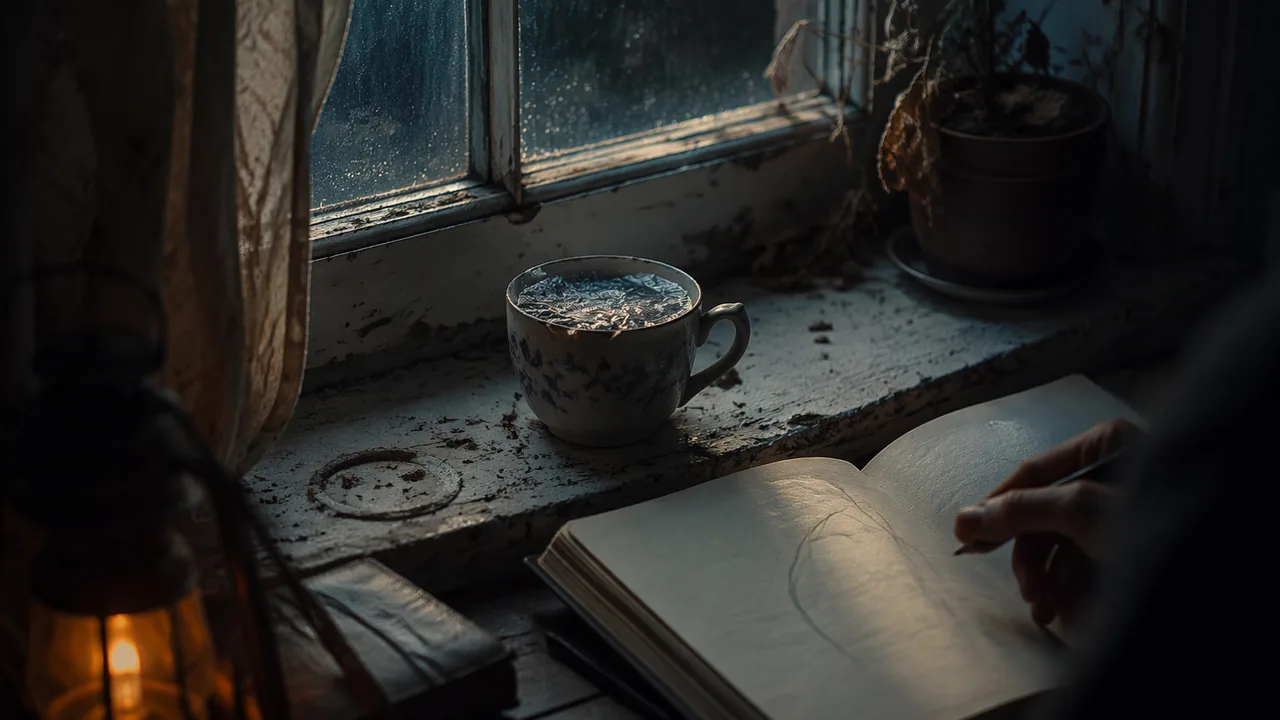
The telling detail. Inexperienced narrative writing describes generally and at length: the room was old and messy and had not been cleaned in a long time. Three adjectives, no image. Experienced narrative writing selects one specific thing and lets the reader build the rest: a teacup on the sill had grown a skin.
The second sentence is shorter and does more, and the reason is not style. It is that a concrete particular licenses inference. The reader who is told the room is messy has been handed a verdict. The reader who is shown the teacup reaches the verdict themselves, and a conclusion a reader reaches is one they believe.
The test: could a camera photograph it? Messy cannot be photographed. Old cannot. A skin on cold tea can.
Sensory language beyond sight. Most student narrative is entirely visual, which is why so much of it feels like a description of a film. The other senses are more intimate and less used: sound (what you can hear from the next room), smell (the fastest route to memory in prose), touch (temperature, texture, the weight of things), and the sense of the body in space. One non-visual detail per scene changes the texture of a whole page.
Precise diction. Everything from Lesson 2.2 applies here on the production side. Walked is a placeholder; trudged, ambled, picked her way and stalked each carry a mood and a relationship to the ground. Choose the verb that carries the most and then delete the adverb you were going to attach to it — if the verb is right, the adverb is repetition.
The implied scene, which is your assignment. Every one of the anthology poems implies a scene it does not show. Dunbar’s poem implies a room in which the mask is worn — a workplace, a street, a conversation with someone who must not be allowed to know. Whitman’s implies a lecture hall and a door. Frost’s traveler implies a morning, a fork in a path, and a decision made in a few seconds that the poem revisits for a lifetime.
Your task is to write that scene as prose — 500-700 words in the final version, drafted today. Rules: you may not quote the poem, and you may not state its theme. Everything the poem says directly, your scene must carry indirectly, through what happens and what is noticed. If a reader who has never met the poem can feel what the poem is about, you have done it.
Today’s revision exercise is the habit the whole unit is training. Take any paragraph of your draft, find the three most general words in it, and replace one of them with a single photographable detail. Delete the other two. Then read both versions and decide honestly which is stronger — sometimes the general sentence was doing structural work, and knowing when to keep it is also craft.
Reading: Workshop set: two Douglass mentor passages, three poems to imply a scene from, a model scene, a revision and criteria
Frederick Douglass, Narrative of the Life of Frederick Douglass, an American Slave (1845), Project Gutenberg eBook #23; Paul Laurence Dunbar, “We Wear the Mask” (1896), Project Gutenberg #18338; Walt Whitman, “When I Heard the Learn’d Astronomer”, Leaves of Grass, Project Gutenberg #1322; Robert Frost, “The Road Not Taken”, Mountain Interval (1916), Project Gutenberg #29345; all retrieved 26 September 2026 · SLS original; quoted passages are public domain (Douglass, 1845; Dunbar, 1896; Whitman; Frost, 1916)
Read the mentor passages and apply the camera test to each sentence, then read the model scene and its commentary before you draft. The model scene, the revisions and the criteria are written by SLS; the passages and poems are copied from the sources named.
This workshop asks you to draft a scene that a poem implies but never shows, and to revise a paragraph by trading general words for one photographable detail. Below you will find two mentor passages from a nineteenth-century narrative, the three poems the lesson names (so you have something to imply a scene from), a complete model scene and its commentary, a before-and-after revision, and the criteria the draft will be scored against.
1. Mentor passages: the telling detail
Frederick Douglass, Narrative of the Life of Frederick Douglass, an American Slave (1845), Chapter V. He describes his childhood on a Maryland plantation. Apply the camera test to each sentence: could it be photographed?
I suffered much from hunger, but much more from cold. In hottest summer and coldest winter, I was kept almost naked—no shoes, no stockings, no jacket, no trousers, nothing on but a coarse tow linen shirt, reaching only to my knees. I had no bed. I must have perished with cold, but that, the coldest nights, I used to steal a bag which was used for carrying corn to the mill. I would crawl into this bag, and there sleep on the cold, damp, clay floor, with my head in and feet out. My feet have been so cracked with the frost, that the pen with which I am writing might be laid in the gashes.
Douglass could have written “I suffered terribly from the cold.” He chose instead a shirt that stops at the knees, a corn sack, a clay floor, and a pen laid in a crack in the skin of his own foot. Every one of those can be photographed, and the last one is the reader’s proof, because it is an object the reader can see resting where the author says it rested. Notice too the non-visual detail: cold, damp is touch, and it is placed on the floor, not on the child.
From Chapter V again, a second passage. This one is about a meal.
The children were then called, like so many pigs, and like so many pigs they would come and devour the mush; some with oyster-shells, others with pieces of shingle, some with naked hands, and none with spoons. He that ate fastest got most; he that was strongest secured the best place; and few left the trough satisfied.
The camera test again: oyster-shells, shingle, hands, no spoons. Then notice the two sentence halves joined by semicolons that follow it, each with the same shape. The repetition does the work of a verdict, and Douglass never has to write cruel.
Douglass, Narrative (1845), Project Gutenberg eBook #23, Chapter V, retrieved 26 September 2026. The passages describe conditions of enslavement, and you can choose to read only the general description of the technique if you prefer.
2. The three poems (so you have a scene to imply)
We Wear the Mask, Paul Laurence Dunbar (1896). Implied scene: a room, a doorway or a street where the mask is put on. Ask who is being kept from seeing behind it, and what happens in the second before the smile.
1 We wear the mask that grins and lies,
2 It hides our cheeks and shades our eyes,—
3 This debt we pay to human guile;
4 With torn and bleeding hearts we smile,
5 And mouth with myriad subtleties.6 Why should the world be over-wise,
7 In counting all our tears and sighs?
8 Nay, let them only see us, while
9 We wear the mask.10 We smile, but, O great Christ, our cries
11 To thee from tortured souls arise.
12 We sing, but oh the clay is vile
13 Beneath our feet, and long the mile;
14 But let the world dream otherwise,
15 We wear the mask!
When I Heard the Learn’d Astronomer, Walt Whitman. Implied scene: a lecture hall, a row of seats, a door. Ask what the speaker’s hands were doing and what the air outside smelled like.
1 When I heard the learn’d astronomer,
2 When the proofs, the figures, were ranged in columns before me,
3 When I was shown the charts and diagrams, to add, divide, and measure them,
4 When I sitting heard the astronomer where he lectured with much applause in the lecture-room,
5 How soon unaccountable I became tired and sick,
6 Till rising and gliding out I wander’d off by myself,
7 In the mystical moist night-air, and from time to time,
8 Look’d up in perfect silence at the stars.
The Road Not Taken, Robert Frost, Mountain Interval (1916). Implied scene: a morning, a fork in a path, a decision made in a few seconds that the poem revisits for a lifetime.
1 Two roads diverged in a yellow wood,
2 And sorry I could not travel both
3 And be one traveler, long I stood
4 And looked down one as far as I could
5 To where it bent in the undergrowth;6 Then took the other, as just as fair,
7 And having perhaps the better claim,
8 Because it was grassy and wanted wear;
9 Though as for that the passing there
10 Had worn them really about the same,11 And both that morning equally lay
12 In leaves no step had trodden black.
13 Oh, I kept the first for another day!
14 Yet knowing how way leads on to way,
15 I doubted if I should ever come back.16 I shall be telling this with a sigh
17 Somewhere ages and ages hence:
18 Two roads diverged in a wood, and I–
19 I took the one less traveled by,
20 And that has made all the difference.
3. A complete model scene (SLS original)
This scene is written from the Whitman poem. It does not quote the poem and it does not state what the poem is about. It is about 290 words. Read it once for the story and once with the commentary.
The radiator under the window knocked twice and went quiet. Marcus had counted the ceiling tiles by the second slide and the exit signs by the fifth. On the screen a column of numbers slid up and another replaced it, and the man at the lectern tapped each with a pointer that clicked against the glass. Around him the room nodded. Someone two rows ahead had copied the same figure into a margin, boxed it, and boxed it again.
Marcus folded his program into a narrower and narrower strip. His coat smelled of the cold it had come in from and now, under the lights, of wet wool. When the man said something about distances the audience laughed, briefly, together, and Marcus felt the laugh go past him like a car on a road he was not on.
Then applause. He stood while everyone was still clapping, so that his standing would look like part of it, and edged along the row with his coat held in front of him, apologizing to knees. The door at the back was heavier than it looked. It closed behind him on its slow arm, and the sound of the room went out like a tap being turned.
Outside the air was damp and tasted of iron. The lamps in the parking lot hummed. He walked past his car, past the last row of cars, to where the pavement ended in grass, and stood there with his head tipped back until his neck ached and he did not mind that it did.
Commentary.
- Telling details, all photographable: the radiator, the boxed figure in the margin, the program folded into a strip, the pointer clicking on glass, the door on its slow arm.
- Non-visual details: the knock of the radiator (sound), the wet wool (smell), the laugh going past him (sound and motion), the iron taste of the air (taste), the hum of the lamps (sound), the ache in his neck (the body in space).
- Verbs that carry the mood: edged says he does not want to be noticed; folded says he is fidgeting without meaning to. The scene has no adverbs on those verbs because the verbs already do the job.
- What is left unsaid: the scene never says Marcus is bored, restless or relieved, and it never says what he thinks of the lecture. The reader gets there from what he does.
4. A before-and-after revision (SLS original)
Before. The long, boring lecture made Marcus feel restless.
Three general words: long, boring, restless. None can be photographed.
After. By the fifth slide Marcus was folding his program into a narrower and narrower strip.
One general word was replaced with one photographable detail (the strip of paper) and the other two were deleted. The after version is stronger because a reader who watches the strip get thinner decides for themselves that he is restless, and a conclusion a reader reaches is a conclusion they believe. Be honest about the other case, though: if the scene needed the reader to know the room’s mood in six words and nothing else, the before sentence would be doing structural work, and keeping it would be craft.
Second example, a verb. Before: She walked slowly and sadly across the yard. After: She picked her way across the yard. The adverbs are gone because the verb now carries the mood and the relationship to the ground.
5. The criteria your Stage 1 draft will be scored against
| Criterion | Meets it when |
|---|---|
| Implied scene | You name the poem and the scene it implies but does not show, and the scene is one the poem could contain without contradicting it. |
| Telling detail | Most of the concrete details pass the camera test, and general judgments (messy, sad, old) are rare or absent. |
| Non-visual sensory detail | At least one detail of sound, smell, taste, touch or bodily position, placed where it changes the scene. |
| No quotation and no stated theme | No line of the poem appears in the scene, and the scene never tells the reader what the poem means. |
| Precise diction | The verbs carry mood; adverbs propping up weak verbs are cut. |
| Revision | The before-and-after paragraph shows three general words traded for one photographable detail, and one sentence says honestly which version is stronger and why. |
The draft is 300 to 400 words today. It grows to 500 to 700 in the final version.
Formative check
Work through these before moving on. They are not graded — they tell you whether the standard below has landed yet.
Which sentence uses a telling detail rather than general description?
Adding a strong adverb to a verb is the most efficient way to make an action vivid.
A detail passes the camera test if it names a particular rather than a judgment; one detail — sound, smell or touch — changes the texture of a whole page of otherwise visual prose.
Submit Stage 1: (1) name the poem and the scene it implies but does not show; (2) draft 300-400 words of that scene, with at least one non-visual sensory detail and no statement of the poem’s theme; (3) paste one paragraph twice — before and after — where you replaced three general words with one photographable detail, and say in a sentence which version is stronger and why.
How confident are you that you can replace a general description with one concrete particular that lets a reader draw the conclusion themselves?