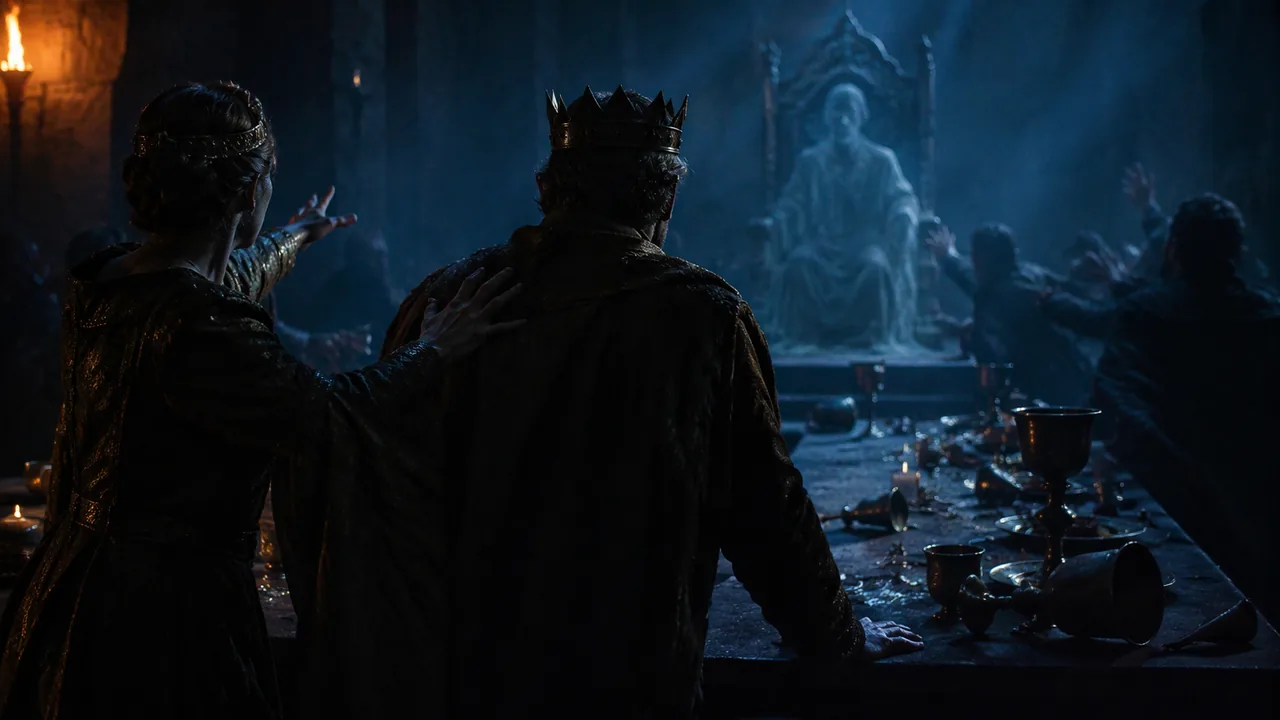
explain how Act 3 develops the idea that power seized by murder can never feel secure, tracing it from Macbeth’s soliloquy on Banquo through the banquet, and cite lines that show the change in Macbeth and in his marriage.
Instruction
Act 3 is where the play stops asking whether Macbeth will take the crown and starts asking what keeping it costs. Follow one idea through the act: power gained by murder cannot feel safe, and every step Macbeth takes to make it safe makes it less so.
Banquo’s silence. The act opens with Banquo alone: “Thou hast it now, King, Cawdor, Glamis, all, / As the Weird Women promis’d; and, I fear, / Thou play’dst most foully for’t.” He suspects murder, and he says nothing, because the same prophecy promised something to him: that he would be “the root and father / Of many kings.” Shakespeare lets the play’s most honest man keep a dangerous secret for the sake of his own hope, and the audience watches him ride out to his death still keeping it.
“To be thus is nothing.” Macbeth’s soliloquy in scene 1 states the theme outright: “To be thus is nothing, / But to be safely thus.” The crown has given him nothing he can feel. Then he names the injury: “Upon my head they plac’d a fruitless crown, / And put a barren sceptre in my gripe.” He has murdered, he says, “For Banquo’s issue,” for another man’s children. The soliloquy ends with a challenge: “Rather than so, come, fate, into the list, / And champion me to th’ utterance!” In Act 1 he hoped that “chance may crown me.” Now he calls fate out to single combat. He has stopped waiting on the prophecy and started fighting it.
He has learned her method. Watch how Macbeth persuades the murderers. When one protests, “We are men, my liege,” he answers, “Ay, in the catalogue ye go for men,” and goes on to rank men like breeds of dog. It is Lady Macbeth’s argument from Act 1, prove that you are a man, now in his mouth. And he no longer needs her. In scene 2, when she asks “What’s to be done?” he tells her, “Be innocent of the knowledge, dearest chuck, / Till thou applaud the deed.” The partnership that planned Duncan’s murder is over, though both partners are alive.
The first failure. Scene 3 is short and dark, and its most important line is a murderer’s complaint: “There’s but one down: the son is fled.” Fleance’s escape means the prophecy about Banquo’s line is still alive. Macbeth’s plan for safety has failed before the banquet begins.
The banquet. Scene 4 is the play’s great public scene. It opens on order, “You know your own degrees, sit down,” a room where every guest has a place by rank. The ghost breaks that order in the simplest way possible: it sits in the king’s place. The stage direction gives it a body (“The Ghost of Banquo rises, and sits in Macbeth’s place”), which the dagger in Act 2 never had, so every production must decide whether the audience sees the ghost too. Among the guests, only Macbeth does. Lady Macbeth reaches for her old script, “Are you a man?”, and links this vision to the last one: “This is the air-drawn dagger which you said, / Led you to Duncan.” It no longer works. The feast that was meant to display a king ends with her ordering the guests out: “Stand not upon the order of your going, / But go at once.”
After the guests leave, Macbeth makes the decision that shapes the rest of the play: “I am in blood / Stepp’d in so far that, should I wade no more, / Returning were as tedious as go o’er.” Going back and going forward cost the same, so he goes forward. The act closes on two quieter scenes you will meet as summaries: Hecate preparing illusions to make Macbeth overconfident, and the lord Lennox speaking about the new king in heavy irony, because in Scotland now even loyal men must speak in code.
📖 Before this lesson, read: Macbeth, Act 3
The reading opens over the lesson; close it to come back to exactly where you were.
Formative check
Work through these before moving on. They are not graded — they tell you whether the standard below has landed yet.
“To be thus is nothing, / But to be safely thus.” What does Macbeth reveal at the start of his soliloquy in Act 3 scene 1?
Lady Macbeth helps Macbeth plan the murder of Banquo, just as she planned Duncan’s.
At the banquet the ghost of Banquo sits in Macbeth’s , and Lady Macbeth compares it to the air-drawn that led him to Duncan.
Trace the idea that stolen power cannot feel safe through Act 3 with three quotations: one from Macbeth’s soliloquy in scene 1, one from the banquet in scene 4, and one of your choice from anywhere in the act. Cite each by act and scene and explain in one or two sentences how it shows Macbeth’s security slipping. Close with a sentence on what Fleance’s escape in scene 3 changes.
How confident are you that you can trace how a theme develops across an act, using quotations from more than one scene?
Macbeth, Act 3
Macbeth, Act 3, Scene 1: Forres. A Room in the Palace.
Source: William Shakespeare, Macbeth (c. 1606), Project Gutenberg eBook #1533 (gutenberg.org) · Public domain
Enter Banquo.
BANQUO.
Thou hast it now, King, Cawdor, Glamis, all,
As the Weird Women promis’d; and, I fear,
Thou play’dst most foully for’t; yet it was said
It should not stand in thy posterity;
But that myself should be the root and father
Of many kings. If there come truth from them
(As upon thee, Macbeth, their speeches shine)
Why, by the verities on thee made good,
May they not be my oracles as well,
And set me up in hope? But hush; no more.
Sennet sounded. Enter Macbeth as King, Lady Macbeth as Queen; Lennox, Ross, Lords, and Attendants.
MACBETH.
Here’s our chief guest.
LADY MACBETH.
If he had been forgotten,
It had been as a gap in our great feast,
And all-thing unbecoming.
MACBETH.
Tonight we hold a solemn supper, sir,
And I’ll request your presence.
BANQUO.
Let your Highness
Command upon me, to the which my duties
Are with a most indissoluble tie
For ever knit.
MACBETH.
Ride you this afternoon?
BANQUO.
Ay, my good lord.
MACBETH.
We should have else desir’d your good advice
(Which still hath been both grave and prosperous)
In this day’s council; but we’ll take tomorrow.
Is’t far you ride?
BANQUO.
As far, my lord, as will fill up the time
’Twixt this and supper: go not my horse the better,
I must become a borrower of the night,
For a dark hour or twain.
MACBETH.
Fail not our feast.
BANQUO.
My lord, I will not.
MACBETH.
We hear our bloody cousins are bestow’d
In England and in Ireland; not confessing
Their cruel parricide, filling their hearers
With strange invention. But of that tomorrow,
When therewithal we shall have cause of state
Craving us jointly. Hie you to horse: adieu,
Till you return at night. Goes Fleance with you?
BANQUO.
Ay, my good lord: our time does call upon’s.
MACBETH.
I wish your horses swift and sure of foot;
And so I do commend you to their backs.
Farewell.—
[Exit Banquo.]
Let every man be master of his time Till seven at night; to make society The sweeter welcome, we will keep ourself Till supper time alone: while then, God be with you.
[Exeunt Lady Macbeth, Lords, &c.]
Sirrah, a word with you. Attend those men Our pleasure?
SERVANT.
They are, my lord, without the palace gate.
MACBETH.
Bring them before us.
[Exit Servant.]
To be thus is nothing, But to be safely thus. Our fears in Banquo Stick deep, and in his royalty of nature Reigns that which would be fear’d: ’tis much he dares; And, to that dauntless temper of his mind, He hath a wisdom that doth guide his valour To act in safety. There is none but he Whose being I do fear: and under him My genius is rebuk’d; as, it is said, Mark Antony’s was by Caesar. He chid the sisters When first they put the name of king upon me, And bade them speak to him; then, prophet-like, They hail’d him father to a line of kings: Upon my head they plac’d a fruitless crown, And put a barren sceptre in my gripe, Thence to be wrench’d with an unlineal hand, No son of mine succeeding. If’t be so, For Banquo’s issue have I fil’d my mind; For them the gracious Duncan have I murder’d; Put rancours in the vessel of my peace Only for them; and mine eternal jewel Given to the common enemy of man, To make them kings, the seed of Banquo kings! Rather than so, come, fate, into the list, And champion me to th’ utterance!—Who’s there?—
Enter Servant with two Murderers.
Now go to the door, and stay there till we call.
[Exit Servant.]
Was it not yesterday we spoke together?
FIRST MURDERER.
It was, so please your Highness.
MACBETH.
Well then, now
Have you consider’d of my speeches? Know
That it was he, in the times past, which held you
So under fortune, which you thought had been
Our innocent self? This I made good to you
In our last conference, pass’d in probation with you
How you were borne in hand, how cross’d, the instruments,
Who wrought with them, and all things else that might
To half a soul and to a notion craz’d
Say, “Thus did Banquo.”
FIRST MURDERER.
You made it known to us.
MACBETH.
I did so; and went further, which is now
Our point of second meeting. Do you find
Your patience so predominant in your nature,
That you can let this go? Are you so gospell’d,
To pray for this good man and for his issue,
Whose heavy hand hath bow’d you to the grave,
And beggar’d yours forever?
FIRST MURDERER.
We are men, my liege.
MACBETH.
Ay, in the catalogue ye go for men;
As hounds, and greyhounds, mongrels, spaniels, curs,
Shoughs, water-rugs, and demi-wolves are clept
All by the name of dogs: the valu’d file
Distinguishes the swift, the slow, the subtle,
The housekeeper, the hunter, every one
According to the gift which bounteous nature
Hath in him clos’d; whereby he does receive
Particular addition, from the bill
That writes them all alike: and so of men.
Now, if you have a station in the file,
Not i’ th’ worst rank of manhood, say’t;
And I will put that business in your bosoms,
Whose execution takes your enemy off,
Grapples you to the heart and love of us,
Who wear our health but sickly in his life,
Which in his death were perfect.
SECOND MURDERER.
I am one, my liege,
Whom the vile blows and buffets of the world
Hath so incens’d that I am reckless what
I do to spite the world.
FIRST MURDERER.
And I another,
So weary with disasters, tugg’d with fortune,
That I would set my life on any chance,
To mend it or be rid on’t.
MACBETH.
Both of you
Know Banquo was your enemy.
BOTH MURDERERS.
True, my lord.
MACBETH.
So is he mine; and in such bloody distance,
That every minute of his being thrusts
Against my near’st of life; and though I could
With barefac’d power sweep him from my sight,
And bid my will avouch it, yet I must not,
For certain friends that are both his and mine,
Whose loves I may not drop, but wail his fall
Who I myself struck down: and thence it is
That I to your assistance do make love,
Masking the business from the common eye
For sundry weighty reasons.
SECOND MURDERER.
We shall, my lord,
Perform what you command us.
FIRST MURDERER.
Though our lives—
MACBETH.
Your spirits shine through you. Within this hour at most,
I will advise you where to plant yourselves,
Acquaint you with the perfect spy o’ th’ time,
The moment on’t; for’t must be done tonight
And something from the palace; always thought
That I require a clearness. And with him
(To leave no rubs nor botches in the work)
Fleance his son, that keeps him company,
Whose absence is no less material to me
Than is his father’s, must embrace the fate
Of that dark hour. Resolve yourselves apart.
I’ll come to you anon.
BOTH MURDERERS.
We are resolv’d, my lord.
MACBETH.
I’ll call upon you straight: abide within.
[Exeunt Murderers.]
It is concluded. Banquo, thy soul’s flight, If it find heaven, must find it out tonight.
[Exit.]
Macbeth, Act 3, Scene 2: The same. Another Room in the Palace. Bridge summary — not the primary text
This is a short recap written for this course, not William Shakespeare’s own words, so you can follow the story between close-reading lessons.
{summary}Macbeth, Act 3, Scene 3: The same. A Park or Lawn, with a gate leading to the Palace. Bridge summary — not the primary text
This is a short recap written for this course, not William Shakespeare’s own words, so you can follow the story between close-reading lessons.
{summary}Macbeth, Act 3, Scene 4: The same. A Room of state in the Palace.
Source: William Shakespeare, Macbeth (c. 1606), Project Gutenberg eBook #1533 (gutenberg.org) · Public domain
A banquet prepared. Enter Macbeth, Lady Macbeth, Ross, Lennox, Lords and Attendants.
MACBETH.
You know your own degrees, sit down. At first
And last the hearty welcome.
LORDS.
Thanks to your Majesty.
MACBETH.
Ourself will mingle with society,
And play the humble host.
Our hostess keeps her state; but, in best time,
We will require her welcome.
LADY MACBETH.
Pronounce it for me, sir, to all our friends;
For my heart speaks they are welcome.
Enter first Murderer to the door.
MACBETH.
See, they encounter thee with their hearts’ thanks.
Both sides are even: here I’ll sit i’ th’ midst.
Be large in mirth; anon we’ll drink a measure The table round. There’s blood upon thy face.
MURDERER.
’Tis Banquo’s then.
MACBETH.
’Tis better thee without than he within.
Is he dispatch’d?
MURDERER.
My lord, his throat is cut. That I did for him.
MACBETH.
Thou art the best o’ th’ cut-throats;
Yet he’s good that did the like for Fleance:
If thou didst it, thou art the nonpareil.
MURDERER.
Most royal sir,
Fleance is ’scap’d.
MACBETH.
Then comes my fit again: I had else been perfect;
Whole as the marble, founded as the rock,
As broad and general as the casing air:
But now I am cabin’d, cribb’d, confin’d, bound in
To saucy doubts and fears. But Banquo’s safe?
MURDERER.
Ay, my good lord. Safe in a ditch he bides,
With twenty trenched gashes on his head;
The least a death to nature.
MACBETH.
Thanks for that.
There the grown serpent lies; the worm that’s fled
Hath nature that in time will venom breed,
No teeth for th’ present.—Get thee gone; tomorrow
We’ll hear, ourselves, again.
[Exit Murderer.]
LADY MACBETH.
My royal lord,
You do not give the cheer: the feast is sold
That is not often vouch’d, while ’tis a-making,
’Tis given with welcome. To feed were best at home;
From thence the sauce to meat is ceremony;
Meeting were bare without it.
The Ghost of Banquo rises, and sits in Macbeth’s place.
MACBETH.
Sweet remembrancer!—
Now, good digestion wait on appetite,
And health on both!
LENNOX.
May’t please your Highness sit.
MACBETH.
Here had we now our country’s honour roof’d,
Were the grac’d person of our Banquo present;
Who may I rather challenge for unkindness
Than pity for mischance!
ROSS.
His absence, sir,
Lays blame upon his promise. Please’t your Highness
To grace us with your royal company?
MACBETH.
The table’s full.
LENNOX.
Here is a place reserv’d, sir.
MACBETH.
Where?
LENNOX.
Here, my good lord. What is’t that moves your Highness?
MACBETH.
Which of you have done this?
LORDS.
What, my good lord?
MACBETH.
Thou canst not say I did it. Never shake
Thy gory locks at me.
ROSS.
Gentlemen, rise; his Highness is not well.
LADY MACBETH.
Sit, worthy friends. My lord is often thus,
And hath been from his youth: pray you, keep seat;
The fit is momentary; upon a thought
He will again be well. If much you note him,
You shall offend him, and extend his passion.
Feed, and regard him not.—Are you a man?
MACBETH.
Ay, and a bold one, that dare look on that
Which might appal the devil.
LADY MACBETH.
O proper stuff!
This is the very painting of your fear:
This is the air-drawn dagger which you said,
Led you to Duncan. O, these flaws, and starts
(Impostors to true fear), would well become
A woman’s story at a winter’s fire,
Authoris’d by her grandam. Shame itself!
Why do you make such faces? When all’s done,
You look but on a stool.
MACBETH.
Pr’ythee, see there!
Behold! look! lo! how say you?
Why, what care I? If thou canst nod, speak too.—
If charnel houses and our graves must send
Those that we bury back, our monuments
Shall be the maws of kites.
[Ghost disappears.]
LADY MACBETH.
What, quite unmann’d in folly?
MACBETH.
If I stand here, I saw him.
LADY MACBETH.
Fie, for shame!
MACBETH.
Blood hath been shed ere now, i’ th’ olden time,
Ere humane statute purg’d the gentle weal;
Ay, and since too, murders have been perform’d
Too terrible for the ear: the time has been,
That, when the brains were out, the man would die,
And there an end; but now they rise again,
With twenty mortal murders on their crowns,
And push us from our stools. This is more strange
Than such a murder is.
LADY MACBETH.
My worthy lord,
Your noble friends do lack you.
MACBETH.
I do forget.—
Do not muse at me, my most worthy friends.
I have a strange infirmity, which is nothing
To those that know me. Come, love and health to all;
Then I’ll sit down.—Give me some wine, fill full.—
I drink to the general joy o’ th’ whole table,
And to our dear friend Banquo, whom we miss:
Would he were here.
Ghost rises again.
To all, and him, we thirst, And all to all.
LORDS.
Our duties, and the pledge.
MACBETH.
Avaunt! and quit my sight! let the earth hide thee!
Thy bones are marrowless, thy blood is cold;
Thou hast no speculation in those eyes
Which thou dost glare with!
LADY MACBETH.
Think of this, good peers,
But as a thing of custom: ’tis no other,
Only it spoils the pleasure of the time.
MACBETH.
What man dare, I dare:
Approach thou like the rugged Russian bear,
The arm’d rhinoceros, or th’ Hyrcan tiger;
Take any shape but that, and my firm nerves
Shall never tremble: or be alive again,
And dare me to the desert with thy sword;
If trembling I inhabit then, protest me
The baby of a girl. Hence, horrible shadow!
Unreal mock’ry, hence!
[Ghost disappears.]
Why, so;—being gone, I am a man again.—Pray you, sit still.
LADY MACBETH.
You have displaced the mirth, broke the good meeting
With most admir’d disorder.
MACBETH.
Can such things be,
And overcome us like a summer’s cloud,
Without our special wonder? You make me strange
Even to the disposition that I owe,
When now I think you can behold such sights,
And keep the natural ruby of your cheeks,
When mine are blanch’d with fear.
ROSS.
What sights, my lord?
LADY MACBETH.
I pray you, speak not; he grows worse and worse;
Question enrages him. At once, good night:—
Stand not upon the order of your going,
But go at once.
LENNOX.
Good night; and better health
Attend his Majesty!
LADY MACBETH.
A kind good night to all!
[Exeunt all Lords and Attendants.]
MACBETH.
It will have blood, they say, blood will have blood.
Stones have been known to move, and trees to speak;
Augurs, and understood relations, have
By magot-pies, and choughs, and rooks, brought forth
The secret’st man of blood.—What is the night?
LADY MACBETH.
Almost at odds with morning, which is which.
MACBETH.
How say’st thou, that Macduff denies his person
At our great bidding?
LADY MACBETH.
Did you send to him, sir?
MACBETH.
I hear it by the way; but I will send.
There’s not a one of them but in his house
I keep a servant fee’d. I will tomorrow
(And betimes I will) to the Weird Sisters:
More shall they speak; for now I am bent to know,
By the worst means, the worst. For mine own good,
All causes shall give way: I am in blood
Stepp’d in so far that, should I wade no more,
Returning were as tedious as go o’er.
Strange things I have in head, that will to hand,
Which must be acted ere they may be scann’d.
LADY MACBETH.
You lack the season of all natures, sleep.
MACBETH.
Come, we’ll to sleep. My strange and self-abuse
Is the initiate fear that wants hard use.
We are yet but young in deed.
[Exeunt.]
Macbeth, Act 3, Scene 5: The heath. Bridge summary — not the primary text
This is a short recap written for this course, not William Shakespeare’s own words, so you can follow the story between close-reading lessons.
{summary}Macbeth, Act 3, Scene 6: Forres. A Room in the Palace. Bridge summary — not the primary text
This is a short recap written for this course, not William Shakespeare’s own words, so you can follow the story between close-reading lessons.
{summary}