explain how the apparitions make Macbeth more confident and more violent at once, how the murder of Macduff’s family shows that change, and how the first audience’s beliefs about witches and kings shape what these scenes mean.
Instruction
In Act 1 the witches came to Macbeth. In Act 4 he goes looking for them, and he arrives making demands: answer me, he tells them, even if the answers bring the whole world down, “Even till destruction sicken.” The act shows what happens to a man who gets exactly the reassurance he asked for.
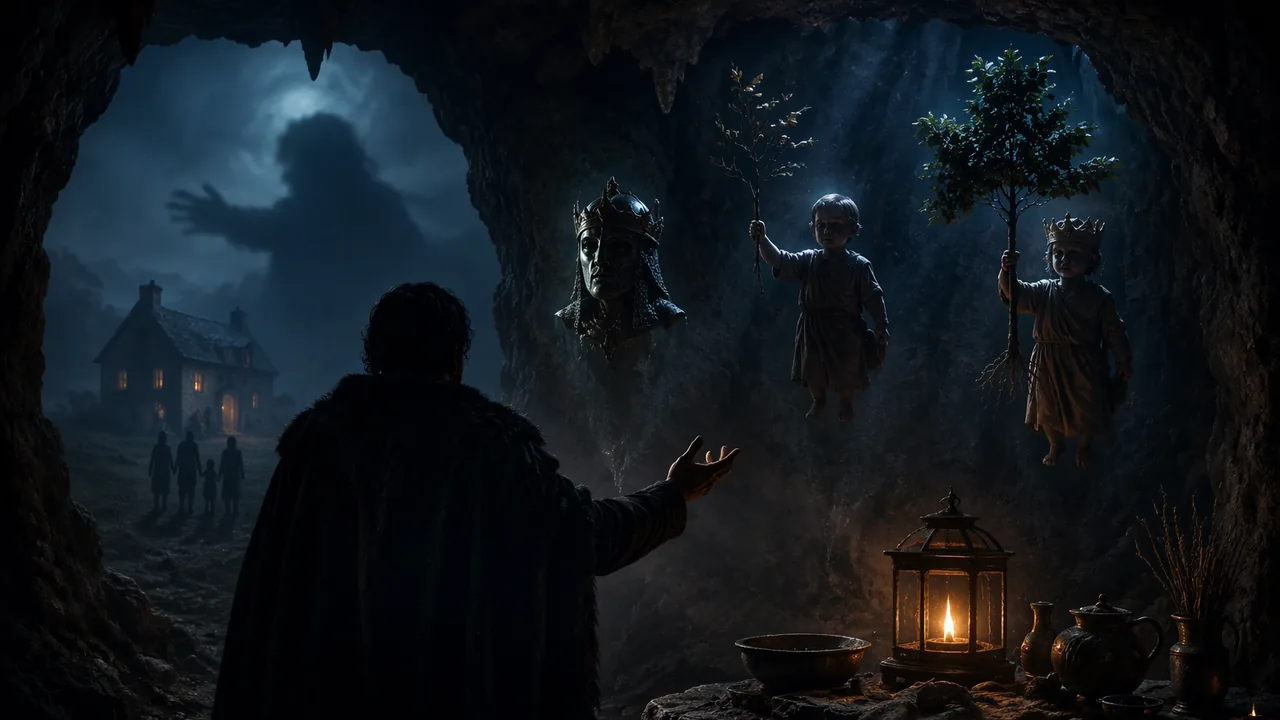
Three apparitions, two messages each. The first, an armed head, warns him: “Beware Macduff; / Beware the Thane of Fife.” The second, a bloody child, promises: “Laugh to scorn / The power of man, for none of woman born / Shall harm Macbeth.” The third, a child crowned with a tree in his hand, adds that “Macbeth shall never vanquish’d be, until / Great Birnam wood to high Dunsinane hill / Shall come against him.” Notice the gap between what the apparitions say and what they are. The words reassure. The images, an armed head, a child covered in blood and a crowned child holding a branch, are strange things to send as comfort, and many readers take each one as a warning in disguise. This is equivocation, the Porter’s word from Act 2: the truth arranged so that the hearer will misunderstand it. The audience is given the chance to read the images; Macbeth listens only to the words.
Reassurance makes him more violent, not less. Told that no man born of woman can harm him, Macbeth first says, “Then live, Macduff: what need I fear of thee?” In the next breath he changes his mind: “But yet I’ll make assurance double sure, / And take a bond of fate. Thou shalt not live.” Hecate said in Act 3 that “security / Is mortals’ chiefest enemy,” and here is the proof: a man who believes himself safe stops counting what his violence costs.
The show of kings and the play’s first audience. Macbeth’s last demand is to know whether Banquo’s descendants will reign, and he is shown eight kings with the bloodied Banquo smiling behind them: “What, will the line stretch out to th’ crack of doom?” For the play’s first audience, around 1606, this was not abstract. King James, who had come to the English throne in 1603, was believed to descend from Banquo, and he had written a book on witchcraft. A play about a king-killer destroyed, a royal line that cannot be cut off, and witches whose promises deceive spoke directly to that audience’s beliefs about kingship and the supernatural. Reading the play well means knowing what those beliefs were, even when we do not share them.
“From this moment.” When Lennox reports that Macduff has fled to England, Macbeth makes a resolution that abolishes the long deliberations of Act 1: “From this moment / The very firstlings of my heart shall be / The firstlings of my hand.” No more soliloquies weighing consequences; thought and act will be the same thing. His first act under this rule is to order the death of Macduff’s “wife, his babes, and all unfortunate souls / That trace him in his line.” He could not end Banquo’s line, so he ends Macduff’s.
This murder happens on stage. Duncan died behind a door. Macduff’s son dies in front of us, after a scene of ordinary family life: a mother angry at a husband who has fled, and a quick, funny boy who works out that “the liars and swearers are fools: for there are liars and swearers enow to beat the honest men and hang up them.” Lady Macduff sees the world clearly. It is a place “where to do harm / Is often laudable; to do good sometime / Accounted dangerous folly,” and that clarity cannot save her. This time Shakespeare refuses the audience the corridor. The killing has no political use at all, and we are made to watch it.
What a man is. In scene 3, after a long test in which Malcolm pretends to be unfit to rule, Ross brings Macduff the news. Malcolm tells him to “Dispute it like a man,” and Macduff answers, “I shall do so; / But I must also feel it as a man.” Lady Macbeth defined manhood as the willingness to act without feeling. Macduff, the man who will face Macbeth at the end, defines it as the ability to grieve.
📖 Before this lesson, read: Macbeth, Act 4
The reading opens over the lesson; close it to come back to exactly where you were.
Formative check
Work through these before moving on. They are not graded — they tell you whether the standard below has landed yet.
After the second apparition promises that none of woman born shall harm him, Macbeth says “Then live, Macduff” and at once decides to kill him anyway. What does this change show?
Why would the show of eight kings descended from Banquo have mattered to the play’s first audience around 1606?
Macduff’s son is killed offstage, just as Duncan was.
Make a three-row prophecy chart, one row for each apparition in Act 4 scene 1: quote what it says, explain what Macbeth hears in it, and suggest what the image itself (the armed head, the bloody child, the crowned child with a tree) might really mean. Then write a short paragraph: how does the scene’s equivocation connect to its first audience’s beliefs about witches and kings?
How confident are you that you can explain how a play’s original cultural setting shapes what a scene means, using lines from the text as evidence?
Macbeth, Act 4
Macbeth, Act 4, Scene 1: A dark Cave. In the middle, a Cauldron Boiling.
Source: William Shakespeare, Macbeth (c. 1606), Project Gutenberg eBook #1533 (gutenberg.org) · Public domain
Thunder. Enter the three Witches.
FIRST WITCH.
Thrice the brinded cat hath mew’d.
SECOND WITCH.
Thrice, and once the hedge-pig whin’d.
THIRD WITCH.
Harpier cries:—’Tis time, ’tis time.
FIRST WITCH.
Round about the cauldron go;
In the poison’d entrails throw.—
Toad, that under cold stone
Days and nights has thirty-one
Swelter’d venom sleeping got,
Boil thou first i’ th’ charmed pot!
ALL.
Double, double, toil and trouble;
Fire, burn; and cauldron, bubble.
SECOND WITCH.
Fillet of a fenny snake,
In the cauldron boil and bake;
Eye of newt, and toe of frog,
Wool of bat, and tongue of dog,
Adder’s fork, and blind-worm’s sting,
Lizard’s leg, and howlet’s wing,
For a charm of powerful trouble,
Like a hell-broth boil and bubble.
ALL.
Double, double, toil and trouble;
Fire, burn; and cauldron, bubble.
THIRD WITCH.
Scale of dragon, tooth of wolf,
Witch’s mummy, maw and gulf
Of the ravin’d salt-sea shark,
Root of hemlock digg’d i’ th’ dark,
Liver of blaspheming Jew,
Gall of goat, and slips of yew
Sliver’d in the moon’s eclipse,
Nose of Turk, and Tartar’s lips,
Finger of birth-strangled babe
Ditch-deliver’d by a drab,
Make the gruel thick and slab:
Add thereto a tiger’s chaudron,
For th’ ingredients of our cauldron.
ALL.
Double, double, toil and trouble;
Fire, burn; and cauldron, bubble.
SECOND WITCH.
Cool it with a baboon’s blood.
Then the charm is firm and good.
Enter Hecate.
HECATE.
O, well done! I commend your pains,
And everyone shall share i’ th’ gains.
And now about the cauldron sing,
Like elves and fairies in a ring,
Enchanting all that you put in.
[Music and a song: “Black Spirits,” &c.]
[Exit Hecate.]
SECOND WITCH.
By the pricking of my thumbs,
Something wicked this way comes.
Open, locks,
Whoever knocks!
Enter Macbeth.
MACBETH.
How now, you secret, black, and midnight hags!
What is’t you do?
ALL.
A deed without a name.
MACBETH.
I conjure you, by that which you profess,
(Howe’er you come to know it) answer me:
Though you untie the winds, and let them fight
Against the churches; though the yesty waves
Confound and swallow navigation up;
Though bladed corn be lodg’d, and trees blown down;
Though castles topple on their warders’ heads;
Though palaces and pyramids do slope
Their heads to their foundations; though the treasure
Of nature’s germens tumble all together,
Even till destruction sicken, answer me
To what I ask you.
FIRST WITCH.
Speak.
SECOND WITCH.
Demand.
THIRD WITCH.
We’ll answer.
FIRST WITCH.
Say, if thou’dst rather hear it from our mouths,
Or from our masters?
MACBETH.
Call ’em, let me see ’em.
FIRST WITCH.
Pour in sow’s blood, that hath eaten
Her nine farrow; grease that’s sweaten
From the murderer’s gibbet throw
Into the flame.
ALL.
Come, high or low;
Thyself and office deftly show!
[Thunder. An Apparition of an armed Head rises.]
MACBETH.
Tell me, thou unknown power,—
FIRST WITCH.
He knows thy thought:
Hear his speech, but say thou naught.
APPARITION.
Macbeth! Macbeth! Macbeth! Beware Macduff;
Beware the Thane of Fife.—Dismiss me.—Enough.
[Descends.]
MACBETH.
Whate’er thou art, for thy good caution, thanks;
Thou hast harp’d my fear aright.—But one word more.
FIRST WITCH.
He will not be commanded. Here’s another,
More potent than the first.
[Thunder. An Apparition of a bloody Child rises.]
APPARITION.
Macbeth! Macbeth! Macbeth!
MACBETH.
Had I three ears, I’d hear thee.
APPARITION.
Be bloody, bold, and resolute. Laugh to scorn
The power of man, for none of woman born
Shall harm Macbeth.
[Descends.]
MACBETH.
Then live, Macduff: what need I fear of thee?
But yet I’ll make assurance double sure,
And take a bond of fate. Thou shalt not live;
That I may tell pale-hearted fear it lies,
And sleep in spite of thunder.
[_Thunder. An Apparition of a Child crowned, with a tree in his hand, rises._]
What is this, That rises like the issue of a king, And wears upon his baby brow the round And top of sovereignty?
ALL.
Listen, but speak not to’t.
APPARITION.
Be lion-mettled, proud, and take no care
Who chafes, who frets, or where conspirers are:
Macbeth shall never vanquish’d be, until
Great Birnam wood to high Dunsinane hill
Shall come against him.
[Descends.]
MACBETH.
That will never be:
Who can impress the forest; bid the tree
Unfix his earth-bound root? Sweet bodements, good!
Rebellious head, rise never till the wood
Of Birnam rise, and our high-plac’d Macbeth
Shall live the lease of nature, pay his breath
To time and mortal custom.—Yet my heart
Throbs to know one thing: tell me, if your art
Can tell so much, shall Banquo’s issue ever
Reign in this kingdom?
ALL.
Seek to know no more.
MACBETH.
I will be satisfied: deny me this,
And an eternal curse fall on you! Let me know.
Why sinks that cauldron? and what noise is this?
[Hautboys.]
FIRST WITCH.
Show!
SECOND WITCH.
Show!
THIRD WITCH.
Show!
ALL.
Show his eyes, and grieve his heart;
Come like shadows, so depart!
[_A show of eight kings appear, and pass over in order, the last with a glass in his hand; Banquo following._]
MACBETH.
Thou are too like the spirit of Banquo. Down!
Thy crown does sear mine eyeballs:—and thy hair,
Thou other gold-bound brow, is like the first.
A third is like the former.—Filthy hags!
Why do you show me this?—A fourth!—Start, eyes!
What, will the line stretch out to th’ crack of doom?
Another yet!—A seventh!—I’ll see no more:—
And yet the eighth appears, who bears a glass
Which shows me many more; and some I see
That twofold balls and treble sceptres carry.
Horrible sight!—Now I see ’tis true;
For the blood-bolter’d Banquo smiles upon me,
And points at them for his.—What! is this so?
FIRST WITCH.
Ay, sir, all this is so:—but why
Stands Macbeth thus amazedly?—
Come, sisters, cheer we up his sprites,
And show the best of our delights.
I’ll charm the air to give a sound,
While you perform your antic round;
That this great king may kindly say,
Our duties did his welcome pay.
[Music. The Witches dance, and vanish.]
MACBETH.
Where are they? Gone?—Let this pernicious hour
Stand aye accursed in the calendar!—
Come in, without there!
Enter Lennox.
LENNOX.
What’s your Grace’s will?
MACBETH.
Saw you the Weird Sisters?
LENNOX.
No, my lord.
MACBETH.
Came they not by you?
LENNOX.
No, indeed, my lord.
MACBETH.
Infected be the air whereon they ride;
And damn’d all those that trust them!—I did hear
The galloping of horse: who was’t came by?
LENNOX.
’Tis two or three, my lord, that bring you word
Macduff is fled to England.
MACBETH.
Fled to England!
LENNOX.
Ay, my good lord.
MACBETH.
Time, thou anticipat’st my dread exploits:
The flighty purpose never is o’ertook
Unless the deed go with it. From this moment
The very firstlings of my heart shall be
The firstlings of my hand. And even now,
To crown my thoughts with acts, be it thought and done:
The castle of Macduff I will surprise;
Seize upon Fife; give to th’ edge o’ th’ sword
His wife, his babes, and all unfortunate souls
That trace him in his line. No boasting like a fool;
This deed I’ll do before this purpose cool:
But no more sights!—Where are these gentlemen?
Come, bring me where they are.
[Exeunt.]
Macbeth, Act 4, Scene 2: Fife. A Room in Macduff’s Castle.
Source: William Shakespeare, Macbeth (c. 1606), Project Gutenberg eBook #1533 (gutenberg.org) · Public domain
Enter Lady Macduff her Son and Ross.
LADY MACDUFF.
What had he done, to make him fly the land?
ROSS.
You must have patience, madam.
LADY MACDUFF.
He had none:
His flight was madness: when our actions do not,
Our fears do make us traitors.
ROSS.
You know not
Whether it was his wisdom or his fear.
LADY MACDUFF.
Wisdom! to leave his wife, to leave his babes,
His mansion, and his titles, in a place
From whence himself does fly? He loves us not:
He wants the natural touch; for the poor wren,
The most diminutive of birds, will fight,
Her young ones in her nest, against the owl.
All is the fear, and nothing is the love;
As little is the wisdom, where the flight
So runs against all reason.
ROSS.
My dearest coz,
I pray you, school yourself: but, for your husband,
He is noble, wise, judicious, and best knows
The fits o’ th’ season. I dare not speak much further:
But cruel are the times, when we are traitors,
And do not know ourselves; when we hold rumour
From what we fear, yet know not what we fear,
But float upon a wild and violent sea
Each way and move—I take my leave of you:
Shall not be long but I’ll be here again.
Things at the worst will cease, or else climb upward
To what they were before.—My pretty cousin,
Blessing upon you!
LADY MACDUFF.
Father’d he is, and yet he’s fatherless.
ROSS.
I am so much a fool, should I stay longer,
It would be my disgrace and your discomfort:
I take my leave at once.
[Exit.]
LADY MACDUFF.
Sirrah, your father’s dead.
And what will you do now? How will you live?
SON.
As birds do, mother.
LADY MACDUFF.
What, with worms and flies?
SON.
With what I get, I mean; and so do they.
LADY MACDUFF.
Poor bird! thou’dst never fear the net nor lime,
The pit-fall nor the gin.
SON.
Why should I, mother? Poor birds they are not set for.
My father is not dead, for all your saying.
LADY MACDUFF.
Yes, he is dead: how wilt thou do for a father?
SON.
Nay, how will you do for a husband?
LADY MACDUFF.
Why, I can buy me twenty at any market.
SON.
Then you’ll buy ’em to sell again.
LADY MACDUFF.
Thou speak’st with all thy wit;
And yet, i’ faith, with wit enough for thee.
SON.
Was my father a traitor, mother?
LADY MACDUFF.
Ay, that he was.
SON.
What is a traitor?
LADY MACDUFF.
Why, one that swears and lies.
SON.
And be all traitors that do so?
LADY MACDUFF.
Every one that does so is a traitor, and must be hanged.
SON.
And must they all be hanged that swear and lie?
LADY MACDUFF.
Every one.
SON.
Who must hang them?
LADY MACDUFF.
Why, the honest men.
SON.
Then the liars and swearers are fools: for there are liars and swearers
enow to beat the honest men and hang up them.
LADY MACDUFF.
Now, God help thee, poor monkey! But how wilt thou do for a father?
SON.
If he were dead, you’ld weep for him: if you would not, it were a good
sign that I should quickly have a new father.
LADY MACDUFF.
Poor prattler, how thou talk’st!
Enter a Messenger.
MESSENGER.
Bless you, fair dame! I am not to you known,
Though in your state of honour I am perfect.
I doubt some danger does approach you nearly:
If you will take a homely man’s advice,
Be not found here; hence, with your little ones.
To fright you thus, methinks, I am too savage;
To do worse to you were fell cruelty,
Which is too nigh your person. Heaven preserve you!
I dare abide no longer.
[Exit.]
LADY MACDUFF.
Whither should I fly?
I have done no harm. But I remember now
I am in this earthly world, where to do harm
Is often laudable; to do good sometime
Accounted dangerous folly: why then, alas,
Do I put up that womanly defence,
To say I have done no harm? What are these faces?
Enter Murderers.
FIRST MURDERER.
Where is your husband?
LADY MACDUFF.
I hope, in no place so unsanctified
Where such as thou mayst find him.
FIRST MURDERER.
He’s a traitor.
SON.
Thou liest, thou shag-ear’d villain!
FIRST MURDERER.
What, you egg!
[Stabbing him.]
Young fry of treachery!
SON.
He has kill’d me, mother:
Run away, I pray you!
[_Dies. Exit Lady Macduff, crying “Murder!” and pursued by the Murderers._]
Macbeth, Act 4, Scene 3: England. Before the King’s Palace. Bridge summary — not the primary text
This is a short recap written for this course, not William Shakespeare’s own words, so you can follow the story between close-reading lessons.
{summary}