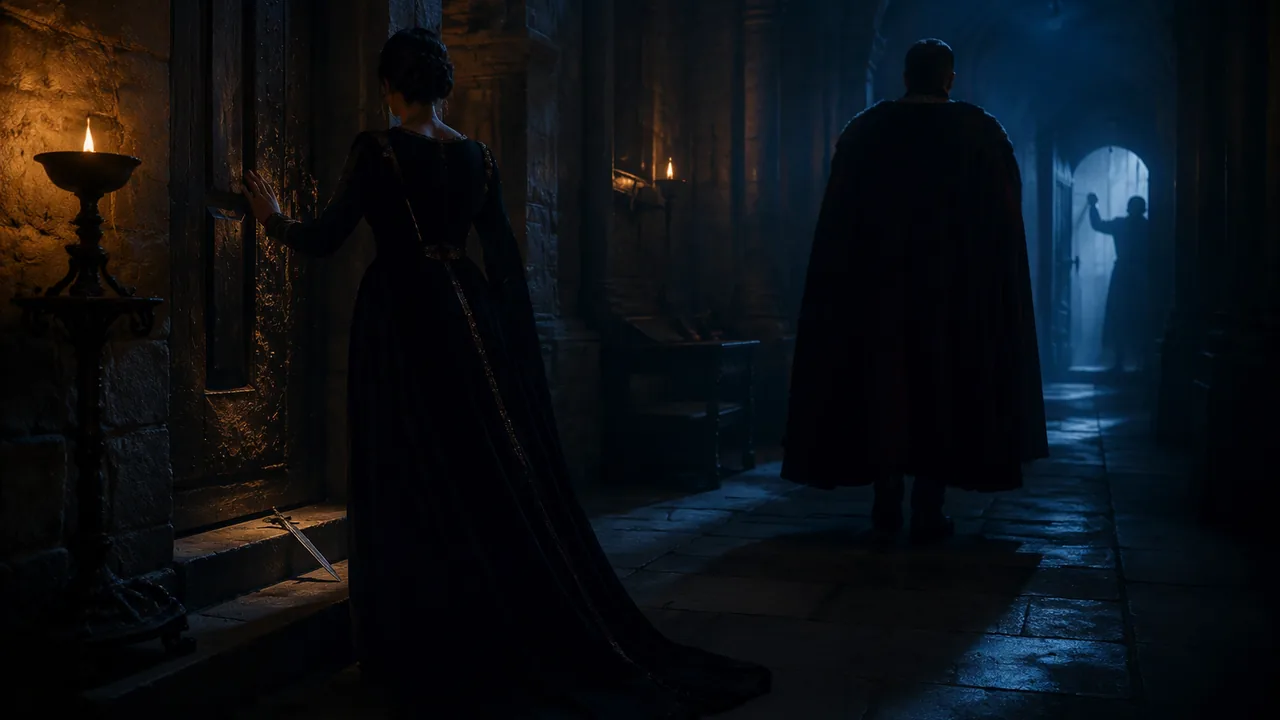
trace how Shakespeare moves Macbeth and Lady Macbeth in opposite directions across the night of the murder, and explain how the offstage killing, the knocking and the Porter shape what the audience experiences.
Instruction
Act 2 covers a single night and the morning after it, and Shakespeare spends it almost entirely on what happens around a murder rather than on the murder itself. Read it as a study in what a play can do by withholding.
The dagger comes after the decision. Scene 1 opens with Banquo, who has also dreamed of the witches and cannot sleep. He prays, “Restrain in me the cursed thoughts that nature / Gives way to in repose!” The play sets his resistance directly beside what follows. Alone, Macbeth sees a dagger, “The handle toward my hand.” He tests it the way a sane man would: he reaches for it, fails to grasp it, and asks whether it is “A dagger of the mind, a false creation.” The key line tells us what the vision does: “Thou marshall’st me the way that I was going.” The dagger does not tempt him toward anything new. It points down a road he has already chosen, and when it grows “gouts of blood, / Which was not so before,” his imagination is simply running ahead of his hand. The speech ends in a rhymed couplet, “Hear it not, Duncan, for it is a knell / That summons thee to heaven or to hell,” and the click of the rhyme is the sound of a decision closing.
The murder happens offstage. Scene 2 gives us Lady Macbeth waiting, and her first line already has a crack in it: “That which hath made them drunk hath made me bold.” Her boldness came from the same cup as the grooms’ sleep. A few lines later she admits why she did not kill the king herself: “Had he not resembled / My father as he slept, I had done’t.” The woman who asked the spirits to unsex her in Act 1 was stopped by a sleeping old man’s face. When Macbeth returns, the verse breaks into pieces (“When?” “Now.” “As I descended?” “Ay.”), single words passed between two frightened people listening for footsteps. Look at the shape of those lines on the page; the fear is in the rhythm before it is in the words.
The two of them move in opposite directions. Macbeth fixes on what he could not do and what he heard: he could not say “Amen,” and a voice cried “Sleep no more!” Lady Macbeth answers with practical orders, “Go get some water, / And wash this filthy witness from your hand,” and when he refuses to go back to the chamber she takes the daggers herself: “Infirm of purpose!” His image of guilt is enormous: “Will all great Neptune’s ocean wash this blood / Clean from my hand?” Hers is small and confident: “A little water clears us of this deed.” Hold on to that line. The play has not finished with it.
The knocking and the Porter. The knocking begins while the Macbeths still have blood on their hands and carries straight into scene 3, where a drunken Porter pretends to be the gatekeeper of hell, welcoming a farmer, a tailor and “an equivocator, that could swear in both the scales against either scale.” The comedy here is not relief. It stretches the time between the crime and its discovery, keeps the audience waiting with the murderers, and plants a word, equivocation (a truth spoken so as to deceive), that the witches will make good on later in the play.
Morning. When the murder is discovered, Macbeth performs grief: “Had I but died an hour before this chance, / I had liv’d a blessed time.” The audience hears a lie, and also a truth Macbeth does not intend. He kills the grooms before they can speak, Duncan’s sons flee, and by scene 4 Macbeth has been named king, while Macduff pointedly goes home to Fife instead of to the coronation.
As you read, keep two columns for each of the Macbeths: how they speak before the murder and how they speak after it. Then ask which of them seems stronger at the end of the act, and which line makes you doubt it will stay that way.
📖 Before this lesson, read: Macbeth, Act 2
The reading opens over the lesson; close it to come back to exactly where you were.
Formative check
Work through these before moving on. They are not graded — they tell you whether the standard below has landed yet.
Macbeth tells the imagined dagger, “Thou marshall’st me the way that I was going.” What does the line suggest about the vision’s role?
In Act 2 scene 2, Lady Macbeth says she did not kill Duncan herself because the grooms might wake.
Macbeth asks whether all great ‘s ocean can wash the blood from his hand; Lady Macbeth answers that a little clears us of this deed.
Build a two-column chart for each of the Macbeths: how each speaks and acts before the murder (scene 1 and the opening of scene 2) and after it (the rest of scene 2). Quote at least one line in each column, cited by act and scene. Then write a short paragraph: at the end of Act 2, which of them seems stronger, and which line from scene 2 makes you doubt that this will last? Add one sentence on what the Porter’s scene does to the audience’s sense of time.
How confident are you that you can explain how Shakespeare develops both Macbeths across the murder scene, using quoted lines rather than plot summary?
Macbeth, Act 2
Macbeth, Act 2, Scene 1: Inverness. Court within the Castle.
Source: William Shakespeare, Macbeth (c. 1606), Project Gutenberg eBook #1533 (gutenberg.org) · Public domain
Enter Banquo and Fleance with a torch before him.
BANQUO.
How goes the night, boy?
FLEANCE.
The moon is down; I have not heard the clock.
BANQUO.
And she goes down at twelve.
FLEANCE.
I take’t, ’tis later, sir.
BANQUO.
Hold, take my sword.—There’s husbandry in heaven;
Their candles are all out. Take thee that too.
A heavy summons lies like lead upon me,
And yet I would not sleep. Merciful powers,
Restrain in me the cursed thoughts that nature
Gives way to in repose!
Enter Macbeth and a Servant with a torch.
Give me my sword.—Who’s there?
MACBETH.
A friend.
BANQUO.
What, sir, not yet at rest? The King’s abed:
He hath been in unusual pleasure and
Sent forth great largess to your offices.
This diamond he greets your wife withal,
By the name of most kind hostess, and shut up
In measureless content.
MACBETH.
Being unprepar’d,
Our will became the servant to defect,
Which else should free have wrought.
BANQUO.
All’s well.
I dreamt last night of the three Weird Sisters:
To you they have show’d some truth.
MACBETH.
I think not of them:
Yet, when we can entreat an hour to serve,
We would spend it in some words upon that business,
If you would grant the time.
BANQUO.
At your kind’st leisure.
MACBETH.
If you shall cleave to my consent, when ’tis,
It shall make honour for you.
BANQUO.
So I lose none
In seeking to augment it, but still keep
My bosom franchis’d, and allegiance clear,
I shall be counsell’d.
MACBETH.
Good repose the while!
BANQUO.
Thanks, sir: the like to you.
[Exeunt Banquo and Fleance.]
MACBETH.
Go bid thy mistress, when my drink is ready,
She strike upon the bell. Get thee to bed.
[Exit Servant.]
Is this a dagger which I see before me, The handle toward my hand? Come, let me clutch thee:— I have thee not, and yet I see thee still. Art thou not, fatal vision, sensible To feeling as to sight? or art thou but A dagger of the mind, a false creation, Proceeding from the heat-oppressed brain? I see thee yet, in form as palpable As this which now I draw. Thou marshall’st me the way that I was going; And such an instrument I was to use. Mine eyes are made the fools o’ the other senses, Or else worth all the rest: I see thee still; And on thy blade and dudgeon, gouts of blood, Which was not so before.—There’s no such thing. It is the bloody business which informs Thus to mine eyes.—Now o’er the one half-world Nature seems dead, and wicked dreams abuse The curtain’d sleep. Witchcraft celebrates Pale Hecate’s off’rings; and wither’d murder, Alarum’d by his sentinel, the wolf, Whose howl’s his watch, thus with his stealthy pace, With Tarquin’s ravishing strides, towards his design Moves like a ghost.—Thou sure and firm-set earth, Hear not my steps, which way they walk, for fear Thy very stones prate of my whereabout, And take the present horror from the time, Which now suits with it.—Whiles I threat, he lives. Words to the heat of deeds too cold breath gives.
[A bell rings.]
I go, and it is done. The bell invites me. Hear it not, Duncan, for it is a knell That summons thee to heaven or to hell.
[Exit.]
Macbeth, Act 2, Scene 2: The same.
Source: William Shakespeare, Macbeth (c. 1606), Project Gutenberg eBook #1533 (gutenberg.org) · Public domain
Enter Lady Macbeth.
LADY MACBETH.
That which hath made them drunk hath made me bold:
What hath quench’d them hath given me fire.—Hark!—Peace!
It was the owl that shriek’d, the fatal bellman,
Which gives the stern’st good night. He is about it.
The doors are open; and the surfeited grooms
Do mock their charge with snores: I have drugg’d their possets,
That death and nature do contend about them,
Whether they live or die.
MACBETH.
[Within.] Who’s there?—what, ho!
LADY MACBETH.
Alack! I am afraid they have awak’d,
And ’tis not done. Th’ attempt and not the deed
Confounds us.—Hark!—I laid their daggers ready;
He could not miss ’em.—Had he not resembled
My father as he slept, I had done’t.—My husband!
Enter Macbeth.
MACBETH.
I have done the deed.—Didst thou not hear a noise?
LADY MACBETH.
I heard the owl scream and the crickets cry.
Did not you speak?
MACBETH.
When?
LADY MACBETH.
Now.
MACBETH.
As I descended?
LADY MACBETH.
Ay.
MACBETH.
Hark!—Who lies i’ th’ second chamber?
LADY MACBETH.
Donalbain.
MACBETH.
This is a sorry sight.
[Looking on his hands.]
LADY MACBETH.
A foolish thought, to say a sorry sight.
MACBETH.
There’s one did laugh in’s sleep, and one cried, “Murder!”
That they did wake each other: I stood and heard them.
But they did say their prayers, and address’d them
Again to sleep.
LADY MACBETH.
There are two lodg’d together.
MACBETH.
One cried, “God bless us!” and, “Amen,” the other,
As they had seen me with these hangman’s hands.
List’ning their fear, I could not say “Amen,”
When they did say, “God bless us.”
LADY MACBETH.
Consider it not so deeply.
MACBETH.
But wherefore could not I pronounce “Amen”?
I had most need of blessing, and “Amen”
Stuck in my throat.
LADY MACBETH.
These deeds must not be thought
After these ways; so, it will make us mad.
MACBETH.
Methought I heard a voice cry, “Sleep no more!
Macbeth does murder sleep,”—the innocent sleep;
Sleep that knits up the ravell’d sleave of care,
The death of each day’s life, sore labour’s bath,
Balm of hurt minds, great nature’s second course,
Chief nourisher in life’s feast.
LADY MACBETH.
What do you mean?
MACBETH.
Still it cried, “Sleep no more!” to all the house:
“Glamis hath murder’d sleep, and therefore Cawdor
Shall sleep no more. Macbeth shall sleep no more!”
LADY MACBETH.
Who was it that thus cried? Why, worthy thane,
You do unbend your noble strength to think
So brainsickly of things. Go get some water,
And wash this filthy witness from your hand.—
Why did you bring these daggers from the place?
They must lie there: go carry them, and smear
The sleepy grooms with blood.
MACBETH.
I’ll go no more:
I am afraid to think what I have done;
Look on’t again I dare not.
LADY MACBETH.
Infirm of purpose!
Give me the daggers. The sleeping and the dead
Are but as pictures. ’Tis the eye of childhood
That fears a painted devil. If he do bleed,
I’ll gild the faces of the grooms withal,
For it must seem their guilt.
[Exit. Knocking within.]
MACBETH.
Whence is that knocking?
How is’t with me, when every noise appals me?
What hands are here? Ha, they pluck out mine eyes!
Will all great Neptune’s ocean wash this blood
Clean from my hand? No, this my hand will rather
The multitudinous seas incarnadine,
Making the green one red.
Enter Lady Macbeth.
LADY MACBETH.
My hands are of your color, but I shame
To wear a heart so white. [Knocking within.] I hear knocking
At the south entry:—retire we to our chamber.
A little water clears us of this deed:
How easy is it then! Your constancy
Hath left you unattended.—[Knocking within.] Hark, more knocking.
Get on your nightgown, lest occasion call us
And show us to be watchers. Be not lost
So poorly in your thoughts.
MACBETH.
To know my deed, ’twere best not know myself. [Knocking within.]
Wake Duncan with thy knocking! I would thou couldst!
[Exeunt.]
Macbeth, Act 2, Scene 3: The same. Bridge summary — not the primary text
This is a short recap written for this course, not William Shakespeare’s own words, so you can follow the story between close-reading lessons.
{summary}Macbeth, Act 2, Scene 4: The same. Without the Castle. Bridge summary — not the primary text
This is a short recap written for this course, not William Shakespeare’s own words, so you can follow the story between close-reading lessons.
{summary}