delineate the Appendix’s argument, explain how Douglass’s distinction between “the Christianity of this land” and “the Christianity of Christ” answers critics who might call him an enemy of religion, and evaluate whether the distinction holds.
Instruction
The Narrative does not end with its last chapter. Douglass adds an Appendix, dated from Lynn, Massachusetts, in April 1845, and its first sentence tells you why: rereading the book, he worries that he has “spoken in such a tone and manner, respecting religion,” that readers may “suppose me an opponent of all religion.” The Appendix is a rebuttal written in advance: an answer to critics before they have spoken.
Why he needed it. You have seen the pattern across the book. Thomas Auld grows crueler after his conversion and quotes Scripture to justify a whipping. Covey, “a professor of religion,” prays loudly at home while working the people he holds past endurance. At Freeland’s, Douglass declares that “religious slaveholders are the worst.” In 1845 many readers would hear attacks like these as an attack on Christianity itself, and that charge could have discredited the whole book. Douglass needed to keep his evidence and remove the excuse to dismiss it.
The key move: a distinction. Douglass splits one word into two things: “between the Christianity of this land, and the Christianity of Christ, I recognize the widest possible difference.” Everything he has attacked belongs to the first; everything he values belongs to the second. Then he builds the distinction into one balanced sentence: “I love the pure, peaceable, and impartial Christianity of Christ: I therefore hate the corrupt, slaveholding, women-whipping, cradle-plundering, partial and hypocritical Christianity of this land.” Look at the adjectives. The first list is short and abstract; the second is long, concrete and violent, packed with compound words he has coined to name specific acts. The grammar makes the two religions mirror images, and the word therefore makes his hatred of one a logical consequence of his love for the other.
Proof by contrast. The middle of the Appendix is a chain of antitheses in which one person holds two roles that cannot both be honest: “The man who wields the blood-clotted cowskin during the week fills the pulpit on Sunday.” “The man who robs me of my earnings at the end of each week meets me as a class-leader on Sunday morning.” Each sentence is a small argument: the same subject, two predicates in conflict. Then Douglass turns the Bible against his opponents, quoting at length the condemnation of the “scribes and Pharisees, hypocrites.” This is the shared-premise strategy from Unit 3 in a new setting: he does not ask his readers to give up their faith, only to apply it.
Defining terms. Near the end, Douglass narrows his target precisely: by “the religion of this land” he means the churches, “north and south,” that remain “in union with slaveholders.” The phrase north and south matters, because it denies Northern readers the comfort of feeling exempt. He closes with a satirical hymn titled “A Parody” and then signs his name with a pledge to “the sacred cause.” As you read, delineate the argument — claim, evidence, link — and then decide whether the distinction holds, or whether a reader has grounds to push back.
📖 Before this lesson, read: Narrative of the Life of Frederick Douglass, Appendix
The reading opens over the lesson; close it to come back to exactly where you were.
Formative check
Work through these before moving on. They are not graded — they tell you whether the standard below has landed yet.
What criticism is the Appendix written to answer?
In “I love the pure, peaceable, and impartial Christianity of Christ: I therefore hate the corrupt, slaveholding … Christianity of this land,” the word therefore presents Douglass’s hatred as a logical consequence of his love.
Splitting one term into two meanings so that a criticism applies to only one is a ; professing a belief while acting against it is .
Delineate the Appendix’s argument: state Douglass’s claim in one sentence, quote two pieces of evidence he offers, and name the link that makes the evidence support the claim. Then evaluate it in two or three sentences: does the distinction between “the Christianity of this land” and “the Christianity of Christ” hold, and what is the strongest objection a reader in 1845 might have raised?
How confident are you that you can delineate an argument that answers its critics in advance, and judge whether its key distinction holds?
Narrative of the Life of Frederick Douglass, Appendix
Narrative of the Life of Frederick Douglass, Appendix (with “A Parody”)
Source: Frederick Douglass, Narrative of the Life of Frederick Douglass, an American Slave (Boston: Anti-Slavery Office, 1845), Project Gutenberg eBook #23 (gutenberg.org) · Public domain
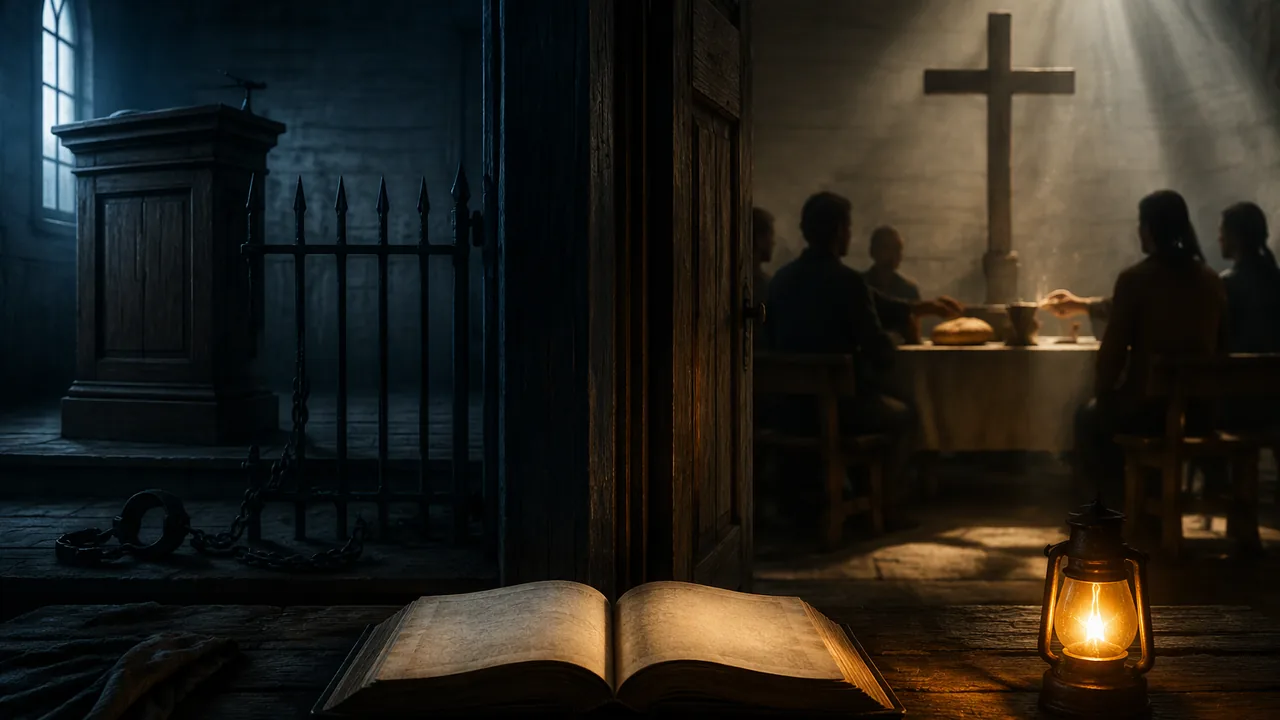
I find, since reading over the foregoing Narrative, that I have, in several instances, spoken in such a tone and manner, respecting religion, as may possibly lead those unacquainted with my religious views to suppose me an opponent of all religion. To remove the liability of such misapprehension, I deem it proper to append the following brief explanation. What I have said respecting and against religion, I mean strictly to apply to the slaveholding religion of this land, and with no possible reference to Christianity proper; for, between the Christianity of this land, and the Christianity of Christ, I recognize the widest possible difference—so wide, that to receive the one as good, pure, and holy, is of necessity to reject the other as bad, corrupt, and wicked. To be the friend of the one, is of necessity to be the enemy of the other. I love the pure, peaceable, and impartial Christianity of Christ: I therefore hate the corrupt, slaveholding, women-whipping, cradle-plundering, partial and hypocritical Christianity of this land. Indeed, I can see no reason, but the most deceitful one, for calling the religion of this land Christianity. I look upon it as the climax of all misnomers, the boldest of all frauds, and the grossest of all libels. Never was there a clearer case of “stealing the livery of the court of heaven to serve the devil in.” I am filled with unutterable loathing when I contemplate the religious pomp and show, together with the horrible inconsistencies, which every where surround me. We have men-stealers for ministers, women-whippers for missionaries, and cradle-plunderers for church members. The man who wields the blood-clotted cowskin during the week fills the pulpit on Sunday, and claims to be a minister of the meek and lowly Jesus. The man who robs me of my earnings at the end of each week meets me as a class-leader on Sunday morning, to show me the way of life, and the path of salvation. He who sells my sister, for purposes of prostitution, stands forth as the pious advocate of purity. He who proclaims it a religious duty to read the Bible denies me the right of learning to read the name of the God who made me. He who is the religious advocate of marriage robs whole millions of its sacred influence, and leaves them to the ravages of wholesale pollution. The warm defender of the sacredness of the family relation is the same that scatters whole families,—sundering husbands and wives, parents and children, sisters and brothers,—leaving the hut vacant, and the hearth desolate. We see the thief preaching against theft, and the adulterer against adultery. We have men sold to build churches, women sold to support the gospel, and babes sold to purchase Bibles for the Poor Heathen! All For The Glory Of God And The Good Of Souls! The slave auctioneer’s bell and the church-going bell chime in with each other, and the bitter cries of the heart-broken slave are drowned in the religious shouts of his pious master. Revivals of religion and revivals in the slave-trade go hand in hand together. The slave prison and the church stand near each other. The clanking of fetters and the rattling of chains in the prison, and the pious psalm and solemn prayer in the church, may be heard at the same time. The dealers in the bodies and souls of men erect their stand in the presence of the pulpit, and they mutually help each other. The dealer gives his blood-stained gold to support the pulpit, and the pulpit, in return, covers his infernal business with the garb of Christianity. Here we have religion and robbery the allies of each other—devils dressed in angels’ robes, and hell presenting the semblance of paradise.
“Just God! and these are they,v Who minister at thine altar, God of right! Men who their hands, with prayer and blessing, lay On Israel’s ark of light.
“What! preach, and kidnap men? Give thanks, and rob thy own afflicted poor? Talk of thy glorious liberty, and then Bolt hard the captive’s door?
“What! servants of thy own Merciful Son, who came to seek and save The homeless and the outcast, fettering down The tasked and plundered slave!
“Pilate and Herod friends! Chief priests and rulers, as of old, combine! Just God and holy! is that church which lends Strength to the spoiler thine?”
The Christianity of America is a Christianity, of whose votaries it may be as truly said, as it was of the ancient scribes and Pharisees, “They bind heavy burdens, and grievous to be borne, and lay them on men’s shoulders, but they themselves will not move them with one of their fingers. All their works they do for to be seen of men.—They love the uppermost rooms at feasts, and the chief seats in the synagogues, . . . . . . and to be called of men, Rabbi, Rabbi.—But woe unto you, scribes and Pharisees, hypocrites! for ye shut up the kingdom of heaven against men; for ye neither go in yourselves, neither suffer ye them that are entering to go in. Ye devour widows’ houses, and for a pretence make long prayers; therefore ye shall receive the greater damnation. Ye compass sea and land to make one proselyte, and when he is made, ye make him twofold more the child of hell than yourselves.—Woe unto you, scribes and Pharisees, hypocrites! for ye pay tithe of mint, and anise, and cumin, and have omitted the weightier matters of the law, judgment, mercy, and faith; these ought ye to have done, and not to leave the other undone. Ye blind guides! which strain at a gnat, and swallow a camel. Woe unto you, scribes and Pharisees, hypocrites! for ye make clean the outside of the cup and of the platter; but within, they are full of extortion and excess.—Woe unto you, scribes and Pharisees, hypocrites! for ye are like unto whited sepulchres, which indeed appear beautiful outward, but are within full of dead men’s bones, and of all uncleanness. Even so ye also outwardly appear righteous unto men, but within ye are full of hypocrisy and iniquity.”
Dark and terrible as is this picture, I hold it to be strictly true of the overwhelming mass of professed Christians in America. They strain at a gnat, and swallow a camel. Could any thing be more true of our churches? They would be shocked at the proposition of fellowshipping a sheep-stealer; and at the same time they hug to their communion a man-stealer, and brand me with being an infidel, if I find fault with them for it. They attend with Pharisaical strictness to the outward forms of religion, and at the same time neglect the weightier matters of the law, judgment, mercy, and faith. They are always ready to sacrifice, but seldom to show mercy. They are they who are represented as professing to love God whom they have not seen, whilst they hate their brother whom they have seen. They love the heathen on the other side of the globe. They can pray for him, pay money to have the Bible put into his hand, and missionaries to instruct him; while they despise and totally neglect the heathen at their own doors.
Such is, very briefly, my view of the religion of this land; and to avoid any misunderstanding, growing out of the use of general terms, I mean by the religion of this land, that which is revealed in the words, deeds, and actions, of those bodies, north and south, calling themselves Christian churches, and yet in union with slaveholders. It is against religion, as presented by these bodies, that I have felt it my duty to testify.
I conclude these remarks by copying the following portrait of the religion of the south, (which is, by communion and fellowship, the religion of the north,) which I soberly affirm is “true to the life,” and without caricature or the slightest exaggeration. It is said to have been drawn, several years before the present anti-slavery agitation began, by a northern Methodist preacher, who, while residing at the south, had an opportunity to see slaveholding morals, manners, and piety, with his own eyes. “Shall I not visit for these things? saith the Lord. Shall not my soul be avenged on such a nation as this?”
A PARODY
“Come, saints and sinners, hear me tell How pious priests whip Jack and Nell, And women buy and children sell, And preach all sinners down to hell, And sing of heavenly union.
“They’ll bleat and baa, dona like goats, Gorge down black sheep, and strain at motes, Array their backs in fine black coats, Then seize their negroes by their throats, And choke, for heavenly union.
“They’ll church you if you sip a dram, And damn you if you steal a lamb; Yet rob old Tony, Doll, and Sam, Of human rights, and bread and ham; Kidnapper’s heavenly union.
“They’ll loudly talk of Christ’s reward, And bind his image with a cord, And scold, and swing the lash abhorred, And sell their brother in the Lord To handcuffed heavenly union.
“They’ll read and sing a sacred song, And make a prayer both loud and long, And teach the right and do the wrong, Hailing the brother, sister throng, With words of heavenly union.
“We wonder how such saints can sing, Or praise the Lord upon the wing, Who roar, and scold, and whip, and sting, And to their slaves and mammon cling, In guilty conscience union.
“They’ll raise tobacco, corn, and rye, And drive, and thieve, and cheat, and lie, And lay up treasures in the sky, By making switch and cowskin fly, In hope of heavenly union.
“They’ll crack old Tony on the skull, And preach and roar like Bashan bull, Or braying ass, of mischief full, Then seize old Jacob by the wool, And pull for heavenly union.
“A roaring, ranting, sleek man-thief, Who lived on mutton, veal, and beef, Yet never would afford relief To needy, sable sons of grief, Was big with heavenly union.
“‘Love not the world,’ the preacher said, And winked his eye, and shook his head; He seized on Tom, and Dick, and Ned, Cut short their meat, and clothes, and bread, Yet still loved heavenly union.
“Another preacher whining spoke Of One whose heart for sinners broke: He tied old Nanny to an oak, And drew the blood at every stroke, And prayed for heavenly union.
“Two others oped their iron jaws, And waved their children-stealing paws; There sat their children in gewgaws; By stinting negroes’ backs and maws, They kept up heavenly union.
“All good from Jack another takes, And entertains their flirts and rakes, Who dress as sleek as glossy snakes, And cram their mouths with sweetened cakes; And this goes down for union.”
Sincerely and earnestly hoping that this little book may do something toward throwing light on the American slave system, and hastening the glad day of deliverance to the millions of my brethren in bonds—faithfully relying upon the power of truth, love, and justice, for success in my humble efforts—and solemnly pledging my self anew to the sacred cause,—I subscribe myself,
FREDERICK DOUGLASS.
LYNN, Mass., April 28, 1845.