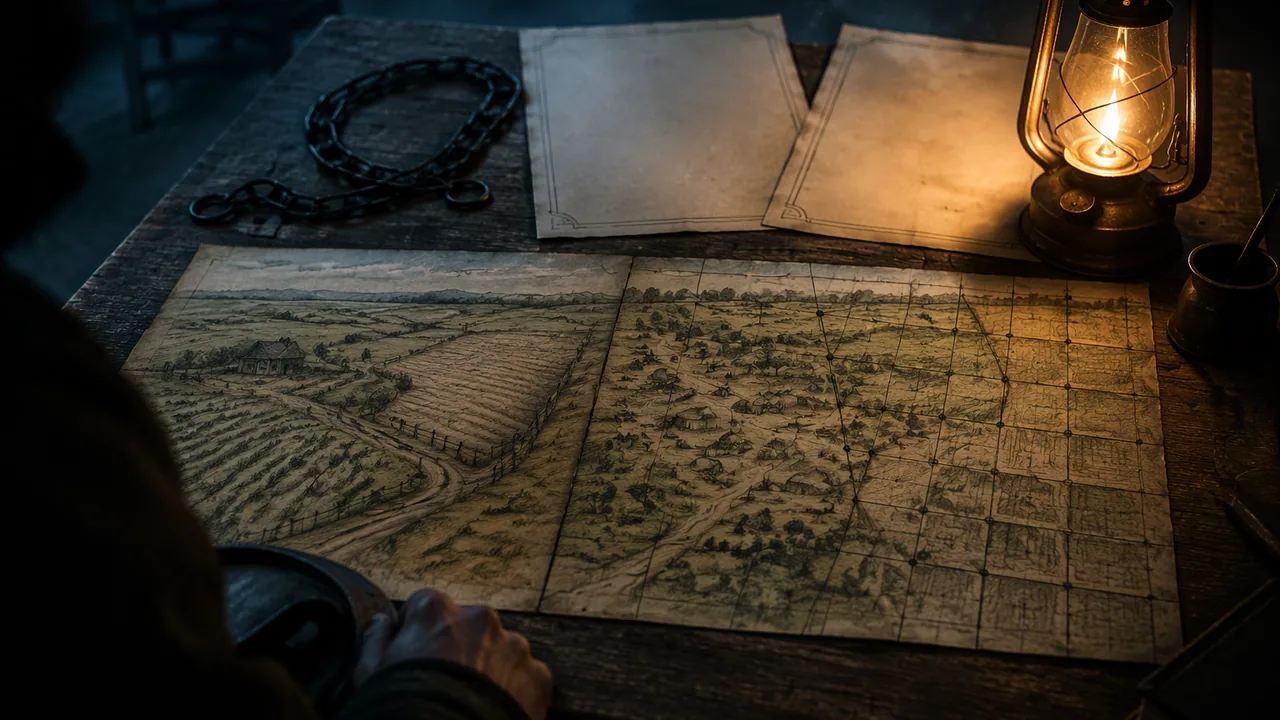
delineate the reasoning and purposes of the Homestead Act and the Dawes Act, evaluate what My Ántonia shows and leaves out about the land they governed, and respond to diverse perspectives, including those of the Native nations the novel barely mentions.
Instruction
11-12.RI.2.D asks you to delineate and evaluate the reasoning in seminal U.S. texts, including legal reasoning and the premises, purposes and arguments of public documents. Two federal statutes shaped the land of My Ántonia. This seminar reads them beside Book II and asks what the novel shows about them, and what it does not.
The Homestead Act (1862). Its purpose is in its title: to “secure Homesteads to actual Settlers on the Public Domain.” Its premises: that public land should go to people who would live on it and farm it, not to speculators; that a citizen, or an immigrant who had declared the intention to become one, could earn a farm with labor instead of money. Its procedure: an affidavit that the claim is “for the purpose of actual settlement and cultivation,” a ten-dollar fee, five years of residence, two witnesses, and then a patent, the government’s deed. Section 4 protects the claim from old debts; Section 5 says abandoned land “shall revert to the government.” Measure the novel against this. The Burdens’ farm has become property that can be rented: in Book II, Chapter 1, “our homestead was rented to ‘that good woman, the Widow Steavens.'” The Shimerdas “bought the homestead” from Krajiek, though the Act required the settler to swear the claim was for his “exclusive use and benefit.” The law’s promise was real, and Ántonia works for it: “I help make this land one good farm.” But the law did not protect the families from money-lenders, bad bargains or brothers who collected their sisters’ wages.
The Dawes Act (1887). Twenty-five years later Congress turned the same tools, survey, quarter section, patent, on the reservations. The General Allotment Act authorized the President to survey a reservation and allot it “in severalty,” that is, to individuals: a quarter section to each head of a family, smaller shares to others. The government would hold each allotment “in trust” for twenty-five years. The land left over after allotment could be bought from the tribe and opened to “actual settlers,” in homestead-sized tracts. Allottees who adopted “the habits of civilized life” were declared citizens. Delineate its premises honestly: that land held in common by a nation was a problem to be solved, that Native people should become individual farmers on the settlers’ model, and that their cultures were something to be left behind.
What it did. The results were devastating. Land held by Native nations fell from about 138 million acres in 1887 to about 48 million acres by 1934, when Congress ended allotment. Unallotted land, which officials called surplus, was sold to settlers; many allotments were lost after the trust period through debt, taxes and fraud; tribal governments and ways of life were deliberately broken up. In Nebraska itself the Pawnee, whose homeland included the country Cather describes, had ceded their lands by treaty and been moved to Indian Territory in the 1870s, before the Burdens arrive. Native nations survived this policy and still govern their own lands today; their dispossession is part of the history on which the novel’s farms stand.
The novel’s silence (11-12.SL.1.C). My Ántonia mentions Native people only as traces: “a great circle where the Indians used to ride,” a snake “left on from buffalo and Indian times,” a face with “something Indian-like” in it. 11-12.SL.1.C asks you to respond thoughtfully to diverse perspectives and resolve contradictions where possible. A strong seminar can hold two truths at once: the novel honors the immigrant families who broke this sod, and it renders almost invisible the people from whom the land was taken.
Preparation (11-12.SL.1.A). Bring your delineation chart and three passages: one about owning or renting land, one about work or wages, and one Native trace. Every claim must point to a section of a statute or a chapter of the novel. Content note: Book II, Chapter 7 describes the Black pianist Blind d’Arnault in openly racist language of its period; quote it only as evidence of the narrator’s and the town’s attitudes.
📖 Before this lesson, read: My Ántonia, Book II, Chapters 1-8
The reading opens over the lesson; close it to come back to exactly where you were.
Reading: Statute and novel: the positions the seminar argues from
An Act to secure Homesteads to actual Settlers on the Public Domain, 37th Congress, ch. 75, 12 Stat. 392 (May 20, 1862), via Wikisource (https://en.wikisource.org/wiki/Homestead_Act); An Act to provide for the allotment of lands in severalty to Indians on the various reservations, 49th Congress, ch. 119, 24 Stat. 388 (February 8, 1887), via Wikisource (https://en.wikisource.org/wiki/Dawes_Act); Willa Cather, My Ántonia (Boston: Houghton Mifflin, 1918), Project Gutenberg eBook #242; all retrieved 2026-11-02. Identifiers: 12 Stat. 392; 24 Stat. 388; Project Gutenberg ebook 242 (My Ántonia) · SLS original; quoted passages are public domain (U.S. statutes of 1862 and 1887; Willa Cather, 1918)
Statute excerpts are quoted exactly from the Wikisource transcriptions, including their original spelling and capitals; an ellipsis marks each omission and [sic] marks a transcription error kept as printed. Novel passages keep the British spelling of the Gutenberg text.
The seminar reads two statutes beside Book II, Chapters 1-8, and the Native traces in Book I. Boxed text is quoted exactly; everything else is SLS original.
Document 1: the Homestead Act (May 20, 1862)
That any person who is the head of a family, or who has arrived at the age of twenty-one years, and is a citizen of the United States, or who shall have filed his declaration of intention to become such, as required by the naturalization laws of the United States, and who has never borne arms against the United States Government or given aid and comfort to its enemies, shall, from and after the first January, eighteen hundred and sixty-three, be entitled to enter one quarter section or a less quantity of unappropriated public lands …
— Homestead Act, Section 1 (12 Stat. 392)
… that such application is made for his or her exclusive use and benefit, and that said entry is made for the purpose of actual settlement and cultivation, and not either directly or indirectly for the use or benefit of any other person or persons whomsoever; and upon filing the said affidavit with the register or receiver, and on payment of ten dollars, he or she shall thereupon be permitted to enter the quantity of land specified: Provided, however, That no certificate shall be given or patent issued therefor until the expiration of five years from the date of such entry …
— Homestead Act, Section 2
That no lands acquired under the provisions of this act shall in any event become liable to the satisfaction of any debt or debts contracted prior to the issuing of the patent therefor.
— Homestead Act, Section 4
Document 2: the General Allotment (Dawes) Act (February 8, 1887)
To provide for the allotment of lands in severalty to Indians on the various reservations, and to extend the protection of the laws of the United States and the Territories over the Indians, and for other purposes.
— Dawes Act, title (24 Stat. 388)
… whenever in his opinion any reservation or any part thereof of such Indians is advantageous for agricultural and grazing purposes, to cause said reservation, or any part thereof, to be surveyed, or resurveyed if necessary, and to allot the lands in said reservation in severalty to any Indian located thereon in quantities as follows: To each head of a family, one-quarter of a section; To each single person over eighteen years of age, one-eighth of a section …
— Dawes Act, Section 1
… declare that the United States does and will hold the land thus allotted, for the period of twenty-five years, in trust for the sole use and benefit of the Indian to whom such allotment shall have been made …
… it shall be lawful for the Secretary of the Interior to negotiate with such Indian tribe for the purchase and release by said tribe, in conformity with the treaty or statute under which such reservation is held, of such portions of its reservation not allotted as such tribe shall, from time to time, consent to sell …
… shall be held by the United States for the sale [sic] purpose of securing homes to actual settlers …
— Dawes Act, Section 5 (three excerpts, in order; “sale” is printed for “sole”)
… every Indian born within the territorial limits of the United States who has voluntarily taken up, within said limits, his residence separate and apart from any tribe of Indians therein, and has adopted the habits of civilized life, is hereby declared to be a citizen of the United States …
— Dawes Act, Section 6
Three positions, attributed
Position 1: the homesteader’s promise, as the novel shows it.
Ántonia stood up, lifting and dropping her shoulders as if they were stiff. ‘I ain’t got time to learn. I can work like mans now. My mother can’t say no more how Ambrosch do all and nobody to help him. I can work as much as him. School is all right for little boys. I help make this land one good farm.’
— Cather, My Ántonia (1918), Book I, Chapter 17
Position 2: land as property and wages, in Book II.
Accordingly our homestead was rented to ‘that good woman, the Widow Steavens,’ and her bachelor brother, and we bought Preacher White’s house, at the north end of Black Hawk.
— Book II, Chapter 1
They had had a long argument with Ambrosch about Ántonia’s allowance for clothes and pocket-money. It was his plan that every cent of his sister’s wages should be paid over to him each month, and he would provide her with such clothing as he thought necessary.
— Book II, Chapter 2
Lena only smiled her sleepy smile. ‘I never made anything to him with my eyes. I can’t help it if he hangs around, and I can’t order him off. It ain’t my prairie.’
— Lena Lingard, Book II, Chapter 4
Position 3: who is missing. Native people appear in the novel only as traces seen by settlers. Read these sentences as evidence of the novel’s limits, not as facts about the Pawnee, Lakota, Omaha or other nations of the plains.
Beyond the pond, on the slope that climbed to the cornfield, there was, faintly marked in the grass, a great circle where the Indians used to ride. Jake and Otto were sure that when they galloped round that ring the Indians tortured prisoners, bound to a stake in the centre; but grandfather thought they merely ran races or trained horses there.
— Book I, Chapter 9
I explained to Ántonia how this meant that he was twenty-four years old, that he must have been there when white men first came, left on from buffalo and Indian times.
— Book I, Chapter 7
Delineation chart (worked key for the Homestead Act)
| Part | Homestead Act |
|---|---|
| Purpose | To put public land into the hands of people who will live on it and farm it. |
| Premise 1 | Labor and residence, not money, can earn title (“actual settlement and cultivation”). |
| Premise 2 | The land is “unappropriated public lands,” free for the government to give. The Act does not ask whose land it was before. |
| Procedure | Affidavit, ten-dollar fee, five years’ residence, witnesses, then a patent (Section 2); protection from old debts (Section 4). |
| What the novel adds | The law does not protect against bad bargains (Krajiek), debt after the patent (Cutter), or a family’s control of a daughter’s wages (Ambrosch). |
Now build the same chart for the Dawes Act yourself: its stated purpose (its title), its premises (what it assumes about land held in common and about “the habits of civilized life”), its procedure (survey, allotment, trust, sale of the remainder) and its effects, which you will find summarized in the lesson.
Protocol and question stems (SLS original)
Each speaker makes a 90-second claim tied to a passage. Every speaker after the first responds to the previous speaker by name before adding a new point. The last speaker of each round gives a synthesis that names the question underneath the disagreement.
- Which words of Section 2 of the Homestead Act does your claim rest on, and which character in the novel tests them?
- The Dawes Act used the same quarter section as the Homestead Act. Is it the same tool doing the same work, or the same tool doing the opposite work?
- The Homestead Act calls the land “unappropriated.” What do the Native traces in Book I suggest about that word?
- Does the novel’s silence about Native nations weaken its picture of the prairie, or is it an honest record of what settlers chose not to see?
Model contribution (SLS original). “I agree with Maya that the Homestead Act’s promise is real in the novel: Ántonia says she will help make the land one good farm, and Book V will show that she does. But Section 1 calls this land ‘unappropriated,’ and Chapter 9 shows a circle in the grass that someone else made. The Dawes Act took the same quarter section and used it to break up land that Native nations held in common. So I would ask the last speaker: when the novel celebrates the homestead, whose loss is it not counting?”
Formative check
Work through these before moving on. They are not graded — they tell you whether the standard below has landed yet.
Which premise underlies the Homestead Act’s procedure?
The Dawes Act allotted reservation land in the same unit the Homestead Act used, a quarter section to each head of a family, and opened the remaining land to settlers.
Which response best synthesizes the seminar’s perspectives?
Delineation chart: for the Homestead Act and the Dawes Act, write the purpose, two premises, the procedure and one effect. Then prepare a 90-second seminar claim on what My Ántonia shows, and leaves out, about the land these laws governed, with one passage from the novel and one quoted provision. After the seminar, write two responses, one to a classmate who raised a perspective different from yours.
How confident are you that you can delineate two statutes’ reasoning and evaluate what a novel shows and leaves out about them?
My Ántonia, Book II, Chapters 1-8
My Ántonia, Book 2 (The Hired Girls), Chapter 1
Source: Willa Cather, My Ántonia (Boston: Houghton Mifflin, 1918), Project Gutenberg eBook #242 (gutenberg.org) · Public domain
I had been living with my grandfather for nearly three years when he decided to move to Black Hawk. He and grandmother were getting old for the heavy work of a farm, and as I was now thirteen they thought I ought to be going to school. Accordingly our homestead was rented to ‘that good woman, the Widow Steavens,’ and her bachelor brother, and we bought Preacher White’s house, at the north end of Black Hawk. This was the first town house one passed driving in from the farm, a landmark which told country people their long ride was over.
We were to move to Black Hawk in March, and as soon as grandfather had fixed the date he let Jake and Otto know of his intention. Otto said he would not be likely to find another place that suited him so well; that he was tired of farming and thought he would go back to what he called the ‘wild West.’ Jake Marpole, lured by Otto’s stories of adventure, decided to go with him. We did our best to dissuade Jake. He was so handicapped by illiteracy and by his trusting disposition that he would be an easy prey to sharpers. Grandmother begged him to stay among kindly, Christian people, where he was known; but there was no reasoning with him. He wanted to be a prospector. He thought a silver mine was waiting for him in Colorado.
Jake and Otto served us to the last. They moved us into town, put down the carpets in our new house, made shelves and cupboards for grandmother’s kitchen, and seemed loath to leave us. But at last they went, without warning. Those two fellows had been faithful to us through sun and storm, had given us things that cannot be bought in any market in the world. With me they had been like older brothers; had restrained their speech and manners out of care for me, and given me so much good comradeship. Now they got on the westbound train one morning, in their Sunday clothes, with their oilcloth valises—and I never saw them again. Months afterward we got a card from Otto, saying that Jake had been down with mountain fever, but now they were both working in the Yankee Girl Mine, and were doing well. I wrote to them at that address, but my letter was returned to me, ‘Unclaimed.’ After that we never heard from them.
Black Hawk, the new world in which we had come to live, was a clean, well-planted little prairie town, with white fences and good green yards about the dwellings, wide, dusty streets, and shapely little trees growing along the wooden sidewalks. In the centre of the town there were two rows of new brick ‘store’ buildings, a brick schoolhouse, the court-house, and four white churches. Our own house looked down over the town, and from our upstairs windows we could see the winding line of the river bluffs, two miles south of us. That river was to be my compensation for the lost freedom of the farming country.
We came to Black Hawk in March, and by the end of April we felt like town people. Grandfather was a deacon in the new Baptist Church, grandmother was busy with church suppers and missionary societies, and I was quite another boy, or thought I was. Suddenly put down among boys of my own age, I found I had a great deal to learn. Before the spring term of school was over, I could fight, play ‘keeps,’ tease the little girls, and use forbidden words as well as any boy in my class. I was restrained from utter savagery only by the fact that Mrs. Harling, our nearest neighbour, kept an eye on me, and if my behaviour went beyond certain bounds I was not permitted to come into her yard or to play with her jolly children.
We saw more of our country neighbours now than when we lived on the farm. Our house was a convenient stopping-place for them. We had a big barn where the farmers could put up their teams, and their womenfolk more often accompanied them, now that they could stay with us for dinner, and rest and set their bonnets right before they went shopping. The more our house was like a country hotel, the better I liked it. I was glad, when I came home from school at noon, to see a farm-wagon standing in the back yard, and I was always ready to run downtown to get beefsteak or baker’s bread for unexpected company. All through that first spring and summer I kept hoping that Ambrosch would bring Ántonia and Yulka to see our new house. I wanted to show them our red plush furniture, and the trumpet-blowing cherubs the German paperhanger had put on our parlour ceiling.
When Ambrosch came to town, however, he came alone, and though he put his horses in our barn, he would never stay for dinner, or tell us anything about his mother and sisters. If we ran out and questioned him as he was slipping through the yard, he would merely work his shoulders about in his coat and say, ‘They all right, I guess.’
Mrs. Steavens, who now lived on our farm, grew as fond of Ántonia as we had been, and always brought us news of her. All through the wheat season, she told us, Ambrosch hired his sister out like a man, and she went from farm to farm, binding sheaves or working with the threshers. The farmers liked her and were kind to her; said they would rather have her for a hand than Ambrosch. When fall came she was to husk corn for the neighbours until Christmas, as she had done the year before; but grandmother saved her from this by getting her a place to work with our neighbours, the Harlings.
My Ántonia, Book 2 (The Hired Girls), Chapter 2 Bridge summary — not the primary text
This is a short recap written for this course, not Willa Cather’s own words, so you can follow the story between close-reading lessons.
{summary}My Ántonia, Book 2 (The Hired Girls), Chapter 3 Bridge summary — not the primary text
This is a short recap written for this course, not Willa Cather’s own words, so you can follow the story between close-reading lessons.
{summary}My Ántonia, Book 2 (The Hired Girls), Chapter 4 Bridge summary — not the primary text
This is a short recap written for this course, not Willa Cather’s own words, so you can follow the story between close-reading lessons.
{summary}My Ántonia, Book 2 (The Hired Girls), Chapter 5 Bridge summary — not the primary text
This is a short recap written for this course, not Willa Cather’s own words, so you can follow the story between close-reading lessons.
{summary}My Ántonia, Book 2 (The Hired Girls), Chapter 6 Bridge summary — not the primary text
This is a short recap written for this course, not Willa Cather’s own words, so you can follow the story between close-reading lessons.
{summary}My Ántonia, Book 2 (The Hired Girls), Chapter 7 Bridge summary — not the primary text
This is a short recap written for this course, not Willa Cather’s own words, so you can follow the story between close-reading lessons.
{summary}My Ántonia, Book 2 (The Hired Girls), Chapter 8 Bridge summary — not the primary text
This is a short recap written for this course, not Willa Cather’s own words, so you can follow the story between close-reading lessons.
{summary}