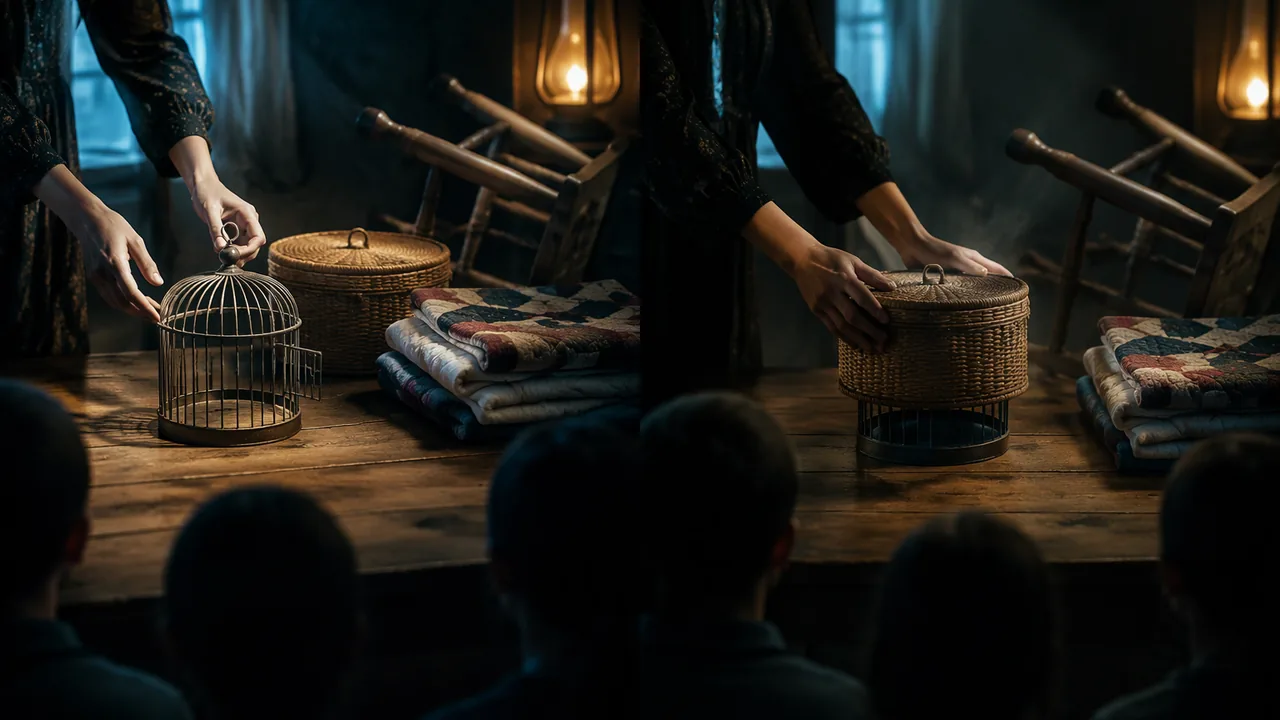
write a 1,300-1,600 word comparison of how Trifles and ‘A Jury of Her Peers’ interpret the same events, connected to another writer of the period, and defend it orally.
Instruction
This essay asks you to evaluate two interpretations of the same story by the same author, and to use a performance as evidence.
Interpretation, not preference (11-12.RL.3.A / 11-12.RL.1.C). Do not argue which version is better. Argue what each version does with the source events, and evaluate the effect. A strong essay might conclude that each version asks a different question: the play asks whether we would have stayed silent; the story asks why these women did.
Performance as evidence. Refer to the class’s staged reading or another performance you have seen. Describe the moment precisely — who stood where, how long a silence lasted, how a line was delivered — and explain what that choice made the scene mean. A performance is an interpretation you can cite.
A shared theme across the period (11-12.RL.3.B). Connect Glaspell to Gilman, Chopin or Sui Sin Far. All four writers, between 1892 and 1917, wrote about women whose understanding is dismissed by the men and institutions around them. Show how two texts from the same period treat that theme differently: Glaspell’s women act together; Gilman’s narrator is alone; Chopin’s Louise has one hour; Sui Sin Far answers in her own essayistic voice.
Themes that interact (11-12.RL.1.D). Justice and loyalty are the obvious pair in Glaspell. Show how they interact: is the women’s loyalty to Minnie a form of justice the law cannot provide, or a betrayal of justice?
Audience and task (11-12.W.2.A). Write for a reader who knows neither version. Give just enough of the events to follow your argument, and let your analysis carry the essay.
The defense (11-12.SL.2.A / 11-12.SL.2.B / 11-12.SL.2.C). Record two minutes: your comparative thesis, the single moment that best shows the difference between the versions, and your answer to this question: “Were the women right?” — framed as a question about how the texts position the audience, not a verdict on a real crime. A live defense is an equal-credit alternative.
A note on the subject. These texts involve domestic cruelty and a killing. Discuss them as literature. If the material is difficult for you personally, you may center your essay on how the two versions treat the women’s investigation and the men’s dismissal of their “trifles,” rather than on the killing itself; the comparison works either way.
Reading: Key Assignment packet: prompt, key passages, rubric and a model thesis
Glaspell, Trifles (1916) and ‘A Jury of Her Peers’ (1917); Gilman, ‘The Yellow Wall-Paper’ (1892); Sui Sin Far, ‘Leaves from the Mental Portfolio of an Eurasian’ (1909). Editions as cited in Lessons 2.1 to 2.3. Retrieved 26 September 2026. Fetchable texts: https://en.wikisource.org/w/index.php?title=Trifles_%28play%29; Project Gutenberg #20872 (https://www.gutenberg.org/ebooks/20872); Project Gutenberg #1952 (https://www.gutenberg.org/ebooks/1952); https://archive.org/stream/sim_independent_1909-01-21_66_3138/sim_independent_1909-01-21_66_3138_djvu.txt. · SLS original; quoted passages are public domain
Passages are quoted exactly; the rubric, thesis, outline and exemplar are SLS original.
The full prompt
Compare how Trifles and “A Jury of Her Peers” interpret the same events, and argue what each version achieves. Use at least three quotations from each version and refer to the class’s staged reading (or another performance) as evidence of how the play works in performance. Connect the Glaspell texts to one other text of the unit (Gilman, Chopin or Sui Sin Far) to show how the writers treat a shared theme. 1,300 to 1,600 words, MLA style. Then record a two-minute defense.
Key passages, by text
SHERIFF: Nothing here but kitchen things.
… HALE: Well, women are used to worrying over trifles. (The two women move a little closer together)
— Trifles (1916): the Sheriff and Hale
“Oh, I wish I’d come over here once in a while!” she cried. “That was a crime! That was a crime! Who’s going to punish that?” “We mustn’t take on,” said Mrs. Peters, with a frightened look toward the stairs. “I might ‘a’ known she needed help! I tell you, it’s queer, Mrs. Peters. We live close together, and we live far apart. We all go through the same things–it’s all just a different kind of the same thing! If it weren’t–why do you and I understand? Why do we know–what we know this minute?”
— ‘A Jury of Her Peers’ (1917): Martha Hale
COUNTY ATTORNEY: (Facetiously) Well, Henry, at least we found out that she was not going to quilt it. She was going to—what is it you call it, ladies?
MRS. HALE: (Hand against her pocket) We call it—knot it, Mr. Henderson.
— Trifles (1916): the last exchange
It is the same woman, I know, for she is always creeping, and most women do not creep by daylight.
— Gilman, ‘The Yellow Wall-Paper’ (1892)
I believe that some day a great part of the world will be Eurasian. I cheer myself with the thought that I am but a pioneer.
— Sui Sin Far, ‘Leaves from the Mental Portfolio of an Eurasian’ (1909)
Rubric at four levels
| Criterion | 4: Exemplary | 3: Proficient | 2: Developing | 1: Beginning |
|---|---|---|---|---|
| Comparative thesis | Claims something neither version alone shows | Clear claim about how the versions differ | Lists similarities and differences | No claim |
| Interpretation | Evaluates what each version does with the events and why | Explains each version’s choices | Summarizes each version | Retells events |
| Performance evidence | Precise moment (who, how long, how said) tied to meaning | Describes a performance choice | General remark about the reading | Absent |
| Period connection | Second text sharpens a specific point | Second text connected through a theme | Mentioned | Absent |
| Organization | Point by point; sections build; transitions name relationships | Point by point | Block structure | Unclear |
| Defense | Thesis and key moment clear; audience question answered | Thesis and moment clear | Thesis only | Unclear |
Model thesis and outline (SLS original)
Thesis. By never letting us inside the women’s minds, Trifles makes its audience complicit in their silence, while “A Jury of Her Peers,” by narrating Martha Hale’s guilt, turns the same silence into an act of conscience, so the story explains what the play dares us to judge; set beside Gilman’s narrator, who has no one to share her knowledge, both versions show that a community of women can do what one woman alone cannot.
- The men’s mockery of “trifles” (play direction against story narration).
- The discovery of the bird (silence against Martha’s outburst).
- The decision to hide it (stage direction against Martha snatching the box).
- The last line and what each ending asks of the audience; Gilman as counterpoint.
Short exemplar paragraph (SLS original). The last line is the same in both versions, but the reader arrives at it differently. In the play, “We call it—knot it, Mr. Henderson” comes as the curtain falls, and the audience is left with the sound of two women lying together. In the story the line closes a paragraph in which Martha Hale takes the box from Mrs. Peters, so the reader has just seen who chose to act. The play ends on the deed; the story ends on the decision.
Formative check
Work through these before moving on. They are not graded — they tell you whether the standard below has landed yet.
dramatic irony
Tap to revealThe reader knows what the characters do not.
unreliable narrator
Tap to revealA narrator to be read critically.
stage direction
Tap to revealScript text telling actors what to do.
point-by-point comparison
Tap to revealBoth texts under each aspect in turn.
near-synonyms
Tap to revealOverlapping denotations, different nuances.
Which is the strongest use of a performance as evidence?
How confident are you that you can compare two interpretations of the same events and use performance as evidence?
Submit: Comparative Interpretation Essay (1,300-1,600 words) + 2-minute defense
Task: Compare how Trifles and ‘A Jury of Her Peers’ interpret the same events, using a performance as evidence and connecting Glaspell to one other writer of the period.
Submission workflow
- Stage 1 — Organizer. Comparative thesis, point-by-point outline, paired quotations, performance moment, third text (from Lesson 2.4).
- Stage 2 — Peer-reviewed draft. A partner reconstructs your argument from topic sentences and transitions alone; submit a revision note.
- Stage 3 — Final essay. 1,300-1,600 words, three or more quotations from each version, MLA.
- Stage 4 — Defense. Two minutes, recorded or live.
How it is scored
| Criterion | What proficient looks like |
|---|---|
| Comparative thesis (11-12.W.2.A) | A claim about the two versions that neither alone could support. |
| Interpretation evaluated (11-12.RL.3.A / 11-12.RL.1.C) | Each version’s handling of the events analyzed; one performance used as precise evidence. |
| Period connection (11-12.RL.3.B) | One other writer of 1892-1917 connected through a shared theme treated differently. |
| Interacting themes (11-12.RL.1.D) | Two themes shown to build on or complicate each other. |
| Organization and cohesion (11-12.W.2.A, 11-12.W.3.A.d) | Point-by-point; each section builds; transitions name relationships. |
| Audience (11-12.W.2.A) | Clear to a reader new to the texts. |
| Defense (11-12.SL.2.A / 11-12.SL.2.B / 11-12.SL.2.C) | Thesis and key moment presented clearly; the audience question addressed. |