stage a reading of Trifles, compare it with ‘A Jury of Her Peers’, and evaluate how each version interprets the same events, adapting my speech to the demands of performance.
Instruction
In 1916 a group of writers and artists in Provincetown, Massachusetts, staged short plays in a converted fish house on a wharf; they became the Provincetown Players, and they changed American theater. One of their first successes was Susan Glaspell’s one-act Trifles. The next year Glaspell rewrote it as a short story, “A Jury of Her Peers,” published in the magazine Everyweek. We therefore have the same events told twice by the same author in two forms. 11-12.RL.3.A / 11-12.RL.1.C asks you to analyze multiple interpretations of a story or drama, including recorded or live productions, and to evaluate how each version interprets the source.
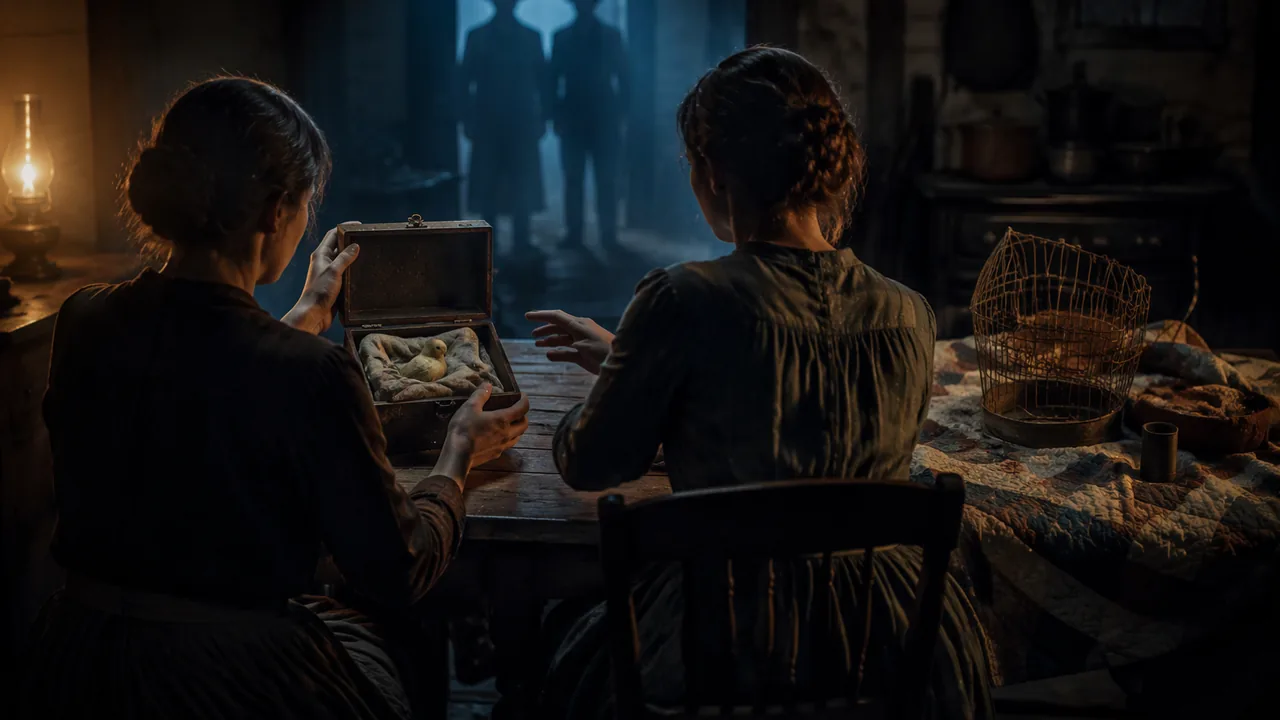
The events. A farmer, John Wright, has been found strangled in his bed. His wife, Minnie, is in jail. The sheriff, the county attorney and a neighbor, Mr. Hale, search the farmhouse for a motive. The sheriff’s wife, Mrs. Peters, and Mrs. Hale wait in the kitchen, gathering things for Minnie. The men mock the kitchen as “nothing here but kitchen things.” The women, noticing the “trifles,” find the motive: an unfinished quilt with wildly uneven stitching, a broken birdcage, and, in a sewing box, a dead canary with its neck wrung. They understand what Minnie’s life with her husband was like. They hide the bird. When the county attorney asks, mockingly, whether Minnie meant to quilt or knot the quilt, Mrs. Hale answers, “We call it—knot it, Mr. Henderson.”
What the play does. On stage there is no narrator. Everything must be shown: where the women stand, what they pick up, how long they are silent. Glaspell’s stage directions do much of the work: glances, pauses, a box moved from one hand to another. Minnie never appears; the kitchen is her stand-in. Performance decisions — how long Mrs. Peters holds the box before she hides it, whether Mrs. Hale’s last line is defiant or quiet — change the meaning.
What the story does. The story opens not in the Wright kitchen but in Martha Hale’s own, as she leaves her work undone to go. It follows her point of view throughout, so we hear her thoughts, her guilt at never visiting Minnie, and her memories of Minnie as a young woman who sang. What the play leaves to silence, the story puts into consciousness. The new title also argues: in 1917 women in most of the country could not sit on juries. The two women become the only jury Minnie will get from her peers.
Evaluating the versions. Neither version is the “real” one. Ask what each gains and loses. Does the story’s access to Martha’s mind make the ending more understandable but less shocking? Does the play’s silence make the audience complicit, because we too watch the women hide the evidence and say nothing?
Author’s choices (11-12.RL.2.D). Why does Glaspell keep Minnie offstage in both versions? Why a canary? Why is the setting an isolated farm?
The staged reading. In groups of five, you will stage one scene. The group sets its own goals and deadlines and assigns roles — actors, a director who decides the silences, and a recorder (11-12.SL.1.A). Adapt your speech to performance (11-12.SL.2.A / 11-12.SL.2.B): projection, pace, the pause before a line. Record it; students who cannot perform may direct, or record a narrated version of the stage directions. Then compare your performance with at least one other group’s: where did different choices produce different meanings?
Reading: Trifles and ‘A Jury of Her Peers’: the scenes for the staged reading
Susan Glaspell, Trifles (New York: Frank Shay, 1916), Wikisource; Susan Glaspell, ‘A Jury of Her Peers’, Every Week (5 March 1917), reprinted in The Best Short Stories of 1917, ed. Edward J. O’Brien, Project Gutenberg #20872. Retrieved 26 September 2026. Fetchable texts: https://en.wikisource.org/w/index.php?title=Trifles_%28play%29; Project Gutenberg #20872 (https://www.gutenberg.org/ebooks/20872). · SLS original; quoted passages are public domain (Glaspell, 1916 and 1917)
The Wikisource transcription of Trifles is quoted exactly, including its stage directions and any original irregularities (for example ‘It’s neck!’).
These are the scenes you will stage and compare. The play is quoted from the 1916 printing; the story from its 1917 magazine text as reprinted in The Best Short Stories of 1917. Stage directions in parentheses belong to the play.
Trifles (1916): the men and the kitchen
SHERIFF: Nothing here but kitchen things.
COUNTY ATTORNEY: (Opens the door of a cupboard closet. Gets up on a chair and looks on a shelf. Pulls his hand away, sticky) Here’s a nice mess. (The women draw nearer)
MRS. PETERS: Oh, her fruit; it did freeze. (To County Attorney) She worried about that when it turned so cold. She said the fire’d go out and her jars would break.
SHERIFF: Well, can you beat the women! Held for murder and worrying about her preserves.
COUNTY ATTORNEY: (Setting his lips firmly) I guess before we are through she may have something more serious than preserves to worry about.
HALE: Well, women are used to worrying over trifles. (The two women move a little closer together)
— Susan Glaspell, Trifles (1916), Wikisource
Trifles: the quilt, and the bird
MRS. PETERS: (Taking off fur tippet, goes to hang it on hook at back of the room, stands looking at the under part of the small table) She was piecing a quilt. (Brings large sewing basket to table front and they look at the bright pieces)
MRS. HALE: It’s log cabin pattern. Pretty, isn’t it? I wonder if she was goin’ to quilt it or just knot it (Footsteps have been heard coming down the stairs. The sheriff enters followed by Hale and Henderson)
SHERIFF: They wonder if she was going to quilt it or just knot it. (The men laugh, the women look abashed)
MRS. PETERS: It’s the bird.
MRS. HALE: (Jumping up) But, Mrs. Peters—look at it! It’s neck! Look at its neck! It’s all—other side to.
MRS. PETERS: Somebody-wrung-its-neck. (Their eyes meet. A look of growing comprehension, of horror. Steps are heard outside. Mrs. Hale slips box under quilt pieces, and sinks into her chair. Enter Sheriff and County Attorney. Mrs. Peters rises)
COUNTY ATTORNEY: (As one turning from serious things to tittle pleasantries) Well, ladies, have you decided whether she was going to quilt it or knot it?
MRS. PETERS: We think she was going to—knot it.
COUNTY ATTORNEY: Well, that’s interesting, I am sure. (Looking at bird-cage) Has the bird flown?
MRS. HALE: (Piling more quilt pieces over the box) We think the—cat got it.
Trifles: the last words
COUNTY ATTORNEY: (Facetiously) Well, Henry, at least we found out that she was not going to quilt it. She was going to—what is it you call it, ladies?
MRS. HALE: (Hand against her pocket) We call it—knot it, Mr. Henderson.
The same moments in the story, “A Jury of Her Peers” (1917)
“You’re convinced there was nothing important here?” he asked the sheriff. “Nothing that would–point to any motive?” The sheriff too looked all around, as if to re-convince himself. “Nothing here but kitchen things,” he said, with a little laugh for the insignificance of kitchen things.
— Susan Glaspell, ‘A Jury of Her Peers’, Every Week (5 March 1917)
The young attorney set his lips. “I guess before we’re through with her she may have something more serious than preserves to worry about.” “Oh, well,” said Mrs. Hale’s husband, with good-natured superiority, “women are used to worrying over trifles.” The two women moved a little closer together. Neither of them spoke.
“Oh, I wish I’d come over here once in a while!” she cried. “That was a crime! That was a crime! Who’s going to punish that?” “We mustn’t take on,” said Mrs. Peters, with a frightened look toward the stairs. “I might ‘a’ known she needed help! I tell you, it’s queer, Mrs. Peters. We live close together, and we live far apart. We all go through the same things–it’s all just a different kind of the same thing! If it weren’t–why do you and I understand? Why do we know–what we know this minute?”
— Martha Hale, in the story only
There was a moment when they held each other in a steady, burning look in which there was no evasion nor flinching. Then Martha Hale’s eyes pointed the way to the basket in which was hidden the thing that would make certain the conviction of the other woman–that woman who was not there and yet who had been there with them all through that hour. For a moment Mrs. Peters did not move. And then she did it. With a rush forward, she threw back the quilt pieces, got the box, tried to put it in her handbag. It was too big. Desperately she opened it, started to take the bird out. But there she broke–she could not touch the bird. She stood there helpless, foolish. There was the sound of a knob turning in the inner door. Martha Hale snatched the box from the sheriff’s wife, and got it in the pocket of her big coat just as the sheriff and the county attorney came back into the kitchen. “Well, Henry,” said the county attorney facetiously, “at least we found out that she was not going to quilt it. She was going to–what is it you call it, ladies?” Mrs. Hale’s hand was against the pocket of her coat. “We call it–knot it, Mr. Henderson.”
Version chart (worked key for three moments; SLS original)
| Moment | The play shows | The story tells | A performance decides |
|---|---|---|---|
| The men’s mockery | The Sheriff’s “kitchen things” and Hale’s “trifles” as dialogue; the stage direction says the women “move a little closer together.” | The same lines, but the narration adds that neither woman spoke and the attorney remembered his manners. | Whether the women look at the men or away as they move closer. |
| Finding the bird | Two short lines and a direction: their eyes meet, and a “look of growing comprehension, of horror.” | Martha Hale’s guilt in words: “That was a crime! Who’s going to punish that?” (the first speech quoted above from the story). | How long the silence lasts before Mrs. Peters speaks. |
| The last line | “We call it—knot it, Mr. Henderson.” The audience has watched the women hide the box. | The same line, after a paragraph in which Martha Hale takes the box from Mrs. Peters. | Whether Mrs. Hale says it defiantly or quietly. |
Staging protocol (SLS original)
- Groups of five choose one scene above. Roles: two actors, a director who decides each silence, a reader for stage directions, a recorder.
- Set your own goals and deadlines on a shared page before rehearsing.
- Record one full run. Students who prefer not to perform may direct, or record a narrated reading of the stage directions.
- After watching another group, name one choice that differed and say what meaning it produced.
Model contribution (SLS original). “In our reading, Mrs. Peters held the box for a slow count of eight before Mrs. Hale took it. The play gives only ‘cannot touch it, goes to pieces.’ The story says the same thing in words, but only the play lets us decide how long we watch her fail. I think that makes the audience more complicit.”
Formative check
Work through these before moving on. They are not graded — they tell you whether the standard below has landed yet.
What does the story version add that the play cannot show directly?
Minnie Wright appears on stage in the final scene of Trifles.
Two groups perform Mrs. Hale’s last line, one defiantly and one quietly. What is the best way to evaluate them?
After the staged reading: complete the version chart for three moments (the men’s mockery, finding the bird, the last line), recording what the play shows, what the story tells, and what your group’s performance chose. Then write a paragraph evaluating which version makes the audience or reader most complicit, with evidence from both texts and one performance.
How confident are you that you can compare how a play, its story version and a performance interpret the same events?