interpret Fitzgerald’s figurative language and word relationships in context, analyze how his sentence rhythms create tone, and use figures and varied syntax deliberately in my own prose.
Instruction
Fitzgerald’s prose is famous for its beauty, and beauty in this novel is always suspect. The same lyricism that makes Gatsby’s world shimmer makes Nick’s judgments hard to see clearly. 11-12.RL.1.B / 11-12.RL.2.C asks you to demonstrate understanding of figurative language, word relationships and nuances in word meaning. This lab reads figures from the three chapters you have read so far and then asks you to write with the same control.
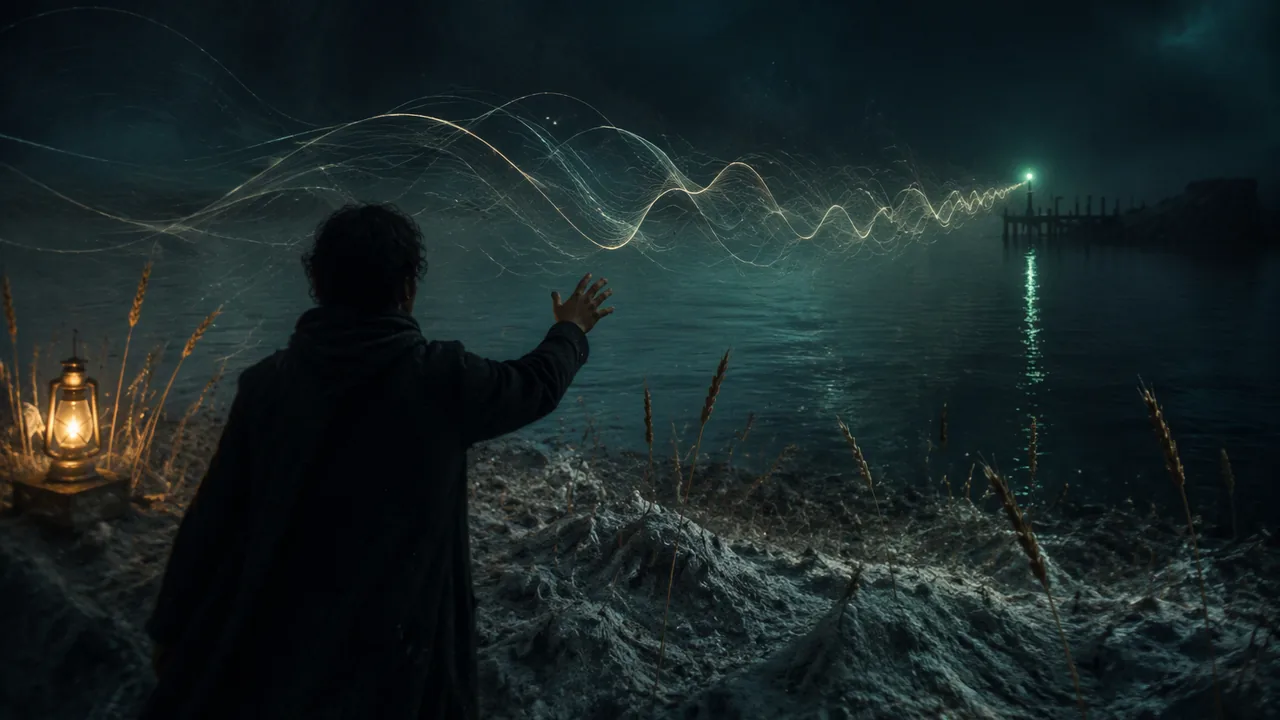
The green light. At the end of Chapter 1, Nick sees Gatsby stretch his arms toward the dark water, and sees nothing there “except a single green light, minute and far away, that might have been the end of a dock.” Literally, it is a light across the bay, on the side where Daisy lives. Already it is more than that, because Nick has just watched a man tremble as he reaches for it. A symbol differs from a metaphor because the object is really there in the story and gathers meaning through repetition and context. Watch for the light’s return; each time it appears, ask what it has come to mean, and to whom.
The valley of ashes. “This is a valley of ashes—a fantastic farm where ashes grow like wheat into ridges and hills and grotesque gardens.” The sentence is built on a paradox (a farm that grows ashes) and a simile (like wheat). Fantastic here means grotesque and dreamlike, not wonderful — an older sense of the word, and a good place to verify meaning by context (11-12.RL.1.B / 11-12.RL.2.C: interpret figures of speech in context and analyze their role). The farming language recalls the agricultural America that the industrial city has burned to fuel itself.
A voice like music. Daisy’s voice is “the kind of voice that the ear follows up and down, as if each speech is an arrangement of notes that will never be played again.” The simile turns speech into music that cannot be repeated, and it tells us as much about the listener as about Daisy: Nick, and the men “who had cared for her,” hear her voice as a promise. Word relationships matter here (11-12.RL.1.B / 11-12.RL.2.C). Track the words Nick uses for Daisy’s voice (thrilling, singing, murmur) and ask what they leave out.
Sentence rhythm (11-12.W.3.A.b). Read the opening of Chapter 3 aloud: “In his blue gardens men and girls came and went like moths among the whisperings and the champagne and the stars.” The guests are compared to moths, drawn to light and quick to die; the list that follows joins sound, drink and sky with a repeated and, so that the sentence drifts the way the guests do. Fitzgerald’s long sentences often end on a surprising or deflating word; his short ones often follow a long passage for force. Later in Chapter 3 a paragraph of swirling description ends with four words: “The party has begun.” Varying syntax is how he controls tone.
Hyperbole and understatement. Nick describes Gatsby’s smile as one “that you may come across four or five times in life.” That is hyperbole, and it tells us as much about Nick’s susceptibility as about Gatsby. Against it, set the most violent moment you have read so far: “Making a short deft movement, Tom Buchanan broke her nose with his open hand.” There is no word of horror and no comment from Nick. Understatement at the moment of violence is a deliberate contrast, and you will see Fitzgerald use it again.
Imitation with purpose. You will write a 200-word passage describing a real place you know, using one extended symbol, one figure of speech you can name, and at least one long sentence followed by a short one. Then write a commentary explaining each choice. Proofread carefully: spelling in your own prose must be correct (11-12.W.3.A.c), and the names in your essays (Fitzgerald, Gatsby, Buchanan, Wilson, Carraway) must be spelled as the novel spells them.
📖 Before this lesson, read: The Great Gatsby, Chapters 1-3
The reading opens over the lesson; close it to come back to exactly where you were.
Reading: Fitzgerald’s Figures: mentor sentences from Chapters 1-3, worked key and a model imitation
F. Scott Fitzgerald, The Great Gatsby (New York: Charles Scribner’s Sons, 1925), text of Project Gutenberg eBook #64317 (released 17 January 2021), https://www.gutenberg.org/ebooks/64317, retrieved 26 September 2026. Chapter numbers as printed in that edition. · SLS original; quoted passages are public domain (F. Scott Fitzgerald, The Great Gatsby, 1925)
The passages in blockquotes are Fitzgerald’s, exactly as the edition prints them, including its British spellings. The worked key, the model imitation and the scoring list are SLS original.
How to use this lab. Every figure in your log must come from Chapters 1-3 of the novel and carry its chapter. This bank gives you real sentences to start from, in the order the lab discusses them; find two more of your own to complete the five the log requires. The spelling is the edition’s. Read the mentor sentences aloud before you analyze them.
Part 1. Mentor sentences from Chapters 1-3
1. Chapter I: the green light, first seen
gave a sudden intimation that he was content to be alone—he stretched out his arms toward the dark water in a curious way, and, far as I was from him, I could have sworn he was trembling. Involuntarily I glanced seaward—and distinguished nothing except a single green light, minute and far away, that might have been the end of a dock.
2. Chapter I: Daisy’s voice
I looked back at my cousin, who began to ask me questions in her low, thrilling voice. It was the kind of voice that the ear follows up and down, as if each speech is an arrangement of notes that will never be played again. Her face was sad and lovely with bright things in it, bright eyes and a bright passionate mouth, but there was an excitement in her voice that men who had cared for her found difficult to forget: a singing compulsion, a whispered “Listen,” a promise that she had done gay, exciting things just a while since and that there were gay, exciting things hovering in the next hour.
3. Chapter II: the valley of ashes
This is a valley of ashes—a fantastic farm where ashes grow like wheat into ridges and hills and grotesque gardens; where ashes take the forms of houses and chimneys and rising smoke and, finally, with a transcendent effort, of ash-grey men, who move dimly and already crumbling through the powdery air.
4. Chapter II: understatement at the moment of violence
“Daisy! Daisy! Daisy!” shouted Mrs. Wilson. “I’ll say it whenever I want to! Daisy! Dai—”
Making a short deft movement, Tom Buchanan broke her nose with his open hand.
5. Chapter III: hyperbole in Nick’s praise
He smiled understandingly—much more than understandingly. It was one of those rare smiles with a quality of eternal reassurance in it, that you may come across four or five times in life. It faced—or seemed to face—the whole eternal world for an instant, and then concentrated on you with an irresistible prejudice in your favour. It understood you just so far as you wanted to be understood, believed in you as you would like to believe in yourself, and assured you that it had precisely the impression of you that, at your best, you hoped to convey.
6. Chapter III: the rhythm of the opening
There was music from my neighbour’s house through the summer nights. In his blue gardens men and girls came and went like moths among the whisperings and the champagne and the stars. At high tide in the afternoon I watched his guests diving from the tower of his raft, or taking the sun on the hot sand of his beach while his two motorboats slit the waters of the Sound, drawing aquaplanes over cataracts of foam. On weekends his Rolls-Royce became an omnibus, bearing parties to and from the city between nine in the morning and long past midnight, while his station wagon scampered like a brisk yellow bug to meet all trains. And on Mondays eight servants, including an extra gardener, toiled all day with mops and scrubbing-brushes and hammers and garden-shears, repairing the ravages of the night before.
7. Chapter III: a long passage, then a short sentence
Suddenly one of these gypsies, in trembling opal, seizes a cocktail out of the air, dumps it down for courage and, moving her hands like Frisco, dances out alone on the canvas platform. A momentary hush; the orchestra leader varies his rhythm obligingly for her, and there is a burst of chatter as the erroneous news goes around that she is Gilda Gray’s understudy from the Follies. The party has begun.
Part 2. Worked key (SLS original)
Each entry follows the form your log should use: figure, chapter, name, literal meaning, meaning in context, effect.
| Sentence | Analysis |
|---|---|
| “a valley of ashes—a fantastic farm where ashes grow like wheat” (Chapter II) | Name: paradox (a farm that grows ashes) built around a simile (“like wheat”). Literal: a dumping ground of ash beside the railroad. In context: fantastic here means unreal and grotesque, not wonderful; the sentence goes on to “grotesque gardens,” which confirms the sense. Farm words (farm, wheat, ridges, gardens) set the industrial ruin against the agricultural country it replaced. Effect: the setting between the rich neighborhoods and the city looks like a landscape harvested for someone else’s profit. |
| “the kind of voice that the ear follows up and down, as if each speech is an arrangement of notes that will never be played again” (Chapter I) | Name: simile (“as if”), comparing speech to music. Literal: Daisy’s voice rises and falls. In context: each sentence she speaks becomes a performance that can never be repeated, and the passage goes on to call her voice “a singing compulsion” and “a promise.” Effect: the figure shows how Nick, and the men who loved her, hear Daisy: as a promise of excitement rather than as a person saying something. |
| “Making a short deft movement, Tom Buchanan broke her nose with his open hand” (Chapter II) | Name: understatement. Literal: Tom hits Myrtle and breaks her nose. In context: the sentence follows Myrtle’s shouting of Daisy’s name; “short” and “deft” describe the blow as neat and practiced, and Nick adds no comment. Effect: the calm wording makes the violence, and how easily Tom commits it, more disturbing than a dramatic description would. |
| “In his blue gardens men and girls came and went like moths among the whisperings and the champagne and the stars” (Chapter III) | Name: simile (“like moths”) and polysyndeton (the repeated and). Literal: guests arrive and leave all night. In context: moths are drawn to light and burn in it; the guests are drawn to Gatsby’s lights. Reasoning: to claim a figure, name the two things it joins and say which word does the joining. |
Long, then short. Mentor 7 does this: it builds a long stretch of motion (the dancer seizes a cocktail, the orchestra changes rhythm, the rumor goes around) and then says only “The party has begun.” The short sentence is a plain statement, not a figure; its force comes from position.
Part 3. Model imitation with commentary (SLS original)
This 200-word model was written for this lab by SLS, not by any published author. It is about a real kind of place, uses one extended symbol, names its figures, and has a long sentence followed by a short one. Write yours about a different place.
The laundromat on Fifth Street stays open all night, and its one fluorescent tube has been dying for as long as anyone can remember. It flickers over the folding table, over the row of dryers turning their patient circles, over the man who has fed the same quarters into the same machine since before the neighborhood changed its name, so that every hour of the night seems to arrive already used. The light hums. Nobody looks up at it. The clothes go around like slow planets, and the woman by the window, with a baby asleep on a sweatshirt, watches them the way you watch a train you have decided not to catch. Everyone here is waiting for a small warm thing to finish. The tube goes dark for half a second, then comes back, a little weaker, exactly as it did last night; and in that half second the whole room holds its breath, as if it too could be turned off and had simply never been told. Someone always laughs. It is the only proof that the light is not the only thing still running.
Commentary. Extended symbol: the failing tube stands for a place that keeps going on very little, and it returns three times (opening, middle, close). Named figures: a simile (“like slow planets”), personification (“patient circles,” “holds its breath”), and a paradox in the last line, where laughter is offered as proof of survival in a room lit by a dying light. Long, then short: the second sentence runs on through three “over” phrases, and “The light hums.” follows it; the short sentence is quiet on purpose. Deflation: the paragraph ends on the plain word “running,” as Fitzgerald ends on plain words after lyrical ones.
Part 4. What the log and imitation will be scored on (SLS original)
- Five figures from Chapters 1-3, each quoted exactly with its chapter, including at least one symbol, one simile or metaphor, one paradox and one example of understatement or hyperbole.
- Each figure is named, and its literal and contextual meanings are kept apart.
- The imitation is about 200 words, with one extended symbol that recurs, one named figure, and a long sentence followed by a short one.
- The commentary names each deliberate choice and says what it does to the reader.
- Your own prose is spelled in American English. Names from the novel (Fitzgerald, Gatsby, Buchanan, Wilson, Carraway) are spelled as the book spells them; quotations keep the edition’s spelling.
Formative check
Work through these before moving on. They are not graded — they tell you whether the standard below has landed yet.
In ‘a fantastic farm where ashes grow like wheat’, what does ‘fantastic’ most nearly mean?
The green light is only a metaphor; it does not exist literally in the story.
In ‘Making a short deft movement, Tom Buchanan broke her nose with his open hand,’ what makes the sentence an example of understatement?
Figure log: analyze five figures from Chapters 1-3 (at least one symbol, one simile or metaphor, one paradox and one example of understatement or hyperbole), each quoted with its chapter, named and interpreted in context. Then write your 200-word imitation passage about a real place, with a commentary naming each deliberate choice.
How confident are you that you can interpret figurative language and sentence rhythm and use them deliberately?
The Great Gatsby, Chapters 1-3
The Great Gatsby, Chapters 1-3 so far Bridge summary — not the primary text
A recap of what you have already read, written for this course, so the reading check below does not require re-opening every earlier popover.
Nick Carraway, a young Midwesterner learning the bond business, rents a small house in West Egg beside the enormous mansion of a man named Gatsby. At dinner across the bay in East Egg he meets his cousin Daisy; her husband, Tom Buchanan, who praises a racist book and takes a call from his mistress during dinner; and the golfer Jordan Baker. That night he sees Gatsby alone on his lawn, reaching toward a green light across the water (Chapter 1). Tom takes Nick to the valley of ashes to meet his mistress, Myrtle Wilson, the wife of a garage owner, and at their apartment in the city Tom breaks Myrtle’s nose when she shouts Daisy’s name (Chapter 2). Nick attends one of Gatsby’s huge parties, hears rumors that his host killed a man or was a German spy, and meets Gatsby without recognizing him; he begins seeing Jordan, decides she is dishonest, and calls himself one of the few honest people he has ever known (Chapter 3).