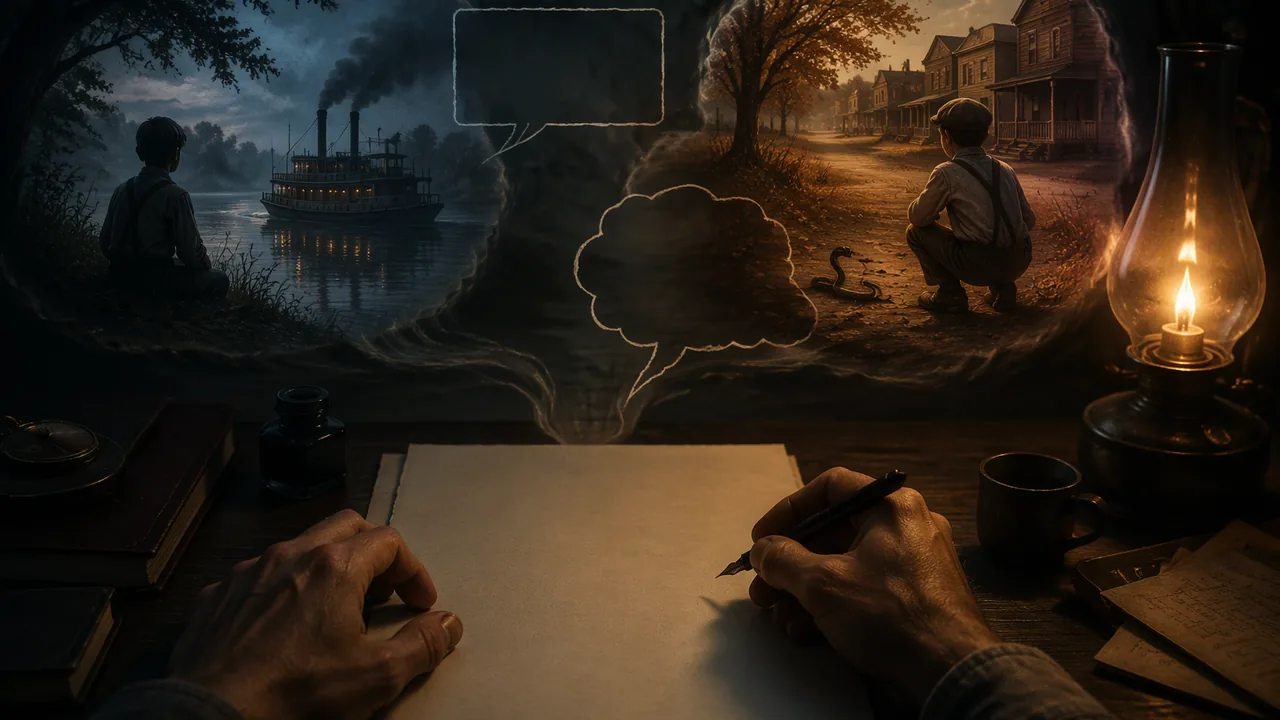
explain how register and dialect function in different contexts, analyze how a remembering narrator’s voice creates irony, and distinguish what a narrator states from what the passage means.
Instruction
Mark Twain grew up in Hannibal, Missouri, on the west bank of the Mississippi, in the 1840s. In 1883 he published Life on the Mississippi, and its fourth chapter, “The Boys’ Ambition,” opens: “When I was a boy, there was but one permanent ambition among my comrades in our village [Hannibal, Missouri] on the west bank of the Mississippi River. That was, to be a steamboatman.” Thirty-five years later Cather published a novel narrated by a grown man remembering his boyhood in a prairie town. Both writers are funny about childhood, and both are serious. This lab studies how their language does it. 11-12.W.3.A.b asks you to understand how language functions in different contexts and to make effective choices for meaning or style.
The remembering voice. Both narrators speak in two times at once. Twain says, “After all these years I can picture that old time to myself now, just as it was then.” Cather’s Jim says, “All the years that have passed have not dimmed my memory of that first glorious autumn.” The adult narrator knows how things turned out, and that knowledge is the source of the irony. When Twain’s cub engineer is blown up and comes home a hero, the grown narrator reports the boys’ fury in mock-pious language: “the partiality of Providence for an undeserving reptile had reached a point where it was open to criticism.” The boy felt it; the man phrases it. In the same way, Jim’s snake becomes “a mock adventure” once the older Jim explains it.
Register. Register is the level of formality a speaker chooses for a context. Twain’s narrator mixes a formal, Latinate register (“partiality,” “undeserving,” “open to criticism”) with the boy’s raw feeling, and the collision is the joke. Cather’s Jim writes in a calm, formal, lyrical register about the prairie and lets other people speak in their own voices.
Dialect and usage (11-12.W.3.A.c). Cather gives her characters the English they would really speak. Ántonia, learning the language, says, “My papa sick all the time,” and later, “I help make this land one good farm.” Otto Fuchs speaks a Western vernacular: “Got him in the head first crack, didn’t you?” Jake says, “They ain’t the same, Jimmy.” Twain does something similar with jargon: the cub engineer speaks of “the ‘labboard’ side of a horse” to show off his river knowledge. Each variety follows its own rules; Ántonia drops the verb “to be” and keeps Bohemian word order, consistently. Which variety counts as “correct” is a convention, often tied to social power. You write essays in standard academic English because that is the convention of your audience, but when you quote a character, you quote the dialect exactly and analyze it as a choice.
Dialect and sympathy (11-12.RL.2.B / 11-12.RL.3.C). Dialect can be used to mock a speaker or to honor one. Ask which Cather is doing. Ántonia’s broken English carries some of the most moving lines in Book I, and by Book V she says she has “forgot my English so” because her family speaks Bohemian at home. The novel never asks us to laugh at her grammar. It does sometimes let Jim’s prejudices show: when he shouts at her, “What did you jabber Bohunk for?”, the slur is his, and the older narrator lets it stand.
Figures in context (11-12.RL.1.B / 11-12.RL.2.C). Look for hyperbole and understatement. Twain’s narrator wishes he “could kill some of these mates and clerks and pay for them”: comic hyperbole. Cather often uses understatement for pain; Peter’s ruin ends with a man eating melons on an empty floor, with no comment at all.
A note on period language. Twain’s chapter refers to a “negro minstrel show” and “a negro drayman,” in the vocabulary of his time; minstrel shows were performances that mocked Black Americans. Quote such words exactly when you must, and name them for what they are.
📖 Before this lesson, read: My Ántonia, Book I, Chapters 1-13
The reading opens over the lesson; close it to come back to exactly where you were.
Reading: Mentor sentences: register, dialect and the remembering voice
Mark Twain, Life on the Mississippi (Boston: James R. Osgood, 1883), Chapter 4, ‘The Boys’ Ambition’, Project Gutenberg eBook #245; Willa Cather, My Ántonia (Boston: Houghton Mifflin, 1918), Project Gutenberg eBook #242; both retrieved 2026-11-02. Identifiers: Project Gutenberg ebook 245 (Life on the Mississippi); Project Gutenberg ebook 242 (My Ántonia) · SLS original; quoted passages are public domain (Mark Twain, 1883; Willa Cather, 1918)
Mentor sentences are quoted exactly, including dialect spellings and the British spelling of the Cather text. The bracketed place name in Twain’s first sentence is printed in the Gutenberg text. The key and the model paragraph are SLS original.
Three mentor sentences come from Mark Twain and four from Book I of the novel, the part you have read so far. Read each aloud once before you classify it.
Mentor set A: Mark Twain, “The Boys’ Ambition” (1883)
When I was a boy, there was but one permanent ambition among my comrades in our village [Hannibal, Missouri] on the west bank of the Mississippi River. That was, to be a steamboatman.
He would speak of the ‘labboard’ side of a horse in an easy, natural way that would make one wish he was dead.
But when he came home the next week, alive, renowned, and appeared in church all battered up and bandaged, a shining hero, stared at and wondered over by everybody, it seemed to us that the partiality of Providence for an undeserving reptile had reached a point where it was open to criticism.
— Twain, Life on the Mississippi (1883), Chapter 4
Mentor set B: Cather, My Ántonia, Book I
So in reality it was a mock adventure; the game was fixed for me by chance, as it probably was for many a dragon-slayer.
— Jim as narrator, Book I, Chapter 7
‘My papa sick all the time,’ Tony panted as we flew. ‘He not look good, Jim.’
— Ántonia, Book I, Chapter 6
Otto winked at me. After Ántonia rode on he said: ‘Got him in the head first crack, didn’t you? That was just as well.’
— Otto Fuchs, Book I, Chapter 7
Grandmother chuckled and drove her bright needle across a hole in Otto’s sock. ‘She’s not old, Jim, though I expect she seems old to you. No, I wouldn’t mourn if she never came again. But, you see, a body never knows what traits poverty might bring out in ‘em. It makes a woman grasping to see her children want for things.
— Jim’s grandmother, Book I, Chapter 13
Register chart (worked key)
| Speaker | Register | Evidence in the sentence |
|---|---|---|
| Twain’s narrator | Formal, mock-pious, retrospective | “partiality of Providence,” “undeserving reptile,” “open to criticism”: the language of a sermon or a lawsuit applied to boyish envy. The grown man phrases what the boy felt. |
| Twain’s cub engineer (reported) | Jargon used to show off | “’labboard’” for larboard, the river word for the left side, applied to a horse. Specialized vocabulary marks who belongs. |
| Jim as narrator | Formal, reflective, ironic about himself | “mock adventure,” “dragon-slayer”: the adult places the boy’s victory in the frame of old romance and gently deflates it. |
| Ántonia | A learner’s English, consistent in its rules | No form of “to be” (“My papa sick”), “not” before the verb (“He not look good”). The grammar is regular, not random. |
| Otto Fuchs | Western vernacular | “first crack,” a dropped subject (“Got him”), and a dry understatement (“That was just as well”). |
| The grandmother | Southern rural, warm, proverbial | “a body never knows,” “in ’em”: the speech of a Virginia farm woman, used here for the passage’s wisest judgment. |
Worked key: how the retrospective irony works
SLS original. In Twain’s third sentence the narrator never says “we were jealous.” The stated meaning is solemn: Providence has been unfair. The real meaning is comic: a pack of envious boys resented a show-off who survived an explosion. To find the real meaning, ask three questions. What does the sentence say? Who would say it sincerely? What tells me this narrator does not? Here the marks are the grand words “Providence” and “reptile,” far too large for the occasion. Jim’s “dragon-slayer” works the same way.
Model two-voice memory paragraph (SLS original)
When I was eight, I knew with perfect certainty that I would one day drive the town’s snowplow. “You just push the big lever and everything moves,” my cousin Dale explained, and I believed him, for Dale was eleven and had once been inside the garage. I practiced on the kitchen chairs all winter. The town, as it turned out, contracted the plowing to a firm two counties over, and the lever, I learned many years later, was a button.
Irony explained in two sentences. The boy’s voice and Dale’s vernacular carry the certainty, while the adult narrator’s flat closing facts quietly take it apart. The last word, “button,” is understatement that does the work a comment would spoil.
Your turn
Copy one sentence from each of four speakers into the chart, name the register and point to one word or mark as evidence. Then write your own 150-word memory paragraph in two voices, using the three questions above.
Formative check
Work through these before moving on. They are not graded — they tell you whether the standard below has landed yet.
In Twain’s sentence about “the partiality of Providence for an undeserving reptile,” where does the humor come from?
Ántonia’s early English (“My papa sick all the time”) is random error with no rules of its own.
Jim says his snake fight was “a mock adventure; the game was fixed for me by chance.” What does the older narrator mean?
Register chart: copy one sentence each from Twain’s narrator, Jim as narrator, Ántonia and one other speaker in Book I, and describe each register with one word or mark as evidence. Then write a 150-word memory paragraph in two voices (a remembering narrator and a quoted speaker in their own dialect), and explain in two sentences how a reader can tell what the narrator really means.
How confident are you that you can explain how register, dialect and a remembering narrator’s irony shape a reader’s sympathies?
My Ántonia, Book I, Chapters 1-13
My Ántonia, Book I, Chapters 1-13 so far Bridge summary — not the primary text
A recap of what you have already read, written for this course, so the reading check below does not require re-opening every earlier popover.
In the Introduction an unnamed friend meets Jim Burden, now a railroad lawyer in New York, and receives his manuscript about Ántonia, a Bohemian girl they both knew as children. Orphaned at ten, Jim travels from Virginia to his grandparents’ Nebraska farm on the same train as the Shimerdas, who have paid their countryman Krajiek too much for a poor homestead and are living in a dugout; Jim teaches Ántonia English, and her gentle, homesick father begs the Burdens to teach her (Introduction and Chapters 1-6). That autumn Jim kills a huge rattlesnake and becomes a hero to Ántonia, though the older Jim calls it a mock adventure; the Russian Peter is ruined by debts to the money-lender Wick Cutter after his friend Pavel dies confessing that he once threw a bride and groom to the wolves (Chapters 7-8). Through the first hard winter the Burdens bring food to the hungry Shimerdas, Mr. Shimerda kneels before the Burdens’ Christmas tree, Jim and Ántonia quarrel over whether her family should have come at all, and a great blizzard begins on Jim’s eleventh birthday (Chapters 9-13).