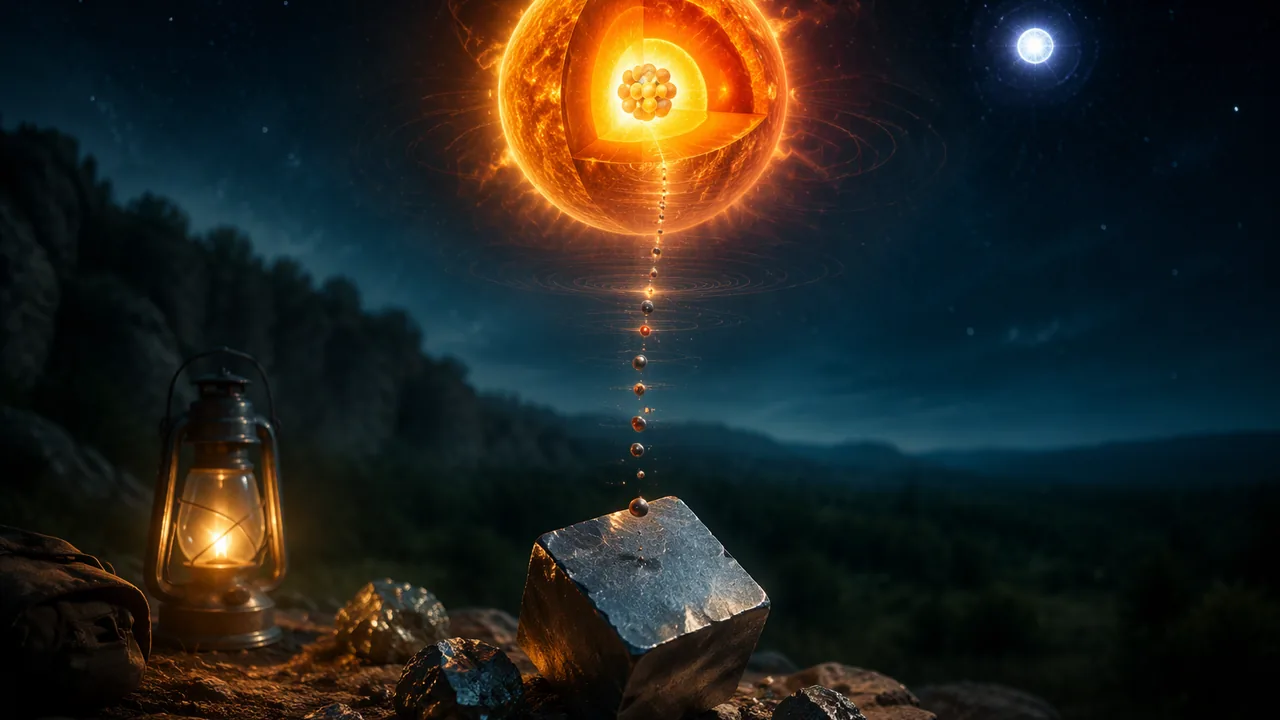
explain how nuclear fusion in the Sun’s core releases energy, use E = mc² to connect the Sun’s luminosity to its mass loss, and describe the Sun’s life span from its birth to a white dwarf.
Instruction
The phenomenon. Missouri has been the nation’s leading lead producer since 1907, and today all of that lead comes from the Viburnum Trend, a narrow ore district about 35 miles long in southeast Missouri. The ore is galena, lead sulfide (PbS), Missouri’s official state mineral: heavy, shiny gray cubes that look as if they formed yesterday. Yet the lead nuclei in a galena cube were built inside stars that lived and died before the Sun existed. By the end of this unit you will be able to explain how that can be true. We start with the star we know best.
What the Sun does. The Sun gives off about 3.83 × 1026 watts, its luminosity. At Earth’s distance (1.496 × 10¹¹ m) that power is spread over a sphere, so each square meter facing the Sun receives L / (4πd2) ≈ 1,361 W. This is the solar constant, and it drives weather, climate and life.
Where the energy comes from. Chemical burning cannot explain it: a Sun made of coal would burn out in a few thousand years. The answer is nuclear fusion. In the core, at about 15 million K, hydrogen nuclei (protons) move so fast that they overcome their electric repulsion and fuse. Through a chain of steps, four hydrogen nuclei become one helium-4 nucleus. Four hydrogen atoms have a mass of 4 × 1.007825 = 4.031300 u; one helium atom has 4.002603 u. About 0.7% of the mass is missing, and it leaves as energy, E = mc2.
Worked example: how much mass does the Sun lose? Divide the power by c2: 3.828 × 1026 W / (2.998 × 10⁸ m/s)2 ≈ 4.26 × 10⁹ kg every second, about 4.3 million metric tons. Since only 0.7% of the fused mass disappears, the Sun fuses about 4.26 × 10⁹ / 0.0071 ≈ 6 × 10¹¹ kg of hydrogen per second. That sounds enormous, but the Sun’s mass is 2 × 1030 kg, so it can keep this up for billions of years.
From core to Earth. Energy released in the core moves outward first by radiation, as photons are absorbed and re-emitted countless times, then by convection in the outer third of the Sun, where hot gas rises and cool gas sinks. The energy leaves the surface (about 5,800 K) as light and takes only about 8.3 minutes to cross the 150 million km to Earth, although it spent many thousands of years working its way out of the interior.
The Sun’s life span. The Sun is about 4.6 billion years old and is roughly halfway through its hydrogen-burning life of about 10 billion years. It is stable because outward gas pressure from fusion heat balances inward gravity. As helium builds up in the core, the core contracts and heats, and the Sun slowly brightens. In about 5 billion years it will swell into a red giant, fuse helium into carbon and oxygen, shed its outer layers as a planetary nebula, and leave a white dwarf about the size of Earth. It is not massive enough to explode.
Your questions. A good scientific question can be investigated. “Why is the Sun hot?” becomes “What reaction could release this much energy for 4.6 billion years?” Your question board should hold questions like that about the Sun, the stars and Missouri’s lead.
📖 Read for this lesson
The reading opens over the lesson; close it to come back to exactly where you were. The checks below draw on it.
Formative check
Work through these before moving on. They are not graded — they tell you whether the standard below has landed yet.
Suppose the Sun were a giant ball of coal burning in oxygen. About how long could it shine at its present brightness?
Four hydrogen nuclei fuse into one helium nucleus. What happens to the 0.7% of mass that is ‘missing’?
The Sun converts about million metric tons of mass into energy every second, and its light takes about minutes to reach Earth.
Draw and label a model of the Sun that shows the core, the radiative zone, the convective zone and the surface, with arrows for how energy moves in each. Add two balanced arrows for gravity and gas pressure. Then write two investigable questions about the Sun or about Missouri’s galena for your own question board.
How confident are you that you can explain how fusion powers the Sun and describe the stages of its life?
Practice
Work these on paper or in your notebook, then open Check your answer. Aim for all of Fluency and Application; try at least one Challenge.
Printable version: this unit’s practice workbook (PDF)
Fluency
Build speed and accuracy with the core skill.
- Convert 60 kPa to atm.
Check your answer
Answer: 0.5922 atm - Convert 25 kPa to atm.
Check your answer
Answer: 0.2467 atm - Four hydrogen-1 atoms (1.007825 u each) fuse into one helium-4 atom (4.002603 u). What mass is ‘missing’, and what percentage of the starting mass is it?
Check your answer
Answer: 0.028697 u, about 0.71%4 × 1.007825 = 4.031300 u; 4.031300 − 4.002603 = 0.028697 u; 0.028697 / 4.031300 = 0.0071. - How much energy is released if 1.0 kg of mass is converted completely to energy? (c = 2.998 × 10⁸ m/s)
Check your answer
Answer: 8.988 × 10¹⁶ JE = mc2 = 1.0 × (2.998 × 108)2. - Light travels 1.496 × 10¹¹ m from the Sun to Earth at 2.998 × 10⁸ m/s. How long does the trip take, in seconds and minutes?
Check your answer
Answer: about 499 s, or 8.3 minutest = d / v.
Application
Use the skill in context. Show your reasoning.
- The Sun’s luminosity is 3.828 × 1026 W. How much mass does it convert to energy each second, and each year (1 year = 3.156 × 10⁷ s)?
Check your answer
Answer: about 4.26 × 10⁹ kg/s; about 1.34 × 10¹⁷ kg per yearm = L / c2; multiply by the seconds in a year. - At that rate for 10 billion years, what fraction of the Sun’s mass (1.989 × 1030 kg) is converted to energy? Does this threaten the Sun’s stability?
Check your answer
Answer: about 0.07% of its mass; no, the Sun ends its main-sequence life because its core runs low on hydrogen, not because it runs out of mass4.259 × 109 kg/s × 3.156 × 10¹⁷ s = 1.344 × 1027 kg; 1.344 × 1027 / 1.989 × 1030 = 6.76 × 10⁻⁴. - The solar constant at Earth (1.000 AU) is 1,361 W/m2. Sunlight spreads as 1/d2. What is it at Mars (1.524 AU) and at Jupiter (5.203 AU)?
Check your answer
Answer: Mars about 586 W/m2; Jupiter about 50 W/m2Divide 1,361 by the distance in AU squared.
Challenge
Stretch problems. Expect to think before you write.
- Use the solar constant (1,361 W/m2) and Earth’s distance (1.496 × 10¹¹ m) to calculate the Sun’s luminosity. Explain the geometry.
Check your answer
Answer: about 3.83 × 1026 WThe Sun’s power spreads over a sphere of radius d, area 4πd2; L = 1,361 × 4π(1.496 × 10¹¹)2.
Review
Keep earlier skills sharp.
- A sample has mass 1,344.0 g and volume 150.0 cm3. Find its density and, using a density table, suggest what it could be.
Check your answer
Answer: 8.96 g/cm3, consistent with copper (8.96 g/cm3)Density = mass / volume. - Convert 60 km/h to m/s.
Check your answer
Answer: 16.67 m/s
The Sun by the Numbers: NASA’s Fact Sheet and the Arithmetic of Fusion
NASA Sun Fact Sheet (NSSDC, last updated 9 May 2024) and Earth Fact Sheet (15 November 2024); NIST Atomic Weights and Isotopic Compositions; CODATA 2022 constants; retrieved September 23, 2026 · Public domain (works of the United States government), with SLS original worked computations
Why this reading. The lesson asks you to predict how long a coal Sun would burn, to explain where 0.7% of the mass goes, and to fill in 4.3 million tons per second and 8.3 minutes. Every one of those numbers can be computed from a handful of measured quantities, and the measured quantities are below, as NASA and NIST publish them. Do the arithmetic yourself; if your answer differs from the lesson’s, you will be able to say at which step.
Table 1. The Sun, as NASA publishes it
NASA Sun Fact Sheet, National Space Science Data Center, retrieved September 23, 2026. The page gives no age; NASA’s Sun overview page states the Sun formed about 4.6 billion years ago.
| Quantity | Value as printed | In everyday units |
|---|---|---|
| Mass | 1,988,400 × 1024 kg | 1.988 × 1030 kg (about 333,000 Earths) |
| Luminosity | 382.8 × 1024 J/s | 3.828 × 1026 W |
| Volumetric mean radius | 695,700 km | 109 Earth radii |
| Mean density | 1,408 kg/m3 | 1.41 g/cm3, a little denser than water |
| Effective (surface) temperature | 5,772 K | about 5,500 °C |
| Central temperature | 1.571 × 10⁷ K | 15.7 million K |
| Central density | 1.622 × 10⁵ kg/m3 | 162 g/cm3, eight times denser than gold |
| Mass loss rate (as printed) | 4,260 × 106 kg/s | 4.26 × 10⁹ kg every second |
From the Earth Fact Sheet: semimajor axis of Earth’s orbit 149.598 × 10⁶ km; solar irradiance 1,361.0 W/m2. From NIST: the mass of a hydrogen-1 atom is 1.00782503223 u and of a helium-4 atom 4.00260325413 u. From CODATA 2022: the speed of light c = 299,792,458 m/s exactly.
Check 1: the solar constant follows from the luminosity
Spread 3.828 × 1026 W over a sphere of radius 1.49598 × 10¹¹ m. The sphere’s area is 4πd2 = 4 × 3.1416 × (1.49598 × 1011)2 = 2.812 × 10²³ m2. Then 3.828 × 1026 / 2.812 × 1023 = 1,361 W/m2, exactly NASA’s irradiance. Two independently measured numbers agree, which is what you want from a model.
Check 2: the missing mass
Four hydrogen atoms: 4 × 1.00782503 = 4.03130013 u. One helium-4 atom: 4.00260325 u. Difference: 0.02869687 u. As a fraction of the starting mass, 0.02869687 / 4.03130013 = 0.00712, that is 0.71%. (Using atomic rather than nuclear masses cancels the electrons on both sides, so the fraction is the same either way.)
Check 3: mass lost per second, and the fill-in-the-blank
E = mc2, so m = E/c2. Per second: 3.828 × 1026 J / (2.99792 × 10⁸ m/s)2 = 3.828 × 1026 / 8.98755 × 1016 = 4.259 × 10⁹ kg/s. NASA’s own line, 4,260 × 106 kg/s, is the same number. One metric ton is 1,000 kg, so this is 4.26 million metric tons per second, the lesson’s 4.3 million. Because only 0.712% of the fused hydrogen disappears, the hydrogen consumed per second is 4.259 × 10⁹ / 0.00712 = 5.98 × 10¹¹ kg/s, about 600 million tons of hydrogen a second.
Check 4: how long light takes
Distance over speed: 1.49598 × 10¹¹ m / 2.99792 × 10⁸ m/s = 499.0 s = 8.32 minutes. That is the second blank. (Light from the surface takes 8.3 minutes; the energy it carries took far longer to work its way out of the interior, so the two times measure different things.)
Check 5: the coal Sun
Burning coal in oxygen releases roughly 30 million joules per kilogram (an ordinary engineering figure for good coal; take it as an upper bound). If the whole solar mass were coal: 1.988 × 1030 kg × 3 × 107 J/kg = 6 × 1037 J. At 3.828 × 1026 W that lasts 6 × 1037 / 3.828 × 1026 = 1.6 × 10¹¹ s. One year is 3.156 × 10⁷ s, so about 5,000 years. The Sun is 4.6 billion years old. Chemistry is short by a factor of about a million; only nuclear reactions, releasing about 0.7% of the fuel’s mass as energy, close the gap.
Check 6: how long the hydrogen lasts
Only the core, roughly a tenth of the Sun’s mass, ever gets hot enough to fuse. A tenth of 1.988 × 1030 kg is 1.99 × 1029 kg. At 5.98 × 10¹¹ kg/s that is 3.3 × 10¹⁷ s, or 3.3 × 10¹⁷ / 3.156 × 107 = 1.05 × 10¹⁰ years: about 10 billion years of hydrogen fusion, which is why the lesson calls the Sun roughly halfway through its life. The one-tenth figure is the rough part of this estimate, and a careful answer says so.
What the numbers are evidence of
Notice which claims rest on measurement and which on inference. The luminosity, distance, irradiance and atomic masses are measured. The mass-loss rate is computed from them with E = mc2. The core temperature of 15.7 million K comes from models of a gas ball that must hold itself up against its own gravity while radiating 3.8 × 1026 W; it cannot be measured with a thermometer. When you write an investigable question for the board, ask about the inferred quantities: What observation would tell us the core is really that hot? (One answer, which you may look into later, is the neutrinos that fusion produces and that detectors on Earth count.)
Your turn
- Redo Check 3 using 3.83 × 1026 W and 3.00 × 10⁸ m/s, the rounded values in the mini-lecture. How much does the answer change, and does it still round to 4.3 million tons?
- NASA lists the central density as 162 g/cm3 and the mean density as 1.41 g/cm3. What does that contrast tell you about where the Sun’s mass is concentrated, and why does it matter for where fusion happens?
- Rewrite the coal estimate for a fuel ten times better than coal. Does anything change about the conclusion?
Sources: NASA Sun Fact Sheet (NSSDC) (nssdc.gsfc.nasa.gov); NASA Earth Fact Sheet (NSSDC) (nssdc.gsfc.nasa.gov); NASA Science: Sun facts (science.nasa.gov); NIST Atomic Weights and Isotopic Compositions (H, He) (physics.nist.gov); NIST CODATA 2022 fundamental constants (physics.nist.gov)