explain how water’s unusual properties, expansion on freezing, its power as a solvent and its high heat capacity, break down rock, and measure how surface area and acidity change the rate of chemical weathering.
Instruction
An unusual molecule. Water is so common that its strangeness is easy to miss. A water molecule is bent, with a slightly negative oxygen end and slightly positive hydrogen ends: it is polar. Neighboring molecules attract each other through hydrogen bonds. Those two facts explain nearly every property that makes water the planet’s main agent of weathering.
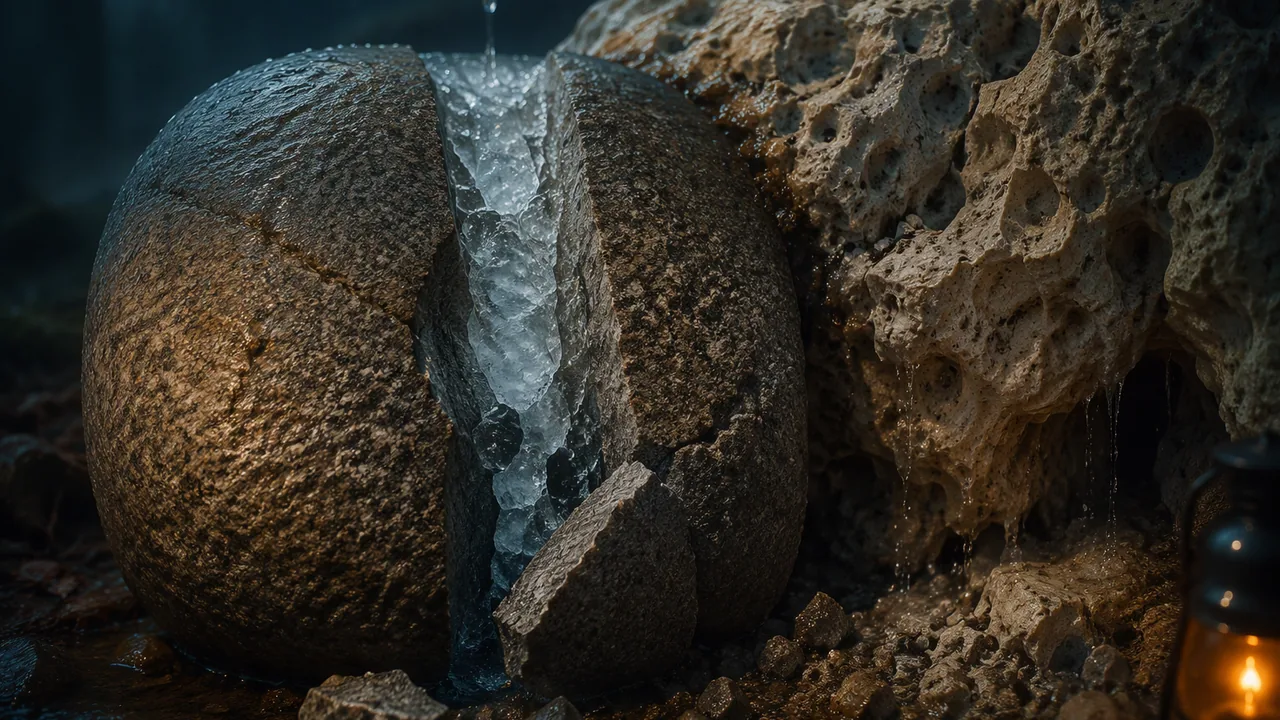
1. Water expands when it freezes. Most substances shrink as they solidify. Water does the opposite: hydrogen bonds lock the molecules into an open crystal. Ice has a density of about 0.917 g/cm3, so a given mass of water takes up 1 / 0.917 ≈ 1.09 times as much space as ice, about 9% more. Worked example. A crack in granite holds 50 cm3 of water. When it freezes, it needs about 50 × 1.09 ≈ 54.5 cm3. Confined in rock, that expansion pushes the crack wider. Repeat it on many freezing nights and the rock splits. This is frost wedging. Missouri winters are made for it: at Columbia, an average year (1991-2020) has about 101 nights at or below 32°F but only about 24 days that stay below freezing all day, so on roughly 77 days water in cracks freezes at night and thaws in the afternoon. At Elephant Rocks, rainwater that soaks into small fractures and freezes keeps rounding the granite boulders.
2. Water dissolves minerals. Because it is polar, water pulls ions out of crystals. Rainwater dissolves carbon dioxide from the air and soil, forming weak carbonic acid (H2O + CO2 → H2CO3). This acid dissolves calcite: CaCO3 + H2CO3 → Ca2+ + 2HCO3−. Dolomite, CaMg(CO3)2, dissolves the same way, more slowly. That is how Missouri’s more than 7,500 caves and 16,000 sinkholes formed, and how marble gravestones lose their lettering. Big Spring’s water carries a typical 173 milligrams of dissolved rock per liter (measured as calcium carbonate), so the spring removes well over a hundred tons of the Ozarks every day. Feldspar, the most common mineral in granite, reacts slowly with the same acid to form clay, loosening the quartz grains so the granite crumbles into coarse sand called grus. Lichens on the Elephant Rocks add a weak organic acid of their own. Chemical weathering is faster where it is warm and wet and where rock has more surface exposed.
Surface area. Breaking rock exposes more surface to attack. A 1 cm cube has 6 cm2 of surface. Cut it into 1 mm cubes and you have 1,000 cubes with 6 mm2 each: 6,000 mm2 = 60 cm2, ten times as much. Physical weathering (frost wedging, root growth, rock falls) and chemical weathering speed each other up.
3. Water stores heat. Water’s specific heat is about 4,184 J per kilogram per degree Celsius, roughly five times that of granite (about 790). Water warms and cools slowly, which moderates temperatures near oceans and large lakes and in wet soil, and keeps Ozark spring water near the same temperature all year. Where rock is dry and bare, as in a desert or on a sun-baked granite outcrop, daily heating and cooling are larger.
4. Water flows and carries. Liquid water moves under gravity, so it carries away weathered material, exposing fresh rock (Lesson 4.2); underground, it carries dissolved rock out through springs. Frozen, it becomes a glacier. Glaciers pluck and grind rock and carve mountain valleys from a V-shape into a U-shape, as in the Rocky Mountains and Alaska.
Modeling a granite outcrop. Your model today shows the Elephant Rocks granite and every way water attacks it: joints that let water in, water rotting the corners of blocks underground into rounded core stones, ice wedging in the cracks, feldspar weathering to clay, grus washed downhill, rain-filled solution pans on the top of the outcrop, and the heat-storing effect of water held in cracks and soil. Mark which steps are physical and which chemical, and where each one speeds up another.
📖 Read for this lesson
The reading opens over the lesson; close it to come back to exactly where you were. The checks below draw on it.
Lab: Chalk and Vinegar: What Speeds Chemical Weathering?
Question. How do surface area and acidity affect the rate at which calcite rock dissolves?
Materials
- White chalk whose label says calcium carbonate (many chalkboard chalks are calcium sulfate, which will not fizz), 4 sticks
- White vinegar and tap water
- Four clear plastic cups and masking tape for labels
- Kitchen balance (0.01 g or 0.1 g)
- Paper towels, a spoon and a plastic bag for crushing
- Stopwatch
- Wear safety glasses: vinegar stings eyes, and fizzing can splash.
- Do not taste any materials. Pour used vinegar down the sink with running water, never mix it with bleach or other cleaners, and wash hands after the lab.
Procedure
- Label four cups: A (whole chalk, water), B (whole chalk, vinegar), C (crushed chalk, vinegar), D (crushed chalk, water). Pour 100 mL of the right liquid into each.
- Break two chalk sticks into pieces of equal mass (about 5 g each) and record each mass. Crush the pieces for cups C and D inside the plastic bag.
- Add the chalk to each cup at the same time and start the stopwatch. Record observations (fizzing, cloudiness) every minute for 5 minutes.
- After 10 minutes, pour off the liquid, blot the solid chalk that remains on a paper towel, let it air-dry overnight, and record its mass.
- Compute the percent mass lost for each cup: (starting mass − final mass) / starting mass × 100.
Data
| Cup | Chalk form | Liquid | Start mass (g) | Final dry mass (g) | Mass lost (%) | Observations |
|---|---|---|---|---|---|---|
| A | Whole | Water | ||||
| B | Whole | Vinegar | ||||
| C | Crushed | Vinegar | ||||
| D | Crushed | Water |
Analysis
- Claim: which factor, acidity or surface area, had the larger effect on the weathering rate? Compare cups A with B and B with C as evidence, and explain using the reaction of acid with calcite.
- Rainwater is only weakly acidic, far less than vinegar. Explain why marble gravestones and Missouri’s limestone and dolomite caves still show dissolving over hundreds or thousands of years.
- Connect to granite: how would frost wedging at Elephant Rocks speed up the chemical weathering of feldspar?
- Sources of error: how might crushed chalk lost when pouring, incomplete drying, or chalk that is not pure calcium carbonate affect your percent mass lost?
If you cannot do this lab in person: Choose one. Both earn full credit and answer the same four analysis questions. Option A — run your own cups. The procedure above; a piece of chalk or an eggshell also works in a pinch at home, with vinegar and water, photographed every hour for four hours instead of weighed. Option B — the illustrative run in this lesson’s hosted reading. No materials needed. Use the reading’s Table 2 (four cups, same procedure, masses and percent lost already computed) to compare acidity and surface area and answer every analysis question from its numbers and observations.
Formative check
Work through these before moving on. They are not graded — they tell you whether the standard below has landed yet.
Because ice has a density of 0.917 g/cm³, water expands by about % when it freezes, so 50 cm³ of water in a crack becomes about cm³ of ice.
A 2 cm cube of rock is broken into 1 cm cubes. What happens to the total surface area?
Water’s high specific heat means it warms and cools slowly, which moderates temperatures near oceans and large lakes.
Draw a labeled model of the Elephant Rocks granite through one year. Show joints, water entering cracks, frost wedging on a freeze-thaw night, feldspar weathering to clay, grus washing downhill, a rounded core stone and a rain-filled solution pan. Label each process physical or chemical, name the property of water behind it, and draw one arrow where one process speeds up another.
How confident are you that you can explain how water’s properties break down rock and what controls the rate of chemical weathering?
Practice
Work these on paper or in your notebook, then open Check your answer. Aim for all of Fluency and Application; try at least one Challenge.
Printable version: this unit’s practice workbook (PDF)
Fluency
Build speed and accuracy with the core skill.
- Ice has density 0.917 g/cm3. By what percentage does water expand when it freezes?
Check your answer
Answer: about 9%1 / 0.917 = 1.09. - A crack holds 80 cm3 of water. What volume does it need when the water freezes?
Check your answer
Answer: about 87 cm380 / 0.917. - A 3 cm cube is broken into 1 cm cubes. By what factor does the total surface area increase?
Check your answer
Answer: 3 times (54 cm2 to 162 cm2)One 3 cm cube: 6 × 9 = 54; 27 small cubes: 27 × 6 = 162.
Application
Use the skill in context. Show your reasoning.
- How much energy warms 2.0 kg of water by 5.0 °C, and how much would warm 2.0 kg of granite by the same amount? (c: water 4,184, granite 790 J/(kg·°C))
Check your answer
Answer: water 41,840 J; granite 7,900 JQ = mcΔT. - A 5.00 g chalk stick loses mass in vinegar and dries to 4.12 g. What percentage dissolved?
Check your answer
Answer: 17.6%(5.00 − 4.12) / 5.00. - Write the reaction of calcite with carbonic acid and explain why limestone caves form where rainwater soaks through soil.
Check your answer
Answer: CaCO3 + H2CO3 → Ca2+ + 2HCO3−; soil adds CO2, making the water more acidic, and it dissolves calcite along cracks. - Big Spring’s water carries about 173 mg of dissolved rock per liter (as calcium carbonate). Its mean flow in water year 2026 was 363 ft3/s (10.3 m3/s). How many metric tons of rock does it carry away per day?
Check your answer
Answer: about 154 metric tons per day10.3 m3/s × 1,000 L/m3 × 0.173 g/L ≈ 1,780 g/s; × 86,400 s ≈ 1.54 × 10⁸ g.
Challenge
Stretch problems. Expect to think before you write.
- Explain how frost wedging and chemical weathering speed each other up in the granite at Elephant Rocks.
Check your answer
Answer: Frost wedging splits rock and exposes new surface area for chemical attack; chemical weathering of feldspar to clay weakens the rock along joints and grain boundaries, so ice splits it more easily, and the rounded core stones and solution pans show both at work.
Review
Keep earlier skills sharp.
- Compare a magnitude 5.0 earthquake with a magnitude 4.0 earthquake. About how many times larger is the ground-motion amplitude, and about how many times more energy is released?
Check your answer
Answer: amplitude ≈ 10.0 times; energy ≈ 32 timesEach whole step in magnitude is 10 times the amplitude and about 32 times (101.5) the energy. - Review (Unit 2): a zircon has 1 lead-206 atom per 3 uranium-238 atoms. How many half-lives have passed?
Check your answer
Answer: about 0.42log2(1 + 1/3).
Ice, Heat, Missouri Freeze-Thaw Days and Big Spring’s Dissolved Rock, With a Worked Chalk-and-Vinegar Run
USGS Water Science School ‘Water Density’ and ‘Specific Heat Capacity and Water’; Engineering ToolBox ice thermal properties; Robertson 1988 USGS OFR 88-441 Table 12; NOAA NCEI 1991-2020 U.S. Climate Normals (annual/seasonal) for USW00003945 and USW00013994; Water Quality Portal results for USGS-07067500 (hardness, calcium, magnesium, dissolved solids, 1973-2021); USGS NWIS daily discharge 07067500 water year 2026; NPS Ozark National Scenic Riverways springs and Big Spring pages; Missouri State Parks Elephant Rocks natural history; retrieved November 6, 2026; SLS original worked arithmetic and illustrative chalk-and-vinegar data · SLS original (cites USGS, NOAA and NPS public-domain data and Missouri State Parks and Engineering ToolBox published values; brief quotations only)
Why this reading. The mini-lecture states the ice-expansion percentage, the specific heat of water and granite, Missouri’s freeze-thaw days and Big Spring’s dissolved rock, and the lab’s data table is blank until you run it. Here are the published values behind those numbers, the arithmetic checked, and an illustrative run of the chalk-and-vinegar lab so the analysis can be answered even if your own cups have not finished drying. Retrieved November 6, 2026.
Table 1. Reference values, as published
| Quantity | Value | Source |
|---|---|---|
| Change on freezing | “Upon freezing, the density of ice decreases by about 9 percent”; ice is “about 90 percent” as dense as water | USGS Water Science School, Water Density |
| Density of ice | 916.2 kg/m3 at 0°C; 917.5 kg/m3 at −5°C | Engineering ToolBox, Ice thermal properties table |
| Specific heat of water | 4,184 J to warm 1 kg by 1°C (1 kilocalorie) | USGS Water Science School, Specific Heat Capacity and Water |
| Specific heat of granite | 0.65 to 0.80 × 10³ J/(kg·K) near 0°C, rising with temperature | Robertson 1988, USGS Open-File Report 88-441, Table 12 (from Goranson 1942) |
| Freezing nights and freezing days, Columbia Regional Airport, 1991-2020 normals | 101.1 days a year with a low at or below 32°F; 23.6 days with a high at or below 32°F | NOAA NCEI U.S. Climate Normals |
| The same, St. Louis Lambert International Airport | 84.9 and 19.3 days | NOAA NCEI U.S. Climate Normals |
Checking the mini-lecture’s numbers. A fixed mass of water takes up more space as ice in the ratio of the densities: 1 / 0.917 = 1.0905, about 9% more (1 / 0.9162 = 1.0915 at exactly 0°C). The 50 cm3 example: 50 / 0.917 = 54.5 cm3. For heat: 4,184 / 790 = 5.3 and 4,184 / 800 = 5.2, so “roughly five times” is fair for granite near room temperature (granite’s lowest listed value, 650, would make it 6.4). Freeze-thaw days. Every day whose high stays at or below freezing also has a low at or below freezing, so the days that freeze and then thaw are about 101.1 − 23.6 = 77.5 a year at Columbia and 84.9 − 19.3 = 65.6 at St. Louis. (This is an estimate: a few days have a high just above 32°F without real thawing in shaded cracks.)
Big Spring’s dissolved rock, computed from USGS samples
The USGS has sampled Big Spring (station 07067500) since 1973. Across 103 samples from 1973 to 2021 (Water Quality Portal), the median hardness, the calcium and magnesium dissolved from limestone and dolomite expressed as calcium carbonate, is 173 mg/L; the median dissolved calcium is 35.3 mg/L and magnesium 20.6 mg/L. The magnesium is the signature of dolomite.
Worked. Mean flow in water year 2026: 362.8 ft3/s × 28.317 L/ft3 = 10,272 L/s. × 0.173 g/L = 1,777 g/s. × 86,400 s/day = 153.5 metric tons per day, about 154 t/day (169 short tons). Over a year that is 56,043 t; at dolomite’s 2.84 t/m3, about 19,733 m3 of rock. The USGS’s own computed dissolved-solids loads for the spring have a median of 213 tons a day across 89 measurements, because they count everything dissolved and are taken at whatever the flow was that day.
Check the claims. The National Park Service’s springs page quotes one researcher’s estimate of about 175 tons of rock a day, close to our numbers, and its Big Spring page says 70 tons, which is lower than any of them. The springs page adds that a year’s rock would make a cavern 30 feet high, 50 feet wide and one mile long; that is about 224,269 m3. Our 19,733 m3 a year would fill a passage of that cross-section only about 142 m (465 feet) long, roughly a tenth of a mile. Published numbers are worth recomputing: the daily tonnage is well supported, the one-mile cavern is not.
Table 2. Illustrative chalk-and-vinegar run (SLS original, worked so the analysis can be answered without a live lab)
Four sticks of calcium-carbonate chalk, each started at 5.00 g, 100 mL of liquid, 10 minutes of contact, then blotted and air-dried overnight before the final weighing, following the lesson’s own procedure.
| Cup | Chalk form | Liquid | Start mass (g) | Final dry mass (g) | Mass lost (%) | Observations |
|---|---|---|---|---|---|---|
| A | Whole | Water | 5.00 | 4.96 | 0.8 | No fizzing; a faint chalky cloudiness in the water |
| B | Whole | Vinegar | 5.00 | 3.85 | 23.0 | Steady fine fizzing over the full 10 minutes; edges rounded |
| C | Crushed | Vinegar | 5.00 | 1.75 | 65.0 | Vigorous fizzing in the first 2 minutes, slowing as vinegar was used up; cloudy white liquid |
| D | Crushed | Water | 5.00 | 4.90 | 2.0 | No fizzing; slightly more cloudiness than cup A |
Reading the table as evidence. Percent mass lost is (start − final) / start × 100. Whole chalk in vinegar (B, 23.0%) lost far more than whole chalk in water (A, 0.8%): that isolates acidity, since surface area is the same in both. Crushed chalk in vinegar (C, 65.0%) lost far more than whole chalk in vinegar (B, 23.0%): that isolates surface area, since acidity is the same in both. Comparing C with A shows what both factors do together. Crushed chalk in water (D, 2.0%) shows surface area has a small effect even without acid. In this run, adding acid to whole chalk raised the loss by 22.2 percentage points (A to B), and crushing on top of acid added another 42.0 points (B to C), so surface area did more of the work here; check whether your own cups agree, since home runs vary with how finely the chalk was crushed and how completely it was drained.
Why limestone and dolomite still dissolve in weak rainwater
Vinegar (about 5% acetic acid) is far more acidic than rainwater, which is only weakly acidic from dissolved carbon dioxide; water soaking through soil picks up more carbon dioxide and becomes more acidic. The same reaction runs in both. Rainwater’s advantage is time, not strength: a cave wall or a gravestone is exposed for centuries, and the water is renewed by every rain, so a very slow reaction removes a measurable thickness over decades. Big Spring shows the result at the scale of a landscape: well over a hundred tons a day.
Frost and water at Elephant Rocks (Missouri State Parks)
The park describes the whole sequence: joints that opened as erosion removed the overlying rock; water moving down the fractures that “disintegrated the adjacent granite and rounded the edges and corners of the blocks while still underground”; core stones exposed by erosion; and today, rainwater that freezes in small fractures, lichens that produce “a weak organic acid that dissolves the rock,” and solution pans that hold water and so help both freeze-thaw and lichen growth. That is physical and chemical weathering speeding each other up, which is the link the modeling task asks you to draw.
Sources: USGS Water Science School, Water Density (usgs.gov); USGS Water Science School, Specific Heat Capacity and Water (usgs.gov); Engineering ToolBox, Ice – Thermal Properties (engineeringtoolbox.com); Robertson, E.C., 1988, Thermal Properties of Rocks, USGS Open-File Report 88-441 (pubs.usgs.gov); NOAA NCEI, U.S. Climate Normals 1991-2020, annual/seasonal (Columbia and St. Louis) (ncei.noaa.gov); Water Quality Portal, USGS-07067500 Big Spring near Van Buren, MO (waterqualitydata.us); NPS Ozark National Scenic Riverways, Springs and Seeps (nps.gov); NPS Ozark National Scenic Riverways, Big Spring (nps.gov); Missouri State Parks, Natural History – Elephant Rocks (mostateparks.com)