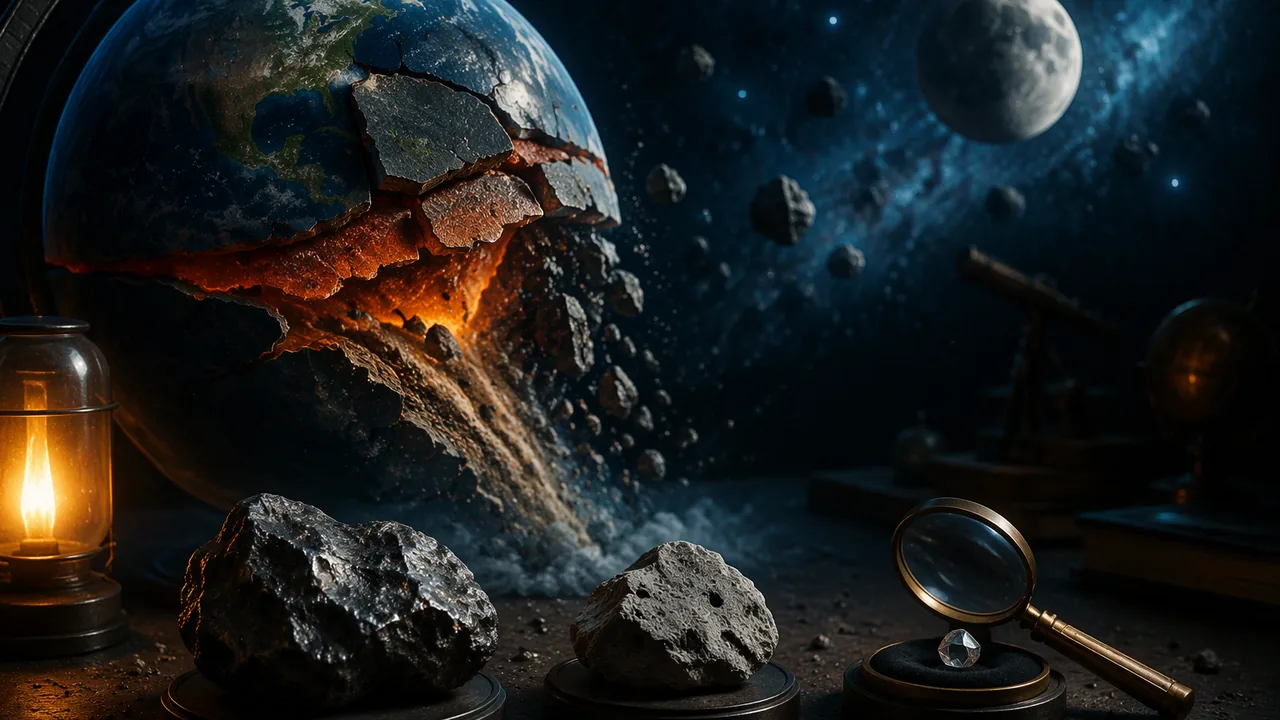
construct an account of Earth’s formation and early history from meteorites, lunar samples, ancient zircons and planetary surfaces, and evaluate how the scientific estimate of Earth’s age changed.
Instruction
The problem. Earth recycles its surface. Plate tectonics carries crust down into the mantle, erosion grinds rocks into sediment, and heat and pressure remake them. So no rock on Earth has survived from the planet’s first days. To date Earth’s birth, scientists must use materials that were not recycled.
Evidence 1: meteorites. Most meteorites are pieces of asteroids that formed with the planets and never melted or were remade. In 1956 Clair Patterson, working at Caltech, measured lead isotopes in meteorites, including the iron meteorite that made Meteor Crater in Arizona, and calculated an age of about 4.55 billion years. Modern uranium-lead dates on the oldest meteorite grains, calcium-aluminum-rich inclusions, give 4.567 billion years: the start of the solar system. Earth is taken to be about 4.54 billion years old, a little younger because it took time to assemble. Meteorites still arrive: Missouri has 24 on record, among them the Warrenton carbonaceous chondrite of 1877 and a 1-kg stone that hit a car on West Florissant Avenue in St. Louis in 1950.
Evidence 2: the Moon. Apollo astronauts returned 382 kg of lunar rock. The Moon has no plate tectonics and almost no erosion, so its oldest rocks survive: some highland samples are about 4.4-4.5 billion years old. The Moon’s chemistry is very similar to Earth’s mantle. Together with computer models, this supports the giant impact hypothesis: a Mars-sized body struck the young Earth, and the Moon formed from the debris.
Evidence 3: ancient zircons. Tiny zircon crystals from the Jack Hills of Western Australia give uranium-lead ages up to about 4.4 billion years, although the sandstone that holds them is much younger. Their oxygen isotopes suggest they formed from magma that had interacted with liquid water, which implies oceans within about 150 million years of Earth’s formation. The oldest intact rocks, the Acasta Gneiss in Canada, are about 4.0 billion years old.
Evidence 4: planetary surfaces. The Moon, Mercury and Mars are covered with craters. Dated lunar samples let scientists calibrate crater counts: heavily cratered surfaces are old, smooth ones young. The record shows many large impacts early in solar system history, falling off after about 3.8 billion years. Earth must have been hit just as hard, but its craters have been erased.
A historical argument. In 1862 Lord Kelvin calculated Earth’s age from how fast a molten ball would cool and got between 20 and 400 million years (and later he favored the low end). His physics was careful, but two things were unknown in his time: radioactive decay keeps heating Earth’s interior, and the mantle carries heat by convection, not only by conduction. Science corrected him when new evidence appeared. That is a feature, not a flaw.
Your argument. Claim a value for Earth’s age. Support it with at least two independent lines of evidence, with numbers. Explain the reasoning: why meteorites date Earth’s formation even though they are not from Earth. Then rebut a counter-claim: “The oldest rock is 4.0 billion years old, so Earth is 4.0 billion years old.”
📖 Read for this lesson
The reading opens over the lesson; close it to come back to exactly where you were. The checks below draw on it.
Formative check
Work through these before moving on. They are not graded — they tell you whether the standard below has landed yet.
Which would you expect to be older: the oldest rocks on the Moon or the oldest rocks on Earth?
Why do scientists date Earth’s formation using meteorites rather than Earth rocks?
Lord Kelvin’s estimate was too young because he made arithmetic errors.
Write a CER argument for Earth’s age using at least two independent lines of evidence with numbers (meteorites, lunar samples, zircons or crater records). Then rebut this claim: ‘The oldest rock is 4.0 billion years old, so Earth is 4.0 billion years old.’ Finally, write the strongest objection a skeptical reader could raise to your argument (for example, ‘meteorites are not pieces of Earth, so they cannot date Earth’) and answer it, in writing or on a recording.
How confident are you that you can argue for Earth’s age from meteorites, lunar samples, zircons and planetary surfaces?
Practice
Work these on paper or in your notebook, then open Check your answer. Aim for all of Fluency and Application; try at least one Challenge.
Printable version: this unit’s practice workbook (PDF)
Fluency
Build speed and accuracy with the core skill.
- A wood sample has 50% of the carbon-14 of living wood. Using a half-life of 5,730 years, estimate its age.
Check your answer
Answer: ≈ 5,730 yearst = 5730 × log2(100/percent remaining). - An isotope has a half-life of 28.8 days. How long until only 1/16 of the original sample remains?
Check your answer
Answer: 115.2 days (4 half-lives)1/16 = (1/2)4. - A meteorite is 4.54 billion years old. What ratio of lead-206 to uranium-238 would you expect (half-life 4.468 billion years, no starting lead)?
Check your answer
Answer: about 1.02D/P = 2t/half-life − 1. - Earth’s oldest intact rocks are about 4.0 billion years old and Earth is about 4.54 billion years old. How long is the gap?
Check your answer
Answer: about 540 million years (0.54 billion)
Application
Use the skill in context. Show your reasoning.
- A zircon from the Jack Hills has 0.979 lead-206 atoms per uranium-238 atom. Find its age and state the assumption.
Check your answer
Answer: about 4.40 billion years, assuming a closed system with no lead at the startn = log2(1.979) = 0.985. - Explain why meteorites give the age of Earth’s formation even though they are not pieces of Earth.
Check your answer
Answer: They formed with the planets from the same cloud and were never recycled by plate tectonics, erosion or metamorphism, so their clocks started when the solar system formed. - A lunar highland rock is 4.46 billion years old; the oldest intact Earth rock is 4.03 billion. Give two reasons Earth has no surface rocks as old as the Moon’s.
Check your answer
Answer: Plate tectonics recycles crust into the mantle, and erosion and metamorphism destroy or reset old rocks; the Moon has neither plate tectonics nor liquid-water erosion.
Challenge
Stretch problems. Expect to think before you write.
- Uranium-235 decays to lead-207 with a half-life of 0.704 billion years. What lead-207/uranium-235 ratio should a 4.40-billion-year-old zircon have, and why do geologists check both clocks?
Check your answer
Answer: about 75D/P = 24.40/0.704 − 1. If the two clocks give the same age (concordant), the grain has stayed a closed system.
Review
Keep earlier skills sharp.
- Review (Unit 1): a comet has a period of 27 years. What is its semi-major axis?
Check your answer
Answer: 9 AUa = 272/3 = 9.
USGS, ‘Age of the Earth’, with the Measurements Behind Each Line of Evidence
USGS General Interest Publication ‘Geologic Time: Age of the Earth’ (pubs.usgs.gov/gip/geotime/age.html), reproduced as published, retrieved September 23, 2026; evidence table from Patterson 1956, Connelly et al. 2012, Wilde et al. 2001, Bowring and Williams 1999, NASA lunar sample curation · Public domain (works of the United States government), with an SLS original evidence table
Why this reading. The lab asks for a CER argument with “at least two independent lines of evidence with numbers” and a rebuttal of “the oldest rock is 4.0 billion years old, so Earth is 4.0 billion years old.” The mini-lecture summarizes the evidence; here is the U.S. Geological Survey’s own account of it, reproduced as published, followed by a table of the actual measurements with their uncertainties and sources. Quote the USGS; cite the table.
Age of the Earth (USGS)
So far scientists have not found a way to determine the exact age of the Earth directly from Earth rocks because Earth’s oldest rocks have been recycled and destroyed by the process of plate tectonics. If there are any of Earth’s primordial rocks left in their original state, they have not yet been found. Nevertheless, scientists have been able to determine the probable age of the Solar System and to calculate an age for the Earth by assuming that the Earth and the rest of the solid bodies in the Solar System formed at the same time and are, therefore, of the same age.
The ages of Earth and Moon rocks and of meteorites are measured by the decay of long-lived radioactive isotopes of elements that occur naturally in rocks and minerals and that decay with half lives of 700 million to more than 100 billion years to stable isotopes of other elements. These dating techniques, which are firmly grounded in physics and are known collectively as radiometric dating, are used to measure the last time that the rock being dated was either melted or disturbed sufficiently to rehomogenize its radioactive elements.
Ancient rocks exceeding 3.5 billion years in age are found on all of Earth’s continents. The oldest rocks on Earth found so far are the Acasta Gneisses in northwestern Canada near Great Slave Lake (4.03 Ga) and the Isua Supracrustal rocks in West Greenland (3.7 to 3.8 Ga), but well-studied rocks nearly as old are also found in the Minnesota River Valley and northern Michigan (3.5-3.7 billion years), in Swaziland (3.4-3.5 billion years), and in Western Australia (3.4-3.6 billion years). These ancient rocks have been dated by a number of radiometric dating methods and the consistency of the results give scientists confidence that the ages are correct to within a few percent. An interesting feature of these ancient rocks is that they are not from any sort of “primordial crust” but are lava flows and sediments deposited in shallow water, an indication that Earth history began well before these rocks were deposited. In Western Australia, single zircon crystals found in younger sedimentary rocks have radiometric ages of as much as 4.3 billion years, making these tiny crystals the oldest materials to be found on Earth so far. The source rocks for these zircon crystals have not yet been found. The ages measured for Earth’s oldest rocks and oldest crystals show that the Earth is at least 4.3 billion years in age but do not reveal the exact age of Earth’s formation. The best age for the Earth (4.54 Ga) is based on old, presumed single-stage leads coupled with the Pb ratios in troilite from iron meteorites, specifically the Canyon Diablo meteorite. In addition, mineral grains (zircon) with U-Pb ages of 4.4 Ga have recently been reported from sedimentary rocks in west-central Australia.
The Moon is a more primitive planet than Earth because it has not been disturbed by plate tectonics; thus, some of its more ancient rocks are more plentiful. Only a small number of rocks were returned to Earth by the six Apollo and three Luna missions. These rocks vary greatly in age, a reflection of their different ages of formation and their subsequent histories. The oldest dated moon rocks, however, have ages between 4.4 and 4.5 billion years and provide a minimum age for the formation of our nearest planetary neighbor.
Thousands of meteorites, which are fragments of asteroids that fall to Earth, have been recovered. These primitive objects provide the best ages for the time of formation of the Solar System. There are more than 70 meteorites, of different types, whose ages have been measured using radiometric dating techniques. The results show that the meteorites, and therefore the Solar System, formed between 4.53 and 4.58 billion years ago. The best age for the Earth comes not from dating individual rocks but by considering the Earth and meteorites as part of the same evolving system in which the isotopic composition of lead, specifically the ratio of lead-207 to lead-206 changes over time owing to the decay of radioactive uranium-235 and uranium-238, respectively. Scientists have used this approach to determine the time required for the isotopes in the Earth’s oldest lead ores, of which there are only a few, to evolve from its primordial composition, as measured in uranium-free phases of iron meteorites, to its compositions at the time these lead ores separated from their mantle reservoirs. These calculations result in an age for the Earth and meteorites, and hence the Solar System, of 4.54 billion years with an uncertainty of less than 1 percent. To be precise, this age represents the last time that lead isotopes were homogeneous throughout the inner Solar System and the time that lead and uranium was incorporated into the solid bodies of the Solar System.
The age of 4.54 billion years found for the Solar System and Earth is consistent with current calculations of 11 to 13 billion years for the age of the Milky Way Galaxy (based on the stage of evolution of globular cluster stars) and the age of 10 to 15 billion years for the age of the Universe (based on the recession of distant galaxies).
[USGS, Geologic Time: Age of the Earth. Last updated July 9, 2007. Reproduced in full apart from the figure link and the editor’s note. Spelling as published.]
Table 1. The measurements behind each line of evidence
| Line of evidence | Measurement | Who, when, where published |
|---|---|---|
| Meteorites (lead isotopes) | 4.55 ± 0.07 billion years for meteorites, and the same for Earth’s lead | Clair Patterson, ‘Age of meteorites and the earth’, Geochimica et Cosmochimica Acta 10:230 (1956), working at Caltech |
| Meteorites (oldest solids) | 4,567.30 ± 0.16 million years for calcium-aluminum-rich inclusions | Connelly and others, Science 338:651 (2012) |
| Lunar samples | 382 kg of rock, core samples, pebbles, sand and dust in 2,200 samples from six Apollo landing sites, 1969-1972; oldest dated rocks 4.4 to 4.5 billion years | NASA Johnson Space Center lunar sample curation; USGS above |
| Ancient zircons | 4,404 ± 8 million years for a detrital zircon from the Jack Hills, Western Australia | Wilde and others, Nature 409:175 (2001) |
| Oldest intact rock | 4,031 ± 3 million years, Acasta Gneiss, Slave Province, Canada | Bowring and Williams, 1999; USGS gives 4.03 Ga |
| Kelvin’s cooling estimate | 20 to 400 million years, later narrowed toward the low end | William Thomson (Lord Kelvin), ‘On the secular cooling of the Earth’, 1862 |
Reading the table as an argument
Two independent lines: Patterson’s lead isotopes in meteorites (4.55 ± 0.07 billion years, 1956) and the uranium-lead ages of the oldest lunar highland rocks (4.4 to 4.5 billion years). They use different samples, different laboratories and, in the lunar case, different isotope systems, and they agree. A third: the oldest Earth zircon, 4,404 million years, sets a floor under Earth’s age from Earth’s own material. The rebuttal follows from the USGS text: the Acasta rocks are “not from any sort of primordial crust but are lava flows and sediments deposited in shallow water”, so Earth already had crust, water and history when they formed; an oldest surviving rock is a minimum age, not a birth date, on a planet that recycles its surface. Kelvin’s estimate is the historical counter-claim: careful physics missing two facts, radioactive heating and mantle convection, both unknown in 1862.
Sources: USGS, Geologic Time: Age of the Earth (pubs.usgs.gov); Patterson 1956, Age of meteorites and the earth (ADS abstract) (ui.adsabs.harvard.edu); Connelly et al. 2012, Science 338:651 (ADS abstract) (ui.adsabs.harvard.edu); Wilde et al. 2001, Nature 409:175 (nature.com); NASA JSC Lunar Sample Curation (curator.jsc.nasa.gov)
Two Uranium Clocks in One Grain, and the Evidence for the Half-Billion-Year Gap
SLS worked computations using DDEP/LNHB half-lives for U-238 (4.468 x 10^9 a) and U-235 (704 x 10^6 a); evidence from USGS ‘Age of the Earth’, Wilde et al. 2001, Bowring and Williams 1999, Connelly et al. 2012, NASA lunar curation; retrieved September 23, 2026 · SLS original
Why this reading. The performance task requires a radiometric calculation with its assumption stated, a paragraph explaining why Earth’s oldest rocks are half a billion years younger than Earth, and a defense of the limits of your evidence. The lesson’s defense example mentions comparing “two uranium-lead clocks in the same grain” without showing how. This reading works both clocks with the recommended half-lives, shows what a closed and an open system look like in numbers, and lines up the evidence for the gap paragraph. The readings for Lessons 2.2 and 2.3 hold the half-life sources and the USGS text; cite those.
Two clocks, one grain
Zircon takes in uranium when it crystallizes and rejects lead. Natural uranium is two isotopes, and each decays to a different lead isotope at a different rate (DDEP recommended values):
| Clock | Parent to daughter | Half-life |
|---|---|---|
| Slow clock | Uranium-238 to lead-206 | 4.468 ± 0.005 billion years |
| Fast clock | Uranium-235 to lead-207 | 704 ± 1 million years |
For a closed grain that started with no lead, each daughter-to-parent ratio after time t is D/P = 2t/half-life − 1. Both ratios must give the same t; ages that agree are concordant.
Worked: the lesson’s 4.40-billion-year zircon
The lesson’s example grain has 0.979 lead-206 atoms per uranium-238 atom. Slow clock: n = log2(1.979) = 0.9848 half-lives; t = 0.9848 × 4.468 = 4.400 billion years. Now predict what the fast clock must show if the grain is closed: t/half-life = 4.400/0.704 = 6.250 half-lives, so lead-207 per uranium-235 = 26.250 − 1 = 76.1 − 1 = 75.1. A geologist measures that ratio. If it is about 75, the two clocks agree and the closed-system assumption survives a real test. Check the arithmetic in reverse: log2(76.1) = 6.250; 6.250 × 0.704 = 4.40 billion years.
Worked: what an open system looks like
Suppose the same grain later lost 30% of all its lead when it was heated (lead leaks; uranium stays). Both ratios drop by the same factor, 0.70. Slow clock: 0.979 × 0.70 = 0.685; n = log2(1.685) = 0.753; t = 0.753 × 4.468 = 3.37 billion years. Fast clock: 75.1 × 0.70 = 52.6; n = log2(53.6) = 5.744; t = 5.744 × 0.704 = 4.04 billion years. The two clocks now disagree by 670 million years, and the grain is rejected or its history is modeled. Lead loss makes ages too young; the lesson’s quiz grain with seven lead atoms per uranium (13.4 billion years) is the opposite failure, lead gained, and it is rejected because it is older than the solar system. Either way, the discordance is the evidence. This is the answer to the defense question “how do you know the grain was closed?”: because two independent clocks agree, and they would not if it were not.
The gap, with the evidence lined up
| Claim in your gap paragraph | Evidence with number | Source |
|---|---|---|
| Earth formed with the solar system | The oldest meteorite solids are 4,567.30 ± 0.16 million years old; Patterson’s lead isotopes give Earth and meteorites the same age, 4.55 ± 0.07 billion years; USGS states 4.54 billion years with less than 1% uncertainty | Connelly et al. 2012; Patterson 1956; USGS |
| Earth had solid crust very early | A zircon from the Jack Hills is 4,404 ± 8 million years old, and zircon crystallizes from granite-like magma | Wilde et al. 2001 |
| Earth had liquid water very early | The same zircons carry oxygen isotope ratios that require magma to have interacted with liquid water (the lesson’s ‘oceans within about 150 million years’) | Wilde et al. 2001, as summarized in the lesson |
| The oldest surviving rock is much younger | Acasta Gneiss, 4,031 ± 3 million years; USGS: these rocks are ‘lava flows and sediments deposited in shallow water’, not primordial crust | Bowring and Williams 1999; USGS |
| The Moon kept what Earth lost | 382 kg of Apollo samples; the oldest dated lunar rocks are 4.4 to 4.5 billion years old, because the Moon has no plate tectonics and almost no erosion | NASA lunar curation; USGS |
The arithmetic of the gap: 4,567 − 4,031 = 536 million years between the solar system’s first solids and the oldest intact Earth rock, the lesson’s “about half a billion years”. The zircons close most of it (4,567 − 4,404 = 163 million years) but only as loose grains in a much younger sandstone: the rocks they grew in are gone. The mechanism is the one the USGS text names, recycling by plate tectonics, plus erosion and metamorphism. The Moon is the control: a body of the same age that did not recycle, and whose oldest rocks are correspondingly older than Earth’s.
The limits paragraph
Three honest limits, each with what would change your mind. (1) Every radiometric age assumes a closed system; the concordance test above is how it is checked, and a discordant grain is reported as such. (2) The 4.54-billion-year Earth age is a model age, the time since lead isotopes were last uniform across the inner solar system; it assumes Earth and the meteorites shared that starting composition. (3) The first-life date rests on the oldest fossils accepted as biological, 3.45 to 3.5 billion years; older candidates exist and are disputed, so older rocks might move the date, and the coevolution timeline should mark it with a range.
Sources: DDEP/LNHB Table de Radionucleides, U-238 (lnhb.fr); DDEP/LNHB Table de Radionucleides, U-235 (lnhb.fr); USGS, Geologic Time: Age of the Earth (pubs.usgs.gov); Wilde et al. 2001, Nature 409:175 (nature.com); Connelly et al. 2012, Science 338:651 (ADS abstract) (ui.adsabs.harvard.edu); NASA JSC Lunar Sample Curation (curator.jsc.nasa.gov)