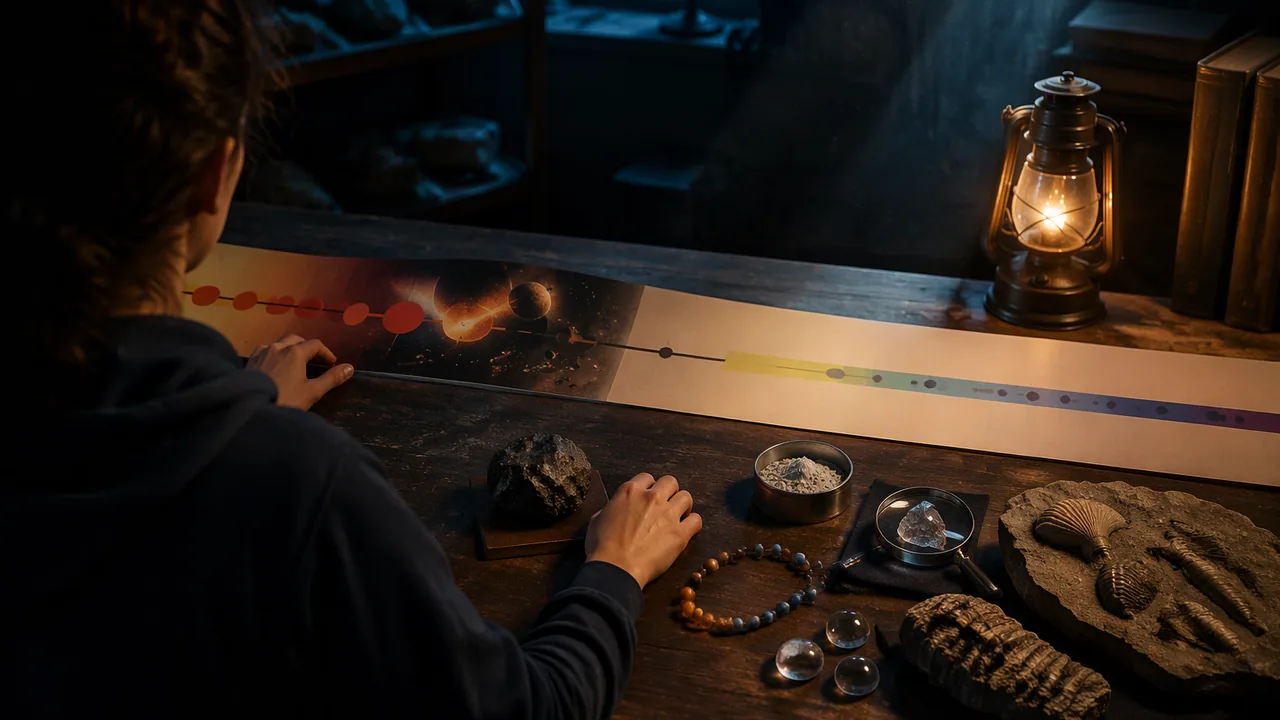
construct and defend an evidence-based account of Earth’s formation and early history, including a radiometric age calculation and a to-scale timeline.
Instruction
The question. How did Earth form, what was it like in its first billion years, and how do we know its age? Your account uses evidence from the whole unit, and it must be an argument: every claim needs evidence and reasoning.
What to include.
- Formation. The solar system formed from a collapsing, enriched gas cloud about 4.57 billion years ago (Unit 1). Earth grew by collisions of smaller bodies and was hit by a Mars-sized body that made the Moon.
- The age. At least three lines of evidence: meteorite ages, lunar samples, zircons, and cratering. Include one radiometric calculation worked from a parent-daughter ratio.
- The gap. Explain why Earth’s oldest intact rocks (about 4.0 billion years) are younger than Earth (about 4.54 billion years).
- Early history. Liquid water by about 4.4 billion years ago (zircon oxygen isotopes), the first life (stromatolites, about 3.5 billion years), and at least two examples of coevolution, such as the Great Oxidation Event.
- Missouri. At least one event from Missouri’s rock record on your timeline, such as the 1.48 to 1.45 billion-year-old St. Francois Mountains or the crinoid-rich Burlington Limestone, and a sentence on what it adds to the story.
- Limits. What is still uncertain, and what evidence would help?
A worked calculation you can model yours on. A zircon grain contains 0.979 atoms of lead-206 for each atom of uranium-238. Assume it began with no lead. The number of half-lives is log2(1 + 0.979) = log2(1.979) ≈ 0.985. With a half-life of 4.468 billion years, the age is 0.985 × 4.468 ≈ 4.40 billion years, like the oldest Jack Hills zircons. State the assumption (a closed system with no starting lead) and why zircon makes it reasonable: it rejects lead when it crystallises.
Using sources well. Earle’s Physical Geology (chapter 8, Measuring Geological Time) and OpenStax Astronomy 2e (chapters 13-14) are your reference texts. When you cite a number, say where it came from. When sources disagree on a detail, such as the timing of the first life, give the range and explain why the evidence is harder to read for older events: older rocks have usually been heated, deformed and partly erased.
Defending your account. Your recorded defense ends with your answer to one question about the limits of your evidence: How do you know the sample you dated stayed a closed system, and what would change your mind? Good answers name the assumption, explain why scientists accept it, and say what would change their minds. For example: “If the zircon had gained lead from outside, the age would be too old. Geologists check this by comparing two uranium-lead clocks (uranium-238 and uranium-235) in the same grain; if they agree, the grain was closed.”
📖 Read for this lesson
The reading opens over the lesson; close it to come back to exactly where you were. The checks below draw on it.
Formative check
Work through these before moving on. They are not graded — they tell you whether the standard below has landed yet.
A mineral has 1 daughter atom for every 3 parent atoms. How many half-lives have passed?
Banded iron formations are evidence that oxygen produced by early life reacted with iron dissolved in seawater.
Write the ‘gap’ paragraph of your account: explain, with evidence, why Earth’s oldest intact rocks are about half a billion years younger than Earth.
How confident are you that you can construct and defend an evidence-based account of Earth’s formation and early history?
Unit 2 checkpoint
Do this before you start the task. It covers the whole unit and tells you what to review first.
A fault cuts layers 1-4 but not layer 5 above them. What can you conclude?
After 4 half-lives, % of the parent isotope remains.
A rock has 3 daughter atoms per parent atom. How many half-lives have passed?
Heating a rock changes the half-life of the uranium in it.
Which method would you use to date a 20,000-year-old campfire?
Earth’s oldest intact rocks are younger than Earth itself.
Why do scientists date the solar system from meteorites?
The Great Oxidation Event happened about billion years ago.
Banded iron formations formed as oxygen from early life reacted with iron dissolved in seawater.
Which is an example of life changing the geosphere?
Submit: How Do We Know Earth’s Age? (1,000-1,300 words) + three-minute defense
Task: Write an evidence-based account of Earth’s formation and early history. Include (1) at least three independent lines of evidence for Earth’s age, with numbers and sources; (2) one radiometric age calculation from a parent-daughter ratio, with the assumption stated; (3) an explanation of why Earth’s oldest rocks are younger than Earth; (4) a to-scale timeline of at least eight events, including two that show life and Earth’s systems changing together and at least one from Missouri’s rock record; (5) a limits paragraph. A photograph of your Lesson 2.4 toilet-paper timeline, a hand-drawn timeline or a spreadsheet chart is acceptable. Include at least one Missouri event.
Submission workflow
- Stage 1 — Plan. Your claim, a table of evidence (source, number, what it shows), your radiometric calculation, and your timeline scale.
- Stage 2 — Reviewed draft. Recompute your radiometric calculation a second time from the ratio and half-life (or have a parent, guardian or other reader recompute it with you), check that each line of evidence is connected to the claim by reasoning, and mark any number without a source. Submit the review notes and your revision plan.
- Stage 3 — Final account. 1,000-1,300 words with the timeline, calculation and sources, and a limits paragraph.
- Stage 4 — Recorded defense. Three minutes, recorded, ending with your answer to the question: how do you know the sample you dated stayed a closed system, and what would change your mind?
How it is scored
| Criterion | What proficient looks like |
|---|---|
| Evidence for Earth’s age (9-12.ESS1.C.2) | Uses at least three independent lines of evidence with specific numbers and sources, and explains why meteorites date Earth’s formation. |
| Radiometric reasoning (SEP.5) | Calculation correct from D/P and half-life, with assumptions stated and justified. |
| Coevolution (9-12.ESS2.E.1) | Two examples explained as two-way cause and effect between life and Earth’s systems, with rock evidence. |
| Scale (CCC.3) | Timeline accurate to scale with at least eight events; the text uses scale to make a point. |
| Argument (SEP.7, WHST.9-10.1) | Claims supported by evidence and reasoning; a counter-claim is answered; limits are honest. |
| Use of sources (RST.9-10.1) | Specific textual and data evidence cited accurately. |
USGS, ‘Age of the Earth’, with the Measurements Behind Each Line of Evidence
USGS General Interest Publication ‘Geologic Time: Age of the Earth’ (pubs.usgs.gov/gip/geotime/age.html), reproduced as published, retrieved September 23, 2026; evidence table from Patterson 1956, Connelly et al. 2012, Wilde et al. 2001, Bowring and Williams 1999, NASA lunar sample curation · Public domain (works of the United States government), with an SLS original evidence table
Why this reading. The lab asks for a CER argument with “at least two independent lines of evidence with numbers” and a rebuttal of “the oldest rock is 4.0 billion years old, so Earth is 4.0 billion years old.” The mini-lecture summarizes the evidence; here is the U.S. Geological Survey’s own account of it, reproduced as published, followed by a table of the actual measurements with their uncertainties and sources. Quote the USGS; cite the table.
Age of the Earth (USGS)
So far scientists have not found a way to determine the exact age of the Earth directly from Earth rocks because Earth’s oldest rocks have been recycled and destroyed by the process of plate tectonics. If there are any of Earth’s primordial rocks left in their original state, they have not yet been found. Nevertheless, scientists have been able to determine the probable age of the Solar System and to calculate an age for the Earth by assuming that the Earth and the rest of the solid bodies in the Solar System formed at the same time and are, therefore, of the same age.
The ages of Earth and Moon rocks and of meteorites are measured by the decay of long-lived radioactive isotopes of elements that occur naturally in rocks and minerals and that decay with half lives of 700 million to more than 100 billion years to stable isotopes of other elements. These dating techniques, which are firmly grounded in physics and are known collectively as radiometric dating, are used to measure the last time that the rock being dated was either melted or disturbed sufficiently to rehomogenize its radioactive elements.
Ancient rocks exceeding 3.5 billion years in age are found on all of Earth’s continents. The oldest rocks on Earth found so far are the Acasta Gneisses in northwestern Canada near Great Slave Lake (4.03 Ga) and the Isua Supracrustal rocks in West Greenland (3.7 to 3.8 Ga), but well-studied rocks nearly as old are also found in the Minnesota River Valley and northern Michigan (3.5-3.7 billion years), in Swaziland (3.4-3.5 billion years), and in Western Australia (3.4-3.6 billion years). These ancient rocks have been dated by a number of radiometric dating methods and the consistency of the results give scientists confidence that the ages are correct to within a few percent. An interesting feature of these ancient rocks is that they are not from any sort of “primordial crust” but are lava flows and sediments deposited in shallow water, an indication that Earth history began well before these rocks were deposited. In Western Australia, single zircon crystals found in younger sedimentary rocks have radiometric ages of as much as 4.3 billion years, making these tiny crystals the oldest materials to be found on Earth so far. The source rocks for these zircon crystals have not yet been found. The ages measured for Earth’s oldest rocks and oldest crystals show that the Earth is at least 4.3 billion years in age but do not reveal the exact age of Earth’s formation. The best age for the Earth (4.54 Ga) is based on old, presumed single-stage leads coupled with the Pb ratios in troilite from iron meteorites, specifically the Canyon Diablo meteorite. In addition, mineral grains (zircon) with U-Pb ages of 4.4 Ga have recently been reported from sedimentary rocks in west-central Australia.
The Moon is a more primitive planet than Earth because it has not been disturbed by plate tectonics; thus, some of its more ancient rocks are more plentiful. Only a small number of rocks were returned to Earth by the six Apollo and three Luna missions. These rocks vary greatly in age, a reflection of their different ages of formation and their subsequent histories. The oldest dated moon rocks, however, have ages between 4.4 and 4.5 billion years and provide a minimum age for the formation of our nearest planetary neighbor.
Thousands of meteorites, which are fragments of asteroids that fall to Earth, have been recovered. These primitive objects provide the best ages for the time of formation of the Solar System. There are more than 70 meteorites, of different types, whose ages have been measured using radiometric dating techniques. The results show that the meteorites, and therefore the Solar System, formed between 4.53 and 4.58 billion years ago. The best age for the Earth comes not from dating individual rocks but by considering the Earth and meteorites as part of the same evolving system in which the isotopic composition of lead, specifically the ratio of lead-207 to lead-206 changes over time owing to the decay of radioactive uranium-235 and uranium-238, respectively. Scientists have used this approach to determine the time required for the isotopes in the Earth’s oldest lead ores, of which there are only a few, to evolve from its primordial composition, as measured in uranium-free phases of iron meteorites, to its compositions at the time these lead ores separated from their mantle reservoirs. These calculations result in an age for the Earth and meteorites, and hence the Solar System, of 4.54 billion years with an uncertainty of less than 1 percent. To be precise, this age represents the last time that lead isotopes were homogeneous throughout the inner Solar System and the time that lead and uranium was incorporated into the solid bodies of the Solar System.
The age of 4.54 billion years found for the Solar System and Earth is consistent with current calculations of 11 to 13 billion years for the age of the Milky Way Galaxy (based on the stage of evolution of globular cluster stars) and the age of 10 to 15 billion years for the age of the Universe (based on the recession of distant galaxies).
[USGS, Geologic Time: Age of the Earth. Last updated July 9, 2007. Reproduced in full apart from the figure link and the editor’s note. Spelling as published.]
Table 1. The measurements behind each line of evidence
| Line of evidence | Measurement | Who, when, where published |
|---|---|---|
| Meteorites (lead isotopes) | 4.55 ± 0.07 billion years for meteorites, and the same for Earth’s lead | Clair Patterson, ‘Age of meteorites and the earth’, Geochimica et Cosmochimica Acta 10:230 (1956), working at Caltech |
| Meteorites (oldest solids) | 4,567.30 ± 0.16 million years for calcium-aluminum-rich inclusions | Connelly and others, Science 338:651 (2012) |
| Lunar samples | 382 kg of rock, core samples, pebbles, sand and dust in 2,200 samples from six Apollo landing sites, 1969-1972; oldest dated rocks 4.4 to 4.5 billion years | NASA Johnson Space Center lunar sample curation; USGS above |
| Ancient zircons | 4,404 ± 8 million years for a detrital zircon from the Jack Hills, Western Australia | Wilde and others, Nature 409:175 (2001) |
| Oldest intact rock | 4,031 ± 3 million years, Acasta Gneiss, Slave Province, Canada | Bowring and Williams, 1999; USGS gives 4.03 Ga |
| Kelvin’s cooling estimate | 20 to 400 million years, later narrowed toward the low end | William Thomson (Lord Kelvin), ‘On the secular cooling of the Earth’, 1862 |
Reading the table as an argument
Two independent lines: Patterson’s lead isotopes in meteorites (4.55 ± 0.07 billion years, 1956) and the uranium-lead ages of the oldest lunar highland rocks (4.4 to 4.5 billion years). They use different samples, different laboratories and, in the lunar case, different isotope systems, and they agree. A third: the oldest Earth zircon, 4,404 million years, sets a floor under Earth’s age from Earth’s own material. The rebuttal follows from the USGS text: the Acasta rocks are “not from any sort of primordial crust but are lava flows and sediments deposited in shallow water”, so Earth already had crust, water and history when they formed; an oldest surviving rock is a minimum age, not a birth date, on a planet that recycles its surface. Kelvin’s estimate is the historical counter-claim: careful physics missing two facts, radioactive heating and mantle convection, both unknown in 1862.
Sources: USGS, Geologic Time: Age of the Earth (pubs.usgs.gov); Patterson 1956, Age of meteorites and the earth (ADS abstract) (ui.adsabs.harvard.edu); Connelly et al. 2012, Science 338:651 (ADS abstract) (ui.adsabs.harvard.edu); Wilde et al. 2001, Nature 409:175 (nature.com); NASA JSC Lunar Sample Curation (curator.jsc.nasa.gov)
Two Uranium Clocks in One Grain, and the Evidence for the Half-Billion-Year Gap
SLS worked computations using DDEP/LNHB half-lives for U-238 (4.468 x 10^9 a) and U-235 (704 x 10^6 a); evidence from USGS ‘Age of the Earth’, Wilde et al. 2001, Bowring and Williams 1999, Connelly et al. 2012, NASA lunar curation; retrieved September 23, 2026 · SLS original
Why this reading. The performance task requires a radiometric calculation with its assumption stated, a paragraph explaining why Earth’s oldest rocks are half a billion years younger than Earth, and a defense of the limits of your evidence. The lesson’s defense example mentions comparing “two uranium-lead clocks in the same grain” without showing how. This reading works both clocks with the recommended half-lives, shows what a closed and an open system look like in numbers, and lines up the evidence for the gap paragraph. The readings for Lessons 2.2 and 2.3 hold the half-life sources and the USGS text; cite those.
Two clocks, one grain
Zircon takes in uranium when it crystallizes and rejects lead. Natural uranium is two isotopes, and each decays to a different lead isotope at a different rate (DDEP recommended values):
| Clock | Parent to daughter | Half-life |
|---|---|---|
| Slow clock | Uranium-238 to lead-206 | 4.468 ± 0.005 billion years |
| Fast clock | Uranium-235 to lead-207 | 704 ± 1 million years |
For a closed grain that started with no lead, each daughter-to-parent ratio after time t is D/P = 2t/half-life − 1. Both ratios must give the same t; ages that agree are concordant.
Worked: the lesson’s 4.40-billion-year zircon
The lesson’s example grain has 0.979 lead-206 atoms per uranium-238 atom. Slow clock: n = log2(1.979) = 0.9848 half-lives; t = 0.9848 × 4.468 = 4.400 billion years. Now predict what the fast clock must show if the grain is closed: t/half-life = 4.400/0.704 = 6.250 half-lives, so lead-207 per uranium-235 = 26.250 − 1 = 76.1 − 1 = 75.1. A geologist measures that ratio. If it is about 75, the two clocks agree and the closed-system assumption survives a real test. Check the arithmetic in reverse: log2(76.1) = 6.250; 6.250 × 0.704 = 4.40 billion years.
Worked: what an open system looks like
Suppose the same grain later lost 30% of all its lead when it was heated (lead leaks; uranium stays). Both ratios drop by the same factor, 0.70. Slow clock: 0.979 × 0.70 = 0.685; n = log2(1.685) = 0.753; t = 0.753 × 4.468 = 3.37 billion years. Fast clock: 75.1 × 0.70 = 52.6; n = log2(53.6) = 5.744; t = 5.744 × 0.704 = 4.04 billion years. The two clocks now disagree by 670 million years, and the grain is rejected or its history is modeled. Lead loss makes ages too young; the lesson’s quiz grain with seven lead atoms per uranium (13.4 billion years) is the opposite failure, lead gained, and it is rejected because it is older than the solar system. Either way, the discordance is the evidence. This is the answer to the defense question “how do you know the grain was closed?”: because two independent clocks agree, and they would not if it were not.
The gap, with the evidence lined up
| Claim in your gap paragraph | Evidence with number | Source |
|---|---|---|
| Earth formed with the solar system | The oldest meteorite solids are 4,567.30 ± 0.16 million years old; Patterson’s lead isotopes give Earth and meteorites the same age, 4.55 ± 0.07 billion years; USGS states 4.54 billion years with less than 1% uncertainty | Connelly et al. 2012; Patterson 1956; USGS |
| Earth had solid crust very early | A zircon from the Jack Hills is 4,404 ± 8 million years old, and zircon crystallizes from granite-like magma | Wilde et al. 2001 |
| Earth had liquid water very early | The same zircons carry oxygen isotope ratios that require magma to have interacted with liquid water (the lesson’s ‘oceans within about 150 million years’) | Wilde et al. 2001, as summarized in the lesson |
| The oldest surviving rock is much younger | Acasta Gneiss, 4,031 ± 3 million years; USGS: these rocks are ‘lava flows and sediments deposited in shallow water’, not primordial crust | Bowring and Williams 1999; USGS |
| The Moon kept what Earth lost | 382 kg of Apollo samples; the oldest dated lunar rocks are 4.4 to 4.5 billion years old, because the Moon has no plate tectonics and almost no erosion | NASA lunar curation; USGS |
The arithmetic of the gap: 4,567 − 4,031 = 536 million years between the solar system’s first solids and the oldest intact Earth rock, the lesson’s “about half a billion years”. The zircons close most of it (4,567 − 4,404 = 163 million years) but only as loose grains in a much younger sandstone: the rocks they grew in are gone. The mechanism is the one the USGS text names, recycling by plate tectonics, plus erosion and metamorphism. The Moon is the control: a body of the same age that did not recycle, and whose oldest rocks are correspondingly older than Earth’s.
The limits paragraph
Three honest limits, each with what would change your mind. (1) Every radiometric age assumes a closed system; the concordance test above is how it is checked, and a discordant grain is reported as such. (2) The 4.54-billion-year Earth age is a model age, the time since lead isotopes were last uniform across the inner solar system; it assumes Earth and the meteorites shared that starting composition. (3) The first-life date rests on the oldest fossils accepted as biological, 3.45 to 3.5 billion years; older candidates exist and are disputed, so older rocks might move the date, and the coevolution timeline should mark it with a range.
Sources: DDEP/LNHB Table de Radionucleides, U-238 (lnhb.fr); DDEP/LNHB Table de Radionucleides, U-235 (lnhb.fr); USGS, Geologic Time: Age of the Earth (pubs.usgs.gov); Wilde et al. 2001, Nature 409:175 (nature.com); Connelly et al. 2012, Science 338:651 (ADS abstract) (ui.adsabs.harvard.edu); NASA JSC Lunar Sample Curation (curator.jsc.nasa.gov)
The Time Scale as Ratified, Missouri’s Rock Record on the Roll, and the Rock Evidence for Oxygen
ICS International Chronostratigraphic Chart v2023/09 (CC BY 4.0), numerical ages; USGS Professional Paper 1866 (2021); USGS Scientific Investigations Map 3320; Parcell et al., GSA Abstracts with Programs (2009 Annual Meeting); Missouri Geological Survey PUB0660 and Missouri DNR PUB3003; Missouri State Parks, Mastodon State Historic Site history; NASA Astrobiology Institute reports (2012, 2013) and NASA Photojournal, Pilbara; retrieved November 6, 2026. USGS Fact Sheet 2018-3054 as cited in the earlier edition. · CC BY 4.0 (ICS chart ages) with public-domain USGS and NASA material, Missouri state agency facts (brief quotations) and SLS original computations
Why this reading. The timeline lab’s event table has a blank “squares from today” column, eight world events and five Missouri events; the open question asks you to argue that the rise of oxygen is coevolution, with “at least two kinds” of rock evidence. Below are the boundary ages the world’s stratigraphers have ratified, the squares column worked, the sources for Missouri’s own rock record, and the specific rock evidence for oxygen as NASA-funded researchers describe it.
Table 1. Boundary ages from the International Chronostratigraphic Chart (v2023/09)
Ages of the base of each unit in millions of years (Ma), as printed on the chart. The USGS Fact Sheet 2018-3054 adopts the ratified ICS ages for U.S. usage and notes that the base of the Quaternary was moved from 1.806 to 2.58 Ma.
| Unit | Base (Ma) | Unit | Base (Ma) |
|---|---|---|---|
| Holocene epoch | 0.0117 | Devonian period | 419.2 ± 3.2 |
| Chibanian age (Middle Pleistocene) | 0.774 | Silurian period | 443.8 ± 1.5 |
| Pleistocene epoch / Quaternary period | 2.58 | Ordovician period | 485.4 ± 1.9 |
| Neogene period | 23.03 | Cambrian period / Phanerozoic eon | 538.8 ± 0.2 |
| Paleogene period / Cenozoic era | 66.0 | Ediacaran period | about 635 |
| Cretaceous period | about 145.0 | Proterozoic eon | 2,500 |
| Jurassic period | 201.4 ± 0.2 | Archean eon | 4,031 ± 3 |
| Triassic period / Mesozoic era | 251.902 ± 0.024 | Hadean (informal) | 4,567, formation of Earth |
| Permian period | 298.9 ± 0.15 | Some boundaries carry no uncertainty because they are defined by agreement, not measured | |
| Carboniferous period | 358.9 ± 0.4 | ||
The lesson’s “Cambrian, 539 million years ago” is the chart’s 538.8 rounded; its “end of non-bird dinosaurs, 66 million” is the Cretaceous-Paleogene boundary, 66.0; its Chibanian base, 0.774 Ma, is the age of the most recent reversal of Earth’s magnetic field, which Lesson 3.1 uses as 0.78. Note that the Archean’s base, 4,031 ± 3 Ma, is simply the age of the Acasta Gneiss (Lesson 2.3): the chart begins the Archean with the oldest rock.
Table 2. The timeline lab, worked
Scale: 1 square = 10 million years; 4,600 million years = 460 squares. Squares from today = age in millions of years / 10.
| Event | Age (Ma) | Squares from today | Squares from the start | Source for the age |
|---|---|---|---|---|
| Earth forms | 4,567 (lesson rounds to 4,600) | 456.7 (460) | 0 | Connelly et al. 2012; ICS chart |
| Oldest zircons | 4,404 | 440.4 | 19.6 | Wilde et al. 2001 |
| Oldest intact rocks (Acasta Gneiss) | 4,031 | 403.1 | 56.9 | Bowring and Williams 1999; ICS chart |
| Oldest widely accepted stromatolites | 3,450 to 3,500 | 345 to 350 | 110 to 115 | NASA, Pilbara, Western Australia: 3.45-billion-year-old fossil stromatolites |
| Great Oxidation Event | 2,400 | 240 | 220 | NASA Astrobiology Institute: first rise of oxygen proposed between about 2.45 and 2.2 billion years ago; the lesson uses about 2.4 |
| Missouri: St. Francois Mountains volcanoes and granites | 1,480 to 1,450 | 148 to 145 | 312 to 315 | USGS Professional Paper 1866 |
| Cambrian begins | 538.8 | 53.9 | 406.1 | ICS chart |
| Missouri: Late Cambrian sea lays the Lamotte Sandstone and Bonneterre algal reefs | about 497 to 485 (Late Cambrian) | about 50 to 49 | about 410 to 411 | USGS SIM 3320; ICS chart (Furongian base about 497) |
| Missouri: Ozark dolomites with stromatolites (Roubidoux, Jefferson City, Cotter formations) | Early Ordovician, 485.4 to 470.0 | 48.5 to 47.0 | 411.5 to 413.0 | Parcell and others, GSA 2009; ICS chart |
| Plants on land | about 470 (lesson); Ordovician, 485.4 to 443.8 | about 47 | about 413 | Lesson figure; the period boundaries from the ICS chart |
| Missouri: crinoid meadows build the Burlington Limestone | Mississippian, 358.9 to 323.4 | 35.9 to 32.3 | 424.1 to 427.7 | Missouri Geological Survey PUB0660; ICS chart |
| End of non-bird dinosaurs | 66.0 | 6.6 | 453.4 | ICS chart |
| Homo sapiens | 0.3 | 0.03 | 459.97 | Lesson figure |
| Missouri: people and mastodons at the Kimmswick Bone Bed | people in Missouri by at least 0.012 (12,000 years) | 0.0012 (about 0.1 mm at 10 cm per square) | 459.9988 | Missouri State Parks, Mastodon State Historic Site history |
The fill-in-the-blank: 539 / 10 = 53.9, about 54 squares; 2,400 / 10 = 240 squares. At 10 cm per square, our species’ 0.03 square is 3 mm. The first analysis question: life existed only as single cells or simple colonies from at least 3,450 Ma until about 540 Ma, roughly 2,900 of Earth’s 4,567 million years, so about 63% of Earth’s history, and it may be more if life began earlier than the oldest accepted fossils.
Missouri’s rock record, with its sources
- St. Francois Mountains. “The igneous geology of the St. Francois Mountains terrane in southeast Missouri is dominated by the products of 1.48 to 1.45 billion year old volcanic and plutonic magmatism”, with minor plutons added 1.34 to 1.27 billion years ago (du Bray and others, USGS Professional Paper 1866, 2021). They are the oldest rocks in Missouri (Missouri DNR PUB3003). On the roll they sit 145 to 148 squares from today, about a third of the way back: 1,470 ÷ 4,600 = 0.32.
- A Cambrian sea and its reefs. “During the Late Cambrian, the Ozark region was flooded by an extensive epicontinental sea”; the Lamotte Sandstone onlaps the old igneous hills, and in the Bonneterre Formation above it “algal reefs developed along the flanks of the remnant islands.” Those reefs, especially along the Viburnum Trend, “later became the focus of precipitation of Mississippi Valley-type base-metal deposits”: Missouri’s lead ores (USGS Scientific Investigations Map 3320). Life built the reef; the reef’s porous rock later steered the metal-bearing fluids. That is the biosphere shaping the geosphere.
- Stromatolites in Ozark dolomite. Microbial structures make up “a significant component of carbonate lithofacies in the Lower Ordovician strata of central and south-central Missouri”; laminated “stromatolites” built mounds up to 1 m wide and conical bioherms up to 2 m thick and 3 m across, formed in intertidal to shallow subtidal settings, most common in the Roubidoux, Jefferson City and Cotter formations (Parcell and others, Geological Society of America Abstracts, 2009). They are built the same way as the 3.45-billion-year-old Pilbara mounds, about three billion years later.
- Crinoid limestone. Crinoids, Missouri’s state fossil (Delocrinus missouriensis, adopted June 16, 1989), “thrived during the Paleozoic Era (490 through 250 million years ago) and reached their apex during the Mississippian Period (360 through 320 million years ago)”. “The Mississippian-Age Burlington Limestone, a rock formation found throughout Missouri, is renowned for its abundant crinoid fossils” (Missouri Geological Survey, PUB0660). Their calcium-carbonate skeletons became the rock: carbon from seawater and air locked into the geosphere.
- Mastodons and people. “Early American Indians also had reached present-day Missouri by at least 12,000 years ago.” At the Kimmswick Bone Bed, now Mastodon State Historic Site, excavations in 1979 found a stone Clovis-type point with mastodon bones, “the first solid evidence of the coexistence of humans and mastodons” in eastern North America (Missouri State Parks). On the roll, 12,000 years is 0.0012 of a square, about 0.1 mm.
The rock evidence for oxygen
NASA Astrobiology Institute investigators (University of Wisconsin team reports) describe the first rise in atmospheric oxygen, the Great Oxidation Event, as proposed to have occurred between about 2.45 and 2.2 billion years ago. They list the evidence the model was built on: detrital pyrite, siderite and uraninite in sediments deposited before the event, iron retained in ancient soils after it, and the disappearance of a distinctive sulfur-isotope signal. Each item is a rock you could hold.
| Evidence | What is observed | Why it points to oxygen |
|---|---|---|
| Detrital pyrite, uraninite and siderite | River-rounded grains of these minerals occur in sediments deposited before the event and disappear from later ones | The minerals dissolve when weathered in oxygen-bearing air and water; their disappearance from younger sediments marks the arrival of oxygen in air and water |
| Banded iron formations | Layered iron-oxide and chert rocks, the source of most of the world’s iron ore, “largely formed prior to the Great Oxidation Event of ~2.4 Ga age, and yet contain substantial quantities of oxidized iron” (NASA Astrobiology Institute, 2013 report) | Iron dissolved in seawater was oxidized and settled out; the deposits record where and when oxygen met iron |
| Red beds and iron retained in ancient soils | Rusted sandstones appear after the event; ancient soils (paleosols) younger than the event keep their iron | Iron rusts and stays put only when oxygen is present |
| Sulfur isotopes | Distinctive mass-independent sulfur isotope patterns occur in rocks older than about 2.4 billion years and vanish afterward | Those patterns form in an atmosphere without an ozone layer, so their end dates the arrival of enough oxygen to make one; NASA-funded work in 2009 questioned part of this interpretation, which is why it is listed last |
Two kinds of evidence for your argument are already here: detrital pyrite that stops, and banded iron and red beds that record the iron rusting. The living things are cyanobacteria, whose oxygen-producing photosynthesis is recorded by stromatolites such as the 3.45-billion-year-old Pilbara mounds NASA’s Mars teams study. The consequence for life: oxygen in the upper atmosphere forms ozone, and ozone absorbs ultraviolet light, which is what made land habitable. The dates the lesson marks with a question mark are the ones NASA’s own reports debate: exactly when oxygen-producing photosynthesis began, and how step-wise the rise was.
Sources: International Commission on Stratigraphy, International Chronostratigraphic Chart v2023/09 (CC BY 4.0) (stratigraphy.org); USGS Fact Sheet 2018-3054, Divisions of Geologic Time (pubs.usgs.gov); NASA Astrobiology Institute, Constraints on oxygen contents in Earth’s early atmosphere (UW team report) (astrobiology.nasa.gov); NASA Astrobiology Institute, Banded iron formation deposition across the Archean-Proterozoic boundary (astrobiology.nasa.gov); NASA Astrobiology news, Evidence for the Great Oxidation Event challenged (2009) (astrobiology.nasa.gov); NASA, Pilbara, NW Australia (stromatolites) (science.nasa.gov); USGS Professional Paper 1866, Petrology and geochronology of 1.48 to 1.45 Ga igneous rocks in the St. Francois Mountains terrane, southeast Missouri (2021) (pubs.usgs.gov); USGS Scientific Investigations Map 3320, Geologic map of the Montauk quadrangle, Missouri (pubs.usgs.gov); Parcell et al. 2009, Occurrence and significance of microbialite structures in Lower Ordovician carbonates of south central Missouri (GSA abstract) (gsa.confex.com); Missouri Geological Survey, Crinoid: Missouri’s Official State Fossil (PUB0660) (dnr.mo.gov); Missouri DNR, St. Francois Mountains Groundwater Province (PUB3003) (dnr.mo.gov); Missouri State Parks, Historic Site History – Mastodon (mostateparks.com)