apply the principles of relative dating to put the events recorded in a rock cross-section in order, and ask questions about how old Earth materials are.
Instruction
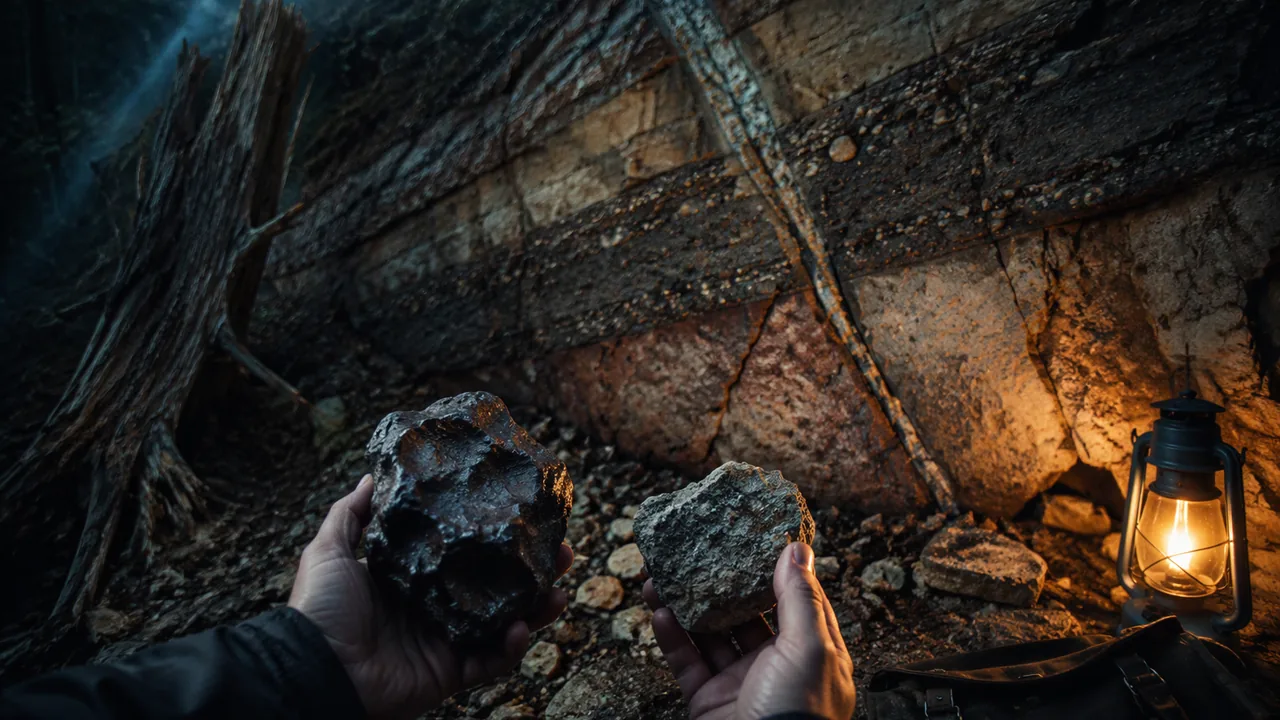
The phenomenon. In 1877, near Warrenton in Warren County, Missouri, people heard a whistling noise and saw a stone of about 100 pounds strike a tree and break into pieces. About 1.6 kg of it survives in collections. The Warrenton meteorite is a carbonaceous chondrite of the CO group, an unusual type among Missouri’s 24 recorded meteorites and among the most primitive materials in the solar system. Meteorites like it carry the solar system’s first solids, which are about 4.567 billion years old. Missouri’s oldest rocks, the granites and rhyolites of the St. Francois Mountains, are 1.48 to 1.45 billion years old, and no rock yet found anywhere on Earth’s surface is as old as the meteorite. How can a stone that fell in 1877 be older than every rock around it? To answer that, we first need to read time in rocks.
Relative dating puts events in order without numbers. Geologists use a few principles, set out by Nicolas Steno in 1669 and James Hutton and others in the 1700s:
- Superposition: in undisturbed sedimentary layers, older layers lie below younger ones.
- Original horizontality: sediments settle in flat layers; tilted or folded layers were disturbed after they formed.
- Cross-cutting relationships: a fault or an igneous intrusion that cuts across rocks is younger than the rocks it cuts.
- Inclusions: a piece of rock inside another is older than the rock that contains it.
- Unconformities: a buried erosion surface marks a gap in the record: time passed, and rock was removed, before deposition resumed. Where sedimentary layers rest on eroded igneous rock, the surface is called a nonconformity.
- Faunal succession: fossils appear in a consistent order, so matching fossils link layers in different places.
Worked example. A canyon wall shows layers A (bottom), B and C, all tilted 30°. A granite dike D cuts through A, B and C. Flat layers E and F lie across the eroded top of the tilted layers, and the dike stops at that surface. The order: A, B, C were deposited (superposition), then tilted (original horizontality says they began flat), then the dike D intruded (cross-cutting), then erosion made the unconformity (the dike is cut off by it), then E and F were deposited. The erosion surface is an angular unconformity, and it may represent millions of years that left no rock at all.
Missouri’s example. In and around the St. Francois Mountains, the volcanic rocks and granites were tilted, faulted and eroded into hills with as much as 2,000 feet of relief. Then, in the Late Cambrian, a shallow sea flooded the Ozark region and laid the Lamotte Sandstone against the flanks of those old hills, which stood for a time as islands (U.S. Geological Survey). Superposition and cross-cutting put the events in order: igneous rocks, then tilting and erosion, then the sandstone and the dolomites above it. The buried surface is a nonconformity, and relative dating alone can only say that a long time is missing there. How long is a question for the next lesson’s clock.
What relative dating cannot do. It tells you C is younger than A, but not whether the difference is a thousand years or a hundred million. In the 1800s geologists estimated rates of deposition and erosion and realized Earth must be very old, but the estimates disagreed widely. Numerical ages came only after the discovery of radioactivity. In the next lesson you will model the clock inside rocks.
Scale. Keep three numbers in mind: the solar system formed about 4.57 billion years ago, Earth’s oldest known rocks are about 4.0 billion years old, and Missouri’s oldest rocks are about 1.5 billion years old. The gap between the first two is part of today’s puzzle, and your questions should aim at it.
📖 Read for this lesson
The reading opens over the lesson; close it to come back to exactly where you were. The checks below draw on it.
Formative check
Work through these before moving on. They are not graded — they tell you whether the standard below has landed yet.
The Warrenton meteorite fell in Missouri in 1877. Which do you expect is older: the meteorite’s minerals or the granite of Missouri’s St. Francois Mountains?
A basalt dike cuts through layers of sandstone and shale but not through the lava flow on top. What can you conclude?
A buried erosion surface that represents missing time is called an ; a rock fragment enclosed in another rock is an .
Sketch a cross-section with at least four layers, one fault and one intrusion. Below your sketch, write the order of events, naming the principle you used for each step. Then order the practice cross-section in this lesson’s reading and check yourself against the answer key in the next lesson’s reading. Finally, write one question you would need a numerical (not relative) age to answer, for example about the gap between the Lamotte Sandstone and the St. Francois rocks beneath it.
How confident are you that you can put the events in a rock cross-section in order using the principles of relative dating?
Practice
Work these on paper or in your notebook, then open Check your answer. Aim for all of Fluency and Application; try at least one Challenge.
Printable version: this unit’s practice workbook (PDF)
Fluency
Build speed and accuracy with the core skill.
- Layers from bottom to top are sandstone, shale and limestone, undisturbed. Which is oldest, and which principle tells you?
Check your answer
Answer: Sandstone; superposition - A granite dike cuts through three layers but stops at an erosion surface with flat layers above it. List the events in order.
Check your answer
Answer: The three layers are deposited; the dike intrudes; erosion forms the unconformity; the flat layers are deposited.Cross-cutting relationships and unconformities. - A conglomerate contains pebbles of basalt. Which is older, the basalt or the conglomerate?
Check your answer
Answer: The basalt (principle of inclusions).
Application
Use the skill in context. Show your reasoning.
- A 30 m thick shale layer formed from mud settling at about 1 cm per 1,000 years (an illustrative rate). About how long did it take to form?
Check your answer
Answer: about 3 million years30 m = 3,000 cm; 3,000 × 1,000 years = 3,000,000 years. - Tilted layers are cut off by a flat erosion surface, with flat layers above. What kind of feature is this, and what does it tell you about time?
Check your answer
Answer: An angular unconformity; the layers were deposited, tilted, eroded and then buried, so a long time is missing from the record. - Two canyons 50 km apart both contain a layer with the same distinctive trilobite fossils. What can a geologist conclude, and by which principle?
Check your answer
Answer: The layers are about the same age (faunal succession), so they can be correlated. - In the St. Francois Mountains of Missouri, the Lamotte Sandstone (laid down in the Late Cambrian, which began about 497 million years ago) rests on eroded volcanic rock about 1,450 million years old. What kind of unconformity is this, and at least how much time does the buried surface represent?
Check your answer
Answer: A nonconformity; at least about 953 million years, nearly a billion yearsSedimentary rock on eroded igneous rock is a nonconformity. 1,450 − 497 = 953 million years.
Challenge
Stretch problems. Expect to think before you write.
- A fault offsets layers A-D but not layer E above it; a dike cuts E and the fault. Put all events in order and explain why relative dating alone cannot say how long the gap between D and E lasted.
Check your answer
Answer: Deposit A-D; faulting; deposit E; dike intrudes. Relative dating orders events but gives no numerical ages, so the gap could be years or millions of years.
Review
Keep earlier skills sharp.
- Convert 300 mL to L.
Check your answer
Answer: 0.3000 L - Review (Unit 1): an object orbits the Sun with a semi-major axis of 16 AU. What is its period?
Check your answer
Answer: 64 yearsT = 161.5 = 64.
The Warrenton Meteorite, Missouri’s Oldest Rocks, and Two Cross-Sections Read in Order
R.L. Korotev, Meteorites from Missouri (Washington University in St. Louis, compiled from the NHM Catalogue of Meteorites and the Meteoritical Bulletin Database); Connelly et al., Science 338:651 (2012), PubMed abstract; USGS Geologic Time: Age of the Earth; du Bray et al., USGS Professional Paper 1866 (2021); USGS Scientific Investigations Map 3320 (Montauk quadrangle, Missouri); Missouri DNR PUB3003; ICS International Chronostratigraphic Chart v2023/09; all retrieved November 6, 2026. Cross-sections are SLS original teaching figures. · SLS original (cites U.S. government and Missouri state public records and published ages; brief quotations only)
Why this reading. The lesson’s phenomenon is a stone that fell in Missouri in 1877 and is far older than every rock around it, and its open question asks you to order the events in a cross-section and check your work. Here are Missouri’s meteorite record as Washington University in St. Louis compiles it, the dated ages that make the puzzle real, Missouri’s own buried erosion surface in the St. Francois Mountains, and two cross-sections, one fully worked and one for you to practice on before you draw your own.
Table 1. Missouri’s meteorites, as recorded
From Randy L. Korotev, Meteorites from Missouri (Department of Earth, Environmental, and Planetary Sciences, Washington University in St. Louis), which draws on the Natural History Museum’s Catalogue of Meteorites (2000) and the Meteoritical Bulletin Database. Retrieved November 6, 2026.
| Quantity | As published |
|---|---|
| Meteorites recorded in Missouri | 24: nine irons, eleven stones, three stony-irons |
| Falls (found shortly after they fell) | 7; the other 16, including all the irons, are finds |
| First recorded | Little Piney, Pulaski County, an observed fall in 1839 |
| Warrenton, Warren County, 1877 (fall) | “With a whistling noise a stone of about 100 lb was seen to strike a tree and break into pieces.” Known mass today 1.6 kg. Type: carbonaceous chondrite, group CO3, “an unusual type” among Missouri meteorites. |
| St. Louis, St. Louis city, 1950 (fall) | “A mass of 1 kg hit a car on West Florissant Ave.” Type: ordinary chondrite, H4 |
About 45 kg (100 lb) was seen to fall at Warrenton, but only 1.6 kg is known today: 1.6 ÷ 45 ≈ 4%. The rest broke up, was kept privately or was lost. A carbonaceous chondrite is made of material that condensed as the solar system formed and was never melted into a planet; meteorites of this kind carry the solar system’s first solids, calcium-aluminum-rich inclusions and chondrules. No age has been published for the Warrenton stone itself in the sources used here; its age is inferred from the dated meteorites of its kind in Table 2.
Table 2. The ages that make the puzzle
| Material | Age | Method and source |
|---|---|---|
| Oldest solids in primitive meteorites (calcium-aluminum-rich inclusions) | 4,567.30 ± 0.16 million years | Uranium-corrected lead-lead dating; Connelly and others, Science 338:651 (2012), PubMed abstract |
| Chondrules in the same meteorites | 4,567.32 ± 0.42 to 4,564.71 ± 0.30 million years: formed over about 3 million years, starting with the inclusions | Connelly and others (2012) |
| Earth and the solar system | 4.54 billion years, uncertainty under 1% | USGS, Geologic Time: Age of the Earth |
| Oldest rocks found on Earth (Acasta Gneisses, Canada) | 4.03 billion years | USGS, Age of the Earth |
| St. Francois Mountains volcanic and plutonic rocks, southeast Missouri | 1.48 to 1.45 billion years (“essentially continuous magmatism during the 30-million-year period”), with minor plutons added 1.34 to 1.27 billion years ago | Uranium-lead dating of zircon; du Bray and others, USGS Professional Paper 1866 (2021) |
| Granite of Castor River Shut-Ins (on the paper’s cover) | 1.47 billion years | USGS Professional Paper 1866 |
The St. Francois rocks are the oldest in Missouri, an exposure of the Precambrian basement that lies beneath the whole state (Missouri Department of Natural Resources, PUB3003). The solar system’s first solids are 4,567 million years old; Missouri’s oldest rocks are 1,480 to 1,450 million years old. 4,567 ÷ 1,480 = 3.09 and 4,567 ÷ 1,450 = 3.15, so the meteorite’s oldest grains are more than three times as old as the oldest rock in the state. The predict item’s answer rests on these dated materials. Relative dating cannot give either number; it can only put events in order. Both are needed.
Missouri’s buried erosion surface
From the U.S. Geological Survey’s Geologic Map of the Montauk Quadrangle, Dent, Texas, and Shannon Counties, Missouri (Scientific Investigations Map 3320, David J. Weary and others), and Missouri DNR PUB3003:
- The granites and volcanic deposits of the St. Francois Mountains “were deformed, faulted, tilted, and subjected to uplift and erosion beginning in the Mesoproterozoic and continuing through the Neoproterozoic.” Relief on this buried erosion surface has been reported to be as much as 2,000 ft (610 m).
- “During the Late Cambrian, the Ozark region was flooded by an extensive epicontinental sea.” High areas stood above the water as islands, and the basal Cambrian unit, the Lamotte Sandstone, “onlaps the flanks of these Mesoproterozoic bedrock hills.” The Lamotte averages about 145 ft thick in the Montauk quadrangle.
- Above the Lamotte lie the Bonneterre Formation, with algal reefs that grew along the flanks of the drowned islands, and then dolomites of Late Cambrian and Early Ordovician age (Potosi, Eminence, Gasconade, Roubidoux).
- The Late Cambrian (Furongian) began about 497 million years ago (International Chronostratigraphic Chart v2023/09).
Read it as relative dating: the volcanic rocks and granites formed first; they were tilted, faulted and eroded into hills; the sea then flooded the hills and laid down sand on their flanks, and younger layers were stacked on top (superposition). The contact is an unconformity of the kind called a nonconformity, sedimentary rock lying on eroded igneous rock. With numbers from Table 2 the gap can be sized: the youngest of the main St. Francois rocks are 1,450 million years old and the Late Cambrian began about 497 million years ago, so the surface hides at least 1,450 − 497 = 953 million years, nearly a billion years with no rock left to record them. Relative dating alone could only say “a long time.”
A worked cross-section
Tilted layers A, B and C dip to the lower right. A dark dike D cuts all three and stops at the dashed surface. Flat layers E and F lie across that surface. The order, with the principle at each step: (1) A, then B, then C were deposited, oldest at the bottom (superposition); (2) they were deposited flat and later tilted (original horizontality); (3) dike D intruded, cutting A, B and C, so it is younger than all three (cross-cutting); (4) erosion cut the tilted layers and the dike to one surface, so the surface is younger than D (cross-cutting again, by the erosion surface); (5) E and then F were deposited on top (superposition). The dashed surface is an angular unconformity, and it hides an unknown span of time. A question that needs a numerical age: how long was that gap?
A cross-section for you
Layers P, Q, R and S are flat but offset across a steep fault, the right side dropped about 20 m on the drawing’s scale. An intrusion I cuts P through S on the left but does not cross the lava flow L. The flow L runs unbroken across the top, over both the fault and the intrusion. Write the order of events, naming a principle for each step, and answer two questions before you check: Is the fault older or younger than the flow, and how do you know? Could the intrusion and the fault be the same age from this drawing alone? (The answer key is one line in the next lesson’s reading; do not read ahead until you have written yours.)
What relative dating can and cannot tell you here
From the worked section you know that F is the youngest rock and A the oldest, and that the dike is younger than C but older than E. You cannot tell whether the gap at the unconformity is a thousand years or a hundred million, whether A is 200 million or 2 billion years old, or how long the dike took to cool. Every one of those is a question for the next lesson’s clock, and the St. Francois section above shows what the clock adds.
Sources: Washington University in St. Louis, Meteorites from Missouri (R.L. Korotev) (sites.wustl.edu); Connelly et al. 2012, The absolute chronology and thermal processing of solids in the solar protoplanetary disk, Science 338:651 (PubMed 23118187) (pubmed.ncbi.nlm.nih.gov); USGS, Geologic Time: Age of the Earth (pubs.usgs.gov); USGS Professional Paper 1866, Petrology and geochronology of 1.48 to 1.45 Ga igneous rocks in the St. Francois Mountains terrane, southeast Missouri (2021) (pubs.usgs.gov); USGS Scientific Investigations Map 3320, Geologic map of the Montauk quadrangle, Dent, Texas, and Shannon Counties, Missouri (pubs.usgs.gov); Missouri DNR, Groundwater Provinces of Missouri: St. Francois Mountains Groundwater Province (PUB3003) (dnr.mo.gov); International Commission on Stratigraphy, International Chronostratigraphic Chart v2023/09 (CC BY 4.0) (stratigraphy.org)