identify minerals and rocks by their properties, including density, and use the rock cycle to explain how internal and surface processes make and remake Earth materials.
Instruction
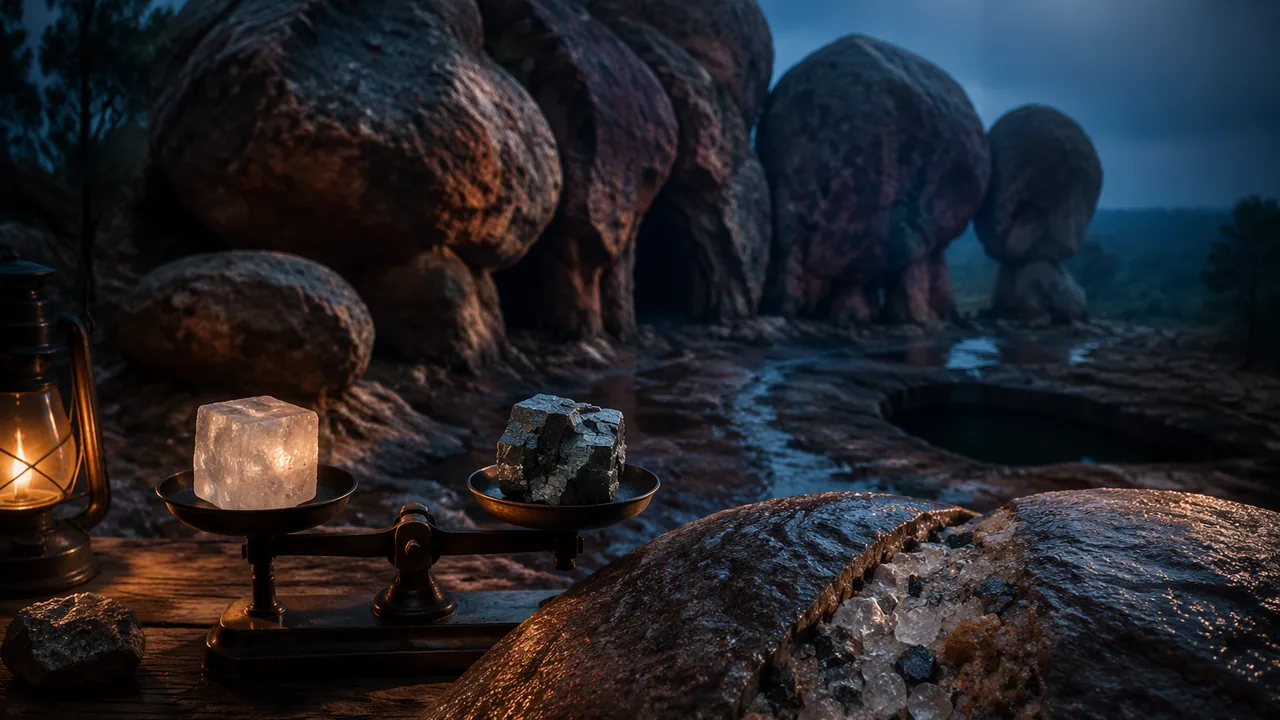
The phenomenon. At Elephant Rocks State Park in the St. Francois Mountains of southeast Missouri, giant boulders of red granite stand end to end like a train of circus elephants. The largest, called Dumbo, is 27 feet tall, 34 feet long and 17 feet wide and weighs about 680 tons. That granite crystallized from magma deep underground about 1.5 billion years ago, yet today children climb on it. Farther south, Big Spring near Van Buren pours out an average of roughly 289 million gallons of water a day, and that water carries dissolved rock with it: the Ozarks are being taken apart from the inside. Missouri has more than 7,500 recorded caves and more than 16,000 known sinkholes. Both landscapes are made of rock that formed far from where we see it, and both are being torn down at the surface. This unit explains how.
Minerals. A mineral is a naturally occurring, inorganic solid with a definite chemical composition and an ordered crystal structure. Quartz (SiO2), feldspar, mica, calcite and dolomite are common ones. Geologists identify minerals by properties that come from their structure: hardness (quartz, 7 on the Mohs scale, scratches glass; calcite, 3, does not), cleavage or fracture, luster, streak color, reaction with dilute acid (calcite fizzes; dolomite fizzes only weakly, and only when powdered) and density.
Worked example: density as evidence. A pale grain has mass 26.5 g and volume 10.0 cm3: density 26.5 / 10.0 = 2.65 g/cm3, matching quartz. A gray metallic grain that breaks into little cubes has mass 37.0 g and displaces 5.0 cm3 of water: 37.0 / 5.0 = 7.4 g/cm3. That is galena, lead sulfide, Missouri’s state mineral and the ore of the lead mines of southeast Missouri; fool’s gold (pyrite) is only about 5.0. Galena is about 2.8 times as dense as quartz, so when a stream slows down, galena grains drop out before quartz grains of the same size. Dense minerals collect in stream gravel this way, and geologists have long sampled stream sediment to trace ore back upstream to its source.
Three families of rock.
- Igneous rocks crystallize from magma. Cooled slowly underground they have large crystals (granite, the rock of Elephant Rocks); cooled quickly at the surface they have tiny crystals or glass (basalt, obsidian, and rhyolite, the volcanic rock of much of the St. Francois Mountains).
- Sedimentary rocks form when weathered fragments or dissolved minerals are deposited, buried, compacted and cemented (sandstone, shale, limestone, dolomite). They form in layers and can hold fossils. Most of the Ozarks is built of dolomite and limestone laid down in shallow seas.
- Metamorphic rocks form when heat and pressure change existing rocks without melting them (marble from limestone, schist from shale). They form deep in mountain belts where plates collide (Unit 3); little metamorphic rock reaches the surface in Missouri.
The rock cycle. Any rock can become any other. Internal processes, driven by Earth’s interior heat (Unit 3), melt, deform and uplift rock. Surface processes, driven by the Sun’s energy and gravity, weather, erode and deposit it. The Elephant Rocks granite crystallized from magma that cooled slowly far below the surface. As erosion removed the rock above it, the granite cracked into blocks; water seeping along the cracks rotted the granite at the edges and corners while it was still underground, leaving rounded core stones that erosion later uncovered. Today frost and rain keep breaking it into loose sand that streams carry toward the Mississippi River, where it may one day become sandstone. Meanwhile, slightly acidic groundwater dissolves the Ozark dolomite and carries it away in solution, opening caves and springs.
Different scales. If granite formed about 8 km down and was exposed over 90 million years (illustrative figures), the average exhumation rate is only about 0.09 mm per year, yet a single event can move enormous amounts of material in minutes: when the Taum Sauk upper reservoir failed in 2005, about 1.5 billion gallons of water tore down the side of Proffit Mountain, stripping soil, rock and trees. Underground the contrast is the same: dissolution is slow and steady, but the soil above a cave can collapse into a sinkhole overnight. Your questions today should aim at that contrast: What makes the ground or a slope suddenly fail? What does water do to rock?
📖 Read for this lesson
The reading opens over the lesson; close it to come back to exactly where you were. The checks below draw on it.
Lab: Identifying Minerals and Rocks by Their Properties
Question. Which physical properties, including density, identify common minerals and rocks, and what does each rock’s texture reveal about how it formed?
Materials
- A rock and mineral set if you have one (for example the Missouri Geological Survey’s Missouri Rocks and Minerals Set), or eight rocks and mineral grains you collect yourself (see Option A); ideally quartz, feldspar, calcite, galena or magnetite, mica, granite, basalt, sandstone, limestone or dolomite
- Kitchen or electronic balance (0.1 g)
- 100 mL graduated cylinder, or a clear measuring cup marked in milliliters, and water
- Streak plate (the unglazed back of a bathroom tile), a steel nail and a glass plate or jar for hardness
- White kitchen vinegar in a dropper or spoon, which takes the place of dilute acid and is safe to handle
- Magnifying glass or a phone camera zoomed in
- Wear safety glasses when scratching minerals on glass and when using vinegar; tape the edges of any glass plate.
- Have an adult nearby. Wash your hands after handling galena or any metallic grain, keep samples away from food and younger children, and taste nothing.
- Carry the cylinder with two hands and wipe up spilled water at once to prevent slips.
Procedure
- For each mineral, record luster, color, streak color on the tile, and whether it scratches glass or is scratched by the nail.
- Add two drops of vinegar to calcite, limestone or dolomite and marble if you have them, and to one other sample. Record whether it fizzes; for dolomite, scratch a little powder off first and test the powder.
- Find each sample’s mass on the balance, then its volume by water displacement: record the water level before and after gently sliding it into the tilted cylinder.
- Compute density = mass / volume for at least four samples and compare with the reference values.
- Use the magnifier to sort the rocks by texture (large crystals, tiny crystals, grains cemented together, layers or bands) and classify each as igneous, sedimentary or metamorphic.
Data
| Sample | Luster, color, streak | Hardness test | Fizz? | Mass (g) | Volume (cm³) | Density (g/cm³) | Identification |
|---|---|---|---|---|---|---|---|
Reference densities (g/cm3): quartz 2.65; orthoclase feldspar about 2.56; calcite 2.71; dolomite about 2.84; pyrite about 5.0; magnetite about 5.15; galena about 7.4; granite about 2.67; basalt about 3.0.
Illustrative sample cards (Option B). Eight samples with their test results already recorded. These are constructed teaching data, not measurements of particular specimens; the density and identification columns are left for you.
| Card | Luster, color, streak | Hardness test | Fizz in vinegar? | Mass (g) | Volume (cm3) |
|---|---|---|---|---|---|
| 1 | Glassy, colorless, white streak | Scratches glass | No | 34.6 | 13.1 |
| 2 | Pearly, salmon pink, white streak | Just scratches glass | No | 30.8 | 12.0 |
| 3 | Glassy, white, white streak | Scratched by a steel nail | Yes, strongly | 27.3 | 10.1 |
| 4 | Metallic, lead gray, gray-black streak, breaks into cubes | Easily scratched by the nail | No | 90.3 | 12.2 |
| 5 | Metallic, black, black streak, attracts a magnet | Not scratched by the nail | No | 57.8 | 11.1 |
| 6 | Rock: large interlocking pink, white and black crystals, no layers | — | No | 81.2 | 30.1 |
| 7 | Rock: dark gray, crystals too small to see, scattered gas bubbles | — | No | 90.4 | 30.2 |
| 8 | Rock: rounded sand grains cemented together in visible layers | — | Weakly, on the cement between grains | 63.9 | 27.0 |
Analysis
- Claim: which property was most useful for telling similar-looking samples apart? Support it with at least two measured densities or test results.
- Explain how texture shows the history of a rock: why does granite have large crystals and basalt small ones?
- Your measured quartz density is compared with 2.65 g/cm³. Compute your percent difference.
- Sources of error: how do air bubbles on the sample, reading the cylinder scale and wet samples on the balance affect your density? Which error is largest for a small sample?
If you cannot do this lab in person: Choose one. All three earn full credit and end in the same completed identification table, at least four computed densities, one percent difference and the same four analysis answers. Option A — real rocks. The procedure above. If you have no set, collect eight rocks and mineral grains yourself from a driveway, a landscaping-gravel pile, a gravel bar or a garden, and identify what you can; in much of Missouri the gravel will be chert and dolomite, which are worth identifying too. A kitchen scale, a measuring cup of water, an unglazed tile, a steel nail and vinegar are the whole toolkit. Option B — the illustrative sample cards in the data section above. No materials and no internet. Compute the density of all eight, match each to the reference densities given above, identify each sample, classify cards 6, 7 and 8 as igneous, sedimentary or metamorphic from their textures, and give the percent difference between card 1 and the quartz reference of 2.65 g/cm3. Option C — PhET Density. Use the sim block below as your measuring bench. On the Mystery screen, record the mass and the displaced volume for blocks A to E, compute five densities and identify each from the sim’s table. Then answer every analysis question with those five in place of the rock set, and for the texture questions use the descriptions on cards 6, 7 and 8 above. Cite the sim and the date you used it.
Formative check
Work through these before moving on. They are not graded — they tell you whether the standard below has landed yet.
Simulation & tools
Density from mass and displaced volume
Open the Mystery screen. For blocks A to E, record the mass shown on the scale, then drop each block in the pool and record the rise in water level (the block’s volume in liters). Compute each density in kg/L (the same number as g/cm3) and identify it from the sim’s density table. Which block would behave like galena in a stream, and which like quartz sand?
No sim? Use cards 1 to 5 in this lesson’s data section, which give the mass and volume of five samples. Compute the same five densities, identify each from the reference list, and answer the same question about which would behave like galena in a stream and which like quartz sand.
Open in a new tab ↗ · PhET Interactive Simulations, University of Colorado Boulder · CC BY 4.0
A rock has large, interlocking crystals of quartz, feldspar and mica, with no layers. How did it most likely form?
A 37.0 g grain that displaces 5.0 cm³ of water has a density of g/cm³, which identifies it as .
Draw a rock-cycle model for one grain of Elephant Rocks granite: label where it crystallized, how it reached the surface, what is breaking it down now, and where it might become sedimentary and then metamorphic rock. Add one grain of Ozark dolomite that dissolves and leaves through Big Spring. Mark which steps are driven by Earth’s interior heat and which by the Sun and gravity. Then write two questions about sudden ground failure (a sinkhole collapse or the Taum Sauk breach) in your question log.
How confident are you that you can identify minerals and rocks by their properties and explain the rock cycle?
Practice
Work these on paper or in your notebook, then open Check your answer. Aim for all of Fluency and Application; try at least one Challenge.
Printable version: this unit’s practice workbook (PDF)
Fluency
Build speed and accuracy with the core skill.
- What is the mass of 20.0 cm3 of ice (density 0.917 g/cm3)?
Check your answer
Answer: 18.3 gMass = density × volume. - What volume does 18.4 g of olive oil (density 0.92 g/cm3) occupy?
Check your answer
Answer: 20.0 cm3Volume = mass / density. - What is the mass of 40.0 cm3 of copper (density 8.96 g/cm3)?
Check your answer
Answer: 358.4 gMass = density × volume. - A pale mineral grain has mass 26.5 g and volume 10.0 cm3. Find its density and identify it from: quartz 2.65, calcite 2.71, dolomite 2.84, galena 7.4.
Check your answer
Answer: 2.65 g/cm3; quartz
Application
Use the skill in context. Show your reasoning.
- A rock of mass 52.0 g raises the water in a cylinder from 60.0 mL to 79.3 mL. Find its density and suggest a rock type (granite about 2.7, basalt about 3.0).
Check your answer
Answer: 2.69 g/cm3; consistent with graniteVolume = 79.3 − 60.0 = 19.3 cm3. - Galena (7.4 g/cm3) and quartz (2.65 g/cm3) grains of the same volume are carried by an Ozark stream. How many times heavier is the galena grain, and where does each settle as the stream slows?
Check your answer
Answer: about 2.8 times heavier; galena settles first, close to where the current slows, and quartz is carried farther - A rock has large interlocking crystals; another has sand grains cemented together in layers; a third has wavy bands of aligned minerals. Classify each and say how it formed.
Check your answer
Answer: Igneous (intrusive), cooled slowly from magma; sedimentary, from deposited and cemented sediment; metamorphic, changed by heat and pressure.
Challenge
Stretch problems. Expect to think before you write.
- A chunk of ore is galena (7.4 g/cm3) in dolomite (2.84 g/cm3). It has mass 30.0 g and volume 6.0 cm3. What fraction of its volume is galena, and what mass of galena does it contain?
Check your answer
Answer: about 47% galena by volume; about 21.0 g of galenaDensity 5.0 = 7.4x + 2.84(1 − x); x = 2.16 / 4.56 = 0.474; galena mass = 0.474 × 6.0 × 7.4. - Dumbo, the largest boulder at Elephant Rocks State Park, is 27 ft tall, 34 ft long and 17 ft wide, and Missouri State Parks gives its weight as 680 tons. Treat it as an ellipsoid, V = (π/6) × length × width × height, with granite at 2.67 g/cm3. Find its volume in m3 and its mass in short tons (1 short ton = 907.18 kg). Does the published weight check out?
Check your answer
Answer: about 231 m3; about 618 metric tons = about 681 short tons; yes, within 1% of 680 tons1 ft = 0.3048 m: 10.36 × 5.18 × 8.23 m = 441.9 m3 for the box; × π/6 = 231.4 m3; × 2,670 kg/m3 = 617,800 kg.
Review
Keep earlier skills sharp.
- Compare a magnitude 5.0 earthquake with a magnitude 4.0 earthquake. About how many times larger is the ground-motion amplitude, and about how many times more energy is released?
Check your answer
Answer: amplitude ≈ 10.0 times; energy ≈ 32 timesEach whole step in magnitude is 10 times the amplitude and about 32 times (101.5) the energy. - A wood sample has 70% of the carbon-14 of living wood. Using a half-life of 5,730 years, estimate its age.
Check your answer
Answer: ≈ 2,949 yearst = 5730 × log2(100/percent remaining).
Missouri Minerals, the Eight Cards Worked, Elephant Rocks and the Karst Record
webmineral.com data pages for quartz, orthoclase, calcite, dolomite, pyrite, magnetite and galena; Robertson 1988, USGS Open-File Report 88-441, Table 11; Missouri Geological Survey karst, caves, sinkholes, springs, losing streams and state geologic symbols pages; Missouri State Parks, Elephant Rocks natural history; NPS Ozark National Scenic Riverways, Big Spring and springs pages; USGS SIR 2009-5111; retrieved November 6, 2026 · SLS original (cites USGS, NPS, Missouri Geological Survey and Missouri State Parks public records and published mineral data; brief quotations only)
Why this reading. The lab’s reference densities need a source, its Option B cards have blank density and identification columns, and the phenomenon paragraph states sizes, ages and counts that need a citation. Here are the mineral and rock densities as two public references give them, the eight cards fully worked, and the Missouri records behind Elephant Rocks, Big Spring and the state’s karst, all retrieved November 6, 2026.
Table 1. Reference properties of minerals (webmineral.com mineral data pages)
| Mineral | Formula | Density (g/cm3) | Hardness | Streak and other tests |
|---|---|---|---|---|
| Quartz | SiO2 | 2.6-2.65 | 7 | White; glassy |
| Orthoclase (a feldspar) | KAlSi3O8 | 2.56 | 6 | White |
| Calcite | CaCO3 | 2.71 | 3 | White; fizzes in acid |
| Dolomite | CaMg(CO3)2 | 2.8-2.9 (average 2.84) | 3.5-4 | White |
| Pyrite | FeS2 | 5-5.02 | 6.5 | Greenish black; metallic |
| Magnetite | Fe3O4 | 5.1-5.2 (average 5.15) | 5.5-6 | Black; naturally strongly magnetic |
| Galena | PbS | 7.2-7.6 (average 7.4) | 2.5 | Grayish black; metallic, lead gray; perfect cubic cleavage; 86.6% lead by mass |
Rocks are mixtures, so their densities vary. The U.S. Geological Survey’s compilation of rock properties (Robertson 1988, Table 11) lists average bulk densities of granite 2.67 g/cm3, and gabbro 2.98 and diabase 2.97, the coarse- and medium-grained equivalents of basalt, which is why the lesson uses “basalt about 3.0.” Sedimentary rocks depend on how much open space they hold: sandstone is 2.7 with almost no pores but 2.3 at 20% porosity, and dolomite 2.8 at 3%.
The Missouri Geological Survey lists galena as Missouri’s state mineral, “the primary ore of lead.” Galena against quartz: 7.4 / 2.65 = 2.79, the lesson’s “about 2.8 times as dense.”
Table 2. The eight Option B cards, worked
Density = mass / volume. Identification uses the density and the card’s other tests together; a density alone can be shared by two minerals.
| Card | Mass (g) | Volume (cm3) | Density (g/cm3) | Deciding tests | Identification |
|---|---|---|---|---|---|
| 1 | 34.6 | 13.1 | 2.64 | Glassy, scratches glass, no fizz | Quartz |
| 2 | 30.8 | 12.0 | 2.57 | Pearly, salmon pink, just scratches glass | Orthoclase feldspar |
| 3 | 27.3 | 10.1 | 2.70 | Scratched by a nail, fizzes strongly | Calcite |
| 4 | 90.3 | 12.2 | 7.40 | Lead gray, gray-black streak, breaks into cubes, soft | Galena |
| 5 | 57.8 | 11.1 | 5.21 | Black streak, attracts a magnet | Magnetite |
| 6 | 81.2 | 30.1 | 2.70 | Large interlocking crystals, no layers | Granite: igneous, cooled slowly underground |
| 7 | 90.4 | 30.2 | 2.99 | Crystals too small to see, gas bubbles | Basalt: igneous, cooled fast at the surface |
| 8 | 63.9 | 27.0 | 2.37 | Cemented sand grains in layers, weak fizz on the cement | Sandstone: sedimentary (a carbonate cement) |
Card 1 against the quartz reference: (2.64 − 2.65) / 2.65 = −0.0033, a percent difference of −0.3%. Density does the most work for the metallic cards: galena (7.40) and magnetite (5.21) are both dark and metallic, but they differ by more than 2 g/cm3, and the magnet and the cubic cleavage confirm it. Cards 1, 2 and 3 all fall between 2.57 and 2.70 and are told apart by hardness and the fizz instead. Card 8’s low density is the air between cemented grains: sedimentary rocks are porous. Sources of error to name: an air bubble clinging to a sample adds to its apparent volume and lowers the density; two cylinder readings each off by up to half a milliliter can add up to 1 mL, a 10% error on a 10 mL sample but only 3% on a 30 mL sample, so the small mineral grains carry the largest relative error; a wet sample weighs more than a dry one.
Elephant Rocks (Missouri State Parks)
The park’s natural-history page: the granite formed about 1.5 billion years ago when magma “accumulated deep below the earth’s surface” and slowly cooled into red granite. As erosion removed the weight of the rock above, horizontal and vertical cracks broke the granite into huge angular blocks; water moving down the fractures disintegrated the granite next to them and rounded the corners “while still underground,” forming core stones that erosion later exposed. Today rainwater that freezes in small fractures keeps rounding the boulders, lichens add a weak acid, and rain-filled “solution pans” up to several feet across pit the top of the outcrop. The landform is a tor, “Missouri’s finest.” The largest boulder, Dumbo, is 27 feet tall, 34 feet long, 17 feet wide and weighs 680 tons.
Checking Dumbo’s weight. An ellipsoid fills π/6 of the box around it. Box: 10.36 m × 5.18 m × 8.23 m = 441.9 m3; ellipsoid: 231.4 m3; at granite’s 2.67 t/m3, 618 metric tons = 681 short tons, within 1% of the published 680. The density from Table 1’s source and the park’s measurements agree.
Missouri’s karst (Missouri Geological Survey; National Park Service)
| Feature | As published |
|---|---|
| Caves | “approximately 7,500 recorded caves”; Missouri “has become known as the Cave State” |
| Sinkholes | about 16,000 identified, “although, many more exist”; the largest known covers about 700 acres in western Boone County; some are more than 100 feet deep |
| Springs | more than 4,400; water entering a sinkhole can travel more than 30 miles underground before reaching a spring |
| Losing streams | streams that lose at least 30% of their water underground during dry conditions |
| How sinkholes form | water moving through cracks “slowly dissolves the rock and carries it away in solution”; soil washes into the voids, and when it “can no longer support itself, it collapses” |
| Big Spring (NPS) | average flow about 289 million gallons a day; dye traces show water traveling up to 45 miles underground, taking 7 to 14 days; over 800 million gallons a day at peak flow |
Sudden change: the Taum Sauk breach (USGS)
On December 14, 2005, a 680-foot-wide section of the Taum Sauk upper reservoir embankment failed, and about 1.5 billion gallons of water ran down Proffit Mountain into Johnson’s Shut-Ins State Park, depositing “enormous quantities of rock, soil, and vegetation” (USGS, Barr 2009). Lesson 4.3 uses this event in detail.
Scale, checked
The lesson’s illustrative exhumation: granite formed about 8 km down and exposed over 90 million years gives 8,000,000 mm / 90,000,000 years = 0.089 mm per year, about the thickness of a sheet of paper each year. The Taum Sauk water emptied a 1.5-billion-gallon reservoir in minutes. Both are surface processes driven by gravity; the contrast between them is the subject of your question log.
Sources: webmineral.com, Galena mineral data (webmineral.com); webmineral.com, Dolomite mineral data (webmineral.com); webmineral.com, Quartz, Orthoclase, Calcite, Pyrite and Magnetite data pages (webmineral.com); Robertson, E.C., 1988, Thermal Properties of Rocks, USGS Open-File Report 88-441 (pubs.usgs.gov); Missouri Geological Survey, Karst in Missouri (dnr.mo.gov); Missouri Geological Survey, Caves (dnr.mo.gov); Missouri Geological Survey, Sinkholes (dnr.mo.gov); Missouri Geological Survey, Springs (dnr.mo.gov); Missouri Geological Survey, State Geologic Symbols (dnr.mo.gov); Missouri State Parks, Natural History – Elephant Rocks (mostateparks.com); NPS Ozark National Scenic Riverways, Big Spring (nps.gov); NPS Ozark National Scenic Riverways, Geologic Formations (nps.gov); Barr 2009, Effects of the upper Taum Sauk Reservoir embankment breach (USGS SIR 2009-5111) (pubs.usgs.gov)