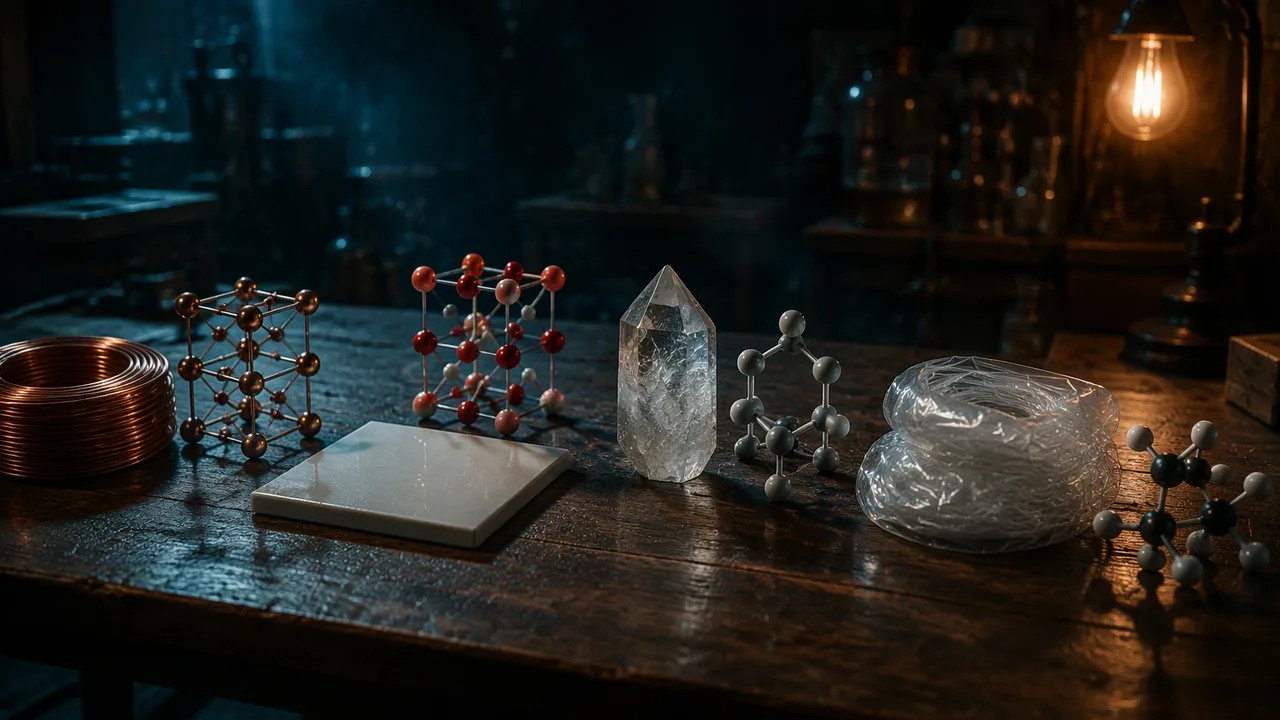
build and annotate particle-level models of a metal, an ionic ceramic, a network solid and a polymer, and explain how each structure gives the material its melting point, strength, brittleness or conductivity.
Instruction
Same atoms, different jobs. Missouri’s mines produce lead and its quarries produce limestone, and both end up in structures people depend on. The U.S. Geological Survey reports that Missouri has five lead mines, which supplied the lead produced domestically in 2025, and that lead-acid batteries use about 67% of U.S. lead. A lead plate can be bent with your hands; a block of limestone shatters if you strike it; a quartz crystal scratches steel; a polyethylene bag stretches and softens in a hot car. These differences come from structure: which particles are present, how they are arranged, and what holds them together. This lesson sorts structural materials into four classes and asks one question about each: what happens to the particles when you push, pull or heat the material?
Metals: a lattice in a sea of electrons. In metallic bonding, positive ions sit in a lattice and the valence electrons are shared across the whole piece. Push on a metal and layers of ions slide past one another, but the electron sea flows with them, so the bonding is not broken: the metal bends instead of cracking (malleable and ductile). Mobile electrons also carry charge and heat, so metals conduct. Melting points vary with how many electrons each atom contributes and how closely the ions pack: NIST lists lead at 600.64 K (327.5 °C), aluminum at 933.45 K (660.3 °C) and copper at 1357.95 K (1084.8 °C).
Ionic ceramics: strong but brittle. In an ionic solid such as CaO (2,613 °C) or MgO (2,825 °C), every ion is held by strong attractions to oppositely charged neighbors. That makes the solid hard and very high-melting. But if a blow shifts one layer by one ion width, positive ions end up beside positive ions and negative beside negative, the repulsion splits the crystal, and it cleaves. This is why ionic solids are brittle, why they do not conduct as solids (the ions cannot move), and why they conduct when melted or dissolved. Cement and concrete are ceramic materials built on calcium compounds that start as limestone.
Network covalent solids: one giant molecule. In quartz, SiO2, each silicon is bonded to four oxygens and each oxygen to two silicons in a continuous network, so there are no separate molecules. Melting requires breaking covalent bonds, and quartz melts near 1,710 °C. The formula unit has a molar mass of 60.083 g/mol, of which silicon is 46.74% and oxygen 53.26%. Diamond is the same idea for carbon: every atom bonded to four others, with PubChem listing a melting point of at least 3,500 °C. Graphite also is a network, but of flat sheets, with shared electrons spread over each sheet, so it conducts and the sheets slide, which is why pencil lead writes.
Polymers: long chains with weak forces between them. A polymer is a very long molecule built from a repeating unit. In polyethylene the unit is CH2, with molar mass 14.027 g/mol, of which carbon is 85.63%. A chain of 10,000 units has a molar mass of about 140,270 g/mol. Atoms within a chain are joined by strong covalent bonds, but neighboring chains attract only through London dispersion forces and, in some polymers, hydrogen bonds. Warming a thermoplastic lets chains slide past one another: it softens without breaking bonds. Cross-links, covalent bonds between chains, make a thermoset that does not soften.
The modeling move. To explain a function, write three linked statements: structure (what particles, arranged how), force (what holds them and what happens when you stress or heat it), and function (what that lets the material do). Example: lead is a lattice of Pb2+ ions in a mobile electron sea; layers slide without breaking bonds, and the lattice melts at only 327.5 °C; so lead can be rolled into sheets and cast at low temperature. A 0.50 m × 0.50 m × 2.0 mm sheet has a volume of 500 cm3 and, at 11.34 g/cm3, a mass of 5.67 kg.
📖 Read for this lesson
The reading opens over the lesson; close it to come back to exactly where you were. The checks below draw on it.
Formative check
Work through these before moving on. They are not graded — they tell you whether the standard below has landed yet.
You strike a thin plate of lead and a thin plate of calcium oxide with a hammer, with the same force. Which outcome do you predict, and why?
Use the melting-point table in this lesson’s reading. Which material is most likely a network covalent solid?
Melting a thermoplastic such as polyethylene requires breaking the covalent bonds along its chains.
The repeating unit CH2 in polyethylene has a molar mass of g/mol and is % carbon by mass.
Choose three materials from this lesson’s reading (one metal, one ceramic or network solid, one polymer). For each, draw a labeled model of the particles and write one structure-force-function sentence that uses a number from the reading’s data table.
How confident are you that you can explain a material’s strength, brittleness, conductivity or softening from the particles in it and the forces between them?
Practice
Work these on paper or in your notebook, then open Check your answer. Aim for all of Fluency and Application; try at least one Challenge.
Printable version: this unit’s practice workbook (PDF)
Fluency
Build speed and accuracy with the core skill.
- Classify each as metallic, ionic, network covalent or molecular/polymer: (a) copper wire, (b) table salt, (c) quartz, (d) polyethylene bag, (e) aluminum foil, (f) calcium oxide.
Check your answer
Answer: (a) metallic; (b) ionic; (c) network covalent; (d) polymer (covalent chains, weak forces between them); (e) metallic; (f) ionicMetals: metallic. Metal + nonmetal: ionic. Silicon and oxygen in a continuous bonded network: network covalent. Long carbon chains: polymer. - Calculate the molar mass of SiO2 and the percent of silicon by mass.
Check your answer
Answer: 60.083 g/mol; 46.74% Si28.085 + 2(15.999) = 60.083; 28.085 ÷ 60.083 × 100 = 46.74%. - Calculate the molar mass of the CH2 repeating unit and of a polyethylene chain with 5,000 units.
Check your answer
Answer: 14.027 g/mol per unit; 70,135 g/mol for the chain12.011 + 2(1.008) = 14.027; 5,000 × 14.027 = 70,135. - Convert the NIST melting points of lead (600.64 K), aluminum (933.45 K) and copper (1357.95 K) to °C.
Check your answer
Answer: 327.5 °C; 660.3 °C; 1084.8 °CSubtract 273.15: 600.64 − 273.15 = 327.49; 933.45 − 273.15 = 660.30; 1357.95 − 273.15 = 1084.80. - Which of lead, calcium oxide, quartz and polyethylene conducts electricity as a solid? Explain with particles.
Check your answer
Answer: Lead only.Lead has mobile valence electrons in its electron sea. In CaO the ions are locked in the lattice, quartz holds its electrons in covalent bonds, and polyethylene has no free charges. - How many moles of lead atoms are in 100 g of lead (atomic weight 207.2 g/mol)?
Check your answer
Answer: 0.4826 mol100 ÷ 207.2 = 0.4826 mol. - A hammer breaks a crystal of an ionic solid cleanly along a flat plane. Explain in one sentence why the crystal breaks instead of bending.
Check your answer
Answer: Shifting a layer of ions by one position puts like charges next to each other, so the repulsion splits the crystal.Metals bend because the electron sea keeps bonding when layers slide; ionic crystals have no such sea.
Application
Use the skill in context. Show your reasoning.
- A lead sheet is 0.50 m × 0.50 m × 2.0 mm thick. Using a density of 11.34 g/cm3, find its volume in cm3 and its mass in kg.
Check your answer
Answer: 500 cm3; 5.67 kg50 cm × 50 cm × 0.20 cm = 500 cm3; 500 × 11.34 = 5,670 g = 5.67 kg. - USGS lists the 2025 average North American lead price at 106 cents per pound. Convert to dollars per metric ton (1 metric ton = 2,204.62 lb) and find the raw-metal value of the 5.67 kg sheet.
Check your answer
Answer: $2,337 per metric ton; about $13.251.06 × 2,204.62 = $2,337/t; 5.67 kg = 0.00567 t; 0.00567 × 2,337 = $13.25. - A solid is very hard, melts at 2,613 °C, does not conduct as a solid but does when molten, and shatters under a hammer. Identify the class of solid, name the type of bonding, and explain each property in one phrase.
Check your answer
Answer: Ionic ceramic (such as CaO): strong ionic bonds give hardness and a high melting point; ions are locked in place as a solid but mobile when molten; shifted layers repel, so it shatters.Match each property to the structure: lattice of ions, charge locked in solid, mobile in liquid, brittle cleavage. - Rank these by melting point from lowest to highest and give the reason for the order: hexane (178 K), lead (600.64 K), sodium chloride (1073.9 K), quartz (about 1,983 K).
Check your answer
Answer: Hexane < lead < sodium chloride < quartz. London forces between small molecules are weakest; metallic bonding in lead is moderate; ionic bonds are strong; a covalent network needs bond breaking.Quartz: 1,710 + 273.15 = 1,983 K. Sodium chloride: 800.7 + 273.15 = 1073.9 K (NIST-JANAF shows the crystal-to-liquid transition at 1073.8 K).
Challenge
Stretch problems. Expect to think before you write.
- Diamond and graphite are both pure carbon. Diamond is extremely hard and does not conduct electricity; graphite is soft and conducts. Explain both differences from how each structure bonds the carbon atoms.
Check your answer
Answer: In diamond every carbon forms four covalent bonds in a 3-D network, so there are no free electrons and the lattice resists deformation. In graphite each carbon bonds within flat sheets, leaving electrons that move across each sheet and only weak forces between sheets, which slide.Same atoms, different structure: three-dimensional network versus layered network with delocalized electrons and weak interlayer forces. - A manufacturer wants a plastic that does not soften in hot sunlight. Using the idea of cross-links, explain what structural change to a thermoplastic would help and what trade-off it creates.
Check your answer
Answer: Add covalent cross-links between chains so the chains cannot slide past each other when warmed. Trade-off: the material cannot be re-melted and reshaped, so it is harder to recycle.Thermoplastics soften because only weak forces hold the chains; cross-links replace them with covalent bonds, as in a thermoset.
Review
Keep earlier skills sharp.
- Electronegativities: Si 1.90, O 3.44. Find the difference and classify the Si–O bond. Why can a bond classified this way still form a hard, high-melting solid?
Check your answer
Answer: 1.54; polar covalent. The bonds are strong and they form a continuous network, so melting means breaking many covalent bonds.3.44 − 1.90 = 1.54, between 0.4 and 1.8. Strength comes from the bond and the network, not the label. - NIST boiling points: methane 111 K, hydrogen sulfide 212.87 K, water 373.17 K. Rank them and name the strongest intermolecular force in each.
Check your answer
Answer: Methane (London) < hydrogen sulfide (dipole-dipole) < water (hydrogen bonding).111 < 212.87 < 373.17 K; the force types rise in strength in the same order.
Metals, Ceramics, Network Solids and Polymers: Melting Points, Missouri Lead and Structure Data
NIST Chemistry WebBook (melting points); NIST-JANAF Thermochemical Tables (NaCl); PubChem density and melting-point records; USGS Mineral Commodity Summaries 2026 (Lead, Aluminum, Copper); NIST atomic weights; SLS calculations; retrieved Nov. 15, 2026 · Public domain (NIST and U.S. government data), with reference values and SLS commentary
Why this reading. The workshop asks you to explain structure-to-function chains with numbers. This reading gathers the numbers: melting points for each class of material, the USGS facts about Missouri lead, density and price, the atomic weights you need for percent-by-mass and chain calculations, and the lecture’s worked sheet example.
Melting points by class of solid
Lead, aluminum and copper from the NIST Chemistry WebBook (phase change data); ethanol and hexane from the same source. Ionic and network values as listed in PubChem (National Library of Medicine). Sodium chloride is also supported by NIST-JANAF Thermochemical Tables, which show a crystal-to-liquid transition at 1073.8 K (800.65 °C).
| Material | Structure class | Melting point (K) | Melting point (°C) |
|---|---|---|---|
| Lead, Pb | Metallic | 600.64 | 327.5 |
| Aluminum, Al | Metallic | 933.45 | 660.3 |
| Copper, Cu | Metallic | 1357.95 | 1084.8 |
| Sodium chloride, NaCl | Ionic | 1073.9 | 800.7 |
| Calcium oxide, CaO | Ionic | 2886 | 2613 |
| Magnesium oxide, MgO | Ionic | 3098 | 2825 |
| Silicon dioxide (quartz), SiO2 | Network covalent | 1983 | 1710 |
| Carbon (diamond or graphite) | Network covalent | at least 3773 | at least 3500 |
| Hexane, C6H14 | Molecular (London forces) | 178 | -95 |
| Ethanol, C2H6O | Molecular (hydrogen bonds) | 159 | -114 |
Kelvin values for the PubChem entries are SLS conversions (add 273.15 to the °C value). NIST gives ethanol 159 K and hexane 178 K as averages with uncertainties of about 2 K and 1 K.
Missouri lead (USGS Mineral Commodity Summaries 2026)
The USGS reports that lead was produced domestically by five lead mines in Missouri, plus as a byproduct at two zinc mines in Alaska and two silver mines in Idaho. Nearly all lead concentrate has been exported since the last primary lead refinery closed in 2013. The lead-acid battery industry accounted for an estimated 67% of apparent U.S. lead consumption in 2025, and the value of secondary (recycled) lead produced in 2025 was an estimated $2.4 billion. The 2025 average North American lead price was 106 cents per pound.
Density and price used in the worked example
| Metal | Density (g/cm3, PubChem) | 2025 price (cents per lb, USGS) | Price ($ per metric ton, SLS) |
|---|---|---|---|
| Lead | 11.34 | 106 | 2,337 |
| Aluminum | 2.70 | 180 | 3,968 |
| Copper | 8.96 | 490 | 10,803 |
Worked example: a lead sheet 0.50 m × 0.50 m × 2.0 mm is 50 cm × 50 cm × 0.20 cm = 500 cm3; mass = 500 × 11.34 = 5,670 g = 5.67 kg; raw-metal value = 0.00567 t × $2,337 = $13.25. Moles of lead in 100 g: 100 ÷ 207.2 = 0.4826 mol, or 2.906e+23 atoms (using Avogadro’s number, 6.02214076 × 10²³ per mole, the exact value fixed in the SI).
Formula units and percent by mass
| Substance | Calculation | Result |
|---|---|---|
| SiO2 molar mass | 28.085 + 2(15.999) | 60.083 g/mol |
| Silicon in SiO2 | 28.085 ÷ 60.083 | 46.74% |
| Oxygen in SiO2 | 2(15.999) ÷ 60.083 | 53.26% |
| CH2 repeating unit | 12.011 + 2(1.008) | 14.027 g/mol |
| Carbon in CH2 | 12.011 ÷ 14.027 | 85.63% |
| Chain of 10,000 units | 10,000 × 14.027 | 140,270 g/mol |
Atomic weights (NIST conventional values): H 1.008, C 12.011, O 15.999, Si 28.085, Pb 207.2.
Structure-force-function summary
| Class | What holds it together | What happens under stress or heat | Typical function |
|---|---|---|---|
| Metal | Positive ions in a sea of mobile electrons | Layers slide, bonding is kept; conducts | Wires, sheets, castings |
| Ionic ceramic | Ions in a lattice, strong attractions | Shifted layers repel, so it cleaves; very high melting point | Cement, kiln linings, insulators |
| Network covalent | Covalent bonds throughout | Must break covalent bonds to melt; very hard | Abrasives, glass sand, cutting tools |
| Polymer | Covalent chains, weak forces between chains | Chains slide when warm (thermoplastic) | Pipe, film, containers |
Sources: USGS, Mineral Commodity Summaries 2026: Lead (pubs.usgs.gov); USGS, Mineral Commodity Summaries 2026: Aluminum (pubs.usgs.gov); USGS, Mineral Commodity Summaries 2026: Copper (pubs.usgs.gov); NIST Chemistry WebBook: lead (phase change data) (webbook.nist.gov); NIST Chemistry WebBook: aluminum and copper (phase change data) (webbook.nist.gov); NIST-JANAF Thermochemical Tables: sodium chloride (crystal to liquid) (janaf.nist.gov); PubChem (NLM): melting point and density records for lead, aluminum, copper, calcium oxide, magnesium oxide, silicon dioxide and carbon (pubchem.ncbi.nlm.nih.gov); NIST, Atomic Weights and Isotopic Compositions (physics.nist.gov)