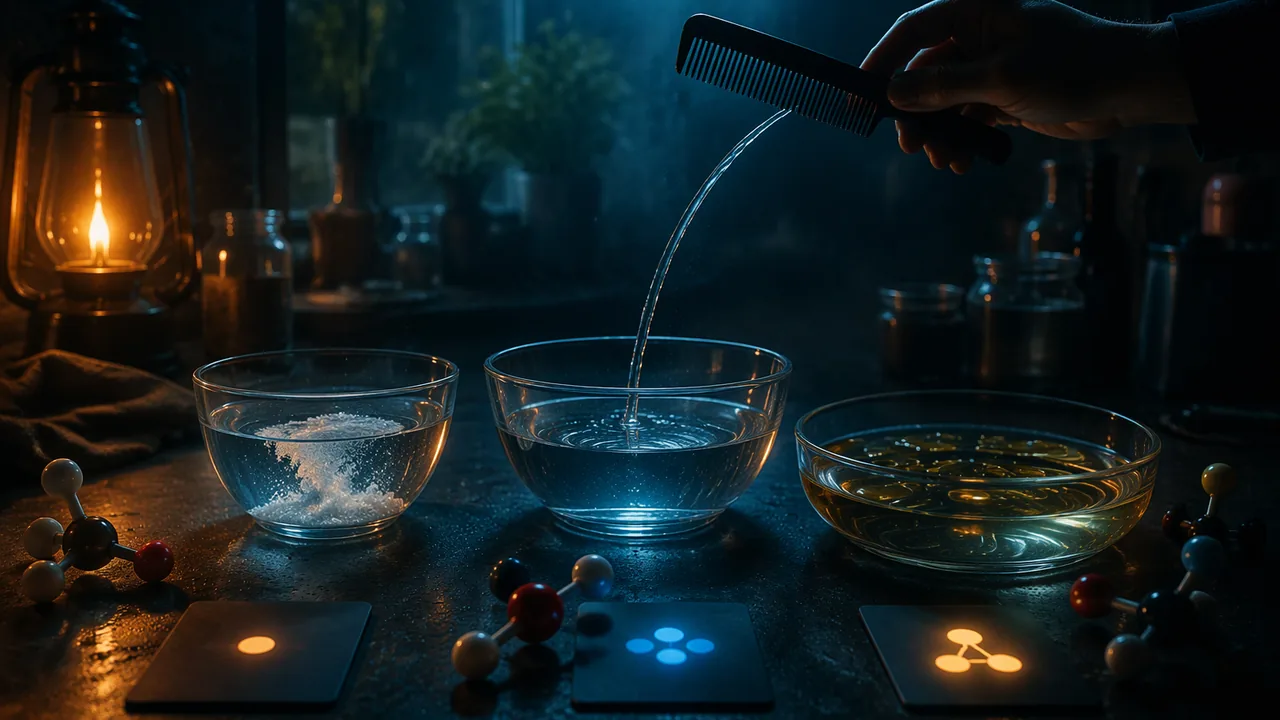
use VSEPR to predict molecular shape and polarity, name the three intermolecular forces, and test water, vinegar, oil and two white solids to infer how strongly their particles attract one another.
Instruction
From bonds to shapes. A bond holds atoms together inside a molecule, but whether a liquid evaporates fast or a drop stays rounded depends on the forces between molecules, and those depend on a molecule’s shape. The model that predicts shape is VSEPR (valence shell electron pair repulsion): the regions of electrons around a central atom, called electron domains (each bond, single or multiple, counts as one domain, and each lone pair counts as one), repel one another and spread as far apart as they can. Two domains give a linear shape with 180° angles (CO2). Three domains give a trigonal planar shape with 120° angles (BF3). Four domains point to the corners of a tetrahedron, 109.5° apart (CH4). Lone pairs take up space but are not atoms, so they change the visible shape: NH3 has four domains with one lone pair, so it is trigonal pyramidal, and H2O has four domains with two lone pairs, so it is bent. Lone pairs push slightly harder than bonds, so measured angles in these two molecules come out a little under 109.5°; you can read them off the PhET Real Molecules screen.
Shape decides polarity. A polar bond has a dipole: a small negative charge on the more electronegative atom and a small positive charge on the other. A molecule is polar only if those bond dipoles do not cancel. In CO2 each C=O bond is polar (difference 3.44 − 2.55 = 0.89), but the molecule is linear, so the two pulls are equal and opposite and the NIST-tabulated dipole moment is 0 D. In H2O the O–H bonds (difference 1.24) meet at a bent angle, so the pulls add and the dipole moment is 1.857 D. Compare SO2, also three atoms: its Lewis structure has 6 + 2(6) = 18 valence electrons, a lone pair on sulfur, and so a bent shape and a dipole of 1.633 D. Symmetry is the test: CH4 and CCl4 are 0 D, but replacing one chlorine with hydrogen in chloroform, CHCl3, breaks the symmetry and gives 1.040 D.
Three intermolecular forces. (1) London dispersion forces act between all molecules: the electron cloud shifts for an instant, creating a temporary dipole that induces one in the neighbor. They grow with the number of electrons and the contact surface, which is why large nonpolar molecules such as the hydrocarbons in cooking oil still hold together. (2) Dipole–dipole forces act between polar molecules, which line up positive end to negative end. (3) Hydrogen bonds are an especially strong dipole–dipole attraction between a hydrogen bonded to N, O or F and a lone pair on N, O or F of a neighbor. All three are far weaker than a covalent bond, so boiling a liquid separates molecules without breaking them. Ionic solids add a fourth, much stronger case you met last lesson, and in salt water the water dipoles surround each ion (ion–dipole attraction).
Forces show up as properties. Stronger forces between particles mean a higher boiling point, a lower vapor pressure (the pressure of vapor in equilibrium with the liquid, which measures how readily molecules escape), slower evaporation and a higher surface tension (molecules at the surface are pulled inward by neighbors, so the surface acts like a skin). Reference data show the pattern. At 25 °C, NIST lists the vapor pressure of water at 3.17 kPa and methanol at 16.98 kPa, a ratio of 5.36, while the surface tension of water is 71.97 mN/m against 22.15 for methanol, a ratio of 3.25. Both lopsided ratios point the same way: water’s hydrogen bonding is strong. Size also matters: for the nonpolar hydrocarbons, hexane (86.178 g/mol) has a vapor pressure of 20.16 kPa and octane (114.232 g/mol) only 1.87 kPa, because the larger molecule has stronger dispersion forces.
Your investigation. You will measure three things with kitchen materials and use them to rank forces: how many drops a coin can hold (surface tension), how long drops take to dry (vapor pressure), and whether a solution carries current (ions). Every result becomes a claim supported by a particle-level reason.
📖 Read for this lesson
The reading opens over the lesson; close it to come back to exactly where you were. The checks below draw on it.
Lab: Ranking the Forces Between Particles with Household Liquids and Solids
Question. How do the surface tension, evaporation rate and electrical conductivity of water, vinegar, cooking oil, salt solution and sugar solution reflect the types and strengths of the forces between their particles?
Materials
- Four liquids: tap water, white vinegar, vegetable oil and water with one drop of dish soap stirred in (optional fifth: vanilla extract, which contains ethanol)
- A clean U.S. penny or other coin, paper towels, a plastic drinking straw or eyedropper to place single drops, and a small cup for each liquid
- A clean plate or glazed saucer, a clock or phone timer, and a kitchen scale (optional)
- Table salt, granulated sugar, tap water, three small clear cups, a measuring spoon, and a spoon for stirring
- Conductivity tester: two AA batteries taped end to end or held in a battery holder, one small LED from a craft kit or old string of lights, and two strips of aluminum foil or wire as probes. No LED or batteries? Use the recorded data in the lesson reading for the conductivity column
- Safety glasses or sunglasses-style eye protection, and an adult nearby
- Wear eye protection; vinegar and soapy water sting if splashed in an eye.
- Do not taste anything used in the lab, including the vinegar, vanilla extract, salt and sugar solutions; use separate cups and wash everything afterward.
- Use only the two-battery tester and never connect anything to a wall outlet. Keep the probe tips away from each other when they are not in a sample.
- Wipe up spills right away (oil makes floors slippery). Pour vegetable oil into a sealed container for the trash instead of down the drain. No flames and no heating are used in this lab.
Procedure
- Surface tension: wash the coin, dry it and lay it flat on a paper towel. Using the same straw or dropper each time, add drops of tap water one at a time, counting, until the dome of water spills over the coin’s edge. Record the count. Repeat for two more trials, then do the same for vinegar, soapy water and vegetable oil, drying the coin between liquids.
- Evaporation: put 5 drops of each liquid in separate spots on the plate, far apart and in the same room, out of sunlight and drafts. Record the time. Check every 15 minutes and record the time at which each spot is dry (no visible liquid). If oil has not dried after 24 hours, record that it did not.
- Conductivity of liquids: test tap water, white vinegar and vegetable oil with the tester, holding the probes the same distance apart (about 1 cm) each time, and record LED brightness on the scale 0 (dark), 1 (faint), 2 (bright). Rinse and dry the probes between samples.
- Conductivity of solids and solutions: dissolve a level 1/4 teaspoon of table salt in 2 tablespoons of tap water, and a level 1/4 teaspoon of sugar in a second cup the same way. Test the dry salt, dry sugar, salt solution and sugar solution, rinsing the probes between each, and record the brightness.
- Use the shape-and-polarity table to classify the particles in each sample (water, acetic acid in vinegar, oil’s large nonpolar molecules, Na+ and Cl− ions, sugar molecules) and write which intermolecular force or bond is strongest in each.
- Repeat any trial that looks off. If your results differ from the recorded set in the reading, say by how much and name one reason.
Data
| Liquid | Drops held on coin (trials 1-3) | Mean drops | Minutes until 5 drops are dry | LED brightness (0-2) |
|---|---|---|---|---|
| Tap water | ||||
| White vinegar | ||||
| Water + 1 drop soap | (optional) | (optional) | ||
| Vegetable oil | ||||
| Vanilla extract (optional) | (optional) |
| Sample | LED brightness (0-2) | Particles present |
|---|---|---|
| Dry table salt | ||
| Dry sugar | ||
| Salt solution | ||
| Sugar solution |
Analysis
- Claim: rank water, vinegar, soapy water and oil from highest to lowest surface tension. Evidence: cite your mean drop counts. Reasoning: name the strongest force between the molecules of each liquid and explain how soap, a molecule with a polar end and a nonpolar end, could weaken the pull between water molecules at the surface.
- Water and vinegar evaporated at similar rates, while the ethanol-containing extract (if you tested it) dried much faster and oil barely changed. Use the vapor pressures in the reading to explain each result, including why oil, a nonpolar liquid, is slow to evaporate.
- Salt solution lit the LED and sugar solution did not, although both dissolved. Explain what this shows about the particles in each solution, using the words ion, molecule and mobile charge.
- Name two sources of error (for example, drops of different sizes, or probes at different distances) and one improvement that would make your ranking more reliable.
- Return to Lesson 2.1: use two results to explain why limestone can dissolve in rainwater, a polar liquid, even though it is a solid held by strong ionic attractions.
If you cannot do this lab in person: Use the recorded data set of three home runs and the NIST reference tables in this lesson’s reading (dipole moments, vapor pressures and surface tensions at 25 °C). Fill in the same data tables from the recorded runs, say which run you used, and write the same claim-evidence-reasoning analysis. You can also explore the forces between molecules with the PhET States of Matter simulation.
Formative check
Work through these before moving on. They are not graded — they tell you whether the standard below has landed yet.
You place drops of tap water and drops of soapy water, one at a time, on a clean coin. Which holds more drops before spilling over, and why?
Simulation & tools
Does the shape cancel the polarity?
Open the Real Molecules screen of Molecule Polarity. (1) Choose CO2 and record the shape and whether the molecule’s net dipole arrow appears. (2) Choose H2O and NH3 and record the same. (3) Choose CH4 and record it. (4) For each molecule, say whether the bond dipoles cancel, and write one sentence on why water is polar but CO2 is not even though both have polar bonds. No device? Draw the Lewis structure and the shape of each molecule from the lecture, add an arrow for each bond dipole, and answer the same question; compare with the dipole moments in the reading.
Open in a new tab ↗ · PhET Interactive Simulations, University of Colorado Boulder · CC BY 4.0
Use the dipole-moment table in this lesson’s reading. CO2 has a dipole moment of 0 D but SO2 has 1.633 D. What explains the difference?
Water is a molecule with a nonzero dipole, so its molecules attract one another by dipole-dipole forces and by bonding.
Write your claim-evidence-reasoning paragraph ranking the forces between particles in water, vinegar, oil and soapy water. Use mean drop counts and at least one vapor-pressure value from this lesson’s reading, name the strongest force in each, and state one source of error.
How confident are you that you can predict a molecule’s shape and polarity with VSEPR and relate the strength of its intermolecular forces to surface tension, evaporation and conductivity?
Practice
Work these on paper or in your notebook, then open Check your answer. Aim for all of Fluency and Application; try at least one Challenge.
Printable version: this unit’s practice workbook (PDF)
Fluency
Build speed and accuracy with the core skill.
- Give the number of electron domains and the molecular shape of (a) CH4, (b) NH3, (c) H2O, (d) CO2, (e) BF3.
Check your answer
Answer: (a) 4, tetrahedral; (b) 4, trigonal pyramidal; (c) 4, bent; (d) 2, linear; (e) 3, trigonal planarCount bonds and lone pairs on the central atom: CH4 4 bonds; NH3 3 bonds + 1 lone pair; H2O 2 bonds + 2 lone pairs; CO2 2 double bonds (2 domains); BF3 3 bonds. - Which of CH4, NH3, H2O and CO2 are polar molecules? Use the NIST dipole moments in the reading as a check.
Check your answer
Answer: NH3 (1.476 D) and H2O (1.857 D) are polar; CH4 and CO2 (0 D) are not.Polar bonds do not make a polar molecule unless their dipoles fail to cancel: CH4 is symmetric and CO2 is linear. - Using the atomic weights in the reading, calculate the molar mass of SO2.
Check your answer
Answer: 64.058 g/mol32.06 + 2(15.999) = 64.058 g/mol. - Name the strongest intermolecular force in each: (a) liquid CH4, (b) liquid HCl, (c) liquid H2O.
Check your answer
Answer: (a) London dispersion; (b) dipole-dipole; (c) hydrogen bondingCH4 is nonpolar; HCl is polar but chlorine is not N, O or F; water has H bonded to O. - Count the valence electrons in SO2 and state how many electron domains surround sulfur.
Check your answer
Answer: 18 valence electrons; 3 domains (2 bonding regions and 1 lone pair)6 + 2(6) = 18. Sulfur has one double bond, one single bond and one lone pair in the usual Lewis structure, so 3 domains and a bent shape. - Which molecule can hydrogen-bond with others of its own kind: CH3OH, CH4, CH3Cl or CO2? Explain.
Check your answer
Answer: CH3OH, because it has an H bonded to O.Hydrogen bonding needs H bonded to N, O or F plus a lone pair on N, O or F in a neighbor; methanol has both. - LED brightness: salt solution 2, sugar solution 0. Which dissolved solid produced mobile ions, and which produced neutral molecules?
Check your answer
Answer: Salt produced ions (Na+, Cl−); sugar produced neutral molecules.Only mobile charged particles carry current through a solution.
Application
Use the skill in context. Show your reasoning.
- NIST lists vapor pressures at 25 °C of 3.17 kPa for water and 16.98 kPa for methanol. By what factor is methanol’s vapor pressure greater, and what does that say about the forces between its molecules?
Check your answer
Answer: 5.36 times greater; weaker forces between methanol molecules than between water molecules.16.98 ÷ 3.17 = 5.36. A higher vapor pressure means molecules escape more easily, so the attractions are weaker (methanol has one O–H group to hydrogen-bond; water has two). - Hexane has a vapor pressure of 20.16 kPa and octane 1.87 kPa at 25 °C. Both are nonpolar. Compute the ratio and explain which force accounts for the difference.
Check your answer
Answer: Hexane’s is 10.8 times higher. Octane’s larger electron cloud gives stronger London dispersion forces, so fewer molecules escape.20.16 ÷ 1.87 = 10.8. Same force type, more electrons in octane (114.232 vs 86.178 g/mol). - Three testers counted drops of tap water on a coin: 25, 24 and 26; and drops of soapy water: 11, 12 and 10. Find each mean and the ratio of the means.
Check your answer
Answer: 25.0 drops and 11.0 drops; ratio 2.3(25 + 24 + 26) ÷ 3 = 25.0; (11 + 12 + 10) ÷ 3 = 11.0; 25.0 ÷ 11.0 = 2.3. Soap lowers surface tension, so the coin holds fewer drops. - The surface tension of water at 25 °C is 71.97 mN/m and of methanol 22.15 mN/m. Compute the ratio and say which liquid would hold more drops on a coin, with a reason.
Check your answer
Answer: Ratio 3.25; water holds more drops because its stronger hydrogen bonding makes the surface harder to stretch.71.97 ÷ 22.15 = 3.25.
Challenge
Stretch problems. Expect to think before you write.
- Draw (in words) the Lewis structure of SO2 with one S=O double bond, one S–O single bond and a lone pair on sulfur, and compute the formal charge of every atom. Do the charges sum correctly?
Check your answer
Answer: S +1, double-bonded O 0, single-bonded O −1; the sum is 0, matching the neutral molecule.S: 6 − 2 − 3 bonds = +1. Double-bonded O: 6 − 4 − 2 = 0. Single-bonded O: 6 − 6 − 1 = −1. Sum: +1 + 0 − 1 = 0. Resonance moves the double bond between the two oxygens. - The recorded runs show 5 drops of water drying in a mean of 95 minutes and 5 drops of vanilla extract (a mixture containing ethanol) in a mean of 31 minutes. Using the vapor pressures 7.87 kPa (ethanol) and 3.17 kPa (water), compare the time ratio with the vapor-pressure ratio and say what the match or mismatch tells you.
Check your answer
Answer: Time ratio 3.1; vapor-pressure ratio 2.48. The extract dries faster in the same direction, but it is mostly water, so its rate sits between water’s and pure ethanol’s.95.0 ÷ 31.0 = 3.1; 7.87 ÷ 3.17 = 2.48. Ethanol’s weaker hydrogen-bond network lets it escape faster, but the mixture contains water and sugars and other compounds, so a simple ratio is not expected to match.
Review
Keep earlier skills sharp.
- Electronegativities: N 3.04, H 2.20. Find the difference, classify the N–H bond and say which atom carries the partial negative charge.
Check your answer
Answer: 0.84; polar covalent; nitrogen is partially negative3.04 − 2.20 = 0.84, between 0.4 and 1.8; the more electronegative atom pulls the shared pair toward itself. - Count the valence electrons in the nitrate ion, NO3−, and in H2O2.
Check your answer
Answer: NO3−: 24; H2O2: 14Nitrate: 5 + 3(6) + 1 = 24. Hydrogen peroxide: 2(1) + 2(6) = 14.
Forces Between Particles: NIST Reference Data and a Recorded Kitchen Lab
NIST Computational Chemistry Comparison and Benchmark Database (experimental dipole moments); NIST Chemistry WebBook fluid properties and Antoine-equation parameters (vapor pressure, surface tension); SLS calculations and illustrative recorded runs; retrieved Nov. 15, 2026 · Public domain (NIST data), with SLS original illustrative recorded runs and commentary
Why this reading. The lab’s data path calls for “the recorded data set.” This is it, together with published NIST reference values for dipole moments, vapor pressures and surface tensions so you can judge whether the recorded results make sense and compare your own kitchen run with three others. The recorded runs are SLS original and illustrative: constructed to match what this procedure typically gives with kitchen materials, not an agency measurement. The NIST tables are published values.
Dipole moments of small molecules (experimental, NIST)
From the NIST Computational Chemistry Comparison and Benchmark Database, experimental dipole moments in debyes (D). Shape explains which ones are zero.
| Molecule | Shape | Dipole moment (D) |
|---|---|---|
| CH4 | Tetrahedral | 0.000 |
| CCl4 | Tetrahedral | 0.000 |
| CHCl3 | Tetrahedral (not symmetric) | 1.040 |
| CO2 | Linear | 0.000 |
| BF3 | Trigonal planar | 0.000 |
| SO2 | Bent | 1.633 |
| H2O | Bent | 1.857 |
| NH3 | Trigonal pyramidal | 1.476 |
| H2S | Bent | 0.977 |
| CH3OH (methanol) | Bent at O | 1.672 |
| Acetic acid (in vinegar) | 1.700 |
Vapor pressure and surface tension at 25 °C
Water, methanol and the hydrocarbons come from NIST Chemistry WebBook fluid properties (saturation at 298.15 K). Ethanol and acetic acid vapor pressures are computed by SLS from NIST Antoine-equation parameters (log10 P = A − B ÷ (T + C), P in bar, T in K).
| Liquid | Molar mass (g/mol) | Vapor pressure (kPa) | Surface tension (mN/m) |
|---|---|---|---|
| Water | 18.015 | 3.17 | 71.97 |
| Methanol | 32.042 | 16.98 | 22.15 |
| Ethanol | 46.069 | 7.87 | not listed |
| Acetic acid | 60.052 | 2.11 | not listed |
| Pentane | 72.151 | 68.36 | 15.45 |
| Hexane | 86.178 | 20.16 | 17.88 |
| Heptane | 100.205 | 6.10 | 19.74 |
| Octane | 114.232 | 1.87 | 21.14 |
SLS ratios: methanol to water vapor pressure 5.36; ethanol to water 2.48; water to methanol surface tension 3.25; hexane to octane vapor pressure 10.8; pentane to hexane vapor pressure 3.39.
The recorded runs (illustrative)
Three home runs of the procedure by three testers, using the same kind of two-battery tester, one U.S. penny, the same straw for dropping, and a plate in a room near 22 °C. Drop counts are the number of drops the coin held before spilling.
| Run | Water | Vinegar | Water + soap | Vegetable oil |
|---|---|---|---|---|
| Tester A | 25 | 22 | 11 | 14 |
| Tester B | 24 | 21 | 12 | 13 |
| Tester C | 26 | 23 | 10 | 15 |
| Mean | 25.0 | 22.0 | 11.0 | 14.0 |
Minutes until 5 drops were dry:
| Run | Water | Vinegar | Vanilla extract | Vegetable oil |
|---|---|---|---|---|
| Tester A | 95 | 94 | 31 | Did not dry in 24 h |
| Tester B | 102 | 99 | 28 | Did not dry in 24 h |
| Tester C | 88 | 90 | 34 | Did not dry in 24 h |
| Mean | 95.0 | 94.3 | 31.0 | — |
LED brightness (0 dark, 1 faint, 2 bright), identical in all three runs: tap water 0; vegetable oil 0; white vinegar 1; dry table salt 0; dry sugar 0; salt solution 2; sugar solution 0.
How to read the runs
Water holds 25.0 drops on average and soapy water 11.0, a ratio of 2.3. Vanilla extract, which contains ethanol, dries in 31.0 minutes against 95.0 for water, a ratio of 3.1, in the same direction as the vapor pressures of ethanol and water. Dry salt does not conduct because its ions are locked in a lattice; the solution conducts because the ions are free. Sugar never produces ions. Vinegar is faint because acetic acid is a weak acid and only a small fraction of its molecules form ions.
Sources: NIST CCCBDB, experimental dipole moments (cccbdb.nist.gov); NIST Chemistry WebBook, fluid properties (saturation at 298.15 K) for water, methanol, pentane, hexane, heptane, octane (webbook.nist.gov); NIST Chemistry WebBook, phase change data and Antoine equation parameters for ethanol and acetic acid (webbook.nist.gov); NIST, Atomic Weights and Isotopic Compositions (physics.nist.gov)