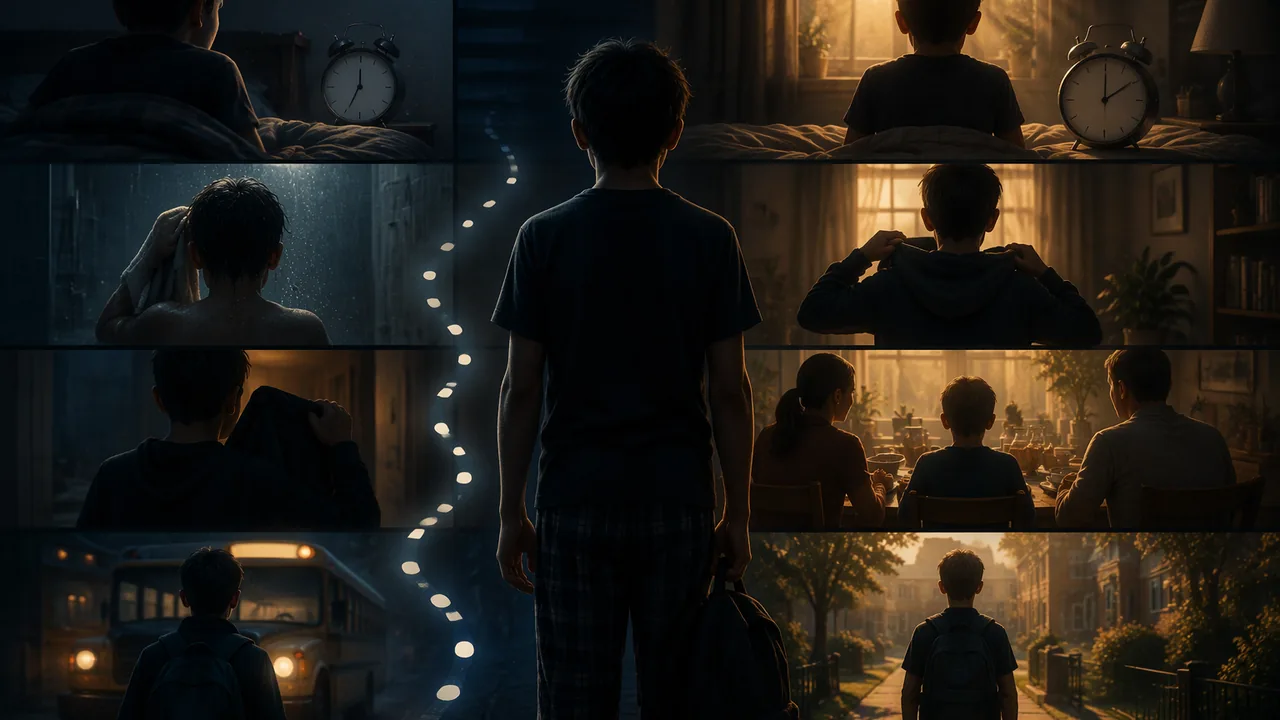
write and present a sequenced comparison of a real and an ideal routine, using reflexive verbs, tener que + infinitive and sequence words.
Instruction
Organizing a text in time
Routine texts are organized by time, which makes them a perfect place to practice sequence. A good routine text moves through the day with clear markers, joins actions with connectors, and says something beyond the list: how the writer feels about it, or what they would change.
Sequence markers
Primero (first), luego and después (then, afterward), más tarde (later), mientras (while), por último or finalmente (finally). Vary them: a text that says después five times sounds like a list. Combine with antes de / después de + infinitive to vary the rhythm: Después de ducharme, me visto y desayuno.
Real versus ideal
For the real routine, use the present: Me levanto a las seis. To explain obligations, use tener que + infinitive (have to): Tengo que levantarme temprano porque tomo el autobús a las siete. Notice the pronoun attached to the infinitive and matching the subject. For the ideal routine, use expressions of wish with an infinitive: Quiero dormir hasta las nueve. Prefiero ducharme por la noche. Me gustaría desayunar con calma. (Me gustaría, “I would like,” is a useful fixed phrase; you will study the conditional later.)
A model
Mi rutina real es muy rápida. Entre semana me despierto a las seis menos cuarto porque tengo que tomar el autobús a las seis y media. Primero me ducho, luego me visto y, mientras me peino, escucho música. Casi nunca desayuno en casa: como algo en la cafetería. Después de las clases trabajo en la tienda de mi tío hasta las siete. Por último, hago la tarea y me acuesto como a las once.
Mi rutina ideal es diferente. Quiero dormir ocho o nueve horas, porque los adolescentes necesitan dormir mucho. Me gustaría levantarme a las siete y media, desayunar con mi familia y caminar a la escuela. Por la tarde, prefiero hacer deporte antes de estudiar. ¿Es posible? Tal vez los fines de semana.
What makes it Intermediate
The model does three things beyond a list. It gives reasons with porque. It uses time connectors to join actions into longer sentences (mientras me peino, escucho música). And it ends with a reaction, a question and a partial answer. Those moves turn a list into a text a reader wants to finish.
Accuracy checklist
- Every reflexive verb has a pronoun that matches the subject.
- With two verbs, the pronoun is before the conjugated verb or attached to the infinitive, never between (tengo que levantarme or me tengo que levantar).
- Stem changes: me despierto, me acuesto, me visto.
- Times: a la una, a las dos.
Presenting
Record a 60-90 second video or audio presentation; a family member may watch or listen. Use images or a simple timeline behind you instead of reading the text. You may present your own routine or that of a character you invent.
📖 Read for this lesson
The reading opens over the lesson; close it to come back to exactly where you were. The checks below draw on it.
Formative check
Work through these before moving on. They are not graded — they tell you whether the standard below has landed yet.
Lee otra vez la rutina real del modelo y contesta.
Mi rutina real es muy rápida. Entre semana me despierto a las seis menos cuarto porque tengo que tomar el autobús a las seis y media. Primero me ducho, luego me visto y, mientras me peino, escucho música. Casi nunca desayuno en casa: como algo en la cafetería. Después de las clases trabajo en la tienda de mi tío hasta las siete. Por último, hago la tarea y me acuesto como a las once.
Show transcript
Mi rutina real es muy rápida. Entre semana me despierto a las seis menos cuarto porque tengo que tomar el autobús a las seis y media. Primero me ducho, luego me visto y, mientras me peino, escucho música. Casi nunca desayuno en casa: como algo en la cafetería. Después de las clases trabajo en la tienda de mi tío hasta las siete. Por último, hago la tarea y me acuesto como a las once.
¿A qué hora se despierta el autor?
¿Qué hace mientras se peina?
¿Dónde come algo por la mañana?
Build the sentence: “I have to get up early because I take the bus at seven.”
Type it instead
Translate into Spanish.
First I shower, then I get dressed.
Draft your real-and-ideal routine (150-180 words): at least six reflexive verbs, four sequence markers, one tener que + infinitive, one antes de or después de + infinitive, and a closing reaction. Mark each reflexive pronoun. Heritage-speaker path: add a paragraph comparing the vocabulary your family uses for routines with the forms in the lesson (bañarse / ducharse, rasurarse / afeitarse, and others you know).
How confident are you that you can write and present a sequenced routine text with reflexive verbs and reasons?
Practice
Work these on paper or in your notebook, then open Check your answer. Aim for all of Fluency and Application; try at least one Challenge.
Printable version: this unit’s practice workbook (PDF)
Fluency
Build speed and accuracy with the core skill.
- Give the meaning of each sequence marker: (a) primero; (b) luego; (c) más tarde; (d) mientras; (e) por último.
Check your answer
Answer: (a) first; (b) then, afterward; (c) later; (d) while; (e) finally, lastly.Varying the markers keeps a routine text from sounding like a list. - Complete with tener que + infinitive and the right pronoun: (a) Yo ____ (levantarse) temprano. (b) Mi hermano ____ (ducharse) rápido.
Check your answer
Answer: (a) tengo que levantarme; (b) tiene que ducharse.Tener is conjugated (tengo, tiene) and the pronoun on the infinitive matches the subject. - Translate the wish expressions: (a) Quiero dormir hasta las nueve. (b) Prefiero ducharme por la noche. (c) Me gustaría desayunar con calma.
Check your answer
Answer: (a) I want to sleep until nine. (b) I prefer to shower at night. (c) I would like to eat breakfast calmly (without rushing).The real routine uses the present; the ideal routine uses wish expressions + infinitive.
Application
Use the skill in context. Show your reasoning.
- Join the list into one sentence with después de + infinitive and mientras: Me ducho. Me visto. Me peino. Escucho música.
Check your answer
Answer: Model: Después de ducharme, me visto y, mientras me peino, escucho música.Después de takes the infinitive with the pronoun attached; mientras joins two actions at the same time. - Read the model: Entre semana me despierto a las seis menos cuarto porque tengo que tomar el autobús a las seis y media. How many minutes does the writer have between waking up and the bus? Show the times.
Check your answer
Answer: 45 minutes: 5:45 to 6:30.Seis menos cuarto = 5:45; seis y media = 6:30; 6:30 − 5:45 = 45 minutes. - Translate into Spanish: “My ideal routine is different. I would like to get up at seven-thirty and eat breakfast with my family.”
Check your answer
Answer: Mi rutina ideal es diferente. Me gustaría levantarme a las siete y media y desayunar con mi familia.Me gustaría + infinitive; the pronoun attaches to levantarme and matches the speaker. - Each sentence breaks one rule from the lesson’s accuracy checklist. Correct it: (a) Me despiertas a las seis. (b) Me acosto a las once. (c) Me levanto a las una.
Check your answer
Answer: (a) Me despierto a las seis. (b) Me acuesto a las once. (c) Me levanto a la una.(a) The pronoun and verb must match the subject (yo). (b) Stem change o → ue. (c) A la una is singular.
Challenge
Stretch problems. Expect to think before you write.
- Review from Lesson 1.4: name three connectors from Unit 1 that you can use alongside sequence markers, and use one in a sentence about a routine.
Check your answer
Answer: Any three of: y/e, pero, porque, también, tampoco, además, por eso. Example: Me levanto temprano porque tengo clase a las siete.Connectors join ideas; sequence markers order them in time.
Review
Keep earlier skills sharp.
- Write a 5-6 sentence real-and-ideal routine for an invented student, Diego, in the first person. Include at least three reflexive verbs, three sequence markers, one tener que, and a closing reaction.
Check your answer
Answer: Model: Entre semana me levanto a las seis porque tengo que trabajar. Primero me ducho, luego me visto y después desayuno. Por último, me acuesto a las diez y media. Mi rutina ideal es diferente: me gustaría dormir hasta las ocho y caminar al parque. ¿Es posible? Tal vez los sábados.A strong answer separates real (present) from ideal (quiero / prefiero / me gustaría + infinitive), gives a reason with porque and ends with a reaction.
Mi rutina real y mi rutina ideal
SLS original mentor text for Spanish 2A, modeling reflexive verbs, tener que + infinitive and mientras for the presentational workshop · SLS original
Por qué esta lectura. Este texto modelo compara una rutina real con una rutina ideal. Fíjate en el uso de tengo que, mientras y me gustaría para hablar de lo que en realidad pasa y de lo que uno preferiría.
Mi rutina real
Mi rutina real es muy rápida. Entre semana me despierto a las seis menos cuarto porque tengo que tomar el autobús a las seis y media. Primero me ducho, luego me visto y, mientras me peino, escucho música. Casi nunca desayuno en casa: como algo en la cafetería. Después de las clases trabajo en la tienda de mi tío hasta las siete. Por último, hago la tarea y me acuesto como a las once.
Mi rutina ideal
Me gustaría tener más tiempo por la mañana. En mi rutina ideal, quiero despertarme a las seis y media, sin prisa, y no tengo que correr para el autobús. Prefiero desayunar algo saludable mientras hablo con mi familia. Por la tarde, me gustaría estudiar antes de trabajar, para no hacer la tarea tan tarde. Y, por último, quiero acostarme a las diez, no a las once — ¡para dormir lo suficiente!