understand a news article about a day of service, talk about a past celebration in a recorded conversation, and present a chronicle, all in the preterite.
Instruction
El tema: celebrar sirviendo
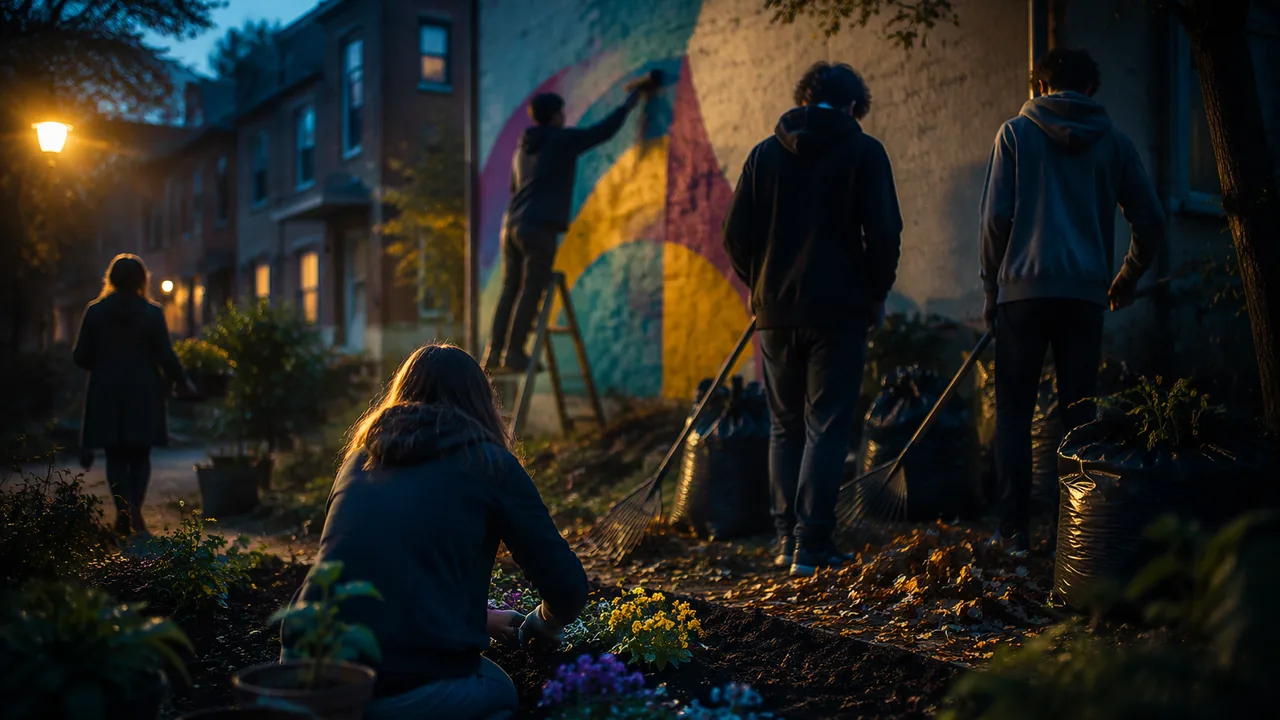
From September 15 to October 15 the United States observes National Hispanic Heritage Month (el Mes de la Herencia Hispana). It began as a week, first proclaimed by President Lyndon Johnson in 1968, and was expanded to a month in 1988. The dates include several independence days: Costa Rica, El Salvador, Guatemala, Honduras and Nicaragua on September 15, Mexico on September 16 and Chile on September 18 (hispanicheritagemonth.gov; Wikipedia, “National Hispanic Heritage Month”). Communities mark the month with festivals, and some with days of service. The interpretive text for this IPA is an original news-style article about students on Kansas City’s Westside who spent a Saturday of the month working in their neighborhood. The event, the school and the students are invented for the course; the month and its dates are real.
Las tres tareas
- Interpretive: read the article without a translator; identify the main idea, put the events in order, and make one inference about why the students chose their project.
- Interpersonal: record a conversation about a celebration or community event you attended or researched. Answer the prompt questions in the task aloud (a willing family member may read them to you), then ask your own questions about what happened, who was there and how it went; react and follow up.
- Presentational: finish, revise and record the chronicle you drafted in Lesson 3.4, or write a new one about a day of service.
Lo que necesitas
The preterite of regular verbs, with accents (trabajaron, limpió, pintamos); the yo spelling changes (llegué, empecé, organicé); and the irregulars fui, fue, hice, hizo, tuve, estuvo, hubo, di, vi. Sequence markers: primero, luego, después, por la tarde, al final. Reactions: ¡Qué bien! ¡Qué padre! ¡Qué lástima!
La meta
At Novice High to Intermediate Low, you narrate in strings of sentences in the past with mostly accurate forms. In the conversation, you ask as well as tell, and you keep going when you lack a word by rephrasing (no sé la palabra, pero es como…). Occasional errors are expected; a consistent time frame (everything in the past) and clear sequence matter more.
Integridad y alternativas
No translators or AI tools for the interpretive and interpersonal tasks. If recording is not possible, type the conversation as a transcript with both speakers’ lines. Any student may narrate a researched public event instead of a personal one.
📖 Read for this lesson
The reading opens over the lesson; close it to come back to exactly where you were. The checks below draw on it.
Formative check
Work through these before moving on. They are not graded — they tell you whether the standard below has landed yet.
Tarea interpretativa. Lee el artículo. No uses traductor.
Estudiantes celebran el Mes de la Herencia Hispana con un día de servicio
Un sábado de septiembre, treinta estudiantes del club de español de una preparatoria del Westside de Kansas City no se quedaron en casa. A las ocho de la mañana llegaron a un parque del barrio con guantes, bolsas y pintura.
Primero, limpiaron el parque y recogieron más de cuarenta bolsas de basura. Luego, pintaron un mural con la frase “Nuestras raíces, nuestro barrio”. Al mediodía, unas familias del barrio les dieron tamales y agua fresca.
Por la tarde, los estudiantes leyeron en voz alta, en inglés y en español, sobre la historia del barrio y de las familias mexicanas que llegaron aquí hace más de cien años. “Muchos de nosotros tenemos abuelos que llegaron a este barrio”, explicó Daniela, la presidenta del club. “Por eso escogimos este parque: aquí jugaron nuestros padres”.
El día terminó con música. Fue, según todos, un día para recordar.
Show transcript
Estudiantes celebran el Mes de la Herencia Hispana con un día de servicio Un sábado de septiembre, treinta estudiantes del club de español de una preparatoria del Westside de Kansas City no se quedaron en casa. A las ocho de la mañana llegaron a un parque del barrio con guantes, bolsas y pintura. Primero, limpiaron el parque y recogieron más de cuarenta bolsas de basura. Luego, pintaron un mural con la frase “Nuestras raíces, nuestro barrio”. Al mediodía, unas familias del barrio les dieron tamales y agua fresca. Por la tarde, los estudiantes leyeron en voz alta, en inglés y en español, sobre la historia del barrio y de las familias mexicanas que llegaron aquí hace más de cien años. “Muchos de nosotros tenemos abuelos que llegaron a este barrio”, explicó Daniela, la presidenta del club. “Por eso escogimos este parque: aquí jugaron nuestros padres”. El día terminó con música. Fue, según todos, un día para recordar.
¿Cuál es la idea principal?
¿Qué hicieron primero los estudiantes?
¿Qué frase pintaron en el mural?
¿Por qué escogieron ese parque? (inferencia)
In context, recogieron most likely means…
Tarea interpersonal (recorded, 3-4 minutes, at least ten turns). Talk about a celebration or community event (attended or researched). Answer these questions aloud, one at a time; a willing family member may read them to you (they may use the English in brackets): ¿Qué celebración fue? [What celebration was it?] / ¿Cuándo y dónde fue? [When and where was it?] / ¿Quién fue contigo? [Who went with you?] / ¿Qué pasó primero? [What happened first?] / ¿Qué hicieron después? [What did you do next?] / ¿Cómo estuvo? [How was it?] / ¿Qué fue lo mejor? [What was the best part?] Then ask at least three questions of your own, including a follow-up, to the family member or to an invented speaker whose answers you also give, and react at least twice. Mention the article once.
Tarea presentacional. Submit your planning notes, your self-reviewed draft (with every preterite verb circled and checked) and your revised chronicle (160-200 words, preterite, five irregular forms, sequence markers, one sensory detail per paragraph, a closing reaction). Record it on audio or video with two or three images; a family member may watch.
How confident are you that you can understand, discuss and narrate past events in the preterite at the Novice High to Intermediate Low level?
Unit 3 checkpoint
Do this before you start the task. It covers the whole unit and tells you what to review first.
Which is a perspectiva of the Día de los Muertos?
The Día de los Muertos is the same as Halloween.
What does bailaron mean?
Ayer yo (tocar) la guitarra.
Choose the correct preterite: Mis primos ____ el cuento.
Hace dos días nosotros (comer) en casa de mi tía.
In El concierto fue increíble, fue comes from ser.
Which preterite form is spelled correctly?
El sábado que trabajar. (I had)
The Guelaguetza is a celebration from…
A crónica tells events in the order they happened and ends with a reaction.
Integrated Performance Assessment 3: Una celebración en la comunidad
Theme: celebrations and service in Missouri communities and the Spanish-speaking world. Target: Novice High to Intermediate Low.
- Interpretive (WL.1.2b.II / WL.1.2c.II): the article about the Hispanic Heritage Month day of service above; five questions including sequence and inference.
- Interpersonal (WL.1.1b.II / WL.1.1c.II / WL.1.1d.II): a recorded 3-4 minute conversation about a past celebration or community event.
- Presentational (WL.1.3b.II / WL.1.3c.II): a 160-200 word chronicle in the preterite, recorded with images.
| Mode | Approaching (Novice Mid) | Meets (Novice High-Intermediate Low) | Exceeds (Intermediate Mid) |
|---|---|---|---|
| Interpretive | Identifies the topic and isolated facts | Identifies the main idea, orders the events and makes a supported inference | Also explains the link between the mural’s phrase and the history of the neighborhood |
| Interpersonal | Present-tense or memorized answers; few questions | Narrates in created past-tense sentences; asks, reacts and follows up | Sustains a two-way narrative, comparing the two events |
| Presentational | Events listed; tense shifts confuse the time frame | Sequenced strings of preterite sentences with detail; mostly accurate forms and accents | Varied sentence types, vivid detail and a consistent past time frame |
Heritage-speaker extension: the chronicle is written as a news report with headline, lead and quotation, and all preterite accents are correct.
Submission workflow
- Stage 1 — Plan. Complete the interpretive task and a sequence chart of the event you will narrate (orientation, six events, details, reaction).
- Stage 2 — Self-reviewed draft. Circle every preterite verb and check accents and irregular forms against the checklist (a family member may read along); then write a revision plan.
- Stage 3 — Revised final. Submit the final chronicle with the revision plan.
- Stage 4 — Present and converse. Record the chronicle with images (audio or video) and record the interpersonal conversation.
How it is scored
| Criterion | What proficient looks like |
|---|---|
| Interpretive comprehension (WL.1.2b.II / WL.1.2c.II) | Identifies the main idea, sequence of events and an inference in a past-tense news text. |
| Interpersonal exchange (WL.1.1b.II / WL.1.1c.II / WL.1.1d.II) | Narrates, asks, reacts and follows up about a past event in created sentences. |
| Presentational product (WL.1.3b.II / WL.1.3c.II) | A sequenced chronicle with orientation, events, detail and reaction. |
| Language control (WL.1.3c.II) | Regular and irregular preterites, spelling changes and accents mostly accurate. |
| Cultural content (WL.2.2b.II / WL.4.2b.II) | Describes the practices of a celebration accurately and explains what they mean to participants. |
Estudiantes celebran el Mes de la Herencia Hispana con un día de servicio
SLS original news-style article for RLP Spanish 2A, written as the interpretive text for Integrated Performance Assessment 3 · SLS original
Por qué esta lectura. Este es el texto interpretativo de la evaluación integrada de la Unidad 3. La escuela y los estudiantes son inventados, pero el mes es real: del 15 de septiembre al 15 de octubre, Estados Unidos celebra el Mes Nacional de la Herencia Hispana. El 15 de septiembre, Costa Rica, El Salvador, Guatemala, Honduras y Nicaragua celebran su independencia; México la celebra el 16.
Estudiantes celebran el Mes de la Herencia Hispana con un día de servicio
Un sábado de septiembre, treinta estudiantes del club de español de una preparatoria del Westside de Kansas City no se quedaron en casa. A las ocho de la mañana llegaron a un parque del barrio con guantes, bolsas y pintura.
Primero, limpiaron el parque y recogieron más de cuarenta bolsas de basura. Luego, pintaron un mural con la frase “Nuestras raíces, nuestro barrio”. Al mediodía, unas familias del barrio les dieron tamales y agua fresca.
Por la tarde, los estudiantes leyeron en voz alta, en inglés y en español, sobre la historia del barrio y de las familias mexicanas que llegaron aquí hace más de cien años. “Muchos de nosotros tenemos abuelos que llegaron a este barrio”, explicó Daniela, la presidenta del club. “Por eso escogimos este parque: aquí jugaron nuestros padres”.
El día terminó con música. Fue, según todos, un día para recordar.
Sources: hispanicheritagemonth.gov, National Hispanic American Heritage Month (September 15 to October 15) (hispanicheritagemonth.gov); Wikipedia, “National Hispanic Heritage Month” (1968 week, independence days in the period) (en.wikipedia.org)