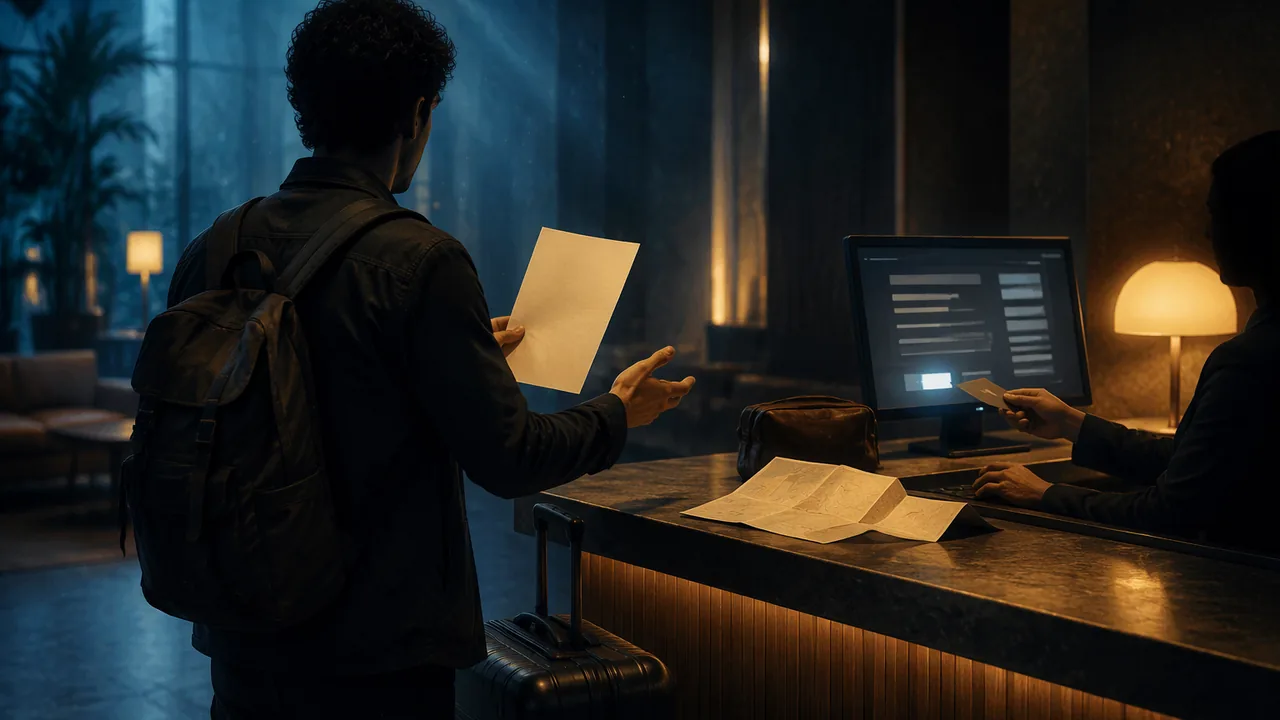
carry out travel transactions in the formal register, report a past problem in the preterite, and ask for help politely.
Instruction
Transacciones
The Intermediate level is defined partly by transactions: getting something done with language. Buying a ticket, checking in, reporting a lost bag. These conversations follow scripts that are similar across the Spanish-speaking world, so learning the script once pays off everywhere.
El registro formal
With a ticket agent, a hotel receptionist or a police officer, use usted (and ustedes for a group). Verbs go in the third person: ¿Me puede ayudar? ¿A qué hora sale el autobús? ¿Usted sabe dónde está el andén cinco? Open and close with courtesy: Buenos días / Buenas tardes, disculpe… and Muchas gracias, muy amable.
Pedir con cortesía
- Quisiera + noun or infinitive (I would like): Quisiera un boleto para Kansas City. It is a fixed polite form; you will study why later.
- ¿Me podría + infinitive? (Could you…?): ¿Me podría decir dónde está la sala de espera?
- ¿Sería posible…? (Would it be possible…?): ¿Sería posible cambiar el vuelo?
Vocabulario de viaje y sus variantes
| English | Mexico / Central America | Other common forms |
|---|---|---|
| ticket | el boleto | el billete (Spain), el pasaje (South America) |
| boarding pass | el pase de abordar | la tarjeta de embarque (Spain) |
| reservation | la reservación | la reserva |
| suitcase | la maleta | la valija (Argentina, Uruguay) |
| round trip | de ida y vuelta | ida y vuelta |
| platform / gate | el andén / la puerta | la puerta de embarque (Spain) |
Also: el equipaje (luggage), la salida / la llegada (departure / arrival), el vuelo (flight), retrasado (delayed), cancelado, la habitación sencilla / doble.
Contar un problema en pretérito
A problem report is a mini-narrative: what happened, when, and what you need.
Recepcionista: Buenas noches. ¿En qué le puedo ayudar?
Viajera: Buenas noches. Hice una reservación para dos noches, pero cuando llegué, me dijeron que no hay habitación.
Recepcionista: Lo siento mucho. ¿A qué nombre hizo la reservación?
Viajera: A nombre de Carmen Ruiz. La hice por teléfono el lunes pasado.
Recepcionista: Ah, sí, aquí está. Hubo un error en el sistema. Le podemos dar una habitación doble por el mismo precio.
Viajera: Perfecto, muchas gracias. Muy amable.
Notice the pattern: greeting, what happened (preterite: hice, llegué, me dijeron), the problem (present: no hay), the agent’s question, details (la hice… el lunes pasado), the solution, thanks. Your role-plays will follow it.
Estrategias de reparación
Transactions break down. Keep them going in Spanish: Perdón, ¿puede hablar más despacio? ¿Cómo se escribe? ¿Me lo puede repetir? And to confirm: Entonces, ¿el autobús sale a las tres y veinte del andén cinco? Repeating the key information back is what experienced travelers do.
📖 Read for this lesson
The reading opens over the lesson; close it to come back to exactly where you were. The checks below draw on it.
Formative check
Work through these before moving on. They are not graded — they tell you whether the standard below has landed yet.
Escucha el anuncio en la estación. ¿Qué pasó con el autobús a Springfield?
Show transcript
Atención, señores pasajeros. El autobús con destino a Springfield salió con retraso de San Luis y va a llegar a las cuatro y media. Va a salir del andén número seis.
Build a polite request: “I would like a round-trip ticket to Kansas City, please.”
Type it instead
Translate into Spanish (formal register).
I made a reservation, but they told me there is no room.
Role-plays (recorded). Use the agent’s script below. A willing family member may read the agent’s lines (they may use the English in brackets); or read each agent line aloud yourself, pause, and answer as the traveler. Then record each scene a second time playing the agent, with an invented traveler. 1) Buy a bus or train ticket. Agente: Buenos días, ¿en qué le puedo ayudar? [How can I help you?] / ¿Para qué día? [For what day?] / ¿De ida o de ida y vuelta? [One way or round trip?] / ¿A qué hora prefiere salir? [What time do you prefer to leave?] / Son ochenta y cinco dólares. [That’s 85 dollars.] As the traveler, also ask for the platform and confirm the time. 2) Report a problem that happened (lost suitcase, delayed flight, missing reservation). Agente: Buenas noches, ¿en qué le puedo ayudar? / ¿Qué pasó exactamente? [What happened exactly?] / ¿Cuándo y cómo hizo la reservación? o ¿En qué vuelo llegó? [When and how did you book? / What flight did you arrive on?] / Lo siento mucho. Le podemos ofrecer… [I’m very sorry. We can offer you…] Greet, tell what happened in the preterite, answer, agree a solution, thank. Use usted, at least one polite form (quisiera, ¿me podría…?) and one repair strategy.
How confident are you that you can carry out a travel transaction in the formal register and report a past problem politely?
Practice
Work these on paper or in your notebook, then open Check your answer. Aim for all of Fluency and Application; try at least one Challenge.
Printable version: this unit’s practice workbook (PDF)
Fluency
Build speed and accuracy with the core skill.
- Give the English: (a) el boleto; (b) el pase de abordar; (c) el equipaje; (d) la llegada; (e) retrasado; (f) de ida y vuelta.
Check your answer
Answer: (a) ticket; (b) boarding pass; (c) luggage; (d) arrival; (e) delayed; (f) round trip.Mexican and Central American forms; Spain says el billete and la tarjeta de embarque. - Match each word to the region the lesson gives for it: (a) el billete; (b) el pasaje; (c) la valija; (d) la reservación.
Check your answer
Answer: (a) Spain; (b) South America; (c) Argentina and Uruguay; (d) Mexico and Central America (la reserva elsewhere).All are correct; they mark where a speaker is from. - Write three polite request openers from the lesson and give the meaning of each.
Check your answer
Answer: Quisiera… (I would like…); ¿Me podría + infinitive? (Could you…?); ¿Sería posible…? (Would it be possible…?).These are fixed polite forms for transactions.
Application
Use the skill in context. Show your reasoning.
- Change each question to the formal register (usted): (a) ¿Me puedes ayudar? (b) ¿Sabes dónde está el andén cinco? (c) ¿Qué hiciste?
Check your answer
Answer: (a) ¿Me puede ayudar? (b) ¿Sabe usted dónde está el andén cinco? (c) ¿Qué hizo usted?With an agent or receptionist, verbs go in the third person. - Translate into Spanish (formal): “Good afternoon, excuse me. I would like a round-trip ticket to Springfield. What time does the bus leave?”
Check your answer
Answer: Buenas tardes, disculpe. Quisiera un boleto de ida y vuelta para Springfield. ¿A qué hora sale el autobús?Open with courtesy, use quisiera, and the present for a schedule (sale). - Read the announcement and answer in English: El autobús con destino a Springfield salió con retraso y va a llegar a las cuatro y media. Va a salir del andén número seis. Then write the sentence you would say to confirm the key information.
Check your answer
Answer: The Springfield bus left late; it will arrive at 4:30 and leave from platform 6. Confirmation: Entonces, ¿el autobús llega a las cuatro y media y sale del andén seis?Repeating key information back is the lesson’s confirming strategy. - The agent says Son ochenta y cinco dólares for one round-trip ticket. How much do three round-trip tickets cost? Write the number in digits and in Spanish words.
Check your answer
Answer: $255; doscientos cincuenta y cinco dólares.85 × 3 = 255.
Challenge
Stretch problems. Expect to think before you write.
- Review from Lesson 4.2: in the model dialogue, the traveler says me dijeron que no hay habitación and La hice por teléfono el lunes pasado. Give the infinitive of dijeron and hice, and explain why dijeron has no i.
Check your answer
Answer: decir and hacer. Dijeron is a j-stem (dij-), and j-stems take -eron, not -ieron.Same rule as trajeron and condujeron.
Review
Keep earlier skills sharp.
- Write a six-line problem report at a hotel between a receptionist and an invented traveler whose suitcase did not arrive with her flight. Follow the lesson’s pattern: greeting, what happened (preterite), the problem (present), the agent’s question, details, solution, thanks. Use usted and one repair strategy.
Check your answer
Answer: Model: Recepcionista: Buenas noches. ¿En qué le puedo ayudar? Viajera: Buenas noches. Llegué en el vuelo de las ocho, pero mi maleta no llegó. No tengo mi equipaje. Recepcionista: Lo siento mucho. ¿En qué vuelo llegó? Viajera: Perdón, ¿puede hablar más despacio? Recepcionista: ¿En qué vuelo llegó usted? Viajera: En el vuelo de Kansas City. Recepcionista: Le podemos ayudar a llamar al aeropuerto. Viajera: Muchas gracias, muy amable.A strong answer uses preterite for the events (llegué, no llegó), present for the problem, usted forms, courtesy and a repair phrase.
En la recepción del hotel: un problema con la reservación
SLS original dialogue for Spanish 2A, modeling a formal-register travel transaction and a problem report in the preterite · SLS original
Por qué esta lectura. Un diálogo formal (usted) entre un viajero y un recepcionista de hotel. Fíjate en las formas de cortesía (quisiera, ¿me podría…?) y en el pretérito para contar lo que pasó.
En la recepción del hotel
Recepcionista: Buenas tardes, señor. ¿En qué le puedo ayudar?
Viajero: Buenas tardes. Quisiera registrarme. Hice una reservación la semana pasada para dos noches, a nombre de Rubén Torres.
Recepcionista: Un momento, por favor… Disculpe, señor Torres, pero no encuentro su reservación en el sistema. ¿Me podría decir cómo la hizo?
Viajero: La hice por internet el jueves pasado. Me llegó un correo de confirmación; lo tengo aquí en el teléfono.
Recepcionista: Ah, perfecto, aquí está: hubo un error con la fecha en el sistema. Lo siento mucho por la confusión. ¿Sería posible ofrecerle una habitación doble esta noche, sin costo adicional, mientras resolvemos el problema?
Viajero: Sí, está bien, muchas gracias. ¿Me podría decir a qué hora sirven el desayuno?
Recepcionista: Claro que sí, de las siete a las diez de la mañana. Aquí tiene su llave. Que tenga una buena estancia.
Viajero: Muy amable, gracias.