write and present a chronicle of a celebration in the preterite, organized in time and enriched with details about who, where and how it went.
Instruction
¿Qué es una crónica?
A crónica is a short narrative of an event, told in the order it happened, with enough detail that the reader feels present. Newspapers across the Spanish-speaking world publish them, and they are a perfect genre for the preterite.
La Guelaguetza
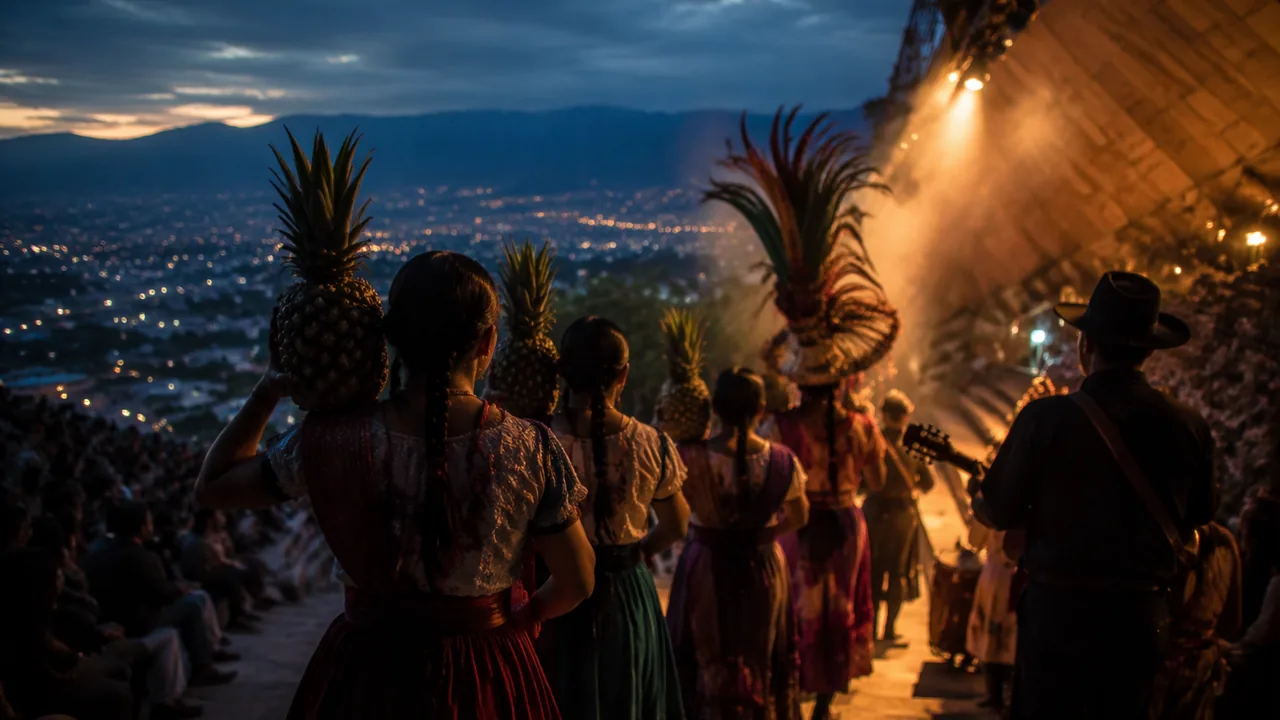
The Guelaguetza is a celebration from the Mexican state of Oaxaca, held every July in the city of Oaxaca. The word comes from Zapotec and is usually explained as “offering” or “reciprocal giving.” Since 1969 it has been held on the two Mondays after July 16, so it is also called los Lunes del Cerro (Mondays on the Hill): the main performances take place in the open-air Auditorio Guelaguetza, built into the Cerro del Fortín above the city center and completed in 2010. Delegations from Oaxaca’s eight regions, many of them Indigenous communities (Zapotec, Mixtec, Mixe, Chinantec and others), perform their dances and share their music, clothing and food. Oaxacan families in the United States also organize Guelaguetzas far from home. Well-known dances include the Danza de la Pluma, with huge feathered headdresses, and Flor de Piña, danced by women from the Tuxtepec region carrying pineapples on their shoulders; it was first presented on July 21, 1958, and was created by Paulina Solís Ocampo of Tuxtepec (Wikipedia, “Guelaguetza,” English and Spanish editions; Por Esto!, July 29, 2024).
Un modelo
El verano pasado, mi amiga Itzel y yo fuimos a Oaxaca a visitar a sus abuelos. Itzel vive en Kansas City, pero su familia es de Oaxaca. El lunes, fuimos a la Guelaguetza en el Auditorio Guelaguetza, en el Cerro del Fortín. Llegamos a las nueve y buscamos nuestros asientos. Primero, compramos tlayudas y agua de horchata. Luego, empezó el programa: una banda de música tocó y los grupos de danza entraron con ropa de muchos colores. Me encantó la Danza de la Pluma: los bailarines llevaban penachos enormes y bailaron por casi media hora. Después, las mujeres de Tuxtepec bailaron Flor de Piña con piñas en los hombros. Itzel me explicó que su abuela bailó en la Guelaguetza de Oaxaca cuando era joven. Por la tarde, escuchamos a un señor que habló en zapoteco y en español. Volvimos a casa a las seis, cansadas pero muy contentas. Fue un día inolvidable.
Cómo está construida
- Orientación: when, who, where (El verano pasado, mi amiga Itzel y yo fuimos a…).
- Secuencia de eventos in the preterite, with markers (primero, luego, después, por la tarde).
- Detalles of the senses: colors, food, music.
- Reacción (Me encantó…, Fue un día inolvidable).
Notice a small thing: cuando era joven. Era is the imperfect, a description of a past state; you will study it in Spanish 2B. For now you can copy the chunk cuando era niño/a or cuando era joven if you need it.
Choosing your celebration
Write about a celebration you attended (a quinceañera, a wedding, a graduation, a festival, a game), or research a public celebration in a Spanish-speaking community in Missouri or elsewhere (the Día de los Muertos on Kansas City’s Westside, a Salvadoran or Guatemalan Independence Day on September 15, a Christmas posada, the Guelaguetza in Oaxaca) and write as a reporter who was there. If you research, list your sources.
Revisión
Check every verb: is it an event (preterite)? Is the accent there (llegó, compró)? Did you use at least five irregular forms (fui, hubo, hice, estuvo, tuvimos…)? Then check that each paragraph has one sensory detail.
📖 Read for this lesson
The reading opens over the lesson; close it to come back to exactly where you were. The checks below draw on it.
Formative check
Work through these before moving on. They are not graded — they tell you whether the standard below has landed yet.
Lee la parte central de la crónica y contesta.
Primero, compramos tlayudas y agua de horchata. Luego, empezó el programa: una banda de música tocó y los grupos de danza entraron con ropa de muchos colores. Me encantó la Danza de la Pluma: los bailarines llevaban penachos enormes y bailaron por casi media hora. Después, las mujeres de Tuxtepec bailaron Flor de Piña con piñas en los hombros. Itzel me explicó que su abuela bailó en la Guelaguetza de Oaxaca cuando era joven.
Show transcript
Primero, compramos tlayudas y agua de horchata. Luego, empezó el programa: una banda de música tocó y los grupos de danza entraron con ropa de muchos colores. Me encantó la Danza de la Pluma: los bailarines llevaban penachos enormes y bailaron por casi media hora. Después, las mujeres de Tuxtepec bailaron Flor de Piña con piñas en los hombros. Itzel me explicó que su abuela bailó en la Guelaguetza de Oaxaca cuando era joven.
¿Qué hicieron primero?
¿Qué llevaron los bailarines de la Danza de la Pluma?
¿Qué hizo la abuela de Itzel?
Build the closing sentence: “We went back home at six, tired but very happy.”
Type it instead
Translate into Spanish.
There were a lot of people and the music was great.
Draft your chronicle (160-200 words): orientation, a sequence of at least six events in the preterite, five irregular forms, three sequence markers, one sensory detail per paragraph, and a closing reaction. If you researched a public celebration, list your sources at the end. Heritage-speaker path: rewrite it as a news report in the third person with a headline and a quotation from an invented participant.
How confident are you that you can write and present a chronicle of a celebration in the preterite with sequence and detail?
Practice
Work these on paper or in your notebook, then open Check your answer. Aim for all of Fluency and Application; try at least one Challenge.
Printable version: this unit’s practice workbook (PDF)
Fluency
Build speed and accuracy with the core skill.
- Give the meaning: (a) la crónica; (b) el penacho; (c) inolvidable; (d) la posada.
Check your answer
Answer: (a) a narrative of an event told in time order; (b) a large feathered headdress; (c) unforgettable; (d) a Christmas-season celebration re-enacting Mary and Joseph’s search for shelter (December 16-24).These words come from the lesson’s chronicle and its list of celebrations. - Name the four parts of a crónica, in order.
Check your answer
Answer: 1. Orientación (when, who, where); 2. secuencia de eventos in the preterite with markers; 3. detalles of the senses; 4. reacción.The Guelaguetza model follows exactly this order. - Give the preterite form: (a) nosotros / llegar; (b) yo / buscar; (c) ella / explicar; (d) nosotros / volver.
Check your answer
Answer: (a) llegamos; (b) busqué; (c) explicó; (d) volvimos.(b) -car → -qué in the yo form only. (d) No stem change in the preterite for -er verbs.
Application
Use the skill in context. Show your reasoning.
- Answer in English from the lesson: (a) Where is the Guelaguetza held, and in what month? (b) What does the word mean? (c) Why is it called los Lunes del Cerro?
Check your answer
Answer: (a) In the city of Oaxaca, Mexico, every July. (b) It comes from Zapotec and is usually explained as “offering” or “reciprocal giving.” (c) Since 1969 it has been held on the two Mondays after July 16, and the main performances are in the Auditorio Guelaguetza on the Cerro del Fortín (a hill).A complete answer gives place, month, meaning and both reasons for the name (Mondays + hill). - Flor de Piña was first presented on July 21, 1958. How many years before the Auditorio Guelaguetza was completed (2010) was that?
Check your answer
Answer: 52 years.2010 − 1958 = 52. - Put these events from the model chronicle in order and add a sequence marker to each: (a) las mujeres de Tuxtepec bailaron Flor de Piña; (b) compramos tlayudas; (c) volvimos a casa a las seis; (d) empezó el programa.
Check your answer
Answer: Primero, compramos tlayudas. Luego, empezó el programa. Después, las mujeres de Tuxtepec bailaron Flor de Piña. Por último, volvimos a casa a las seis.The order follows the model: food first, then the program, the dances, and the return home. - Translate into Spanish: “Last summer we went to a festival. There was a lot of music, and it was an unforgettable day.”
Check your answer
Answer: El verano pasado fuimos a un festival. Hubo mucha música y fue un día inolvidable.Fuimos (ir), hubo (there was), fue (ser): all irregular, no accents.
Challenge
Stretch problems. Expect to think before you write.
- Review from Lesson 3.3: translate into English and name the infinitive of each verb: Hubo un DJ y estuvo increíble.
Check your answer
Answer: There was a DJ and it was incredible (great). Hubo = haber (the preterite of hay); estuvo = estar.¿Cómo estuvo? / Estuvo increíble is the usual way to talk about how an event went.
Review
Keep earlier skills sharp.
- Write a five-sentence crónica in the first person about an invented visit to a public celebration the lesson names (for example the Día de los Muertos on Kansas City’s Westside or a posada). Include an orientation, three events in the preterite with markers, one sensory detail and a reaction.
Check your answer
Answer: Model: El año pasado mi prima y yo fuimos al Día de los Muertos en el Westside de Kansas City. Primero, vimos los altares de muchas familias. Luego, compramos pan de muerto. Hubo flores de cempasúchil y papel picado de muchos colores. Por la noche, caminamos en el desfile de las calacas. ¡Fue un día inolvidable!A strong answer follows the four parts, uses accented regular forms (compramos, caminamos) and irregular ones (fuimos, vimos, fue), and draws details only from what the lessons describe.
Crónica de una celebración: la Guelaguetza en Oaxaca
SLS original first-person chronicle for RLP Spanish 2A (fictional narrator), closing with real, sourced background on the Guelaguetza (los Lunes del Cerro) on the Cerro del Fortín in the city of Oaxaca (Wikipedia English and Spanish editions, cross-checked with Por Esto!, retrieved November 10, 2026) · SLS original
Por qué esta lectura. La narradora de esta crónica y su amiga Itzel, de Kansas City, son inventadas, pero la Guelaguetza es una celebración real de la ciudad de Oaxaca, México. El último párrafo explica ese contexto con fuentes reales.
Crónica de una celebración
El verano pasado, mi amiga Itzel y yo fuimos a Oaxaca a visitar a sus abuelos. Itzel vive en Kansas City, pero su familia es de Oaxaca. El lunes, fuimos a la Guelaguetza en el Auditorio Guelaguetza, en el Cerro del Fortín.
Primero, compramos tlayudas y agua de horchata. Luego, empezó el programa: una banda de música tocó y los grupos de danza entraron con ropa de muchos colores. Me encantó la Danza de la Pluma: los bailarines llevaban penachos enormes y bailaron por casi media hora. Después, las mujeres de Tuxtepec bailaron Flor de Piña con piñas en los hombros. Itzel me explicó que su abuela bailó en la Guelaguetza de Oaxaca cuando era joven.
La Guelaguetza es una fiesta tradicional del estado de Oaxaca. Desde 1969 se celebra los dos lunes después del 16 de julio; por eso también se llama los Lunes del Cerro. Los bailes principales son en el Auditorio Guelaguetza, un teatro al aire libre en el Cerro del Fortín, sobre el centro de la ciudad; la ciudad terminó el auditorio nuevo en 2010. Allí bailan delegaciones de las ocho regiones del estado. La danza Flor de Piña, de Tuxtepec, se presentó por primera vez el 21 de julio de 1958; la creó Paulina Solís Ocampo, una mujer de Tuxtepec.
Sources: Wikipedia, “Guelaguetza” (English edition: dates since 1969, Cerro del Fortín, 2010 auditorium) (en.wikipedia.org); Wikipedia, “Guelaguetza” (Spanish edition: los Lunes del Cerro, eight regions) (es.wikipedia.org); Por Esto!, “Guelaguetza 2024 Oaxaca: la historia de Flor de Piña” (July 29, 2024) (poresto.com)