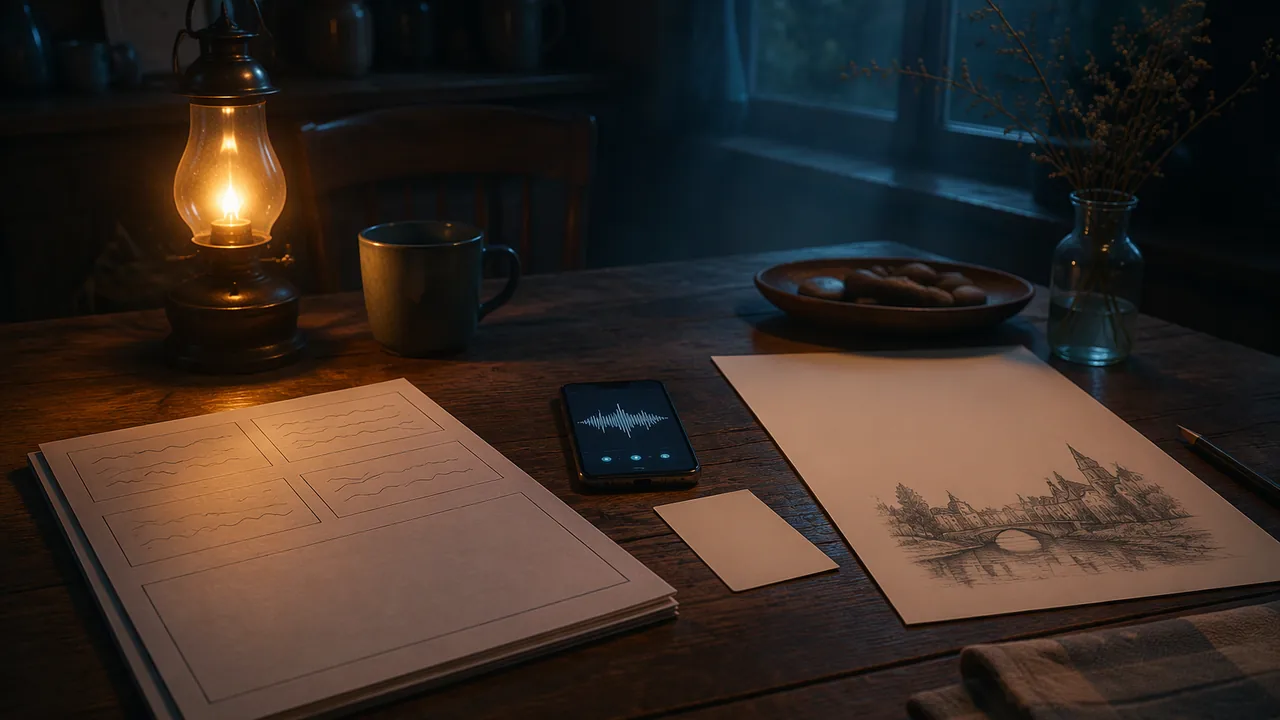
show what I can understand, say and present about my community in Spanish across the interpretive, interpersonal and presentational modes.
Instruction
What an Integrated Performance Assessment is
An Integrated Performance Assessment (IPA) is three linked tasks on one theme, done in order. Each task feeds the next. First you interpret: you read an unseen text and show what you understood. Then you interact: you record a conversation on the same theme, answering a question card and asking questions back, using ideas from the text. Finally you present: you create something for an audience. The theme of this IPA is your community.
The target: Novice High to Intermediate Low
You are aiming at the line between Novice and Intermediate. In practice that means:
- Interpretive: you identify the main idea of a text on a familiar topic and several details, and you can guess some new words from context.
- Interpersonal: you create your own sentences (not only memorized phrases), you answer questions and you ask them, and you keep the conversation going when it stalls.
- Presentational: you write and speak in strings of sentences joined by connectors, mostly accurate in the present tense, so that a sympathetic reader understands you without effort.
Errors are expected at this level. What raises a score is more of your own language, not perfection.
How to prepare
Before the interpretive task, remind yourself of the four reading moves: predict, use cognates, use word families, read the verbs. Before the conversation, list five questions you can ask back about someone’s community (¿Qué lugar te gusta más? ¿Por qué? ¿Qué hay cerca de tu casa? ¿Qué vas a hacer allí?). Before you write, plan your four moves: what the place is, where it is and how it is, why you like it, what you are going to do there.
Integrity and access
Do the interpretive and interpersonal tasks without a translator or AI tool: the point is to find out what you can do. In the presentational task you may use a dictionary for single words. For the conversation, a family member or another adult you know may read you the question card (in English if they prefer) and answer your questions; if no one is available, read each question aloud yourself, answer it, and then ask and answer your own questions as if you were a friend. If you cannot record audio, write the conversation as a script of at least eight turns. If you prefer not to describe your own neighborhood, describe a public place in any Missouri community. Heritage speakers complete the same three tasks with the extension noted in each rubric.
📖 Read for this lesson
The reading opens over the lesson; close it to come back to exactly where you were. The checks below draw on it.
Formative check
Work through these before moving on. They are not graded — they tell you whether the standard below has landed yet.
Tarea interpretativa. Lee el artículo del boletín comunitario. No uses traductor.
Boletín del barrio: la biblioteca abre los domingos
¡Buenas noticias! A partir de este mes, la biblioteca pública del barrio va a abrir los domingos de las doce a las cinco. Muchas familias trabajan de lunes a sábado y no pueden venir entre semana. Ahora van a tener más tiempo para leer, estudiar y usar las computadoras.
Los domingos también hay actividades gratuitas. A la una, una voluntaria lee cuentos en español y en inglés para los niños. A las tres, hay una clase de computación para adultos. Los jóvenes pueden ayudar como voluntarios: necesitan tener quince años o más y hablar dos idiomas.
“Estamos muy contentos”, dice la directora. “La biblioteca es de todos, y ahora es más fácil venir”.
Show transcript
Boletín del barrio: la biblioteca abre los domingos ¡Buenas noticias! A partir de este mes, la biblioteca pública del barrio va a abrir los domingos de las doce a las cinco. Muchas familias trabajan de lunes a sábado y no pueden venir entre semana. Ahora van a tener más tiempo para leer, estudiar y usar las computadoras. Los domingos también hay actividades gratuitas. A la una, una voluntaria lee cuentos en español y en inglés para los niños. A las tres, hay una clase de computación para adultos. Los jóvenes pueden ayudar como voluntarios: necesitan tener quince años o más y hablar dos idiomas. “Estamos muy contentos”, dice la directora. “La biblioteca es de todos, y ahora es más fácil venir”.
¿Cuál es la idea principal?
¿Por qué es importante abrir los domingos?
¿Qué hay a la una?
¿Qué necesitan los jóvenes voluntarios?
In context, what does gratuitas most likely mean?
Tarea interpersonal (recorded, 3-4 minutes, at least eight turns). Talk about places in your community: what there is, what you like and why, when you go, and what you are going to do there this weekend. Use the question card: a family member or another adult you know may read it to you (English in parentheses), or read each question aloud yourself and answer it. Mention one idea from the library article. Ask at least three questions back, including two follow-ups (if you are alone, answer them as a friend would). No script: you may use a list of five question words. Question card: 1. ¿Qué lugares hay en tu comunidad? (What places are there in your community?) 2. ¿Qué lugar te gusta más? ¿Por qué? (Which place do you like most? Why?) 3. ¿Cuándo vas? ¿Con quién? (When do you go? With whom?) 4. ¿Qué vas a hacer allí este fin de semana? (What are you going to do there this weekend?) 5. ¿Hay una biblioteca cerca de tu casa? ¿Qué hay allí? (Is there a library near your home? What is there?) 6. ¿Qué piensas del nuevo horario de la biblioteca del artículo? (What do you think of the library’s new hours in the article?)
Tarea presentacional. Plan, draft and revise a poster, slide or video script (120-160 words) about a place that matters in a Missouri community: what and where it is (ser, estar), why people like it (gustar, porque), and what you or others are going to do there (ir a + infinitive). Use at least four connectors. Review your draft with the checklist from Lesson 1.4 (agreement, ser/estar, gustar); a family member may read it and tell you one question it leaves unanswered. Upload your plan, your self-reviewed draft and your final.
How confident are you that you can understand, discuss and present information about a community in Spanish at the Novice High to Intermediate Low level?
Unit 1 checkpoint
Do this before you start the task. It covers the whole unit and tells you what to review first.
What is the main idea of “Los nombres cuentan historias”?
Largo means “large.”
Carondelet is named for…
Nosotros (dormir) ocho horas.
Which form is correct for yo + conocer?
In stem-changing verbs, the nosotros form also changes its stem.
Choose the correct sentence.
A mi abuela le (gustar) las canciones viejas.
A friend says “No me gusta el frío.” You agree. What do you say?
Estoy cansado trabajo mucho. (because)
Vos is a standard form of “you” in countries such as El Salvador and Guatemala, not slang.
Integrated Performance Assessment 1: Mi comunidad en Missouri
Theme: the places that make a community. Target: Novice High to Intermediate Low.
- Interpretive (WL.1.2b.II / WL.1.2c.II): read the community newsletter article above without a translator and answer the five questions: main idea, two details, one reason, one word guessed from context.
- Interpersonal (WL.1.1b.II / WL.1.1c.II / WL.1.1d.II): a 3-4 minute recorded conversation about community places, likes and weekend plans, built on the question card (with a family member or playing both roles), asking at least three questions back.
- Presentational (WL.1.3b.II / WL.1.3c.II): a 120-160 word poster, slide or video about a place that matters in a Missouri community, taken through planning, self-review and revision.
| Mode | Approaching (Novice Mid) | Meets (Novice High-Intermediate Low) | Exceeds (Intermediate Mid) |
|---|---|---|---|
| Interpretive | Identifies the topic and a few isolated words | Identifies the main idea and several details; guesses some words from context | Identifies main idea, all key details and the reason behind them; explains the director’s point |
| Interpersonal | Memorized phrases; answers but rarely asks | Creates sentences; asks and answers questions, including follow-ups; repairs breakdowns in Spanish | Strings of sentences; initiates new topics; sustains the conversation with little hesitation |
| Presentational | Lists of words and short sentences; frequent errors impede meaning | Strings of sentences joined by connectors; mostly accurate present tense, ser/estar and gustar; understood without effort | Connected sentences approaching paragraph length; varied connectors; few errors |
Heritage-speaker extension: the presentational piece is written in formal register for a public audience, with every accent mark checked.
Submission workflow
- Stage 1 — Plan. Complete the interpretive task, then write planning notes for the presentational piece: the place, four moves, and the vocabulary and connectors you will use.
- Stage 2 — Self-reviewed draft. Check agreement, ser/estar and gustar with the checklist from Lesson 1.4 and write one question the draft leaves unanswered (a family member may read it and suggest one); you write a one-line revision plan.
- Stage 3 — Revised final. Submit the final poster, slide or video script with the revision plan attached.
- Stage 4 — Present and converse. Record the piece (audio or video) and record the interpersonal conversation from the question card, with a family member or on your own.
How it is scored
| Criterion | What proficient looks like |
|---|---|
| Interpretive comprehension (WL.1.2b.II / WL.1.2c.II) | Identifies the main idea and several supporting details of an unseen text; infers meaning of new words from context. |
| Interpersonal exchange (WL.1.1b.II / WL.1.1c.II / WL.1.1d.II) | Creates sentences to ask and answer questions, uses follow-ups and repairs breakdowns in Spanish. |
| Presentational product (WL.1.3b.II / WL.1.3c.II) | Presents a place in strings of connected sentences for a real audience, with a clear purpose. |
| Language control (WL.1.3c.II) | Mostly accurate present tense, ser/estar, gustar and ir a + infinitive; errors do not block meaning. |
| Cultural content (WL.2.2b.II / WL.4.2b.II) | Describes a community practice or place accurately and explains why it matters to the people who use it. |
Boletín del barrio: la biblioteca abre los domingos
SLS original scenario text for the Unit 1 Integrated Performance Assessment (Spanish 2A), an announcement students interpret and respond to · SLS original
Por qué esta lectura. Este es el texto interpretativo de la evaluación integrada de la Unidad 1: un boletín comunitario. Léelo con cuidado: la parte interpersonal y la parte presentacional de la evaluación usan la información de aquí.
Boletín del barrio: la biblioteca abre los domingos
¡Buenas noticias! A partir de este mes, la biblioteca pública del barrio va a abrir los domingos de las doce a las cinco. Muchas familias trabajan de lunes a sábado y no pueden venir entre semana. Ahora van a tener más tiempo para leer, estudiar y usar las computadoras.
Los domingos también hay actividades gratuitas. A la una, una voluntaria lee cuentos en español y en inglés para los niños. A las tres, hay una clase de computación para adultos. Los jóvenes pueden ayudar como voluntarios: necesitan tener quince años o más y hablar dos idiomas.
“Estamos muy contentos”, dice la directora. “La biblioteca es de todos, y ahora es más fácil venir. Solo pedimos que las familias se inscriban en la entrada, para saber cuántas personas usan el nuevo horario”.