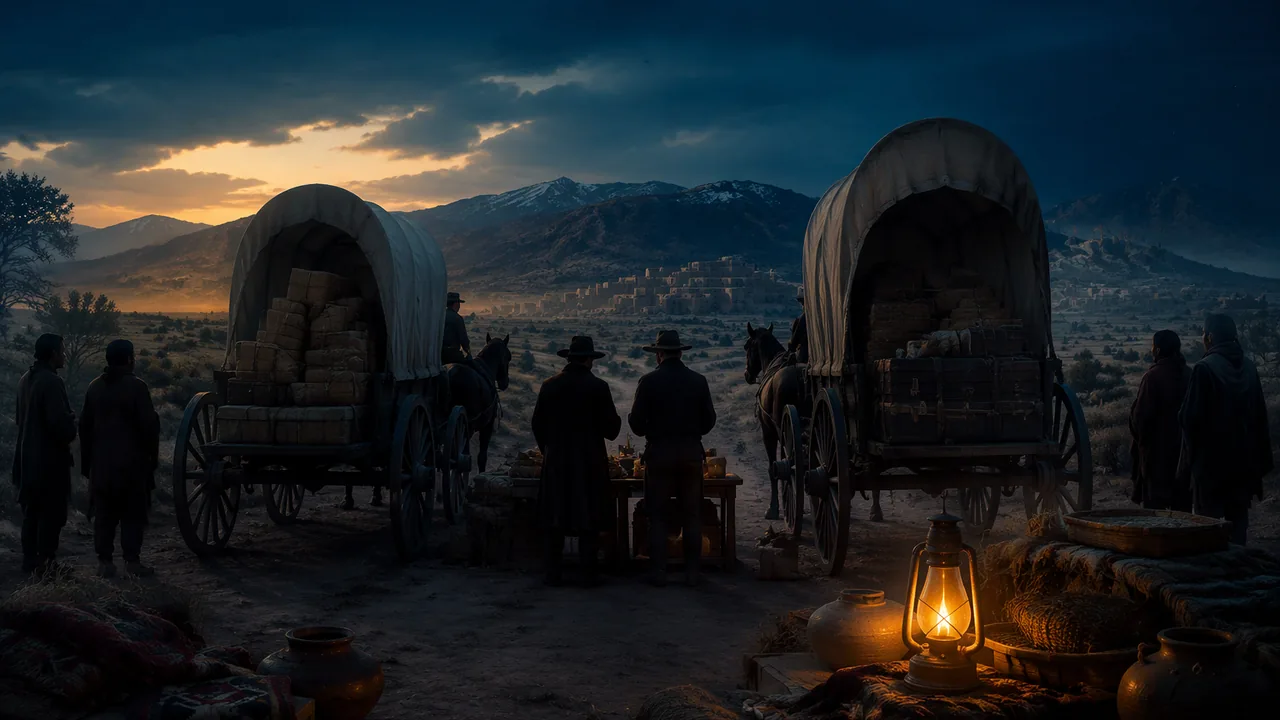
understand a past-tense account of the Santa Fe Trail, identify whose perspective each part of the story reflects, and recognize new irregular preterites in context.
Instruction
Una historia con muchas voces
In Missouri, the Santa Fe Trail is often told as the story of bold Missouri traders who “opened” the West. The National Park Service itself points out that writing about the trail tends to celebrate American traders and overlook the equally important role of New Mexican traders, and the trail crossed the homelands of many Native nations who lived its history very differently. This lesson reads the history of the trail in Spanish and asks a question you will ask of every text: ¿Desde qué perspectiva está contada esta historia? From whose point of view is it told?
Los hechos
- Spain ruled New Mexico from 1598 and outlawed trade with the United States. European goods reached Santa Fe from Veracruz and Mexico City along El Camino Real de Tierra Adentro, a 1,600-mile road through Chihuahua.
- In 1821 Mexico won its independence and opened trade. That September, Missouri trader William Becknell left Franklin, Missouri; on November 13, near Las Vegas, New Mexico, Captain Pedro Ignacio Gallego and his troops met Becknell’s small party and welcomed them to trade.
- From 1821 to 1846 the trail was a two-way international highway of about 900 miles between Missouri and Mexican Santa Fe, used by both Mexican and American traders. Goods from Missouri cost about a third of the price of goods shipped from Chihuahua.
- New Mexican families such as the Chávez, Otero, Perea and Yrizarri became leading traders: they sold goods in Missouri and bought more for the return trip, and by the 1840s some traveled on to New York, Philadelphia and Baltimore. Doña Gertrudis “La Tules” Barceló, a Santa Fe businesswoman, invested in the trade.
- The trail crossed the homelands of the Osage, Kansa (Kaw), Comanche, Kiowa, southern Cheyenne and Arapaho, Plains Apache, Jicarilla Apache, Ute and Pueblo peoples. On August 10, 1825, at Council Grove, in present-day Kansas, chiefs of the Great and Little Osage and three U.S. commissioners agreed on safe passage through Osage territory in exchange for an $8,000 payment; that year the U.S. signed eight treaties with eleven tribes about the trail. Most early encounters were negotiations and trade in horses and mules. As traffic grew, so did conflict, and as the buffalo were hunted nearly to extinction, Native peoples were pushed aside or assigned to reservations.
- In 1846 the U.S. Army of the West marched down the trail to take New Mexico in the Mexican-American War; communities such as Taos and Mora fought back. After the Treaty of Guadalupe Hidalgo (1848), New Mexico became U.S. territory. In February 1880 the railroad reached Santa Fe, and the trail faded into history.
Sources: National Park Service, Santa Fe National Historic Trail: “History & Culture,” the park brochure text, “New Mexican Traders on the Santa Fe Trail” and “The Gathering at the Grove” (nps.gov/safe).
Leer la perspectiva
Look at the verbs and their subjects. Los comerciantes de Missouri llevaron mercancía: the Missouri traders are the actors. Los comerciantes nuevomexicanos vinieron a Missouri: the New Mexicans are the actors. Los jefes osage firmaron un acuerdo: the Osage act. Muchos pueblos indígenas tuvieron que vivir en reservas: they are acted upon. Asking “who does what to whom?” shows you whose story you are reading. A history in which New Mexicans and Native people are only ever the object of verbs is telling one side.
Nuevos verbos en el pretérito
The reading uses irregular preterites you will learn in the next lesson. Use context and your knowledge of the infinitive:
- vinieron (from venir): they came
- trajeron (from traer): they brought
- pudieron (from poder): they could, they managed to
- murieron (from morir): they died
- quisieron (from querer): they wanted, they tried
These all share the -ieron or -eron ending for “they,” which you already know from tuvieron and hicieron.
El Camino de Santa Fe hoy
In 1987 Congress designated the Santa Fe National Historic Trail, and the National Park Service now works with the Santa Fe Trail Association to protect it. You can still see wagon-wheel ruts, and in Council Grove the stump of the Council Oak stands under a shelter. Many of the stone markers along the route were put up beginning in 1906 by the Daughters of the American Revolution, and they mostly tell the traders’ story. That too is a perspective to read with care.
📖 Read for this lesson
The reading opens over the lesson; close it to come back to exactly where you were. The checks below draw on it.
Formative check
Work through these before moving on. They are not graded — they tell you whether the standard below has landed yet.
Lee el texto. Piensa: ¿quién hace la acción de cada verbo?
El Camino de Santa Fe: otras voces
En 1821, México ganó su independencia de España y abrió sus puertas al comercio. Ese año, el comerciante William Becknell salió de Franklin, Missouri, con mercancía para vender en Santa Fe. Unos soldados mexicanos lo encontraron en el camino y le dieron la bienvenida. Durante los siguientes sesenta años, miles de carretas viajaron por el Camino de Santa Fe, una ruta de unas novecientas millas.
Pero la historia no es solo de Missouri. Muchos comerciantes nuevomexicanos también vinieron a Missouri con sus caravanas. Trajeron lana y plata, y volvieron a Santa Fe con telas, platos y herramientas. Familias como los Chávez, los Otero y los Perea pudieron construir grandes negocios.
Y la tierra no estaba vacía. El camino cruzó las tierras de muchas naciones indígenas: los osage, los kaw, los comanches, los kiowa y otras. En 1825, los jefes osage firmaron un acuerdo: los viajeros pudieron pasar por su territorio a cambio de un pago. Al principio, muchos encuentros fueron negociaciones y comercio. Pero con más viajeros llegaron más conflictos. Los cazadores mataron a muchísimos bisontes, y casi todos los bisontes de las llanuras murieron. Muchos pueblos indígenas perdieron sus tierras y tuvieron que vivir en reservas.
En 1846, los Estados Unidos quisieron el territorio de México, y su ejército llegó a Santa Fe por el mismo camino. Hoy, el Servicio de Parques Nacionales protege la ruta y cuenta también las historias de los comerciantes nuevomexicanos y de las naciones indígenas. Para entender el camino, hay que escuchar todas las voces.
Show transcript
El Camino de Santa Fe: otras voces En 1821, México ganó su independencia de España y abrió sus puertas al comercio. Ese año, el comerciante William Becknell salió de Franklin, Missouri, con mercancía para vender en Santa Fe. Unos soldados mexicanos lo encontraron en el camino y le dieron la bienvenida. Durante los siguientes sesenta años, miles de carretas viajaron por el Camino de Santa Fe, una ruta de unas novecientas millas. Pero la historia no es solo de Missouri. Muchos comerciantes nuevomexicanos también vinieron a Missouri con sus caravanas. Trajeron lana y plata, y volvieron a Santa Fe con telas, platos y herramientas. Familias como los Chávez, los Otero y los Perea pudieron construir grandes negocios. Y la tierra no estaba vacía. El camino cruzó las tierras de muchas naciones indígenas: los osage, los kaw, los comanches, los kiowa y otras. En 1825, los jefes osage firmaron un acuerdo: los viajeros pudieron pasar por su territorio a cambio de un pago. Al principio, muchos encuentros fueron negociaciones y comercio. Pero con más viajeros llegaron más conflictos. Los cazadores mataron a muchísimos bisontes, y casi todos los bisontes de las llanuras murieron. Muchos pueblos indígenas perdieron sus tierras y tuvieron que vivir en reservas. En 1846, los Estados Unidos quisieron el territorio de México, y su ejército llegó a Santa Fe por el mismo camino. Hoy, el Servicio de Parques Nacionales protege la ruta y cuenta también las historias de los comerciantes nuevomexicanos y de las naciones indígenas. Para entender el camino, hay que escuchar todas las voces.
¿Cuál es la idea principal?
¿Qué trajeron los comerciantes nuevomexicanos a Missouri?
¿Qué pasó en 1825?
In the sentence “Muchos pueblos indígenas tuvieron que vivir en reservas”, who has control over the action?
Match each preterite verb from the reading to its meaning.
Escucha a un guía en Council Grove, Kansas. ¿Qué dice sobre el acuerdo de 1825?
Show transcript
Según la tradición, bajo este roble, en 1825, los jefes osage y tres comisionados de Estados Unidos firmaron un acuerdo. Los osage permitieron el paso de los viajeros, pero después perdieron gran parte de su territorio.
Make a three-column chart: “La historia contada desde Missouri,” “La historia contada desde Nuevo México” and “La historia contada desde las naciones indígenas.” Put at least two facts from the reading or lesson in each column. Then write three sentences in Spanish in the preterite in which New Mexican traders or a Native nation is the subject of the verb (for example: En 1825, los osage…).
How confident are you that you can understand a past-tense account of the Santa Fe Trail and identify whose perspective each part of the story reflects?
Practice
Work these on paper or in your notebook, then open Check your answer. Aim for all of Fluency and Application; try at least one Challenge.
Printable version: this unit’s practice workbook (PDF)
Fluency
Build speed and accuracy with the core skill.
- Give the meaning: (a) el comercio; (b) la caravana; (c) la mercancía; (d) los nuevomexicanos; (e) la perspectiva.
Check your answer
Answer: (a) trade; (b) a group of wagons and animals traveling together; (c) merchandise, goods for sale; (d) Spanish-speaking residents of New Mexico in the Spanish, Mexican and later periods; (e) point of view.These are the lesson’s glossary words for reading the history of the trail. - Use the infinitive to translate each preterite: (a) vinieron (venir); (b) trajeron (traer); (c) pudieron (poder); (d) murieron (morir).
Check your answer
Answer: (a) they came; (b) they brought; (c) they could, they managed to; (d) they died.All share the “they” ending -ieron or -eron, like tuvieron and hicieron. - Put the events in order: (a) the railroad reaches Santa Fe; (b) Mexico wins independence and opens trade; (c) the Osage agreement at Council Grove; (d) the U.S. Army of the West marches down the trail. Give the year of each.
Check your answer
Answer: (b) 1821; (c) 1825; (d) 1846; (a) 1880.These dates come from the lesson’s summary of the National Park Service history.
Application
Use the skill in context. Show your reasoning.
- Who does what to whom? For each sentence, name the actor (subject) and say whose perspective it shows: (a) Los comerciantes nuevomexicanos vinieron a Missouri. (b) Los jefes osage firmaron un acuerdo. (c) Muchos pueblos indígenas tuvieron que vivir en reservas.
Check your answer
Answer: (a) New Mexican traders are the actors. (b) The Osage chiefs act. (c) The Native peoples are acted upon: they had to live on reservations, so others’ actions shaped their lives.A history in which New Mexicans and Native people are only ever objects of verbs tells one side. - Read and answer in English: Muchos comerciantes nuevomexicanos también vinieron a Missouri con sus caravanas. Trajeron lana y plata, y volvieron a Santa Fe con telas, platos y herramientas. What did they bring to Missouri, and what did they take back?
Check your answer
Answer: They brought wool (lana) and silver (plata); they took back cloth (telas), dishes (platos) and tools (herramientas).The trail was a two-way highway used by both Mexican and American traders. - The trail between Missouri and Santa Fe was about 900 miles; El Camino Real de Tierra Adentro was about 1,600 miles. How much longer was the Camino Real? If goods from Missouri cost about a third of the price of goods from Chihuahua, what would a Missouri version of a $90 Chihuahua item cost?
Check your answer
Answer: 700 miles longer; about $30.1,600 − 900 = 700. One third of $90 = 90 ÷ 3 = $30. - The 1825 Council Grove agreement gave safe passage through Osage territory in exchange for $8,000. Write one Spanish sentence in the preterite with the Osage as the subject, using only words from the lesson.
Check your answer
Answer: Model: En 1825, los jefes osage firmaron un acuerdo en Council Grove. (or …los osage permitieron el paso de los viajeros.)The point is to make the Native nation the actor of the verb.
Challenge
Stretch problems. Expect to think before you write.
- Review from Lesson 3.2: write the preterite of salir, ganar and abrir for él/ella, as in “Becknell ____ de Franklin” and “México ____ su independencia y ____ el comercio.”
Check your answer
Answer: salió; ganó; abrió.Regular preterite: -ar → -ó, -er/-ir → -ió, with the accent.
Review
Keep earlier skills sharp.
- Many trail markers put up beginning in 1906 by the Daughters of the American Revolution mostly tell the traders’ story. In 3-4 English sentences, explain why a reader should read them “with care,” and name two groups whose story the lesson adds.
Check your answer
Answer: Model: The markers present one perspective, the American traders’, so they can leave out others who lived the trail’s history. The lesson adds New Mexican traders (families such as the Chávez, Otero, Perea and Yrizarri, and La Tules Barceló) and Native nations (the Osage, Kaw, Comanche, Kiowa and others), who experienced the trail very differently, through trade, treaties, conflict and loss of land.A strong answer asks “from whose point of view?” and names both added groups with evidence from the lesson.
El Camino de Santa Fe: otras voces
SLS original history reading for RLP Spanish 2A, closing with real, sourced facts from the National Park Service on New Mexican traders and on the 1825 Osage agreement at Council Grove (nps.gov, retrieved November 10, 2026) · SLS original
Por qué esta lectura. Este texto cuenta la historia del Camino de Santa Fe, que unió Missouri y el Santa Fe mexicano desde 1821, dando peso a las voces de los comerciantes nuevomexicanos y de las naciones indígenas, no solo a la de los comerciantes de Missouri. El último párrafo resume fuentes reales del Servicio de Parques Nacionales.
El Camino de Santa Fe: otras voces
En 1821, México ganó su independencia de España y abrió sus puertas al comercio. Ese año, el comerciante William Becknell salió de Franklin, Missouri, con mercancía para vender en Santa Fe. Unos soldados mexicanos lo encontraron en el camino y le dieron la bienvenida. Durante los siguientes sesenta años, miles de carretas viajaron por el Camino de Santa Fe, una ruta de unas novecientas millas.
Pero la historia no es solo de Missouri. Muchos comerciantes nuevomexicanos también vinieron a Missouri con sus caravanas. Trajeron lana y plata, y volvieron a Santa Fe con telas, platos y herramientas. Familias como los Chávez, los Otero y los Perea pudieron construir grandes negocios.
Y la tierra no estaba vacía. El camino cruzó las tierras de muchas naciones indígenas: los osage, los kaw, los comanches, los kiowa y otras. En 1825, los jefes osage firmaron un acuerdo: los viajeros pudieron pasar por su territorio a cambio de un pago. Al principio, muchos encuentros fueron negociaciones y comercio. Pero con más viajeros llegaron más conflictos. Los cazadores mataron a muchísimos bisontes, y casi todos los bisontes de las llanuras murieron. Muchos pueblos indígenas perdieron sus tierras y tuvieron que vivir en reservas.
En 1846, los Estados Unidos quisieron el territorio de México, y su ejército llegó a Santa Fe por el mismo camino. Hoy, el Servicio de Parques Nacionales protege la ruta y cuenta también las historias de los comerciantes nuevomexicanos y de las naciones indígenas. Para entender el camino, hay que escuchar todas las voces.
Fuentes reales. El Servicio de Parques Nacionales explica que muchos libros celebran a los comerciantes de Estados Unidos y olvidan el papel, igual de importante, de los comerciantes nuevomexicanos. Familias como los Chávez, los Otero, los Yrizarri y los Perea vendieron mercancía en Missouri y compraron más para el viaje de regreso. El Servicio también explica que las tierras del camino eran, desde hacía mucho tiempo, las tierras de los comanches, los kiowa, los cheyenne y los arapaho del sur, los apaches, los osage, los kaw, los utes y los pueblos. El 10 de agosto de 1825, en Council Grove (hoy Kansas), los jefes de los osage y tres comisionados de Estados Unidos firmaron un acuerdo: los viajeros estadounidenses e hispanos pudieron pasar por el territorio osage, y los osage recibieron un pago de ocho mil dólares. Fue uno de varios acuerdos; otros tratados redujeron mucho el territorio osage.
Sources: National Park Service, Santa Fe National Historic Trail: History & Culture (nps.gov); National Park Service, Santa Fe National Historic Trail: brochure text (homelands, Becknell and Gallego, 1846 war, 1906 markers) (nps.gov); National Park Service, “New Mexican Traders on the Santa Fe Trail” (nps.gov); National Park Service, “The Gathering at the Grove” (1825 Council Grove treaty) (nps.gov); National Park Service, Council Grove, Kansas ($8,000 payment; passage for Americans and Hispanic people) (nps.gov)