understand a historical narrative about a teenager’s 1867 journey on the Santa Fe Trail, carry out a travel conversation in the formal register, and present a travel guide, all at the Intermediate Low target.
Instruction
El tema: viajar por la historia
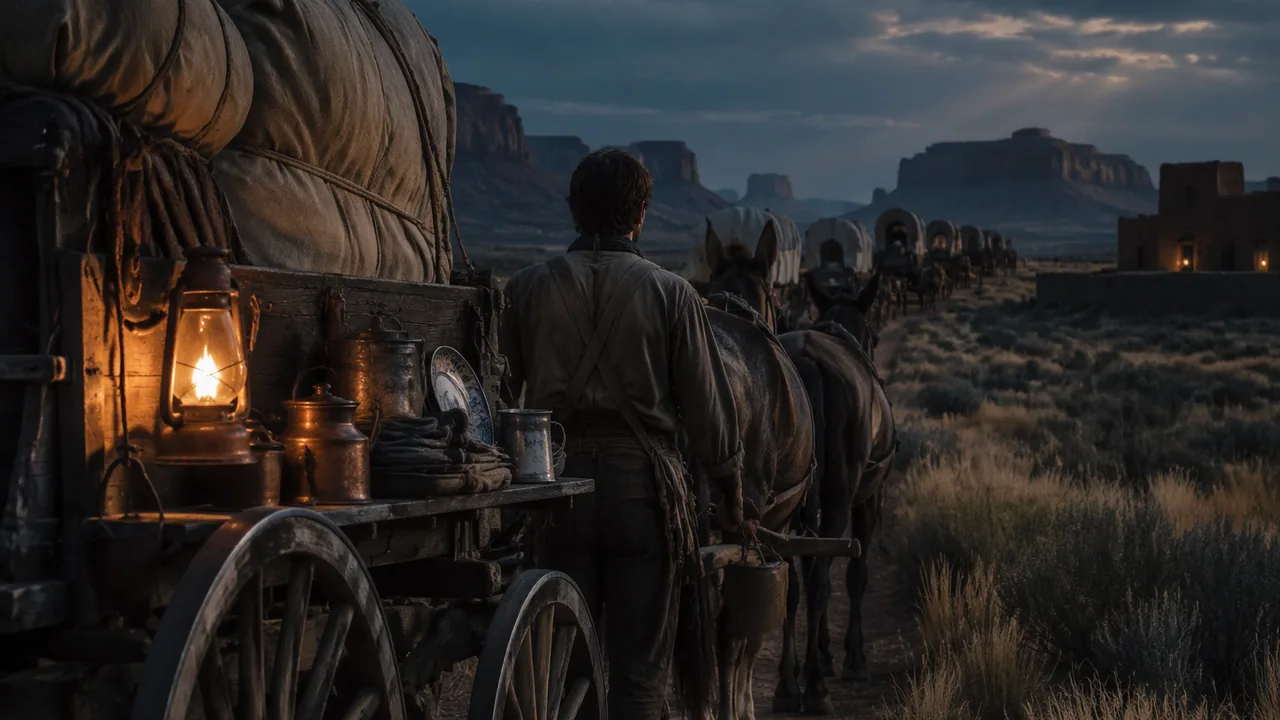
In 1867 José Librado Gurulé (the National Park Service also spells his name Liberado) was sixteen when he was hired, for six to eight dollars a month, to work on a wagon caravan owned by José Perea, one of the wealthiest New Mexican traders. In February fifty wagons, loaded mostly with wool, headed east. Workdays averaged eighteen hours, and the crew ate one full meal a day: tortillas, beans, black-eyed peas and dried mutton or goat. Gurulé saw a brief skirmish with a band of Plains Indians; once it was over, he traded a sugar cube to a Native woman for ground meat. After three months the caravan reached Kansas City, unloaded, bought new clothing, and started back in June with copper kettles, china, steel and clothing. Near Fort Hays the men and animals worked for a while on the new railroad, and then cholera killed a third of the outfit. They reached home in December, where, as Gurulé remembered, feasts and bailes (dances) were waiting. For the whole eleven-month journey he received just $8. About seventy years later, in 1940, he told his story to an interviewer from the Federal Writers’ Project; the Park Service notes that no personal accounts by New Mexicans from the earlier Mexican period are known, which makes accounts like his precious (National Park Service, “New Mexican Traders on the Santa Fe Trail” and Santa Fe Trail brochure text). The interpretive text of this IPA, written for the course, tells his story in the preterite.
Las tres tareas
- Interpretive: read without a translator; identify the main idea, the order of events, two details and what Gurulé’s account shows about New Mexican traders.
- Interpersonal: you are a traveler and the task gives you a travel agent’s questions. Answer them aloud (a willing family member may read them to you), telling what happened on a past trip (real or invented) and asking for help planning a trip along the Santa Fe Trail or to another historical place; then record the agent’s side. Use usted, the preterite and polite forms.
- Presentational: finish, revise and record the travel guide you drafted in Lesson 4.4.
La meta: Intermediate Low
This is the last IPA of the semester, so the target is now Intermediate Low in every mode. You understand main ideas and several details of a connected text; you create sentences to ask and answer questions in a transaction; you present in strings of sentences across two time frames (preterite for the visit, present for the recommendation), with most forms under control.
Checklist
- All the preterite families: regular with accents, -car/-gar/-zar, ir/ser, the u- and i-stems (tuve, pude, puse, supe, vine, quise), the j-stems (dije, traje; dijeron, trajeron), and -ir third-person stem changes (pidió, durmió).
- Reflexive verbs from Unit 2 in the past: me levanté, se divirtieron.
- Formal register and polite requests: quisiera, ¿me podría…?
Integrity and alternatives
No translators or AI tools for the interpretive and interpersonal tasks. If recording is not possible, type the conversation as a transcript with both speakers’ lines. The travel story may be invented; you are scored on the Spanish.
📖 Read for this lesson
The reading opens over the lesson; close it to come back to exactly where you were. The checks below draw on it.
Formative check
Work through these before moving on. They are not graded — they tell you whether the standard below has landed yet.
Tarea interpretativa. Lee el texto. No uses traductor.
Un largo viaje hacia el este
En 1867, José Librado Gurulé, un joven nuevomexicano de dieciséis años, consiguió trabajo en una caravana. El dueño de la caravana fue José Perea, uno de los comerciantes más ricos de Nuevo México. En febrero, cincuenta carretas salieron hacia el este, casi todas con lana.
El viaje fue muy duro. Los hombres trabajaron unas dieciocho horas cada día y comieron solo una comida completa: tortillas, frijoles y carne seca. Un día, Gurulé vio una pelea corta con un grupo de indígenas de las llanuras. Después, cuando todo se calmó, le dio un cubito de azúcar a una mujer indígena, y ella le dio carne molida.
Después de tres meses, la caravana llegó a Kansas City. Allí bajaron la lana y compraron ropa nueva. En junio empezaron el viaje de regreso con ollas de cobre, platos, acero y ropa. En el camino, una enfermedad, el cólera, mató a un tercio del grupo. En diciembre, los viajeros por fin llegaron a casa, y hubo fiestas y bailes.
Por once meses de trabajo, Gurulé recibió solo ocho dólares. En 1940, unos setenta años después, le contó su historia a un entrevistador. Hoy, el Servicio de Parques Nacionales usa su relato para explicar el papel de los comerciantes nuevomexicanos en el Camino de Santa Fe.
Show transcript
Un largo viaje hacia el este En 1867, José Librado Gurulé, un joven nuevomexicano de dieciséis años, consiguió trabajo en una caravana. El dueño de la caravana fue José Perea, uno de los comerciantes más ricos de Nuevo México. En febrero, cincuenta carretas salieron hacia el este, casi todas con lana. El viaje fue muy duro. Los hombres trabajaron unas dieciocho horas cada día y comieron solo una comida completa: tortillas, frijoles y carne seca. Un día, Gurulé vio una pelea corta con un grupo de indígenas de las llanuras. Después, cuando todo se calmó, le dio un cubito de azúcar a una mujer indígena, y ella le dio carne molida. Después de tres meses, la caravana llegó a Kansas City. Allí bajaron la lana y compraron ropa nueva. En junio empezaron el viaje de regreso con ollas de cobre, platos, acero y ropa. En el camino, una enfermedad, el cólera, mató a un tercio del grupo. En diciembre, los viajeros por fin llegaron a casa, y hubo fiestas y bailes. Por once meses de trabajo, Gurulé recibió solo ocho dólares. En 1940, unos setenta años después, le contó su historia a un entrevistador. Hoy, el Servicio de Parques Nacionales usa su relato para explicar el papel de los comerciantes nuevomexicanos en el Camino de Santa Fe.
¿Cuál es la idea principal?
¿Qué hicieron Gurulé y la mujer indígena?
¿Qué pasó después de tres meses?
¿Qué llevaron las carretas en el viaje de regreso?
In context, dueño most likely means…
Tarea interpersonal (recorded, 4-5 minutes). You are the traveler. Answer the travel agent’s questions aloud in Spanish, one at a time, using usted; a willing family member may read them to you (they may use the English in brackets). Agente: Buenos días, ¿en qué le puedo servir? [How can I help you?] / ¿Adónde fue en su último viaje y qué pasó? [Where did you go on your last trip and what happened?] / ¿Qué fue lo mejor y qué problema tuvo? [What was the best part, and what problem did you have?] / ¿Adónde quiere viajar ahora? [Where do you want to travel now?] / ¿Cuándo quiere salir y por cuántos días? [When and for how many days?] / ¿Cuál es su presupuesto? [What is your budget?] / ¿Prefiere viajar en carro, en tren o en avión? [Car, train or plane?] Tell about the past trip with at least five preterite verbs, including two irregulars, and ask for help planning a trip to a historical place (for example, along the Santa Fe Trail). Then record a second take as the agent with an invented traveler: ask at least four questions (dates, budget, transport, interests) and make a recommendation. Use usted throughout and at least one polite form.
Tarea presentacional. Submit your planning notes, self-reviewed draft and revised travel guide (180-220 words, preterite visit, present recommendation, one other perspective, two sources). Record it as a 90-second podcast or a video with three images; a family member may watch.
How confident are you that you can understand, discuss and present travel and history in Spanish at the Intermediate Low level?
Unit 4 checkpoint
Do this before you start the task. It covers the whole unit and tells you what to review first.
In what year did Mexico win independence and open trade with the United States?
According to the lesson, the Santa Fe Trail was used only by Missouri traders.
In Muchos pueblos indígenas tuvieron que vivir en reservas, the Native peoples are…
Mis padres (traer) comida para el viaje.
Choose the correct form: Anoche mi hermano no ____ bien.
Supe in the preterite means “I found out.”
Ayer el mesero nos (servir) la cena.
Which is the most polite way to ask for a ticket?
El pase de abordar is…
In a travel guide, the recommendation for the reader is written in the preterite.
el museo, el palacio es de 1610. (According to)
Integrated Performance Assessment 4: Un viaje por la historia
Theme: travel and the Spanish-language and Native history of the Santa Fe Trail, from Missouri to New Mexico. Target: Intermediate Low (semester exit).
- Interpretive (WL.1.2b.II / WL.1.2c.II): the text about José Librado Gurulé’s 1867 journey above; five questions including sequence and the exchange on the plains.
- Interpersonal (WL.1.1b.II / WL.1.1c.II / WL.1.1d.II): a recorded 4-5 minute traveler and travel-agent conversation in the formal register, from the agent’s scripted questions.
- Presentational (WL.1.3b.II / WL.1.3c.II): a 180-220 word travel guide, recorded as a podcast or video.
| Mode | Approaching (Novice High) | Meets (Intermediate Low) | Exceeds (Intermediate Mid) |
|---|---|---|---|
| Interpretive | Identifies the topic, dates and some facts | Identifies the main idea, the sequence, key details and what the account shows about New Mexican traders | Also explains why the Park Service values Gurulé’s account |
| Interpersonal | Memorized phrases; tú and usted mixed | Creates sentences in the formal register; narrates a past trip and handles the transaction | Handles a complication (a change, a problem) and negotiates a solution |
| Presentational | Past and present mixed without signals; a list of facts | Strings of sentences in two time frames; accurate history with sources; mostly accurate preterite | Paragraph-like organization; smooth transitions between narration and recommendation |
Heritage-speaker extension: add the bilingual museum label, and in the conversation’s second take play an agent who must switch between formal and informal register with two invented clients.
Submission workflow
- Stage 1 — Plan. Complete the interpretive task, then outline the guide: orientation, visit, recommendation, other perspective, sources.
- Stage 2 — Self-reviewed draft. Highlight past verbs in one color and present verbs in another, check each against the time frame, and check one fact against a source (a family member may read along); then write a revision plan.
- Stage 3 — Revised final. Submit the final guide with sources and the revision plan.
- Stage 4 — Present and converse. Record the guide as a podcast or video, and record the travel-agent conversation.
How it is scored
| Criterion | What proficient looks like |
|---|---|
| Interpretive comprehension (WL.1.2b.II / WL.1.2c.II) | Identifies main idea, sequence, details and the perspective of a historical narrative. |
| Interpersonal exchange (WL.1.1b.II / WL.1.1c.II / WL.1.1d.II) | Completes a travel transaction in the formal register, narrating a past trip and asking for help. |
| Presentational product (WL.1.3b.II / WL.1.3c.II) | A travel guide in two time frames with accurate, sourced history and a second perspective. |
| Language control (WL.1.3c.II) | All preterite families mostly accurate; present used correctly for recommendations. |
| Intercultural understanding (WL.2.2c.II / WL.2.1d.II) | Shows how Native, Spanish, Mexican, Missouri and present-day influences meet in the place presented. |
Un largo viaje hacia el este
SLS original history reading for RLP Spanish 2A, written as the interpretive text for Integrated Performance Assessment 4, drawing on National Park Service information about New Mexican traders on the Santa Fe Trail (retrieved November 10, 2026) · SLS original
Por qué esta lectura. Este es el texto interpretativo de la evaluación integrada de la Unidad 4. Los hechos son reales: el viaje de José Librado Gurulé (el Servicio de Parques Nacionales también escribe Liberado) en la caravana de José Perea en 1867 está documentado por el Servicio de Parques Nacionales, que usa la entrevista que Gurulé dio en 1940.
Un largo viaje hacia el este
En 1867, José Librado Gurulé, un joven nuevomexicano de dieciséis años, consiguió trabajo en una caravana. El dueño de la caravana fue José Perea, uno de los comerciantes más ricos de Nuevo México. En febrero, cincuenta carretas salieron hacia el este, casi todas con lana.
El viaje fue muy duro. Los hombres trabajaron unas dieciocho horas cada día y comieron solo una comida completa: tortillas, frijoles y carne seca. Un día, Gurulé vio una pelea corta con un grupo de indígenas de las llanuras. Después, cuando todo se calmó, le dio un cubito de azúcar a una mujer indígena, y ella le dio carne molida.
Después de tres meses, la caravana llegó a Kansas City. Allí bajaron la lana y compraron ropa nueva. En junio empezaron el viaje de regreso con ollas de cobre, platos, acero y ropa. En el camino, una enfermedad, el cólera, mató a un tercio del grupo. En diciembre, los viajeros por fin llegaron a casa, y hubo fiestas y bailes.
Por once meses de trabajo, Gurulé recibió solo ocho dólares. En 1940, unos setenta años después, le contó su historia a un entrevistador. Hoy, el Servicio de Parques Nacionales usa su relato para explicar el papel de los comerciantes nuevomexicanos en el Camino de Santa Fe.