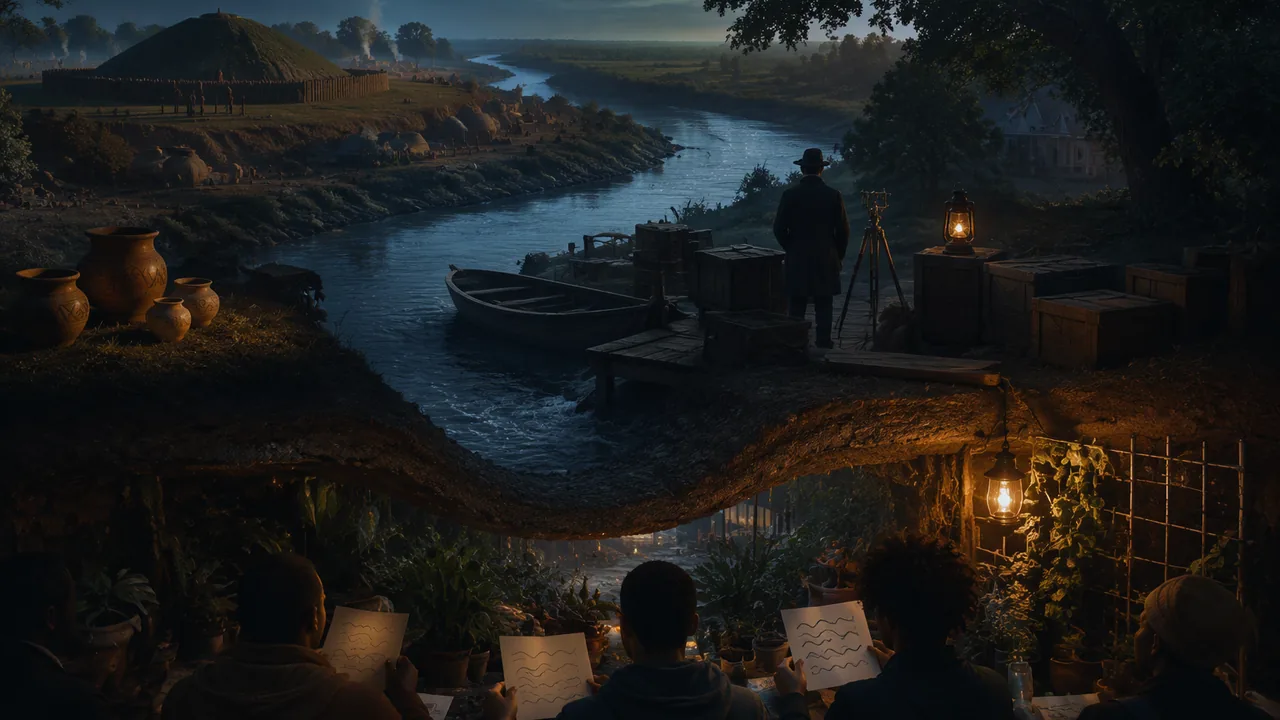
read a short Spanish article for its main idea and key details, and explain how Missouri’s place names and its Spanish-speaking communities today show layers of Native, colonial and present history.
Instruction
Reading like an intermediate learner
In Spanish 1 you read single sentences. In Spanish 2 you will read strings of sentences, short connected texts, and your job changes. You no longer need to know every word. You need the main idea first and the key details second. Readers who stop at every unknown word lose the thread; readers who keep going and come back almost always understand more.
Use four moves every time you read.
- Predict from the title and images. The title “Los nombres cuentan historias” uses three words you know: nombres (names), cuentan (they tell, from contar), historias (stories or histories). Before reading a line, you can predict that the text is about names that tell stories.
- Use cognates, and watch for false friends. Insecto, montañas, historia, colores look like English words and mean what they look like. A few do not: actual means “current,” librería means “bookstore,” and largo means “long,” not “large.”
- Use word families. If you know hispano and hablar, you can work out hispanohablante (a Spanish speaker). If you know viento (wind) and sur (south), el viento del sur is “the south wind.”
- Read the verbs. Every Spanish sentence turns on its verb, and the ending tells you who is doing it. In los pueblos originarios ya tenían nombres you may not know tenían yet, but the root ten- points to tener: they had names. You will learn this past form in Spanish 2B; for now, the root is enough.
A worked example
Take the sentence El nombre Missouri viene de los missouria, un pueblo originario. Cognates: nombre (name, a cousin of “nominate”), originario (original, first). Known words: el, de, un. The verb viene comes from venir: it “comes from.” Main idea: the name Missouri comes from the Missouria, a first people of this land. You understood it without a dictionary.
The map has layers, and so do the people
In Spanish 1 you met New Madrid, Mexico and Cuba, and the Osage Nation. This lesson adds new names and a new question: who lives here now? The Native layer is the oldest. The state and its great river are named for the Missouria, whose villages stood at the Great Bend of the Missouri River, in today’s Saline County. The name, recorded by the French from an Algonquian word, is usually explained as “one who has dugout canoes”; the Missouria called themselves Ñútachi, “People of the River’s Mouth.” Kansas City is named for the Kansas River, which carries the name of the Kaw (Kansa) people, the “People of the Southwind.” Both nations are alive today: the Otoe-Missouria Tribe has its headquarters in Red Rock, Oklahoma, and the Kaw Nation in Kaw City, Oklahoma.
The colonial layer is French and Spanish at the same time. French-speaking settlers named Creve Coeur (“broken heart” in French; no one is sure why). A French village south of St. Louis, founded in 1767, was renamed Carondelet in 1794 to honor the Baron de Carondelet, the Spanish governor of Louisiana. Today Carondelet is a St. Louis neighborhood.
The present layer is the people. In the 2020 Census, about 303,000 Missourians (4.9 percent) were Hispanic or Latino. About 77,800 of them lived in Jackson County, home of most of Kansas City. In proportion, the highest share was in rural Sullivan County in north Missouri, whose county seat is Milan (17.6 percent), followed by McDonald County in the southwest corner and Saline County (12.1 percent each): the same Saline County where the Missouria once lived.
So when you read a Missouri map, you read several stories at once: Native, colonial and the present. Today you will read an original article about this, answer questions about its main idea and details, and start a map note that you will build on all year.
Sources: Missouri Encyclopedia (State Historical Society of Missouri), “Missouria”; Kansas Historical Society, Kansapedia, “Kaws or Kanzas”; City of St. Louis, Carondelet Park history; Missouri Office of Administration, County Population 2020 by Race and Hispanic Origin (from the 2020 Census).
📖 Read for this lesson
The reading opens over the lesson; close it to come back to exactly where you were. The checks below draw on it.
Formative check
Work through these before moving on. They are not graded — they tell you whether the standard below has landed yet.
Read the article once for the main idea and a second time for details. Then answer the questions.
Los nombres cuentan historias
El mapa de Missouri tiene capas, como un pastel. La primera capa es indígena. El nombre Missouri viene de los missouria, un pueblo originario. Hace muchos años, los missouria vivían junto al río Missouri, en lo que hoy es el condado de Saline. Kansas City tiene el nombre del río Kansas, y el río tiene el nombre del pueblo kaw, “el pueblo del viento del sur”. Hoy, los otoe-missouria y los kaw son naciones vivas, con sus gobiernos en Oklahoma.
La segunda capa es francesa y española. Creve Coeur significa “corazón roto” en francés. Carondelet, un barrio de St. Louis, tiene el nombre de un gobernador español de Luisiana.
La tercera capa es la de hoy: las personas. En Missouri viven más de 300.000 personas hispanas o latinas. Muchas viven en el condado de Jackson, donde está Kansas City, pero también en pueblos pequeños, como Milan, en el norte del estado.
Cuando lees un mapa de Missouri, lees muchas historias al mismo tiempo.
Show transcript
Los nombres cuentan historias El mapa de Missouri tiene capas, como un pastel. La primera capa es indígena. El nombre Missouri viene de los missouria, un pueblo originario. Hace muchos años, los missouria vivían junto al río Missouri, en lo que hoy es el condado de Saline. Kansas City tiene el nombre del río Kansas, y el río tiene el nombre del pueblo kaw, “el pueblo del viento del sur”. Hoy, los otoe-missouria y los kaw son naciones vivas, con sus gobiernos en Oklahoma. La segunda capa es francesa y española. Creve Coeur significa “corazón roto” en francés. Carondelet, un barrio de St. Louis, tiene el nombre de un gobernador español de Luisiana. La tercera capa es la de hoy: las personas. En Missouri viven más de 300.000 personas hispanas o latinas. Muchas viven en el condado de Jackson, donde está Kansas City, pero también en pueblos pequeños, como Milan, en el norte del estado. Cuando lees un mapa de Missouri, lees muchas historias al mismo tiempo.
What is the main idea of the article?
¿Qué significa “Creve Coeur”?
Según el texto, ¿de dónde viene el nombre de Kansas City?
¿Qué dice el texto sobre la capa de hoy?
Match each Spanish word or phrase from the article to its meaning.
Escucha a Daniela. ¿Qué idiomas habla su familia?
Show transcript
Me llamo Daniela y vivo en Milan, Missouri. Mi familia es de Oaxaca. En casa hablamos español y mixteco, y con mis amigos hablo inglés.
Start your map note. Choose five Missouri places (from the article or from your own part of Missouri). For each, write the name, its meaning or the story behind it, and which layer of history it shows (Native, French/Spanish colonial, or present). Include at least one name you did not study in Spanish 1, and, if you can, one name from the Native nation whose homeland you live on. Then add one sentence in Spanish about where Spanish speakers live in Missouri today (Muchas personas hispanas viven en…). Say where you found each piece of information (for example, the Missouri Encyclopedia, a tribal nation’s website or a city’s website).
How confident are you that you can read a short Spanish article for its main idea and details, and explain what Missouri’s place names and communities show about history?
Practice
Work these on paper or in your notebook, then open Check your answer. Aim for all of Fluency and Application; try at least one Challenge.
Printable version: this unit’s practice workbook (PDF)
Fluency
Build speed and accuracy with the core skill.
- Give the meaning of each word from the lesson: (a) actual; (b) librería; (c) largo. Why are these words called cognados falsos?
Check your answer
Answer: (a) current; (b) bookstore; (c) long. They look like English words (actual, library, large) but mean something else.A false friend (cognado falso) looks like an English word but has a different meaning, so it can mislead a reader who guesses from the spelling alone. - Use word families to work out the meaning: (a) hispanohablante; (b) el viento del sur.
Check your answer
Answer: (a) a Spanish speaker; (b) the south wind.(a) hispano + hablar (to speak) = a person who speaks Spanish. (b) viento = wind, sur = south. - Name the three layers of history the lesson finds on the Missouri map, in order from oldest to newest.
Check your answer
Answer: 1. the Native (Indigenous) layer; 2. the French and Spanish colonial layer; 3. the present layer: the people who live here today.The article compares the map to a cake with layers: indígena, then francesa y española, then la de hoy: las personas.
Application
Use the skill in context. Show your reasoning.
- Read the sentence and give its main idea in English: Creve Coeur significa “corazón roto” en francés. Which word is a cognate, and which verb tells you what the sentence does?
Check your answer
Answer: Main idea: the name Creve Coeur means “broken heart” in French. Cognate: francés (French) (also significa, signifies). Verb: significa (means).Read the verb first: significa looks like “signifies,” so the sentence explains what a name means. - Translate into English: Kansas City tiene el nombre del río Kansas, y el río tiene el nombre del pueblo kaw.
Check your answer
Answer: Kansas City has the name of (is named for) the Kansas River, and the river has the name of (is named for) the Kaw people.tiene = has; del = of the; el río = the river; el pueblo here = the people (nation). - Sort each place into its layer of history (Native, colonial, present): (a) Missouri (the state’s name); (b) Carondelet; (c) Milan, where many Hispanic families live today; (d) Kansas City.
Check your answer
Answer: (a) Native; (b) colonial (Spanish); (c) present; (d) Native.Missouri comes from the Missouria; Carondelet honors the Baron de Carondelet, Spanish governor of Louisiana; Milan is named in the lesson for its Hispanic population today (Sullivan County); Kansas City is named for the Kansas River and the Kaw people. - Using the 2020 Census figures in the lesson: about 303,000 Missourians were Hispanic or Latino, and about 77,800 of them lived in Jackson County. About what fraction of Missouri’s Hispanic or Latino residents lived in Jackson County? Then write one Spanish sentence about it, starting Muchas personas hispanas viven en…
Check your answer
Answer: About one in four (77,800 ÷ 303,000 ≈ 0.26, or about 26%). Muchas personas hispanas viven en el condado de Jackson. (or …en Kansas City.)77,800 ÷ 303,000 = 0.257 ≈ 26%, a little more than a quarter. The sentence reuses the article’s own structure.
Challenge
Stretch problems. Expect to think before you write.
- The Missouria called themselves Ñútachi. What does the name mean, and what does the article say about the Missouria and the Kaw today? Answer in English, then write one Spanish sentence from the article’s language: Hoy, los… son…
Check your answer
Answer: “People of the River’s Mouth.” Both are living nations today: the Otoe-Missouria Tribe has its headquarters in Red Rock, Oklahoma, and the Kaw Nation in Kaw City, Oklahoma. Hoy, los otoe-missouria y los kaw son naciones vivas.A strong answer gives the meaning, makes clear that both nations still exist (not only in the past), and names Oklahoma as the seat of their governments.
Review
Keep earlier skills sharp.
- Prerequisite review from Spanish 1: the lesson says you met three Missouri names in Spanish 1 that connect to the Spanish-speaking world or to a Native nation. Name them.
Check your answer
Answer: New Madrid, Mexico and Cuba (Missouri towns), and the Osage Nation.The lesson recalls them before adding new names (Missouria, Kaw, Creve Coeur, Carondelet).
Los nombres cuentan historias: Missouri, capa por capa
SLS original Spanish reading for RLP Spanish 2A, Lesson 1.1; facts from the Missouri Encyclopedia (State Historical Society of Missouri), the Kansas Historical Society’s Kansapedia, the City of St. Louis (Carondelet Park history), Wikipedia (Kansas City, Carondelet, Creve Coeur; cross-checked with the city and historical-society pages) and the Missouri Office of Administration’s 2020 Census county table (all retrieved November 10, 2026) · SLS original
Por qué esta lectura. El mapa de Missouri tiene capas: la capa indígena, la capa colonial (francesa y española) y la capa de hoy, que son las personas. Esta lectura da más ejemplos para tu nota del mapa. En Español 1 viste New Madrid, Mexico, Cuba y la Nación Osage; aquí hay nombres nuevos.
La capa indígena
El estado y el río tienen el nombre de los missouria. Hace muchos años, sus pueblos estaban en la Gran Curva del río Missouri, en lo que hoy es el condado de Saline. Los franceses escribieron el nombre de una palabra de un idioma algonquino; muchas fuentes dicen que significa “los que tienen canoas de tronco”. Los missouria se llamaban a sí mismos Ñútachi, “el pueblo de la boca del río”. Hoy la Tribu Otoe-Missouria vive en Oklahoma, con su gobierno en Red Rock.
Kansas City tiene el nombre del río Kansas, y el río tiene el nombre del pueblo kaw (o kansa). La palabra viene de una palabra siux que significa “viento del sur”: los kaw son “el pueblo del viento del sur”. En 1850, el pueblo junto al río se llamaba Town of Kansas. Hoy la Nación Kaw tiene más de 3.100 miembros y su gobierno está en Kaw City, Oklahoma.
La capa colonial: francesa y española
Creve Coeur, cerca de St. Louis, significa “corazón roto” en francés. Hay varias leyendas sobre el nombre, pero nadie sabe la razón exacta.
Carondelet es hoy un barrio de St. Louis. Un francés, Clément Delor de Treget, funda el pueblo en 1767. En 1794, el pueblo recibe el nombre de Carondelet, en honor del barón de Carondelet, el gobernador español de Luisiana. Un pueblo francés con el nombre de un gobernador de España: así es la capa colonial de Missouri.
La capa de hoy: las personas
Según el Censo de 2020, en Missouri viven unas 303.000 personas hispanas o latinas: el 4,9 por ciento de la población. En el condado de Jackson, donde está la mayor parte de Kansas City, viven unas 77.800. Pero el porcentaje más alto está en un condado rural: el condado de Sullivan, en el norte del estado, donde está el pueblo de Milan (17,6 por ciento). Después vienen el condado de McDonald, en el suroeste, y el condado de Saline (12,1 por ciento cada uno). Sí: el mismo condado de Saline donde vivían los missouria.
Los nombres del mapa cuentan quién vivía aquí antes. Las personas cuentan quién vive aquí hoy.
Sources: Missouri Encyclopedia (State Historical Society of Missouri), Missouria (missouriencyclopedia.org); Kansas Historical Society, Kansapedia: Kaws or Kanzas (kansashistory.gov); Kansas City, Missouri (Wikipedia): named for the Kansas River; Town of Kansas incorporated 1850 (en.wikipedia.org); City of St. Louis, Carondelet Park (history of the name, 1794) (stlouis-mo.gov); Carondelet, St. Louis (Wikipedia): founded 1767 by Clément Delor de Treget (en.wikipedia.org); Creve Coeur, Missouri (Wikipedia): French for “broken heart”, origin uncertain (en.wikipedia.org); Missouri Office of Administration, Division of Budget and Planning, County Population 2020 by Race, Hispanic Origin and Total Minority (2020 Census) (oa.mo.gov)