write and present a recipe for a family or regional dish, with ingredients, quantities, sequence words and present-tense verbs.
Instruction
A recipe is a procedural text: it tells an audience how to do something, step by step. Spanish cookbooks and cooking videos often write recipes with the command form (“mix,” “add”), which you will learn in Spanish 2. Many cooks, especially on video, use the nosotros present instead, as if cooking together with the viewer: Primero, lavamos las flores. That is what you will do today, and it is natural, friendly Spanish.
Ingredients and quantities. los ingredientes; una taza de (a cup of), una cucharada de (a tablespoon of), una cucharadita de (a teaspoon of), un litro de (a liter of), medio kilo de (half a kilo of), un poco de (a little), al gusto (to taste). Most Spanish-speaking countries use metric units: a liter is a little more than a quart, and a kilo is about 2.2 pounds.
Cooking verbs (nosotros forms). lavamos (we wash), cortamos (cut), mezclamos (mix), añadimos or agregamos (add), cocinamos (cook), hervimos (boil), freímos (fry), ponemos (put), esperamos (wait), colamos (strain), servimos (serve). Many of these are stem-changers (hervir e→ie, colar o→ue, servir e→i), but as you learned in Lesson 1.2, the nosotros form never changes. That is one more reason cooks like it.
Sequence words. primero (first), luego (then), después (after that), mientras (while), al final (finally). They make a list of steps into a text a listener can follow.
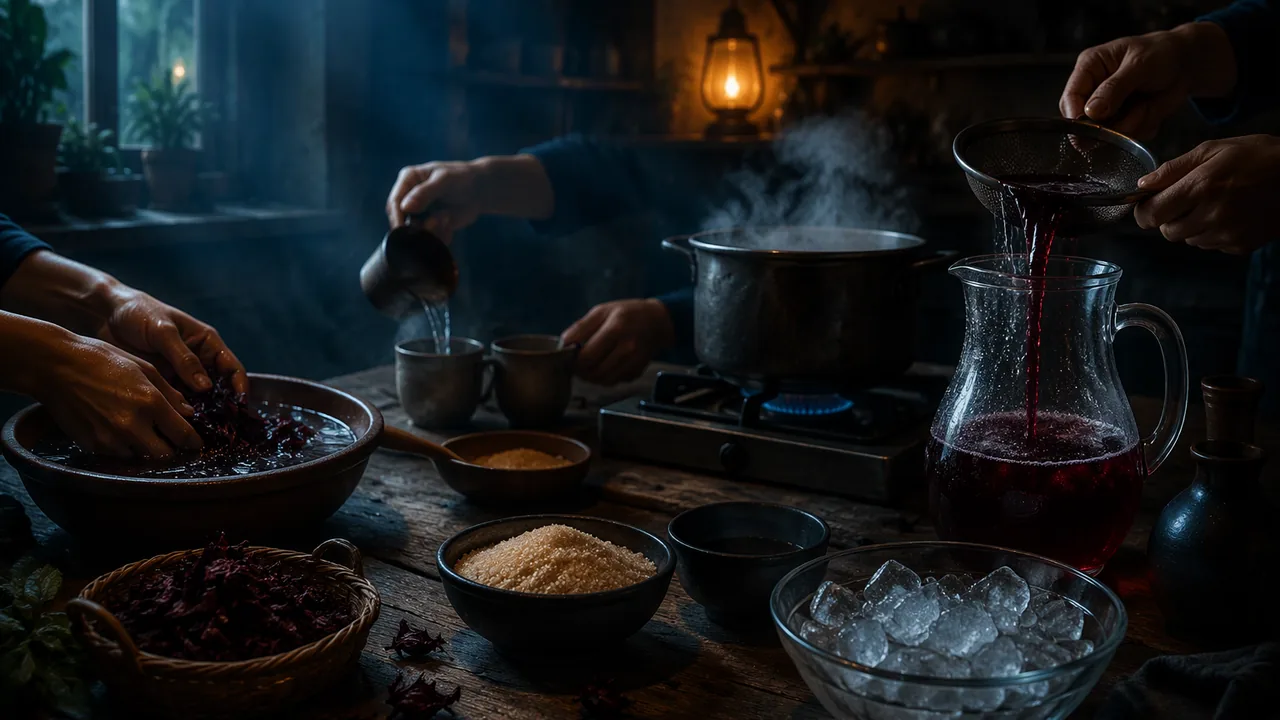
A model: agua de jamaica.
Ingredientes: una taza de flor de jamaica, dos litros de agua, media taza de azúcar, hielo.
- Primero, lavamos la flor de jamaica con agua fría.
- Luego, hervimos un litro de agua.
- Después, ponemos la flor en el agua caliente y esperamos quince minutos.
- Colamos el agua y añadimos el azúcar.
- Mezclamos con un litro de agua fría.
- Al final, servimos con hielo. ¡Buen provecho!
¡Buen provecho! is what people say to someone who is eating, like “Enjoy your meal.” In many Spanish-speaking communities it is polite to say it even to strangers as you pass their table, and to answer ¡Gracias!
Choosing your dish. Choose a dish your family makes, a dish from a region you are interested in (pozole, tamales, pupusas, arroz con leche, gallo pinto from Costa Rica and Nicaragua, or a dish from your own family’s tradition, whatever it is), or a simple dish you make yourself. You do not need to share a family recipe if you prefer not to; a public dish from a region is equal. Add one sentence of culture: where the dish comes from, when people eat it, or who makes it in your family (En mi familia, mi tía hace los tamales en diciembre.).
Self-check. Read your card aloud, to a family member if one is willing to listen, and check that every step has a sequence word or a clear order, every verb is in the nosotros form, quantities agree (media taza, dos litros), and the culture sentence is accurate.
📖 Read for this lesson
The reading opens over the lesson; close it to come back to exactly where you were. The checks below draw on it.
Formative check
Work through these before moving on. They are not graded — they tell you whether the standard below has landed yet.
Build the step: “Then, we put the flowers in the hot water.”
Type it instead
Listen to the step. How long do they wait?
Show transcript
Después, esperamos quince minutos y colamos el agua.
Listen and write the step.
Show transcript
Al final, servimos el agua con hielo.
How do I type á é í ó ú ñ ¿ ¡ ?
Long-press the vowel on a phone keyboard. On Windows use the US-International layout (apostrophe then the vowel); on a Mac hold Option+E then the vowel. You can also use the buttons below.
Servir is a stem-changer, but not in the nosotros form.
Say it in Spanish.
In my family, my aunt makes the tamales in December.
How confident are you that you can write and present a recipe with ingredients, sequence words and present-tense verbs?
Practice
Work these on paper or in your notebook, then open Check your answer. Aim for all of Fluency and Application; try at least one Challenge.
Printable version: this unit’s practice workbook (PDF)
Fluency
Build speed and accuracy with the core skill.
- Translate into English: (a) una taza de; (b) una cucharada de; (c) una cucharadita de; (d) medio kilo de; (e) al gusto.
Check your answer
Answer: (a) a cup of; (b) a tablespoon of; (c) a teaspoon of; (d) half a kilo of; (e) to taste.These are the recipe quantities from the lesson. - Put these sequence words in order and translate them: después, al final, primero, luego.
Check your answer
Answer: primero (first), luego (then), después (after that), al final (finally).Sequence words turn a list of steps into a text a listener can follow. Mientras (while) is another one. - Give the nosotros form of each cooking verb: (a) lavar; (b) mezclar; (c) hervir; (d) servir; (e) poner.
Check your answer
Answer: (a) lavamos; (b) mezclamos; (c) hervimos; (d) servimos; (e) ponemos.Hervir (e → ie) and servir (e → i) are stem-changers, but the nosotros form never changes.
Application
Use the skill in context. Show your reasoning.
- The agua de jamaica recipe uses una taza de flor de jamaica, dos litros de agua y media taza de azúcar. Write the ingredient list in Spanish for a double batch.
Check your answer
Answer: dos tazas de flor de jamaica, cuatro litros de agua y una taza de azúcar.Double each amount: 1 × 2 = 2 tazas; 2 × 2 = 4 litros; ½ × 2 = 1 taza. Quantities agree: dos tazas, una taza. - A recipe calls for dos kilos de pollo. About how many pounds is that? And about how much is medio kilo?
Check your answer
Answer: About 4.4 pounds; medio kilo is about 1.1 pounds.A kilo is about 2.2 pounds: 2 × 2.2 = 4.4; 0.5 × 2.2 = 1.1. - These steps are out of order. Number them 1–4 and add a sequence word to each: (a) colamos el agua; (b) lavamos la flor de jamaica; (c) servimos con hielo; (d) hervimos el agua.
Check your answer
Answer: 1 Primero, lavamos la flor de jamaica. 2 Luego, hervimos el agua. 3 Después, colamos el agua. 4 Al final, servimos con hielo.Follow the model recipe: wash, boil, (steep and) strain, serve. Any clear order with sequence words in this position earns credit. - Write a culture sentence for a recipe card: say in Spanish that in your example family the grandmother makes pupusas on Sundays.
Check your answer
Answer: En mi familia, mi abuela hace las pupusas los domingos. (or: …prepara las pupusas los domingos.)Follow the lesson’s model En mi familia, mi tía hace los tamales en diciembre. Hace is from hacer; days and months are lower case.
Challenge
Stretch problems. Expect to think before you write.
- Write a short recipe card (title, three ingredients with quantities, four steps with sequence words, nosotros forms, and ¡Buen provecho!) for a simple dish of rice and beans. Use only words from the unit.
Check your answer
Answer: Model: Arroz con frijoles. Ingredientes: una taza de arroz, dos tazas de agua, una taza de frijoles. Primero, lavamos el arroz. Luego, hervimos el agua. Después, ponemos el arroz en el agua y esperamos veinte minutos. Al final, servimos el arroz con los frijoles. ¡Buen provecho!A strong card has a quantity for every ingredient that agrees (dos tazas), every step in the nosotros form, a sequence word on each step and a correct closing. You may choose any dish.
Review
Keep earlier skills sharp.
- Review (Lesson 1.3): you are in a restaurant. Write, in Spanish, (a) a polite order for a soup, (b) a question about what it has in it, (c) a request for the bill.
Check your answer
Answer: (a) Quisiera una sopa, por favor. (or ¿Me da una sopa, por favor?) (b) ¿Qué lleva la sopa? (c) La cuenta, por favor.From Lesson 1.3: quisiera / ¿me da…?, ¿qué lleva…? and la cuenta.
Los tamales: una receta de la comunidad
SLS original text for Spanish 1B, Lesson 1.4; an original recipe, not a translation of a published one · SLS original
En muchas familias mexicanas y centroamericanas, preparamos tamales para las fiestas de diciembre. Esta receta sencilla es para tamales de elote. Es una receta original de SLS, no una receta de familia.
Ingredientes: dos tazas de masa de maíz, una taza de elote fresco, media taza de mantequilla, una cucharadita de azúcar, hojas de maíz secas.
Primero, remojamos las hojas de maíz en agua tibia por treinta minutos. Luego, mezclamos la masa con la mantequilla, el azúcar y el elote. Después, ponemos una cucharada de masa en cada hoja y doblamos la hoja con cuidado. Cocinamos los tamales al vapor por una hora. Al final, servimos los tamales calientes, con salsa o crema.
En muchas familias, una persona mayor, como una abuela, hace tamales cada diciembre, y toda la familia ayuda: unos preparan la masa, otros doblan las hojas. Es un trabajo de equipo y una tradición que pasa de generación en generación.
¡Buen provecho!