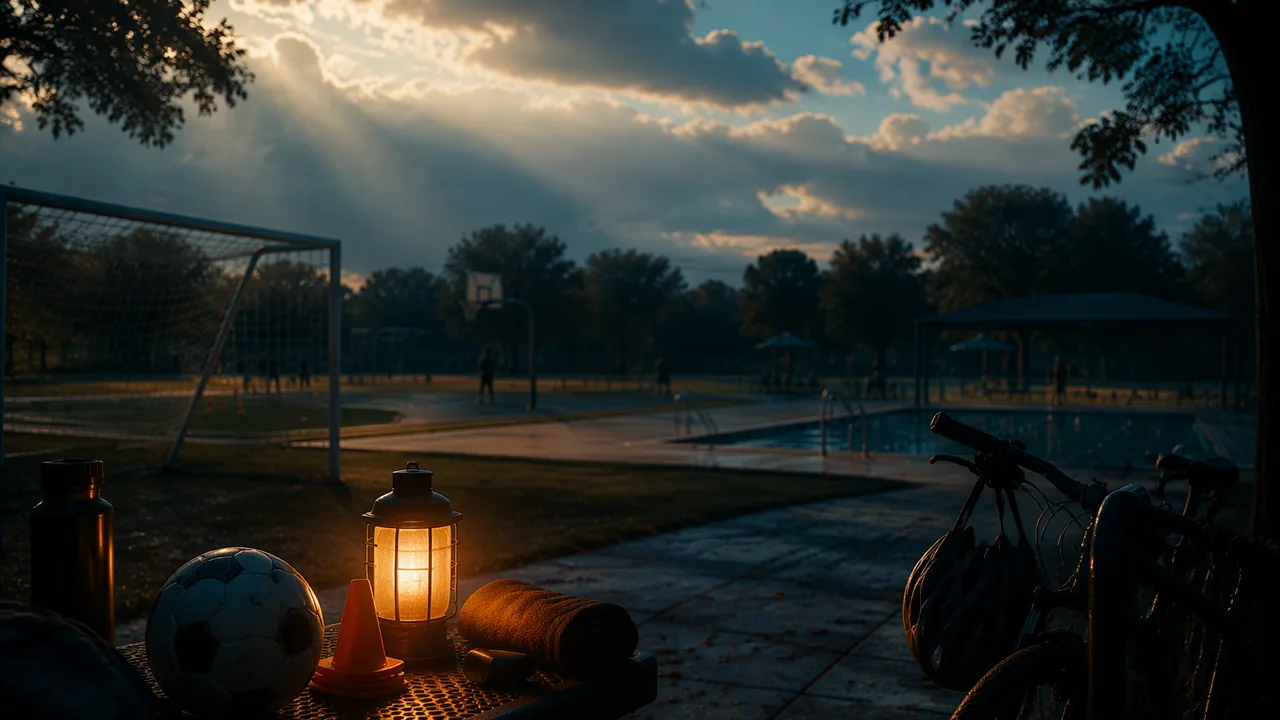
conjugate jugar and the verbs with irregular yo forms (hacer, salir, poner, traer, ver), and use them to talk about sports and free time.
Instruction
Jugar (to play a sport or game) is the only verb in Spanish with a u → ue stem change. It follows the same boot pattern you learned in Unit 1:
| juego | jugamos |
| juegas | jugáis |
| juega | juegan |
Many speakers, especially in Spain and parts of South America, say jugar al fútbol, jugar al béisbol (with a + el); many in Mexico, Central America and the Caribbean say jugar fútbol, jugar béisbol. Both are correct. Remember: instruments use tocar.
Sports. el fútbol (soccer), el fútbol americano (American football), el béisbol, el básquetbol or el básquet (el baloncesto in Spain), el voleibol, el tenis, la natación (swimming), el atletismo (track and field), la lucha libre (professional wrestling, hugely popular in Mexico). Related words: el equipo (team), el partido (game, match), el estadio, ganar (to win), perder (to lose; e→ie: pierdo), el aficionado (fan).
Verbs with an irregular yo form. These verbs are regular in every form except yo, which ends in -go or has another change. You already know one: tener → tengo.
| infinitive | yo | tú, él… |
|---|---|---|
| hacer (to do, to make) | hago | haces, hace, hacemos, hacéis, hacen |
| salir (to go out, to leave) | salgo | sales, sale, salimos, salís, salen |
| poner (to put, to set) | pongo | pones, pone, ponemos, ponéis, ponen |
| traer (to bring) | traigo | traes, trae, traemos, traéis, traen |
| ver (to see, to watch) | veo | ves, ve, vemos, veis, ven |
Because these are among the most common verbs in the language, their yo forms come up constantly in conversation: ¿Qué haces los sábados? — Salgo con mis amigos y vemos un partido.
Hacer in questions and answers. ¿Qué haces? asks what you do or are doing, but the answer usually uses a different verb: ¿Qué haces los domingos? — Juego fútbol. Answering Hago fútbol is an English-influenced error. Hacer does appear in some fixed expressions: hacer ejercicio (to exercise), hacer la tarea (to do homework), hacer yoga, and weather (hace calor).
Salir with prepositions. salir de (to leave a place): Salgo de la escuela a las tres. salir con (to go out with): Salgo con mis primos. salir a + infinitive: Salimos a correr. (We go out to run.)
Worked example. “On Saturdays I leave the house early, I bring water and I play soccer in the park; then I watch a game on TV.” Los sábados salgo de la casa temprano, traigo agua y juego fútbol en el parque; luego veo un partido en la tele. Four verbs, four irregular yo forms, one stem-changer. Say it aloud until it sounds natural.
Comparing languages. English irregular verbs are mostly irregular in the past (go / went); Spanish irregular verbs are often irregular in the present yo. Learn each new verb with its yo form, the way you learn a noun with its article.
📖 Read for this lesson
The reading opens over the lesson; close it to come back to exactly where you were. The checks below draw on it.
Formative check
Work through these before moving on. They are not graded — they tell you whether the standard below has landed yet.
Complete the present tense of jugar (u → ue).
| yo | |
|---|---|
| tú | |
| él / ella / usted | juega |
| nosotros / nosotras | |
| vosotros / vosotras | jugáis Spain; recognize it |
| ellos / ellas / ustedes |
Match each infinitive to its yo form.
Build it: “On Saturdays I go out with my friends and we watch a game.”
Type it instead
Say it in Spanish.
My cousins play baseball and I play soccer.
How confident are you that you can conjugate jugar and the irregular yo verbs and use them to talk about sports and free time?
Practice
Work these on paper or in your notebook, then open Check your answer. Aim for all of Fluency and Application; try at least one Challenge.
Printable version: this unit’s practice workbook (PDF)
Fluency
Build speed and accuracy with the core skill.
- Conjugate jugar (u → ue) in the present: yo, tú, él/ella/usted, nosotros, ellos/ellas/ustedes.
Check your answer
Answer: juego, juegas, juega, jugamos, juegan. (vosotros: jugáis)Jugar is the only Spanish verb with u → ue. Nosotros keeps the u. - Give the yo form of: (a) hacer; (b) salir; (c) poner; (d) traer; (e) ver; (f) tener.
Check your answer
Answer: (a) hago; (b) salgo; (c) pongo; (d) traigo; (e) veo; (f) tengo.These verbs are regular in every form except yo. - Translate into English: (a) el equipo; (b) el partido; (c) ganar; (d) perder; (e) el aficionado; (f) la natación.
Check your answer
Answer: (a) team; (b) game, match; (c) to win; (d) to lose; (e) fan; (f) swimming.Perder is e → ie: pierdo.
Application
Use the skill in context. Show your reasoning.
- Complete with the correct form: (a) Yo ____ la tarea a las cinco. (hacer) (b) Mi hermana ____ voleibol. (jugar) (c) Nosotros ____ un partido en la tele. (ver) (d) Yo ____ agua al parque. (traer)
Check your answer
Answer: (a) hago; (b) juega; (c) vemos; (d) traigo.Irregular only in yo: hago, traigo. Ver → vemos is regular. Jugar → juega (stressed stem). - Answer the question in Spanish with a different verb, as the lesson recommends: ¿Qué haces los domingos? (you play basketball)
Check your answer
Answer: Juego básquetbol. (or: Juego al básquetbol / Juego básquet / Juego al baloncesto.)Answering Hago básquetbol is an English-influenced error. Jugar básquetbol and jugar al básquetbol are both correct. - Complete with de, con or a: (a) Salgo ____ la escuela a las tres. (b) Salgo ____ mis primos. (c) Salimos ____ correr.
Check your answer
Answer: (a) de; (b) con; (c) a.salir de = to leave a place; salir con = to go out with; salir a + infinitive = to go out to do something. - Translate into Spanish: On Saturdays I leave the house early, I bring water and I play soccer in the park.
Check your answer
Answer: Los sábados salgo de la casa temprano, traigo agua y juego fútbol en el parque. (or: …juego al fútbol…)Three yo forms, two irregular and one stem-changer: salgo, traigo, juego.
Challenge
Stretch problems. Expect to think before you write.
- Write four Spanish sentences about an example teen’s weekend using four different verbs from this lesson in the yo form, one of them jugar, and one fixed expression with hacer.
Check your answer
Answer: Model: Los sábados salgo con mis amigos. Juego béisbol en el parque y traigo agua. Por la noche veo un partido en la tele. Los domingos hago ejercicio.A strong answer has correct yo forms (salgo, juego, traigo, veo, pongo, hago), one hacer expression (hacer ejercicio, hacer la tarea, hacer yoga) and no “hago + sport”.
Review
Keep earlier skills sharp.
- Review (Lesson 1.2): jugar follows the same boot pattern as the stem-changers from Unit 1. Conjugate poder for yo and nosotros, and explain why only one of them changes.
Check your answer
Answer: puedo, podemos. Yo has the stress on the stem (PUE-do), so o → ue; nosotros has the stress on the ending (po-DE-mos), so it keeps the o.From Lesson 1.2: the stem vowel changes only when it is stressed.
Mi fin de semana típico
SLS original text for RLP Spanish 1B, Lesson 3.2; the facts about the Cardinals’ Spanish-language broadcasts (first Spanish play-by-play on 29 September 2016 by Polo Ascencio, born and raised in Tijuana) come from the Cardinals’ page Escucha los Cardenales en Español and MLB.com (2020), retrieved November 10, 2026 · SLS original
Los sábados, hago ejercicio por la mañana. Salgo de casa a las ocho y voy al parque. Allí, juego fútbol con mis amigos. Mi amigo Diego juega muy bien; siempre gana.
Después del partido, traigo agua para todo el equipo, porque hace mucho calor. Pongo mis cosas en mi mochila y salgo a caminar con mi familia.
Por la tarde, veo un partido de béisbol en la televisión con mi papá. Él es aficionado de los Cardenales de San Luis. A veces escuchamos el partido en español: los Cardenales tienen transmisiones en español desde 2016. El narrador es Polo Ascencio, de Tijuana, México. Mi papá dice: «¡El béisbol en español es más emocionante!»
Los domingos, no hago mucho. A veces, salgo con mis primos, y otras veces, no salgo de casa y solo descanso. Pongo música y veo videos en mi teléfono. ¿Qué haces tú los fines de semana? ¿Juegas algún deporte? ¿Qué traes cuando sales a jugar con tus amigos?