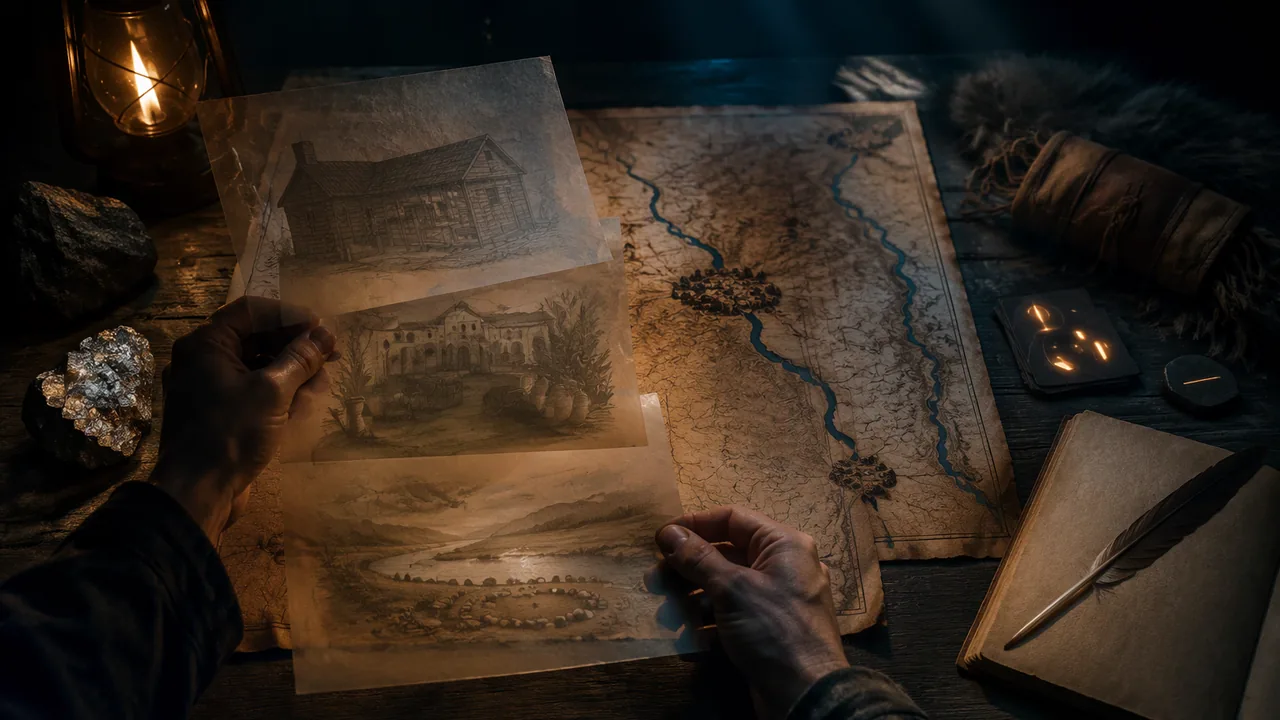
explain what some Missouri place names mean and where they come from, describe Spanish Upper Louisiana (1770–1804) with the perspectives of the region’s Native nations, and draft a short guided tour of a place.
Instruction
A map in many languages. Missouri’s map is a record of who was there and who named it. Some names are French, from the first colonial towns: St. Louis, named for King Louis IX of France, and Ste. Genevieve. Some point to the Spanish-speaking world. New Madrid was formally established on February 14, 1789, under Spanish rule, as Nuevo Madrid, with the name of Spain’s capital (New Madrid County). Potosi, first a lead-mining settlement called Mine au Breton, was renamed by Moses Austin after Potosí in Bolivia, a city famous for its silver mines (Washington County Chamber of Commerce). Mexico, the seat of Audrain County, was named in 1836, when the Missouri frontier was full of stories of Texas, then part of Mexico (Mexico, Missouri chamber of commerce). Cuba, platted in 1857 when the railroad was coming, was named after the island of Cuba (Robert L. Ramsay, Our Storehouse of Missouri Place Names, 1952). And the oldest names are neither French nor Spanish: the Osage River carries the name of the Osage Nation, whose people lived along it.
Spanish Upper Louisiana (1770–1804). In 1762 France secretly ceded Louisiana, the land west of the Mississippi, to Spain in the Treaty of Fontainebleau. Fur traders led by Pierre Laclède Liguest and his stepson Auguste Chouteau founded St. Louis on February 15, 1764, and on May 20, 1770, Spain officially took control (Missouri State Archives timeline). Pedro Piernas, the first Spanish lieutenant governor, governed Upper Louisiana from St. Louis from 1770 to 1775 (Missouri Encyclopedia). The towns of Upper Louisiana were small and mostly French-speaking: Ste. Genevieve (founded by 1750, the first permanent European settlement in today’s Missouri), St. Louis, St. Charles, New Madrid and Cape Girardeau. To bring in settlers, Spanish officials granted land, even to Americans: in 1798 Lieutenant Governor Zenon Trudeau granted Daniel Boone 1,000 arpents. Upper Louisiana was also a slaveholding society; enslaved people had been forced to work in the region’s lead mines since 1719. In 1800 Spain returned Louisiana to France, France sold it to the United States in 1803, and on March 9 and 10, 1804, the flags changed in a ceremony in St. Louis remembered as Three Flags Day (National Park Service).
The Native nations’ story. For the Osage Nation, this land was home long before any colonial flag. The Osage name for themselves translates as “Children of the Middle Waters”; they kept settlements on the Missouri River and moved up the Osage River, and when the written record begins they lived in southwest and south-central Missouri (Osage Nation Historic Preservation Office). Spain claimed Upper Louisiana, but it could not command the Osage. Spanish records show the other side of that relationship: when Piernas refused to let licensed traders go to the Osage villages, the Osage simply traded with the British instead. In other words, the Osage chose their own trading partners. By 1804 the Osage ruled western Missouri, northern Arkansas and eastern Kansas, and the Chouteau family of St. Louis held a trade monopoly with them for many years (National Park Service). Other nations lived in the region too: St. Louis lies in the traditional territory of the Illini Confederacy (City of St. Louis), and in 1793, under Spain, Shawnee and Delaware people received a land grant near Cape Girardeau. After 1804 the United States took Osage land through a series of treaties, beginning in 1808, until the Osage were forced into what is now Oklahoma. The Osage Nation is a living nation today, governed from Pawhuska, Oklahoma. To learn its history in its own words, start with the Osage Nation’s own pages, linked above.
Telling this history with Native perspectives is not about taking a side; it is about including the people the colonial towns were built among, in their own terms, and describing them as nations that still exist. A tour that mentions only flags and founders leaves most of the story out.
Spanish for history, in the present. You have not learned a past tense yet, and you do not need one here: Spanish often tells history in the present tense, the presente histórico. En 1764, Laclède y Chouteau fundan St. Louis. (In 1764 Laclède and Chouteau found St. Louis.) En 1770, España toma el control de la Alta Luisiana. Newspapers, documentaries and museum signs do this all the time.
Your tour script. Choose a place: a neighborhood, a park, a street or a town in your area, or a Missouri place with a Spanish, French or Native name. Write at least eight sentences, with a guide’s voice (the examples are models; describe your own place):
- Welcome and name: Bienvenidos a New Madrid. “Madrid” es la capital de España.
- What there is: Hay un parque grande, una biblioteca y muchos restaurantes.
- Where things are (estar + prepositions): La biblioteca está enfrente del parque.
- Where people go and how (ir): Las familias van al río a pie.
- One historical fact, in the historical present, with whose land it is: En 1789, Nuevo Madrid es un pueblo de la Luisiana española. En 1808, con un tratado, esta tierra de los osage pasa a Estados Unidos.
Check your fact against a reliable source (a city, county, state, National Park Service or tribal website) and cite it at the bottom.
📖 Read for this lesson
The reading opens over the lesson; close it to come back to exactly where you were. The checks below draw on it.
Formative check
Work through these before moving on. They are not graded — they tell you whether the standard below has landed yet.
Missouri standard: WL.2.2c.I
Read the short text, then answer.
La Alta Luisiana española
En 1764, Laclède y Chouteau fundan St. Louis. En 1770, España toma el control de la Alta Luisiana. Los pueblos son pequeños y muchas personas hablan francés: Ste. Genevieve, St. Louis, St. Charles, Cape Girardeau y Nuevo Madrid. Nuevo Madrid nace en 1789 y tiene el nombre de la capital de España. Pero gran parte de esta tierra es de los osage, una nación muy fuerte. Los osage comercian con los españoles, pero ellos deciden con quién comercian. En 1804, la Alta Luisiana pasa a Estados Unidos. Hoy la Nación Osage tiene su gobierno en Pawhuska, Oklahoma.
Show transcript
La Alta Luisiana española En 1764, Laclède y Chouteau fundan St. Louis. En 1770, España toma el control de la Alta Luisiana. Los pueblos son pequeños y muchas personas hablan francés: Ste. Genevieve, St. Louis, St. Charles, Cape Girardeau y Nuevo Madrid. Nuevo Madrid nace en 1789 y tiene el nombre de la capital de España. Pero gran parte de esta tierra es de los osage, una nación muy fuerte. Los osage comercian con los españoles, pero ellos deciden con quién comercian. En 1804, la Alta Luisiana pasa a Estados Unidos. Hoy la Nación Osage tiene su gobierno en Pawhuska, Oklahoma.
When does Spain take control of Upper Louisiana?
Where does the name Nuevo Madrid come from?
Which sentence best matches the text’s perspective?
Match each Missouri place name to its origin.
Build the tour sentences: “Welcome to New Madrid. The library is across from the park.”
Type it instead
Say it in Spanish, using the present tense for history.
In 1764, Laclède and Chouteau found St. Louis.
How confident are you that you can explain Missouri place names, describe Spanish Upper Louisiana with Native perspectives and draft a tour?
Practice
Work these on paper or in your notebook, then open Check your answer. Aim for all of Fluency and Application; try at least one Challenge.
Printable version: this unit’s practice workbook (PDF)
Fluency
Build speed and accuracy with the core skill.
- Match each Missouri place name to its origin: (a) New Madrid; (b) Potosi; (c) Mexico; (d) Cuba; (e) St. Louis.
Check your answer
Answer: (a) Madrid, the capital of Spain (Nuevo Madrid, 1789); (b) Potosí, a silver-mining city in Bolivia; (c) the country of Mexico (named in 1836); (d) the island of Cuba (named in 1857); (e) King Louis IX of France.The Osage River carries an even older name: the Osage Nation, whose people lived along it. - Give the year for each event: (a) Laclède and Chouteau found St. Louis; (b) Spain officially takes control of Upper Louisiana; (c) New Madrid is formally established; (d) Three Flags Day.
Check your answer
Answer: (a) 1764 (February 15); (b) 1770 (May 20); (c) 1789 (February 14); (d) 1804 (March 9-10).From the lesson’s timeline of Spanish Upper Louisiana (1770–1804). - Translate into English: En 1770, España toma el control de la Alta Luisiana. What is this use of the present tense called?
Check your answer
Answer: In 1770, Spain takes (took) control of Upper Louisiana. It is the presente histórico (historical present).Spanish often tells history in the present tense; newspapers, documentaries and museum signs do it all the time.
Application
Use the skill in context. Show your reasoning.
- Write in Spanish with the historical present: (a) In 1789, Nuevo Madrid is a town of Spanish Louisiana. (b) In 1804, Upper Louisiana passes to the United States.
Check your answer
Answer: (a) En 1789, Nuevo Madrid es un pueblo de la Luisiana española. (b) En 1804, la Alta Luisiana pasa a Estados Unidos.Present-tense verbs (es, pasa) for past events: the presente histórico. - Spanish records show that when Lieutenant Governor Piernas refused to let licensed traders go to the Osage villages, the Osage traded with the British instead. What does this show about the relationship between Spain and the Osage?
Check your answer
Answer: Spain claimed Upper Louisiana but could not command the Osage. The Osage were a strong, independent nation that chose their own trading partners.A strong answer states that the Osage acted on their own terms; by 1804 they ruled western Missouri, northern Arkansas and eastern Kansas. - Write four sentences for a short tour of an example town with a guide’s voice: a welcome, what there is (hay), where one place is (estar + preposition), and where families go and how (ir).
Check your answer
Answer: Model: Bienvenidos a New Madrid. Hay un parque grande, una biblioteca y muchos restaurantes. La biblioteca está enfrente del parque. Las familias van al río a pie.A strong answer uses Bienvenidos a…, hay, estar with a preposition (and del), and a form of ir with al/a la and a means of travel. - True or false, and correct the false ones: (a) Ste. Genevieve was the first permanent European settlement in today’s Missouri. (b) The towns of Upper Louisiana were mostly Spanish-speaking. (c) The Osage Nation is governed today from Pawhuska, Oklahoma.
Check your answer
Answer: (a) True (founded by 1750). (b) False: they were small and mostly French-speaking. (c) True.Spain governed the region from 1770, but most settlers spoke French. The Osage Nation is a living nation today.
Challenge
Stretch problems. Expect to think before you write.
- A tour of St. Louis that mentions only the French founders and the Spanish and American flags “leaves most of the story out.” In three or four English sentences, explain what a fuller tour should add, using facts from the lesson.
Check your answer
Answer: It should add the Native nations the colonial towns were built among: the Osage, whose homeland included much of Missouri and who chose their own trading partners; the Illini Confederacy, whose traditional territory St. Louis lies in; and the Shawnee and Delaware, who received a land grant near Cape Girardeau in 1793. It should say that after 1804 the United States took Osage land through treaties beginning in 1808 and forced the Osage into what is now Oklahoma, and that the Osage Nation is a living nation today. It could also note that Upper Louisiana was a slaveholding society, with enslaved people forced to work in the lead mines since 1719.A strong answer names at least two Native nations with a fact for each, describes them as nations that still exist, and draws only on facts from the lesson.
Review
Keep earlier skills sharp.
- Review (Lesson 2.3): write two Spanish sentences for your tour that use estar with a preposition: the church is next to the plaza; the museum is far from the river.
Check your answer
Answer: La iglesia está al lado de la plaza. El museo está lejos del río.From Lesson 2.3: location uses estar; de + el río = del río.
Los nombres de Missouri: un mapa con muchas voces
SLS original text for RLP Spanish 1B, Lesson 2.4; facts from the Missouri State Archives timeline, the Osage Nation Historic Preservation Office, the National Park Service (Gateway Arch National Park), the Missouri Encyclopedia, the City of St. Louis, New Madrid County, the Washington County and Mexico, Missouri chambers of commerce, and Ramsay’s Our Storehouse of Missouri Place Names (1952) (all retrieved November 10, 2026); flagged for native-speaker and subject review given the sensitivity of this history · SLS original
El mapa de Missouri tiene nombres de muchos orígenes: nombres indígenas, franceses, españoles e ingleses.
Algunos nombres son franceses: St. Louis (por el rey Luis IX de Francia) y Ste. Genevieve. Otros nombres miran al mundo hispano. Nuevo Madrid (New Madrid) nace en 1789, bajo el gobierno español, y tiene el nombre de la capital de España. Potosi tiene el nombre de Potosí, una ciudad de Bolivia famosa por sus minas de plata. Mexico, en el condado de Audrain, recibe su nombre en 1836, por el país de México. Cuba, Missouri, recibe su nombre en 1857, por la isla de Cuba.
Pero los nombres más antiguos son indígenas. El río Osage tiene el nombre de la Nación Osage. El nombre que los osage usan para su pueblo significa «Hijos de las Aguas del Medio».
Entre 1770 y 1804, España gobierna la Alta Luisiana desde St. Louis. Los pueblos son pequeños y muchas personas hablan francés. Para atraer colonos, el gobierno español da tierras, por ejemplo a Daniel Boone en 1798. La colonia también tiene personas esclavizadas, que trabajan en las minas de plomo.
Pero gran parte de esta tierra es de los osage. Los osage viven junto a los ríos Missouri y Osage, y son una nación muy fuerte. Comercian con los franceses y los españoles de St. Louis, pero ellos deciden con quién comercian: cuando el gobierno español no deja ir a los comerciantes a sus pueblos, los osage comercian con los británicos. St. Louis también está en la tierra tradicional de la Confederación Illini, y en 1793 el gobierno español da tierras a personas de las naciones shawnee y delaware cerca de Cape Girardeau.
En 1804, la Alta Luisiana pasa a Estados Unidos. Con tratados, desde 1808, Estados Unidos toma la tierra de los osage en Missouri, y los osage tienen que ir a lo que hoy es Oklahoma. Hoy la Nación Osage es una nación viva, con su gobierno en Pawhuska, Oklahoma. En sus propias páginas, la Nación Osage cuenta esta historia con su propia voz.
Sources: Missouri State Archives, Missouri history timeline, 1700–1810 (Missouri Secretary of State) (s1.sos.mo.gov); Osage Nation Historic Preservation Office, Osage cultural history (osagenation-nsn.gov); National Park Service, Gateway Arch National Park: the Osage (nps.gov); National Park Service, Gateway Arch National Park: St. Louis and Three Flags Day (nps.gov); Missouri Encyclopedia (State Historical Society of Missouri), Piernas, Pedro Joseph (missouriencyclopedia.org); City of St. Louis, A Brief History of St. Louis (stlouis-mo.gov); New Madrid County, History (newmadridcountymo.gov); Washington County Chamber of Commerce, Community (Potosi) (washcomochamber.com); Mexico, Missouri chamber of commerce, What’s in our name (mexico-chamber.org); Cuba, Missouri (Wikipedia, citing Robert L. Ramsay, Our Storehouse of Missouri Place Names, University of Missouri Press, 1952, p. 28) (en.wikipedia.org)