understand an unseen menu and order, carry out a restaurant role-play, and present a recipe for a community cookbook.
Instruction
The theme of this IPA is the community table: the food a community cooks, sells and shares. You are building a page for a community cookbook, and each task feeds into it.
Task 1: Interpretive. You will read the menu of a food truck in Kansas City and listen to a customer ordering for her family. Identify what she orders, how many of each, what she prefers and why, and what the total is. The menu uses cognates and food words from this unit; the audio uses the phrases from Lesson 1.3 (¿Me da…?, para mí, prefiero). Compute the total yourself from the menu prices; you may use a calculator.
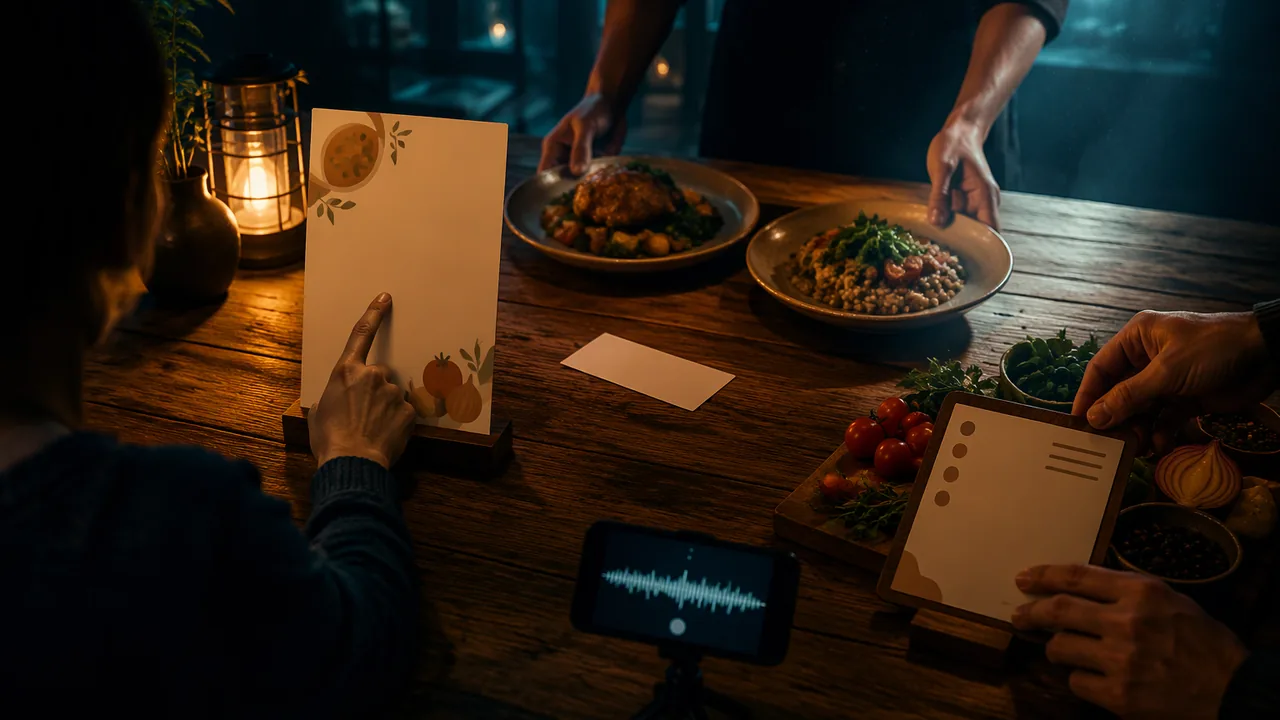
Task 2: Interpersonal. Record a visit to a restaurant. Draw one of the situation cards (for example, you are ordering for yourself and a younger cousin who does not eat meat). Play the server audio from Lesson 1.3 and this lesson and answer each prompt aloud, then record the whole visit, speaking both parts: greet, order for two, ask at least one question about a dish, state a preference, ask for the bill and pay. Stay in the usted register. If a family member or another adult you know is willing, they can read the English prompt card as the server, asking the questions in any order so you cannot plan your answers.
Task 3: Presentational. Write a recipe card for your community cookbook and present it in a short recorded video or audio demonstration (no stove needed: you can explain with pictures or ingredients on a table). Include the ingredients with quantities, at least six steps with sequence words and nosotros verbs, at least three stem-changing verbs somewhere in the card (for example in an introduction: En mi familia, preferimos…, Mi abuela siempre sirve…, Quiero compartir…), and one sentence of culture.
What moves you toward Novice High. At Novice Mid you complete the transaction with memorized phrases. At Novice High you create with the language: you ask an unexpected question, explain a preference with porque, handle a problem (No hay pupusas de loroco hoy. — Entonces, prefiero…), and connect steps into a smooth text.
Heritage and home speakers. Add an introduction of five sentences about the dish’s place in your family or community, including who cooks it and when, and use your family’s own words for ingredients and utensils; if they differ from the ones taught (jitomate, tomate; comal; olla), keep them and add a note for readers from other regions.
Food and access. No student is ever required to cook, bring or eat food. Allergies, dietary rules and cost are all respected: picture-based demonstrations earn full credit.
📖 Read for this lesson
The reading opens over the lesson; close it to come back to exactly where you were. The checks below draw on it.
Formative check
Work through these before moving on. They are not graded — they tell you whether the standard below has landed yet.
Interpretive task, part A. Read the food-truck menu (prices are illustrative), then answer.
Lonchera Los Compadres, Kansas City
Tacos de pollo o de carne asada: $2.75 cada uno
Tamal de rajas con queso: $3.50
Elote con limón y chile: $4.00
Agua fresca (horchata, jamaica o sandía): $2.50
Hoy no hay tamales de pollo. ¡Buen provecho!
Show transcript
Lonchera Los Compadres, Kansas City Tacos de pollo o de carne asada: $2.75 cada uno Tamal de rajas con queso: $3.50 Elote con limón y chile: $4.00 Agua fresca (horchata, jamaica o sandía): $2.50 Hoy no hay tamales de pollo. ¡Buen provecho!
Which item is not available today?
How much do two tacos, one tamal de rajas and two aguas frescas cost?
What comes on the elote?
Interpretive task, part B. Listen to the customer. Why does her son want chicken?
Show transcript
Buenas tardes. ¿Me da dos tacos de carne asada, por favor? Y para mi hijo, un taco de pollo, porque no come carne de res.
Presentational planning. Name your dish, list the ingredients with quantities in Spanish, outline six steps with sequence words, and write your culture sentence.
How confident are you that you can understand a menu and an order, carry out a restaurant role-play and present a recipe in Spanish?
Unit 1 checkpoint
Do this before you start the task. It covers the whole unit and tells you what to review first.
In Mexico, la comida as a meal usually means…
To say “I’m very thirsty,” say: Tengo sed.
In the milpa, the beans add nitrogen to the soil.
Which English word came from Nahuatl ahuacatl through Spanish?
Nosotros (poder) cocinar esta noche.
Which form is correct for ellos with pedir?
In a stem-changing verb, the nosotros form changes its stem vowel.
Which is the most formal way to order?
Three revuelta pupusas ($3.75 each) and one agua de jamaica ($3.00) cost $.
In a recipe with the nosotros present, “we serve” is…
¡Buen provecho! is said to someone who is eating, like “Enjoy your meal.”
Submit: IPA La mesa de mi comunidad (interpretive answers, restaurant role-play, recipe card and presentation)
Theme: the community table.
Interpretive. Read the food-truck menu (in the lesson checks) and listen to the order; identify items, quantities, preferences and the total.
Interpersonal. A restaurant visit from a situation card, recorded in both roles in the usted register: greet, order for two, ask about a dish, state a preference, ask for the bill and pay.
Presentational. A recipe card for your community cookbook (ingredients with quantities, six or more steps with sequence words and nosotros verbs, three stem-changing verbs, one culture sentence), presented as a short recorded video or audio demonstration with pictures or ingredients.
Heritage-speaker extension: a five-sentence introduction on the dish’s place in your family or community, with a note on regional words.
Submission workflow
- Stage 1: Plan. Choose the dish, list ingredients with quantities in Spanish, outline the steps with sequence words, and draft the culture sentence.
- Stage 2: Self-checked draft. Write the recipe card. Check nosotros forms, stem-changing verbs, quantity agreement and sequence against the checklist, read the card aloud (to a family member if one is willing), and write one question a reader might have. Submit the draft with your notes.
- Stage 3: Revised final. Revise, answer the reader’s question in the card, and add the card to your community cookbook page.
- Stage 4: Presentation. Record the recipe as a short video or audio demonstration with pictures or ingredients (no cooking required), and end by answering, in Spanish, the reader question you wrote in Stage 2. A family member may watch. Video and audio earn equal credit.
How it is scored
| Criterion | What proficient looks like |
|---|---|
| Interpretive (WL.1.2a.I / WL.1.2b.I) | Novice Mid: identifies items, quantities and prices in an unseen menu and order. Novice High: also identifies preferences and reasons and computes the total correctly. |
| Interpersonal (WL.1.1a.I / WL.1.1b.I / WL.1.1c.I / WL.1.1d.I / WL.1.1e.I) | Novice Mid: completes the transaction with memorized phrases in the usted register. Novice High: asks unexpected questions, explains preferences and handles a problem. |
| Culturally appropriate interaction (WL.2.1a.I / WL.4.2c.I / WL.1.2c.I) | Uses polite ordering formulas (quisiera, ¿me da…?, por favor), the usted register and ¡buen provecho! where fitting. |
| Presentational (WL.1.3a.I / WL.1.3b.I) | Novice Mid: a complete recipe with ingredients and steps that a listener can follow. Novice High: a connected text with an introduction, sequence words and a culture sentence. |
| Language control and culture (WL.2.1b.I / WL.2.2b.I / WL.4.2a.I) | Stem-changing verbs and nosotros forms correct; quantities agree; the cultural information is accurate and free of stereotype. |
Recetario comunitario: tres platos, tres historias
SLS original text for RLP Spanish 1B, Lesson 1.5 (IPA support material; gallo pinto and pupusas are real, widely documented regional dishes; Cherokee Street from Explore St. Louis, retrieved November 10, 2026) · SLS original
Cada plato de esta lista viene de una comunidad diferente.
Las pupusas son el plato nacional de El Salvador: tortillas de maíz rellenas de queso, frijoles o chicharrón. Hoy hay pupuserías en muchas ciudades de Estados Unidos.
En Missouri también hay comida de muchas comunidades: en la calle Cherokee de St. Louis, por ejemplo, hay panaderías, restaurantes y tiendas hispanas.
El gallo pinto es un plato de Costa Rica y Nicaragua: arroz y frijoles cocinados juntos, con cebolla y cilantro. Muchas familias lo comen en el desayuno, con huevo y plátano.
Los tamales son populares en México y Centroamérica. La masa de maíz se rellena de carne, pollo o elote, se envuelve en una hoja y se cocina al vapor. En diciembre, muchas familias preparan tamales juntas.
Para tu recetario, piensa en preguntas útiles: ¿Qué ingredientes necesitas? ¿Cuántos pasos tiene la receta? ¿Qué palabra de secuencia usas primero: primero, luego, después o al final?
En un restaurante, recuerda las frases de cortesía: «Quisiera…», «¿Me da…?», «La cuenta, por favor.» Y cuando alguien come, puedes decir: «¡Buen provecho!»
Sources: Explore St. Louis, Cherokee Street neighborhood guide (explorestlouis.com)