read a neighborhood description and follow directions, ask for and give directions in a recorded exchange, and present a guided tour of a place.
Instruction
This IPA is about knowing a place well enough to guide someone through it. You will read a place, talk your way through it and then present it.
Task 1: Interpretive. You will read an unseen description of Barrio San Miguel, an illustrative neighborhood, next to its map, and listen to recorded directions from a resident. Locate the places the text describes and trace the route on the map. Read the prepositions carefully: enfrente de and al lado de put a place in very different spots. The directions use the present tense (vas derecho, doblas) and cuadras.
Task 2: Interpersonal. Record an exchange in which you play a visitor and a resident. Draw a card without looking: it names two places on a new map, so you do not know in advance which places the visitor will ask about. As the visitor, approach politely (Disculpe…), ask where the two places are and how to get there, and check understanding (¿Está lejos? ¿A la derecha o a la izquierda?). As the resident, locate the places with estar and prepositions and give directions. Then draw a new card and map and record again. If a family member or another adult you know is willing, they can play the visitor by reading the English prompt card.
Task 3: Presentational. Turn your Lesson 2.4 draft into a finished guided tour, audio or video, of at least eight sentences. It must include the name of the place and what it means or where it comes from, what there is (hay), where things are (estar + prepositions), where people go and how (ir + transport), and one historical fact in the historical present, including whose land it is. Add a simple map or photos if you like; you may record while walking, or narrate over images.
Accuracy focus. The two big contrasts of this unit: ser vs. estar (location → estar) and dónde vs. adónde (movement → adónde). Add the contraction al, and you have three things to check in your draft.
Accuracy of history. Your historical fact must come from a reliable source that you cite: a city, state park, National Park Service or tribal website. Describe Native nations in the present tense as living communities, not only as part of the past.
Heritage and home speakers. Extend the tour to twelve sentences and add an interview: ask a family member or neighbor (in Spanish) one question about how the place has changed, and include their answer in your tour, with their permission. If your family uses different words for transport or places (camión, colonia, guagua), use them.
Access. You never need to visit a place in person or show your home; a public place, a map and images are enough.
📖 Read for this lesson
The reading opens over the lesson; close it to come back to exactly where you were. The checks below draw on it.
Formative check
Work through these before moving on. They are not graded — they tell you whether the standard below has landed yet.
Interpretive task, part A. Read the description of Barrio San Miguel (an illustrative neighborhood), then answer.
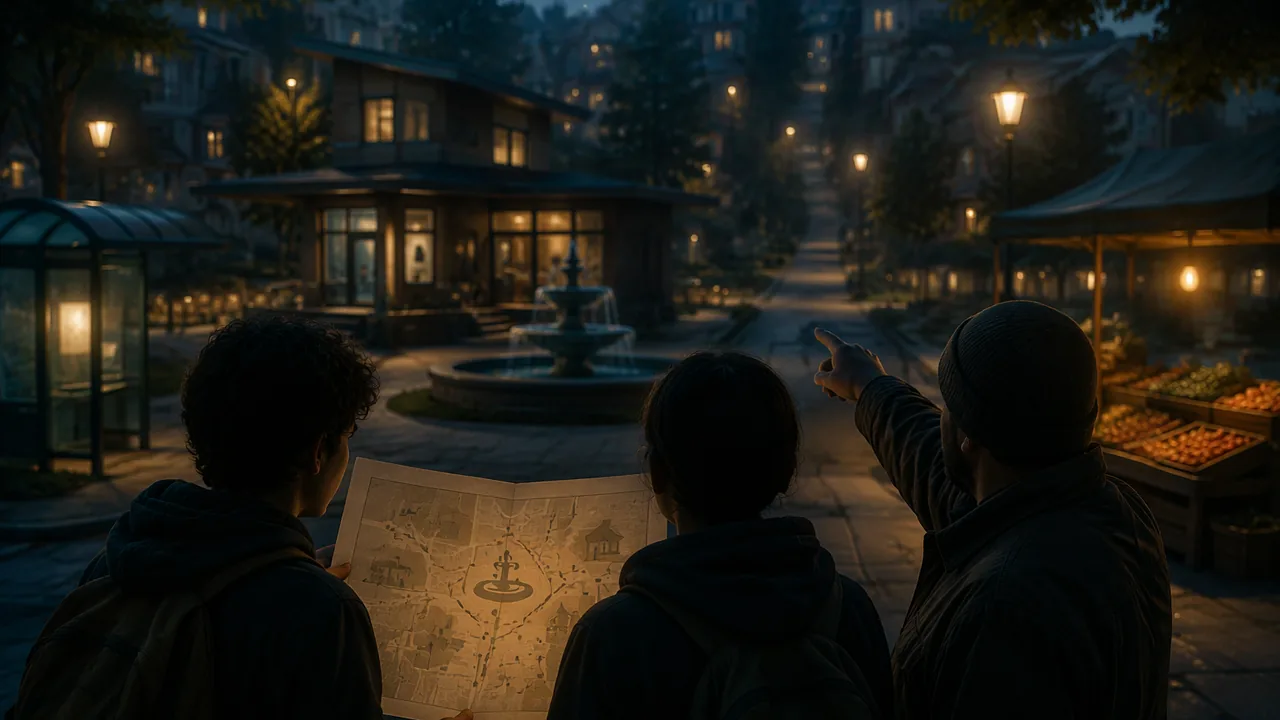
El Barrio San Miguel está cerca del río. En el centro del barrio hay una plaza con una fuente. La iglesia está enfrente de la plaza. La panadería La Espiga está al lado de la iglesia, y la farmacia está en la esquina de la calle Juárez y la calle Robles. La biblioteca está detrás de la escuela, lejos de la plaza. Los sábados, muchas familias van al mercado de la calle Juárez a pie o en bici.
Show transcript
El Barrio San Miguel está cerca del río. En el centro del barrio hay una plaza con una fuente. La iglesia está enfrente de la plaza. La panadería La Espiga está al lado de la iglesia, y la farmacia está en la esquina de la calle Juárez y la calle Robles. La biblioteca está detrás de la escuela, lejos de la plaza. Los sábados, muchas familias van al mercado de la calle Juárez a pie o en bici.
Where is the church?
What is next to the church?
Is the library near the plaza?
How do many families go to the market on Saturdays?
Interpretive task, part B. Listen to the resident. Where does the route end?
Show transcript
Desde la plaza, vas derecho tres cuadras por la calle Juárez y doblas a la izquierda. La farmacia está a la derecha, en la esquina.
Presentational planning. Name your place and its meaning or origin, list what there is and where things are, and write your historical fact with its source.
How confident are you that you can follow directions in a text, ask for and give directions, and present a tour of a place in Spanish?
Unit 2 checkpoint
Do this before you start the task. It covers the whole unit and tells you what to review first.
Which place sells bread?
The Guadalupe Center was opened in 1919 by the railroad companies.
Voy parque con mis amigos. (a + el)
Which question asks where someone is going?
In Cuba, Puerto Rico and the Dominican Republic, a bus is often called…
Nosotros (ir) al mercado en tren.
La biblioteca al lado del banco. (estar)
How do you politely start asking a stranger for directions?
Spain officially took control of Upper Louisiana on May 20, 1770.
Where does the name of Potosi, Missouri, come from?
Which statement matches the lesson’s account of the Osage?
Submit: IPA Un recorrido por mi comunidad (interpretive route, direction exchange, guided tour)
Theme: guiding someone through a place you know.
Interpretive. Read the Barrio San Miguel description (in the lesson checks) and listen to the resident’s directions; locate the places and trace the route.
Interpersonal. Visitor and resident exchange, recorded in both roles, with a new card and map each time: approach politely, ask where two places are and how to get there, check understanding; answer with estar, prepositions and directions.
Presentational. A guided audio or video tour of at least eight sentences: name and meaning, hay, estar + prepositions, ir + transport, one cited historical fact in the historical present, including whose land it is.
Heritage-speaker extension: twelve sentences and a short Spanish interview with a family member or neighbor, included with permission.
Submission workflow
- Stage 1: Plan. Choose the place, find its name’s origin and one historical fact from a reliable source, and outline the five parts of the tour.
- Stage 2: Self-checked draft. Write the script. Check ser / estar, dónde / adónde, al / a la, and that the historical fact is cited and treats Native nations as living communities; read it aloud (to a family member if one is willing). Submit the draft with your notes.
- Stage 3: Revised final. Revise and add a map or images with Spanish labels.
- Stage 4: Delivery. Record the tour (audio or video). End with one question in Spanish that a visitor might ask, and answer it. Audio and video earn equal credit.
How it is scored
| Criterion | What proficient looks like |
|---|---|
| Interpretive (WL.1.2a.I / WL.1.2b.I) | Novice Mid: locates places and follows most of a route from an unseen text and audio. Novice High: follows the full route, reading prepositions and directions precisely. |
| Interpersonal (WL.1.1a.I / WL.1.1b.I / WL.1.1c.I / WL.1.1d.I / WL.1.1e.I) | Novice Mid: asks and answers where places are with memorized patterns. Novice High: gives multi-step directions, checks understanding and repairs misunderstandings. |
| Culturally appropriate interaction (WL.2.1a.I / WL.4.2c.I / WL.1.2c.I) | Approaches a stranger with Disculpe, a greeting and the usted register, and closes with thanks. |
| Presentational (WL.1.3a.I / WL.1.3b.I) | Novice Mid: eight understandable sentences covering the five parts. Novice High: connected sentences with a cited, accurate historical fact. |
| Perspectives and language control (WL.3.2a.I / WL.3.2b.I) | Includes Native perspectives accurately; ser / estar, dónde / adónde and al are used correctly; errors do not block meaning. |
Modelo de un recorrido guiado
SLS original text for RLP Spanish 1B, Lesson 2.5 (IPA support material; the Parque de la Amistad is an invented example, not a real place; Osage Nation facts from the National Park Service, retrieved November 10, 2026) · SLS original
Aquí hay un ejemplo de recorrido para inspirar tu presentación.
«¡Bienvenidos al Parque de la Amistad! El parque está en el centro de la ciudad, cerca de la biblioteca. En el parque hay una fuente, muchos árboles y una cancha de básquetbol. La cancha está al lado de la fuente. Los sábados, muchas familias van al parque a pie o en bicicleta, y los niños juegan fútbol.
Este es un ejemplo imaginario, pero muchos parques y barrios de Missouri están en tierras de naciones indígenas, como la Nación Osage. Hoy la Nación Osage tiene su gobierno en Pawhuska, Oklahoma, y cuenta su propia historia.
Si tienen hambre, hay una panadería enfrente del parque. Si quieren descansar, pueden sentarse cerca de la fuente. ¡Esperamos su visita!»
Para tu propio recorrido, recuerda las cinco partes: el nombre y su significado, qué hay, dónde están las cosas (estar + preposición), adónde van las personas (ir), y un dato histórico con su fuente.
Sources: National Park Service, Gateway Arch National Park: the Osage (nps.gov); Osage Nation Historic Preservation Office, Osage cultural history (osagenation-nsn.gov)