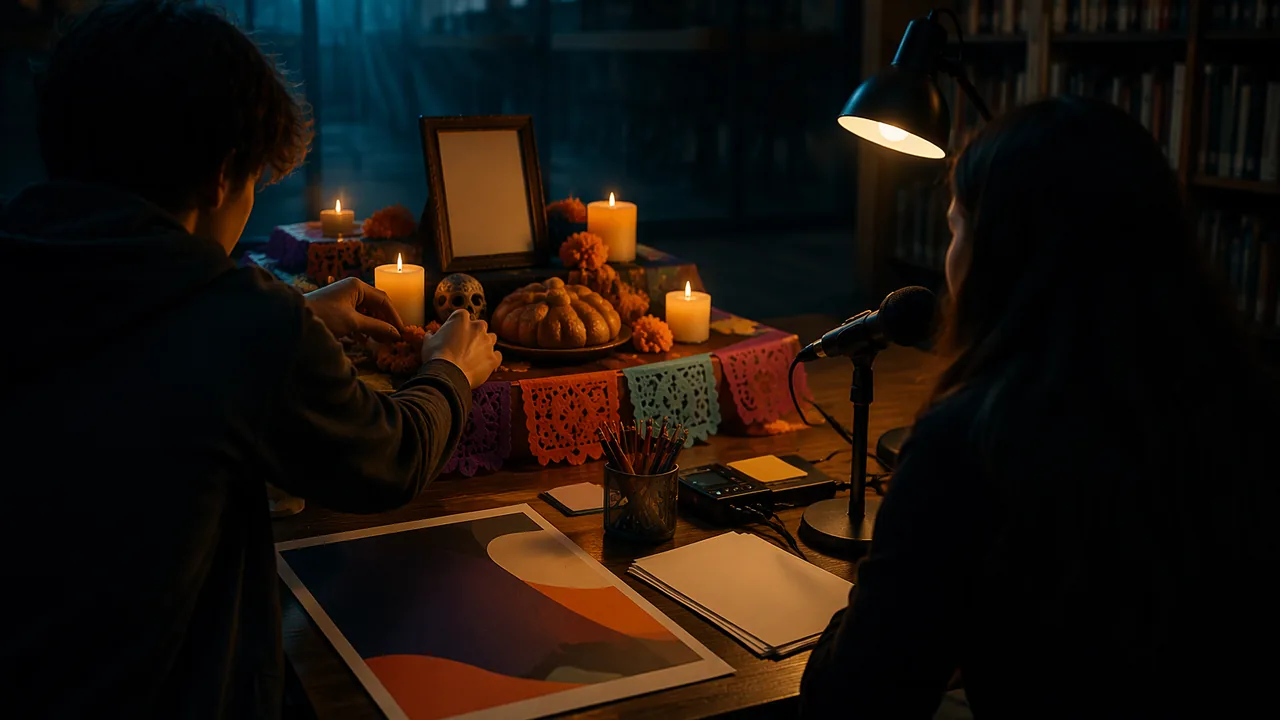
design a flyer and write a spoken announcement for a community event, using ir a + infinitive, va a haber, dates, times and places.
Instruction
An event announcement is a presentational text with a job to do: it has to make people want to come and tell them exactly how. Many community organizations publish their announcements in Spanish and English; even the St. Louis Cardinals keep a Spanish-language page, Escucha los Cardenales en Español. Today you write one.
Two products, one event. A flyer is visual and brief: a title, the essential facts and an image. A spoken announcement (for a radio spot, a video or a podcast) uses full sentences and a friendly voice. You will make both for the same event.
What to announce. Choose a real or imagined event: a community ofrenda, a posada, a Guelaguetza, a César Chávez Day service project, a mariachi concert, a soccer tournament, a food fair, a library bilingual story hour. It can also be a community event you would like to exist.
The essential facts (el qué, el cuándo, el dónde).
- What: ¡Vamos a celebrar el Día de los Muertos!
- When: El sábado 1 de noviembre, de las cuatro a las ocho de la noche. Dates are day first, months lower case.
- Where: En la biblioteca central, enfrente del parque César Chávez.
- Cost: La entrada es gratis. (Admission is free.)
Making people want to come: va a haber and ir a. Va a haber música, pan de muerto y un taller de papel picado. Los estudiantes del club de arte van a pintar calaveras. El mariachi de la escuela va a tocar a las seis. Address the audience directly: ¿Quieres aprender a hacer una ofrenda? Pueden traer una foto de un ser querido.
Meaning. Add one or two sentences that explain the celebration for people who do not know it, in simple, accurate Spanish: El Día de los Muertos es una tradición para recordar a las personas que ya no están con nosotros. This is where your cultural knowledge from Lesson 4.1 matters: an announcement that calls Día de los Muertos “Mexican Halloween” would mislead its audience.
Bilingual design. On a bilingual flyer, the Spanish and English should carry the same information, not one translated word for word. Put them side by side or in two colors. Check that numbers, dates and places match in both versions.
Connections: planning numbers. Real events have budgets. If your event has a food table, add a short planning box: for example, if 60 people are expected and each eats two pan de muerto pieces, you need 120 pieces; at an illustrative $1.25 each, that is $150.00. Recompute any number you include.
Structure of the spoken announcement (8+ sentences).
- Greeting and hook: ¡Hola, comunidad! ¿Tienen planes para el sábado?
- What, when, where.
- Two or three sentences with va a haber and ir a.
- One or two sentences on the meaning.
- What to bring or how to take part.
- Closing: ¡Los esperamos! (We look forward to seeing you!)
Self-check. Before you record, check ir a + infinitive (with the a), va a haber in the singular, date and time formats, ser for where the event takes place (La fiesta es en la plaza), and whether the meaning sentence is accurate.
📖 Read for this lesson
The reading opens over the lesson; close it to come back to exactly where you were. The checks below draw on it.
Formative check
Work through these before moving on. They are not graded — they tell you whether the standard below has landed yet.
Read the flyer, then answer.
¡Día de César Chávez: Servicio a la Comunidad!
Martes 31 de marzo, de las nueve a las doce.
Parque Central, al lado de la biblioteca.
Vamos a limpiar el parque y a plantar árboles. Va a haber agua, fruta y música.
Pueden traer guantes y una gorra.
César Chávez y Dolores Huerta organizan a los trabajadores del campo. Hoy recordamos su trabajo con servicio.
La entrada es gratis. ¡Los esperamos!
Show transcript
¡Día de César Chávez: Servicio a la Comunidad! Martes 31 de marzo, de las nueve a las doce. Parque Central, al lado de la biblioteca. Vamos a limpiar el parque y a plantar árboles. Va a haber agua, fruta y música. Pueden traer guantes y una gorra. César Chávez y Dolores Huerta organizan a los trabajadores del campo. Hoy recordamos su trabajo con servicio. La entrada es gratis. ¡Los esperamos!
What are volunteers going to do?
What should people bring?
Why is service part of this day, according to the flyer?
Build the announcement line: “There is going to be music, and the school mariachi is going to play at six.”
Type it instead
Say it in Spanish.
Día de los Muertos is a tradition to remember our loved ones.
Listen and write the line from the announcement.
Show transcript
La fiesta es el sábado en la plaza. ¡Los esperamos!
How do I type á é í ó ú ñ ¿ ¡ ?
Long-press the vowel on a phone keyboard. On Windows use the US-International layout (apostrophe then the vowel); on a Mac hold Option+E then the vowel. You can also use the buttons below.
Events use ser for where they take place. Don’t forget the opening ¡.
How confident are you that you can design a flyer and write an announcement using ir a, va a haber, dates, times and places?
Practice
Work these on paper or in your notebook, then open Check your answer. Aim for all of Fluency and Application; try at least one Challenge.
Printable version: this unit’s practice workbook (PDF)
Fluency
Build speed and accuracy with the core skill.
- Translate into English: (a) la entrada es gratis; (b) el taller; (c) el ser querido; (d) ¡Los esperamos!; (e) el volante.
Check your answer
Answer: (a) admission is free; (b) workshop; (c) loved one; (d) We look forward to seeing you!; (e) flyer.El folleto is a leaflet; el volante is common in Latin America for a flyer. - Write each date and time in Spanish, day first and month lower case: (a) Saturday, November 1, from 4 to 8 p.m.; (b) Tuesday, March 31, from 9 to 12.
Check your answer
Answer: (a) el sábado 1 de noviembre, de las cuatro a las ocho de la noche; (b) el martes 31 de marzo, de las nueve a las doce.Dates are day first; months and days are lower case. - Complete with es or está: (a) La fiesta ____ en la plaza. (b) La plaza ____ enfrente de la iglesia. (c) El concierto ____ a las seis.
Check your answer
Answer: (a) es; (b) está; (c) es.Events use ser for where and when they happen; places are located with estar.
Application
Use the skill in context. Show your reasoning.
- Write three Spanish lines for a flyer for a community ofrenda: what there is going to be (va a haber), what an art club is going to do (ir a), and what people can bring.
Check your answer
Answer: Model: Va a haber música, pan de muerto y un taller de papel picado. Los estudiantes del club de arte van a pintar calaveras. Pueden traer una foto de un ser querido.Va a haber in the singular; van a + infinitive; pueden + infinitive to address the audience. - Planning box: 80 people are expected and each eats two pieces of pan de muerto at an illustrative $1.25 each. How many pieces are needed, and what is the cost?
Check your answer
Answer: 160 pieces; $200.00.80 × 2 = 160 pieces; 160 × 1.25 = 200.00. - Write one or two simple, accurate Spanish sentences explaining Día de César Chávez for a service-project flyer.
Check your answer
Answer: Model: César Chávez y Dolores Huerta organizan a los trabajadores del campo. Hoy recordamos su trabajo con servicio.The meaning sentence must be accurate: Chávez, with Dolores Huerta and many others, organized farmworkers, and many communities mark the day with service projects. - A bilingual flyer says in Spanish el sábado 1 de noviembre, a las cuatro and in English “Sunday, November 1, at 5.” What is wrong, and what should the English say?
Check your answer
Answer: The day and the time do not match. The English should say “Saturday, November 1, at 4.”On a bilingual flyer the Spanish and English must carry the same information; check numbers, dates and places in both.
Challenge
Stretch problems. Expect to think before you write.
- Write an eight-sentence spoken announcement for a Guelaguetza in the park on Saturday, July 18, from 3 to 7: greeting and hook; what, when, where; two lines with va a haber and ir a; one sentence on its meaning; what to bring; closing.
Check your answer
Answer: Model: ¡Hola, comunidad! ¿Tienen planes para el sábado? ¡Vamos a celebrar la Guelaguetza! Es el sábado 18 de julio, de las tres a las siete, en el parque. Va a haber bailes de Oaxaca y comida tradicional. El grupo de baile de la escuela va a bailar a las cinco. La Guelaguetza es un festival de los pueblos indígenas de Oaxaca. Pueden traer agua y una gorra. ¡Los esperamos!A strong announcement has ser for where/when the event is, va a haber singular, ir a + infinitive with the a, an accurate meaning sentence from Lesson 4.1, and the closing. Any event from the lesson may be substituted.
Review
Keep earlier skills sharp.
- Review (Lesson 4.1): An announcement calls Día de los Muertos “Mexican Halloween.” Write one accurate Spanish meaning sentence to replace it and explain why the change matters.
Check your answer
Answer: El Día de los Muertos es una tradición para recordar a las personas que ya no están con nosotros. It matters because the day is a celebration of love and memory for relatives who have died; calling it Halloween would mislead the audience.From Lesson 4.1 and the lesson’s own model sentence.
Modelo de anuncio: Feria del Libro
SLS original text for Spanish 1B, Lesson 4.4 (an invented community event, modeling the genre) · SLS original
«¡Vengan a la Feria del Libro Bilingüe!
Sábado 10 de mayo, de las diez de la mañana a las dos de la tarde.
En la Biblioteca Central, en la calle Martin Luther King.
Va a haber cuentacuentos en español e inglés, un taller de arte y música en vivo. Los estudiantes del club de lectura van a leer sus cuentos favoritos.
¿Quieres encontrar un libro nuevo? ¡Aquí puedes! Pueden traer sus propios libros para intercambiar con otros lectores.
La feria es en el jardín de la biblioteca. La entrada es gratis.
Esta feria celebra la lectura en las dos lenguas de nuestra comunidad. ¡Los esperamos!»
Recuerda: usa «ir a» + infinitivo y «va a haber» para anunciar actividades futuras, y usa «ser» para decir dónde ocurre el evento («La feria es en el jardín»).