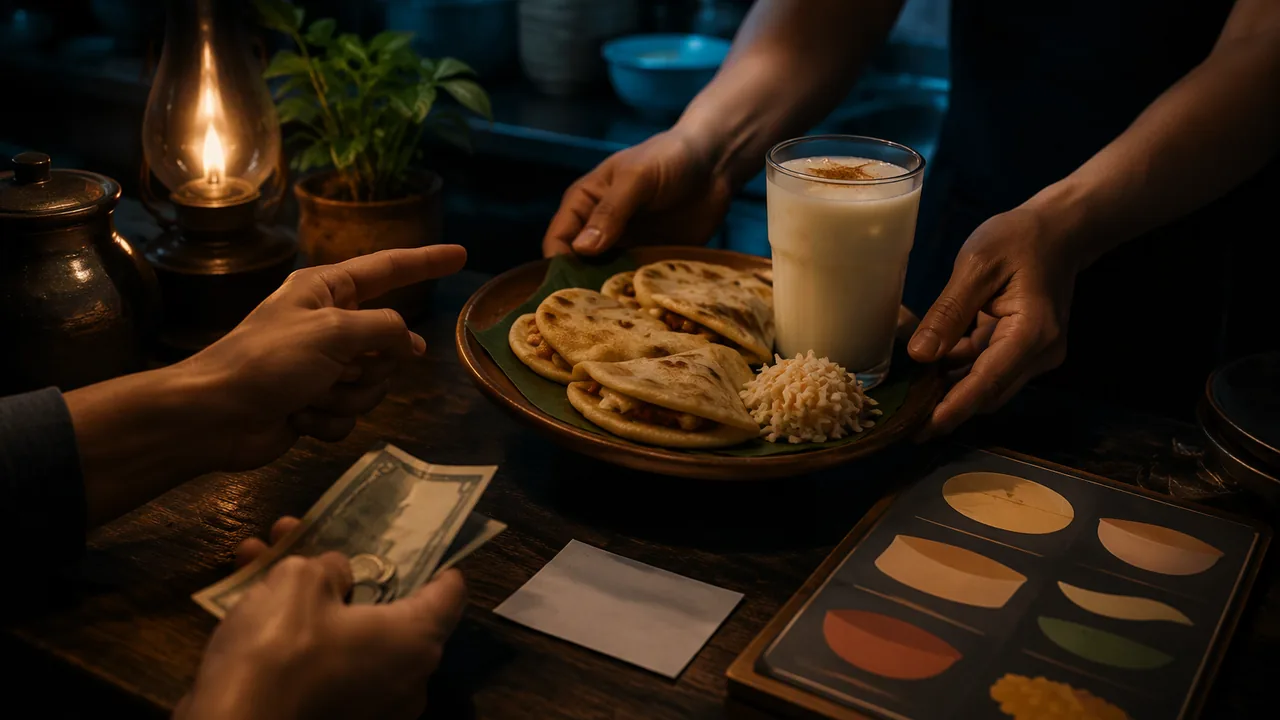
order food and drinks politely, ask about a dish and its price, and pay, playing both the customer and the server.
Instruction
Ordering food is a transaction: a conversation with a practical goal. Transactions follow predictable scripts, which makes them perfect for Novice speakers, and they are real: you can use this lesson this weekend at a taquería or pupusería in your neighborhood.
Register. Customers and servers who do not know each other usually use usted, especially with adults. The server asks ¿Qué desea? (What would you like?) to one person and ¿Qué desean? to a group. In Mexico you will also hear ¿Qué le sirvo? or ¿Qué les sirvo? (What can I serve you?), and ¿Algo de tomar? (Anything to drink?).
Ordering. Three polite ways to order, from the most formal:
- Quisiera dos pupusas de queso, por favor. (I would like …) Quisiera is a special polite form of querer; learn it as a set phrase.
- ¿Me da una horchata, por favor? (Can you give me …? Very common in Mexico and Central America.)
- Para mí, los tacos de pollo. (For me, the chicken tacos.) Good when a group is ordering.
Quiero… is also used, and is not rude, but it sounds more direct; add por favor.
Asking about the food. ¿Qué lleva la pupusa revuelta? (What’s in the revuelta pupusa?) Lleva chicharrón, frijoles y queso. ¿Es picante? (Is it spicy?) ¿Qué me recomienda? (What do you recommend? recomendar is e→ie.) ¿Tienen algo sin carne? (Do you have anything without meat?)
Prices. ¿Cuánto cuesta? (one item) / ¿Cuánto cuestan? (several). At the end: La cuenta, por favor (the bill, please) or ¿Cuánto es? (How much is it?). Dollars and cents: $3.75 is tres dólares con setenta y cinco centavos, or in everyday speech just tres setenta y cinco. You need numbers above 100 for bigger bills: ciento veinte (120), doscientos (200), quinientos (500), mil (1,000).
Connections: the bill. Today’s illustrative menu has pupusas revueltas at $3.75 and agua de jamaica at $3.00. Three pupusas and one drink: 3 × 3.75 = 11.25, plus 3.00 = 14.25, so catorce dólares con veinticinco centavos. A 15% tip on 14.25 is about 2.14. Tipping customs differ: in Mexico about 10 to 15 percent is common in sit-down restaurants, while in the United States many diners leave 15 to 20 percent. At a counter-service pupusería you usually pay when you order.
Culture: the pupusa. Pupusas are thick corn tortillas stuffed with cheese, beans, chicharrón or loroco (an edible flower bud), served with curtido (pickled cabbage) and tomato sauce. In 2005 El Salvador’s Legislative Assembly declared the pupusa the national dish, and the country celebrates the Día Nacional de la Pupusa on the second Sunday of November (La Prensa). Salvadoran families have brought pupuserías to many U.S. cities.
The role-play (on your own, recorded). You have two situation cards. On card A you are the server, with the La Ceiba menu and its prices; on card B you are the customer ordering for two people, with a list of preferences and one allergy. First, play the listening block’s server audio and answer its questions aloud (¿Qué desean? ¿Algo de tomar?). Then record the whole visit, speaking both parts and changing your voice or your seat for each role. As the customer you must order, ask one question about a dish, state a preference with prefiero, and pay; as the server you must take the order, answer, and give the correct total. Then switch cards and record it again. If a family member or another adult you know is willing, they can read the English prompt card as the server while you answer in Spanish.
📖 Read for this lesson
The reading opens over the lesson; close it to come back to exactly where you were. The checks below draw on it.
Formative check
Work through these before moving on. They are not graded — they tell you whether the standard below has landed yet.
Read the menu (prices are illustrative), then answer.
Pupusería y Taquería La Ceiba, St. Louis
Pupusa de queso: $3.25
Pupusa revuelta (chicharrón, frijoles y queso): $3.75
Pupusa de loroco con queso: $3.75
Taco de pollo: $2.75
Taco de carne asada: $3.25
Agua de jamaica u horchata: $3.00
Todas las pupusas llevan curtido y salsa de tomate.
Show transcript
Pupusería y Taquería La Ceiba, St. Louis Pupusa de queso: $3.25 Pupusa revuelta (chicharrón, frijoles y queso): $3.75 Pupusa de loroco con queso: $3.75 Taco de pollo: $2.75 Taco de carne asada: $3.25 Agua de jamaica u horchata: $3.00 Todas las pupusas llevan curtido y salsa de tomate.
How much do two chicken tacos and one horchata cost?
What comes with every pupusa?
Which pupusa has meat?
Listen to the server. What does she ask?
Show transcript
Buenas tardes. ¿Qué desean? ¿Algo de tomar?
Missouri standard: WL.2.1c.I
Order politely, the way a customer speaks to a server in the usted register: “I would like two cheese pupusas and a horchata, please.”
Type it instead
What does this mean in English?
Son catorce dólares con veinticinco centavos.
How confident are you that you can order, ask about a dish, and pay politely in a restaurant role-play?
Practice
Work these on paper or in your notebook, then open Check your answer. Aim for all of Fluency and Application; try at least one Challenge.
Printable version: this unit’s practice workbook (PDF)
Fluency
Build speed and accuracy with the core skill.
- Translate each server phrase into English: (a) ¿Qué desean? (b) ¿Algo de tomar? (c) ¿Qué le sirvo?
Check your answer
Answer: (a) What would you like? (to a group); (b) Anything to drink?; (c) What can I serve you? (to one person, Mexico)Desean is plural: the server is talking to more than one customer. Le is one person, les a group. - Write in Spanish: (a) the bill, please; (b) How much is it?; (c) Is it spicy?; (d) What do you recommend? (usted)
Check your answer
Answer: (a) La cuenta, por favor. (b) ¿Cuánto es? (c) ¿Es picante? (d) ¿Qué me recomienda?Recomendar is e → ie: recomienda. Use usted with a server you do not know. - Write each amount in Spanish words: (a) $3.75; (b) $2.75; (c) $14.25.
Check your answer
Answer: (a) tres dólares con setenta y cinco centavos; (b) dos dólares con setenta y cinco centavos; (c) catorce dólares con veinticinco centavos. (In everyday speech: tres setenta y cinco, dos setenta y cinco, catorce veinticinco.)Dollars + con + cents.
Application
Use the skill in context. Show your reasoning.
- Use the La Ceiba menu (pupusa de queso $3.25, revuelta $3.75, de loroco con queso $3.75, taco de pollo $2.75, taco de carne asada $3.25, agua de jamaica u horchata $3.00). Find the total for two cheese pupusas, one loroco pupusa and one agua de jamaica, and say it in Spanish.
Check your answer
Answer: $13.25: trece dólares con veinticinco centavos.2 × 3.25 = 6.50; 6.50 + 3.75 = 10.25; 10.25 + 3.00 = 13.25. - A group orders four revuelta pupusas and two horchatas. What is the bill, and what is a 15% tip on it?
Check your answer
Answer: Bill $21.00; a 15% tip is $3.15, for a total of $24.15.4 × 3.75 = 15.00; 2 × 3.00 = 6.00; 15.00 + 6.00 = 21.00. 0.15 × 21.00 = 3.15; 21.00 + 3.15 = 24.15. - Order politely in three different ways (most formal first): two cheese pupusas and an horchata.
Check your answer
Answer: Quisiera dos pupusas de queso y una horchata, por favor. / ¿Me da dos pupusas de queso y una horchata, por favor? / Para mí, dos pupusas de queso y una horchata.Quisiera is the most formal; ¿Me da…? is very common in Mexico and Central America; Para mí… works when a group orders. Quiero… por favor is also acceptable. - Write a five-line exchange between a server and a customer: the server greets and asks what the customer would like; the customer asks what the revuelta pupusa has in it; the server answers; the customer orders it with a drink.
Check your answer
Answer: Model: — Buenas tardes. ¿Qué desea? — ¿Qué lleva la pupusa revuelta? — Lleva chicharrón, frijoles y queso. — Quisiera una pupusa revuelta y un agua de jamaica, por favor. — Muy bien.A strong answer uses usted forms (desea), ¿Qué lleva…?, an answer with lleva, a polite order, and correct menu items.
Challenge
Stretch problems. Expect to think before you write.
- You are the server. A customer orders for two: one revuelta pupusa, one taco de pollo and two aguas de jamaica, and asks ¿Cuánto es? Write your answer in Spanish with the total.
Check your answer
Answer: Son doce dólares con cincuenta centavos. (or: Son doce cincuenta.)3.75 + 2.75 = 6.50; 2 × 3.00 = 6.00; 6.50 + 6.00 = 12.50. Son because the amount (dólares) is plural.
Review
Keep earlier skills sharp.
- Review (Lesson 1.2): write the question to ask the price of (a) one pupusa; (b) two tacos. Explain the difference.
Check your answer
Answer: (a) ¿Cuánto cuesta la pupusa? (b) ¿Cuánto cuestan los tacos?Costar (o → ue) agrees with what is being priced: one item → cuesta, several → cuestan.
La pupusa: el plato nacional de El Salvador
SLS original text for RLP Spanish 1B, Lesson 1.3; the 2005 national-dish decree and the second-Sunday-of-November Día Nacional de la Pupusa from La Prensa (retrieved November 10, 2026); La Ceiba and its prices are illustrative · SLS original
Desde 2005, la pupusa es el plato nacional oficial de El Salvador. Es una tortilla gruesa de maíz, rellena de queso, frijoles, chicharrón o loroco (una flor comestible). Se sirve con curtido (repollo encurtido) y salsa de tomate.
Cada año, el segundo domingo de noviembre, El Salvador celebra el Día Nacional de la Pupusa. Hoy, muchas familias salvadoreñas en Estados Unidos preparan pupusas en casa y en restaurantes.
Menú de La Ceiba, St. Louis (restaurante imaginario, precios ilustrativos):
Pupusa de queso: $3.25
Pupusa revuelta (chicharrón, frijoles y queso): $3.75
Pupusa de loroco: $3.75
Agua de jamaica u horchata: $3.00
Cuando un cliente entra, el mesero pregunta: «¿Qué desea?» El cliente responde con cortesía: «Quisiera dos pupusas revueltas y una horchata, por favor.» El mesero pregunta: «¿Algo más?» El cliente puede preguntar: «¿Qué lleva la pupusa de loroco?» El mesero responde: «Lleva loroco y queso; no es picante.»
Al final, el cliente pide la cuenta: «La cuenta, por favor. ¿Cuánto es?» El mesero calcula el total y dice: «Son diez dólares con cincuenta centavos.» En Estados Unidos, en muchos restaurantes con mesero, el cliente deja una propina de 15 a 20 por ciento.
Sources: La Prensa (Panamá), Los salvadoreños le rinden culto a la pupusa, su plato nacional (prensa.com)