understand a community events calendar, name celebrations and their dates, and explain the meaning and origins of Día de los Muertos and Cinco de Mayo accurately.
Instruction
Every community marks its year with celebrations, and Missouri’s Spanish-speaking communities keep a rich calendar. Knowing what each celebration means, and what it does not mean, is part of speaking Spanish well.
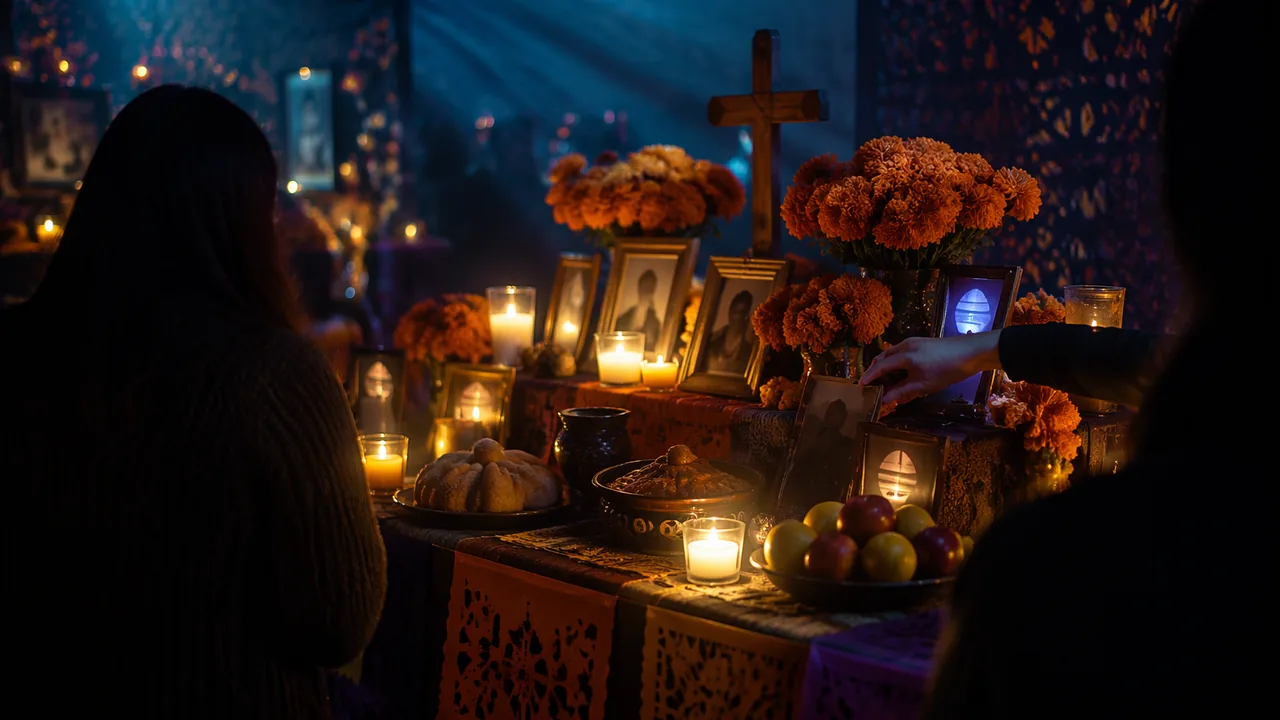
Día de los Muertos (1-2 November). Families remember and honor relatives who have died, welcoming their spirits home for a visit. They build an ofrenda (an altar of offerings) with photographs, candles, the dead person’s favorite foods, pan de muerto and orange cempasúchil flowers (marigolds; the name comes from Nahuatl), whose color and scent are said to guide the spirits. Many families visit and decorate graves. The celebration joins Indigenous Mesoamerican traditions of honoring the dead with the Catholic feasts of All Saints and All Souls, and UNESCO lists it as part of the Intangible Cultural Heritage of Humanity (UNESCO). It is a celebration of love and memory, not a “Mexican Halloween”, and face paint and costumes should be approached with respect for that meaning. In St. Louis, the Missouri History Museum in Forest Park fills with altars every year (2025 was the twelfth year), with music, dance and a procession through the park (FOX 2 St. Louis, 3 November 2025; St. Louis Mosaic Project).
Las Posadas (16-24 December). For nine nights, neighbors re-enact Mary and Joseph’s search for shelter, going from house to house singing and asking for posada (lodging) until one house lets them in, and then sharing food, drinks and a piñata.
Independence days (15-16 September). Guatemala, El Salvador, Honduras, Nicaragua and Costa Rica celebrate their independence on 15 September, from 1821. Mexico celebrates on 16 September, beginning the night of the 15th with el Grito, the cry that recalls Miguel Hidalgo’s call to rise up in 1810. In mid-September, during National Hispanic Heritage Month, the Greater St. Louis Hispanic Festival fills Soulard Park for three days; in 2026 it celebrated its thirtieth year with papel picado, aguas frescas and dance lessons in the Mexican quebradita and the Cuban mambo (St. Louis Public Radio, 18 September 2026).
Cinco de Mayo is not Mexican Independence Day. It commemorates the Mexican army’s victory over French forces at the Battle of Puebla on 5 May 1862. In Mexico it is a significant date mainly in the state of Puebla; in the United States it grew into a large celebration of Mexican American culture, promoted by Mexican American communities over many decades. Missouri has one of the oldest: in Kansas City’s Westside, the Guadalupe Centers, founded in 1919 by a Catholic women’s club to serve Mexican immigrants, many of whom came to work on the railroads, held its first Cinco de Mayo fiesta seven years later. In May 2026 the fiesta celebrated its 100th anniversary on Avenida Cesar E. Chavez with mariachi, folkloric dance and a luchador fight (KCUR, 8 May 2026). In St. Louis, the Cherokee Street Cinco de Mayo festival, started more than fifteen years ago by the street’s Mexican business community, now draws more than 50,000 people (cincodemayostl.com). It is a good example of a cultural practice that changes its meaning as it crosses a border.
La Guelaguetza (July). A festival of the Indigenous peoples of Oaxaca, with dances and music from each region of the state. The word is Zapotec and is often explained as a tradition of reciprocal giving.
Día de César Chávez (31 March). The birthday of the labor leader who, with Dolores Huerta and many others, organized farmworkers; many communities mark it with service projects. In Kansas City, the Westside street where the Guadalupe Centers’ fiesta takes place is named Avenida Cesar E. Chavez. The César E. Chávez National Monument, in Keene, California, is run by the National Park Service (nps.gov/cech).
Personal celebrations. A quinceañera marks a girl’s fifteenth birthday with a religious service in many families and a party with family, godparents, a court of friends, and a waltz. Families celebrate in many different ways, and some not at all.
Reading a calendar. Community calendars list the event, the date (el sábado 1 de noviembre), the time, the place and the activities. Many future events are written with va a haber (there is going to be) or simply in the present: El concierto es a las seis. Remember: events take ser for where they happen.
📖 Read for this lesson
The reading opens over the lesson; close it to come back to exactly where you were. The checks below draw on it.
Formative check
Work through these before moving on. They are not graded — they tell you whether the standard below has landed yet.
Read the community calendar (illustrative), then answer.
Calendario comunitario de Kansas City
Sábado 13 de septiembre: Desfile de la Independencia de Centroamérica, a las diez de la mañana, en la calle Cuarta. Va a haber marimba y comida salvadoreña y guatemalteca.
Martes 16 de septiembre: Noche del Grito en la plaza, a las siete. Música de mariachi.
Sábado 1 de noviembre: Ofrenda comunitaria en el museo. Las familias pueden traer fotos de sus seres queridos. Taller de pan de muerto para niños a las once.
Martes 16 de diciembre: Primera posada del barrio, a las seis de la tarde, en la iglesia.
Show transcript
Calendario comunitario de Kansas City Sábado 13 de septiembre: Desfile de la Independencia de Centroamérica, a las diez de la mañana, en la calle Cuarta. Va a haber marimba y comida salvadoreña y guatemalteca. Martes 16 de septiembre: Noche del Grito en la plaza, a las siete. Música de mariachi. Sábado 1 de noviembre: Ofrenda comunitaria en el museo. Las familias pueden traer fotos de sus seres queridos. Taller de pan de muerto para niños a las once. Martes 16 de diciembre: Primera posada del barrio, a las seis de la tarde, en la iglesia.
What instrument will be at the Central American independence parade?
What can families bring to the community ofrenda?
When is the first posada?
Match each celebration to its date.
Listen to the announcement. What is going to happen on Saturday?
Show transcript
El sábado va a haber una Guelaguetza en el parque, con bailes de Oaxaca y comida tradicional.
Missouri standard: WL.2.2c.I
Cinco de Mayo is Mexico’s Independence Day.
How confident are you that you can understand a community calendar and explain the meaning of celebrations accurately?
Practice
Work these on paper or in your notebook, then open Check your answer. Aim for all of Fluency and Application; try at least one Challenge.
Printable version: this unit’s practice workbook (PDF)
Fluency
Build speed and accuracy with the core skill.
- Give the date of each celebration: (a) Día de los Muertos; (b) Mexico’s independence day; (c) Central American independence day; (d) Las Posadas; (e) Día de César Chávez.
Check your answer
Answer: (a) 1-2 November; (b) 16 September (beginning the night of the 15th with el Grito); (c) 15 September; (d) 16-24 December; (e) 31 March.Guatemala, El Salvador, Honduras, Nicaragua and Costa Rica celebrate independence on 15 September, from 1821. - Translate into English: (a) la ofrenda; (b) el cempasúchil; (c) el Grito; (d) la quinceañera.
Check your answer
Answer: (a) an altar of offerings for Día de los Muertos; (b) the marigold, the orange flower of Día de los Muertos; (c) the cry of independence that opens Mexico’s celebration on the night of 15 September; (d) the celebration of a girl’s fifteenth birthday, and the girl herself.Cempasúchil comes from Nahuatl. - True or false: (a) Cinco de Mayo is Mexico’s Independence Day. (b) Día de los Muertos is a “Mexican Halloween.” (c) La Guelaguetza is a festival of the Indigenous peoples of Oaxaca.
Check your answer
Answer: (a) False: it commemorates the Battle of Puebla, 5 May 1862. (b) False: it is a celebration of love and memory for relatives who have died. (c) True.Knowing what each celebration means, and what it does not mean, is part of speaking Spanish well.
Application
Use the skill in context. Show your reasoning.
- Read: Sábado 1 de noviembre: Ofrenda comunitaria en la biblioteca, a las cuatro. Las familias pueden traer fotos. Va a haber pan de muerto y música. Answer in English: what, when, where, what to bring, and what there is going to be.
Check your answer
Answer: A community ofrenda, on Saturday 1 November at 4:00, at the library. Families can bring photos. There is going to be pan de muerto and music.Va a haber = there is going to be. Calendars list the event, date, time, place and activities. - Describe in English what families put on an ofrenda and why the marigolds are used.
Check your answer
Answer: Photographs, candles, the dead person’s favorite foods, pan de muerto and orange cempasúchil flowers. The flowers’ color and scent are said to guide the spirits home.Many families also visit and decorate graves. The celebration joins Indigenous Mesoamerican traditions with the Catholic feasts of All Saints and All Souls. - Explain in two or three English sentences how Cinco de Mayo changed its meaning as it crossed the border.
Check your answer
Answer: In Mexico it is a significant date mainly in the state of Puebla, remembering the Mexican army’s victory over the French in 1862. In the United States, Mexican American communities promoted it over many decades into a large celebration of Mexican American culture.A strong answer gives the historical event and the two different meanings, Mexico vs. the United States. - Give one Missouri fact from the lesson for each: (a) Día de los Muertos in St. Louis; (b) Cinco de Mayo in Kansas City; (c) the Greater St. Louis Hispanic Festival.
Check your answer
Answer: (a) The Missouri History Museum in Forest Park fills with altars every year (2025 was the twelfth year), with music, dance and a procession. (b) The Guadalupe Centers’ fiesta on the Westside celebrated its 100th anniversary in May 2026 on Avenida Cesar E. Chavez. (c) It fills Soulard Park for three days in mid-September and celebrated its thirtieth year in 2026.Any accurate fact from the lesson for each. The Cherokee Street Cinco de Mayo festival (more than 50,000 people) is also correct for St. Louis.
Challenge
Stretch problems. Expect to think before you write.
- A classmate’s flyer says: Cinco de Mayo: ¡Celebramos la Independencia de México con disfraces de Halloween! Write two corrections in English and one corrected Spanish title.
Check your answer
Answer: Cinco de Mayo is not Mexican Independence Day (that is 16 September); it commemorates the Battle of Puebla (1862). Halloween costumes belong to a different holiday; Día de los Muertos, the celebration the flyer may be mixing up, is not a “Mexican Halloween” either. Corrected title (model): Cinco de Mayo: ¡Celebramos la cultura mexicoamericana!A strong answer fixes the date confusion and the Halloween confusion with facts from the lesson. Any accurate Spanish title using words from the unit earns credit.
Review
Keep earlier skills sharp.
- Review (Lesson 1.1): cempasúchil comes from Nahuatl. Name two other food words that came from Nahuatl into Spanish and then into English.
Check your answer
Answer: Any two: tomatl → tomate → tomato; ahuacatl → aguacate → avocado; chīlli → chile → chili; tamalli → tamal → tamale.From Lesson 1.1: Nahuatl is the language of the Mexica (Aztecs), still spoken in Mexico.
El calendario de las celebraciones en Missouri
SLS original text for RLP Spanish 1B, Lesson 4.1; Missouri facts from KCUR (8 May 2026), St. Louis Public Radio (18 September 2026), FOX 2 St. Louis (3 November 2025) and the Cherokee Street festival’s About page; Día de Muertos recognition from UNESCO; retrieved November 10, 2026 · SLS original
En las comunidades hispanohablantes de Missouri, el año tiene muchas celebraciones.
El primero y el dos de noviembre es el Día de los Muertos. Las familias construyen una ofrenda con fotos, velas, comida favorita y flores de cempasúchil. La UNESCO reconoce esta tradición como Patrimonio Cultural Inmaterial de la Humanidad. No es «Halloween mexicano»; es una celebración de amor y memoria. En San Luis, el Museo de Historia de Missouri tiene altares, música, baile y una procesión en el parque Forest Park.
Del dieciséis al veinticuatro de diciembre son las Posadas: los vecinos caminan de casa en casa, cantan y piden posada.
El quince de septiembre, Guatemala, El Salvador, Honduras, Nicaragua y Costa Rica celebran su independencia. El dieciséis de septiembre, México celebra su independencia, con «el Grito» la noche anterior. En septiembre, el Festival Hispano de San Luis es en el parque Soulard, con música, comida y bailes. En 2026, el festival celebra su año número treinta.
El cinco de mayo no es el Día de la Independencia de México. Es el aniversario de la Batalla de Puebla, en 1862. En Estados Unidos, esta fecha es una gran celebración de la cultura mexicoamericana. En Kansas City, los Guadalupe Centers (fundados en 1919) tienen una fiesta del Cinco de Mayo en el barrio Westside, en la Avenida César E. Chávez. En 2026, la fiesta celebra cien años, con mariachi y bailes folclóricos. En San Luis, la calle Cherokee también tiene una gran fiesta del Cinco de Mayo.
El treinta y uno de marzo es el Día de César Chávez. Muchas comunidades hacen proyectos de servicio ese día, en honor a Chávez y Dolores Huerta, que organizan a los trabajadores del campo.
Sources: UNESCO, Indigenous festivity dedicated to the dead (Día de Muertos) (ich.unesco.org); KCUR, Meet the Kansas City Latinos celebrating 100 years of Cinco de Mayo fiestas in the Westside (8 May 2026) (kcur.org); St. Louis Public Radio, Greater St. Louis Hispanic Festival kicks off 30th annual celebration in Soulard (18 September 2026) (stlpr.org); FOX 2 St. Louis (via Yahoo News), Día de los Muertos fills Missouri History Museum with art and color (3 November 2025) (yahoo.com); Cinco de Mayo: a Cherokee Street festival, About (cincodemayostl.com); César E. Chávez National Monument (National Park Service) (nps.gov)