understand a short visitor’s guide, name the places in a community, and explain how Kansas City’s Westside and St. Louis’s Cherokee Street became centers of Spanish-speaking Missouri.
Instruction
Places in a community. el parque (park), la plaza (town square), el mercado (market), el supermercado, la tienda (shop), la panadería (bakery), la farmacia, el banco, la oficina de correos or el correo (post office), la biblioteca, el museo, el cine (movie theater), el restaurante, la iglesia (church), la clínica and el hospital, la estación de tren, la parada de autobús (bus stop), el centro (downtown), el barrio or la colonia (neighborhood; colonia is common in Mexico). Many are cognates; the endings -ería and -ía usually name a shop by what it sells: pan → panadería, papel → papelería, fruta → frutería, taco → taquería.
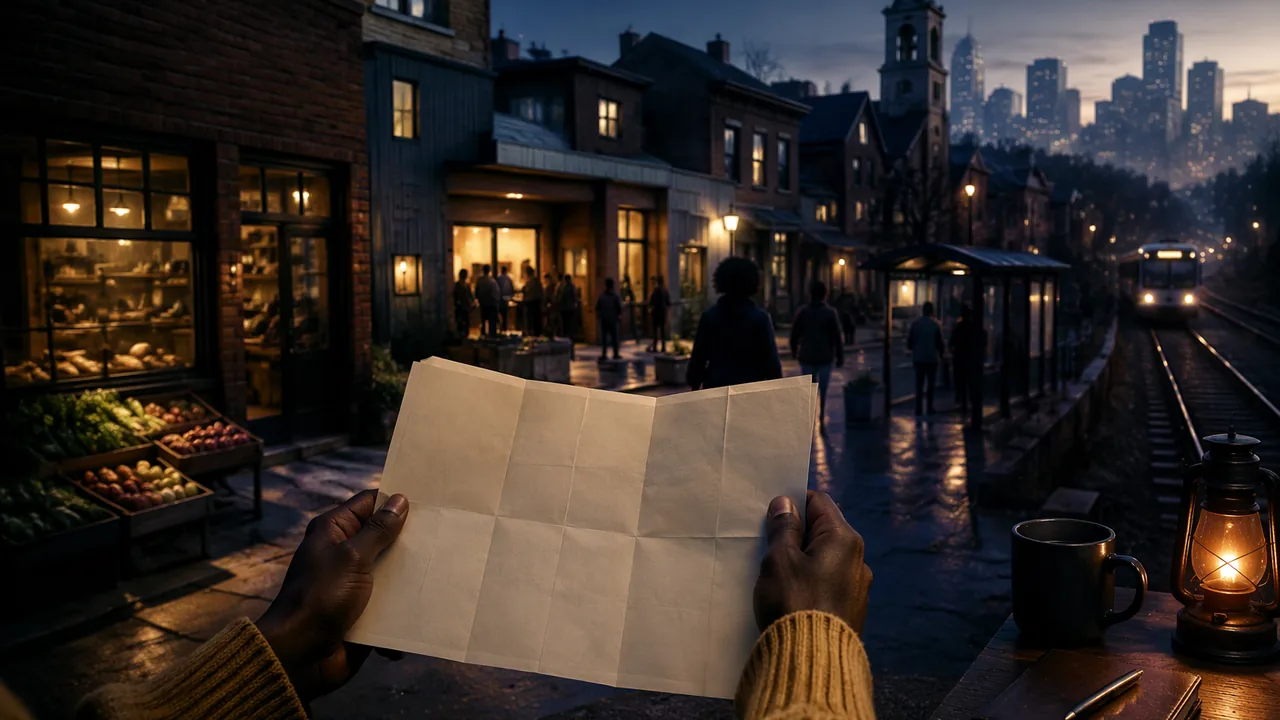
Reading a guide. Visitor’s guides are full of hay (there is, there are) and está (it is located). You will learn estar properly in Lesson 2.3; for now, La plaza está en el centro means “The plaza is downtown.” Before you read, look at the headings and predict what kind of places you will find.
Culture: Spanish-speaking Missouri. Spanish has been part of Missouri’s neighborhoods for more than a century. In Kansas City, families from Mexico settled on the Westside, near downtown. Many of the first arrivals were young men looking for work on the railroads, and the railroad companies later encouraged them to bring their families. In 1919 a Catholic women’s club, the Agnes Ward Amberg Club, opened the Guadalupe Center there as a volunteer school and clinic for the Mexican immigrants of the Westside, and named it after Mexico’s patron saint, Our Lady of Guadalupe. Today Guadalupe Centers has its headquarters on Avenida César Chávez and offers health and human services, education, youth recreation and adult education to more than 20,000 people a year (guadalupecenters.org; KCUR). Across the state, St. Louis’s Cherokee Street has the largest concentration of Hispanic-owned and Hispanic-run bakeries, restaurants, groceries and shops in the city (Explore St. Louis). Its Cinco de Mayo festival, started more than fifteen years ago by the street’s Mexican business community and now organized by the nonprofit Cherokee Street Foundation, fills the street between Nebraska and Jefferson avenues with food, music and dance and brings together more than 50,000 people (cincodemayostl.com).
Whose story? A neighborhood’s history can be told from many points of view: the families who arrived, the railroad companies that hired them, the club that opened the center, the city. The Guadalupe Center was started by a club of mostly Anglo Catholic women for Mexican immigrant families; those families, and the generations after them, tell the story in their own way. Today’s reading is a short guide; as you read, notice which of these perspectives it includes and which it does not. That habit, asking whose perspective a text gives, is one you will use again in Lesson 2.4, when you meet the Native nations of Missouri.
A cultural event, via media. You do not have to travel to experience a community celebration. Open the Cherokee Street festival’s own page (cincodemayostl.com) and look at its photos and program, or find a public video of the festival or of a Guadalupe Centers event. Write three Spanish sentences about what there is (Hay música. Hay baile. Hay tacos.) and one about who goes (Van muchas familias.). The listening check below is a radio-style announcement of the same festival.
Spanish in public. Many government offices publish information in Spanish, so you can find it on city websites, park signs, transit maps and voting materials. The federal government’s portal USA.gov en español (usa.gov/es) is another real text you can read now. This week, find one public sign or web page in Spanish in your community and write down three place words you recognize.
📖 Read for this lesson
The reading opens over the lesson; close it to come back to exactly where you were. The checks below draw on it.
Formative check
Work through these before moving on. They are not graded — they tell you whether the standard below has landed yet.
Read the visitor’s guide, then answer.
Guía para visitantes: el Westside de Kansas City
El Westside es un barrio cerca del centro de Kansas City, Missouri. En la Avenida César Chávez está el edificio de los Centros Guadalupe. En 1919, un club de mujeres católicas abre el centro: es una escuela y una clínica para las familias mexicanas del barrio. Hoy los Centros Guadalupe tienen programas de salud, de educación y para jóvenes. En St. Louis, la calle Cherokee también es un lugar importante: hay panaderías, restaurantes, tiendas y supermercados hispanos. Allí hay tacos, tortas, conchas y paletas.
Show transcript
Guía para visitantes: el Westside de Kansas City El Westside es un barrio cerca del centro de Kansas City, Missouri. En la Avenida César Chávez está el edificio de los Centros Guadalupe. En 1919, un club de mujeres católicas abre el centro: es una escuela y una clínica para las familias mexicanas del barrio. Hoy los Centros Guadalupe tienen programas de salud, de educación y para jóvenes. En St. Louis, la calle Cherokee también es un lugar importante: hay panaderías, restaurantes, tiendas y supermercados hispanos. Allí hay tacos, tortas, conchas y paletas.
Where is the Westside?
What is on Avenida César Chávez?
Who opens the center in 1919, and for whom?
Which perspective does the guide leave out?
Match each place to what you do there.
Missouri standard: WL.5.2a.I
Listen to the radio-style announcement of a community event. Where is the festival?
Show transcript
El sábado hay un festival en la calle Cherokee, entre la avenida Nebraska y la avenida Jefferson. Hay música, baile y comida.
The Guadalupe Center in Kansas City opened in 1919 as a school and clinic for the Mexican immigrant families of the Westside.
How confident are you that you can understand a visitor’s guide, name community places and explain the history of Kansas City’s Westside and the Guadalupe Centers?
Practice
Work these on paper or in your notebook, then open Check your answer. Aim for all of Fluency and Application; try at least one Challenge.
Printable version: this unit’s practice workbook (PDF)
Fluency
Build speed and accuracy with the core skill.
- Write the Spanish word, with its article, for: (a) bakery; (b) library; (c) post office; (d) movie theater; (e) bus stop; (f) downtown.
Check your answer
Answer: (a) la panadería; (b) la biblioteca; (c) la oficina de correos or el correo; (d) el cine; (e) la parada de autobús; (f) el centro.Watch the false friend: la biblioteca is the library; a bookstore is a different place. - Use the -ería pattern: name the shop that sells (a) pan; (b) papel; (c) fruta; (d) tacos.
Check your answer
Answer: (a) la panadería; (b) la papelería; (c) la frutería; (d) la taquería.The endings -ería and -ía usually name a shop by what it sells. - Translate into English: Hay una farmacia y un banco. La plaza está en el centro.
Check your answer
Answer: There is a pharmacy and a bank. The plaza (town square) is downtown.Hay = there is / there are; está tells where something is located.
Application
Use the skill in context. Show your reasoning.
- Read: En el barrio hay un mercado, una iglesia y dos restaurantes. La biblioteca está en el centro. No hay cine. List in English the places the neighborhood has and the one it does not.
Check your answer
Answer: It has a market, a church, two restaurants and (downtown) a library. It does not have a movie theater.No hay = there is not / there are no. - When and by whom was the Guadalupe Center in Kansas City opened, what was it, and whom was it for?
Check your answer
Answer: In 1919, by a Catholic women’s club (the Agnes Ward Amberg Club), as a volunteer school and clinic for the Mexican immigrant families of the Westside.It was named after Our Lady of Guadalupe, Mexico’s patron saint. Today Guadalupe Centers serves more than 20,000 people a year from Avenida César Chávez. - What is Cherokee Street in St. Louis known for, and how many people does its Cinco de Mayo festival bring together?
Check your answer
Answer: It has the largest concentration of Hispanic-owned and Hispanic-run bakeries, restaurants, groceries and shops in the city; the festival brings together more than 50,000 people.The festival was started more than fifteen years ago by the street’s Mexican business community and fills the street between Nebraska and Jefferson avenues. - Write three Spanish sentences about what there is at a community festival, and one about who goes, as the lesson’s media task models.
Check your answer
Answer: Model: Hay música. Hay baile. Hay tacos. Van muchas familias.Use hay + noun for what there is and van for who goes. Other nouns from the unit (comida, paletas, conchas) are fine.
Challenge
Stretch problems. Expect to think before you write.
- The lesson says a neighborhood’s history can be told from many points of view. Name three perspectives on the Guadalupe Center’s history, and explain in two or three English sentences why a short guide written only from the founders’ point of view leaves something out.
Check your answer
Answer: Perspectives: the Mexican families who arrived (and their later generations), the railroad companies that hired them, the women’s club that opened the center, the city. A guide told only from the founders’ side describes what was done for the families, but not how the families themselves experienced and tell their own story.A strong answer names at least three of the perspectives in the lesson and explains that the families’ own voices are the ones a founders-only text leaves out.
Review
Keep earlier skills sharp.
- Review (Lesson 1.1): the milpa. Which three plants grow together in it, and which region domesticated maize, beans, squash, chile, tomatoes, avocados and cacao?
Check your answer
Answer: Maize, beans and squash; Mesoamerica (today’s Mexico and Central America).From Lesson 1.1. These foods traveled across the world after 1492.
El Westside de Kansas City y la calle Cherokee: lugares con historia
SLS original text for RLP Spanish 1B, Lesson 2.1; facts from Guadalupe Centers’ history page, KCUR (2020), Explore St. Louis and the Cherokee Street Cinco de Mayo festival’s About page (all retrieved November 10, 2026) · SLS original
El Westside es un barrio cerca del centro de Kansas City, Missouri. Hace más de cien años, llegan al barrio muchas familias de México. Muchos hombres jóvenes trabajan en el ferrocarril. Después, las compañías del ferrocarril invitan a sus familias a venir también.
En 1919, un club de mujeres católicas abre el Centro Guadalupe: es una escuela y una clínica para las familias mexicanas del Westside. El nombre viene de la Virgen de Guadalupe, la patrona de México. Hoy, la oficina principal de los Centros Guadalupe está en la Avenida César Chávez. Hay programas de salud, de educación y para jóvenes, y los Centros ayudan a más de veinte mil personas cada año.
En St. Louis, la calle Cherokee tiene más panaderías, restaurantes, tiendas y supermercados hispanos que cualquier otra parte de la ciudad. Cada primavera, hay un gran festival de Cinco de Mayo en la calle, entre la avenida Nebraska y la avenida Jefferson. Hay comida, música y baile, y van más de cincuenta mil personas. Los comerciantes mexicanos de la calle empiezan el festival hace más de quince años.
¿Quién cuenta la historia de un barrio? Las familias que llegan, las compañías que les dan trabajo, el club que abre el centro, la ciudad… Cada voz cuenta una parte de la historia.
Sources: Guadalupe Centers, About (history since 1919) (guadalupecenters.org); KCUR, Guadalupe Centers and Kansas City’s Latino immigrants (2020-02-29) (kcur.org); Explore St. Louis, Cherokee Street neighborhood guide (explorestlouis.com); Cinco de Mayo on Cherokee Street, About (Cherokee Street Foundation) (cincodemayostl.com)